28 Other Ways to Say “Please Let Me Know if This Works for You” (With Examples)
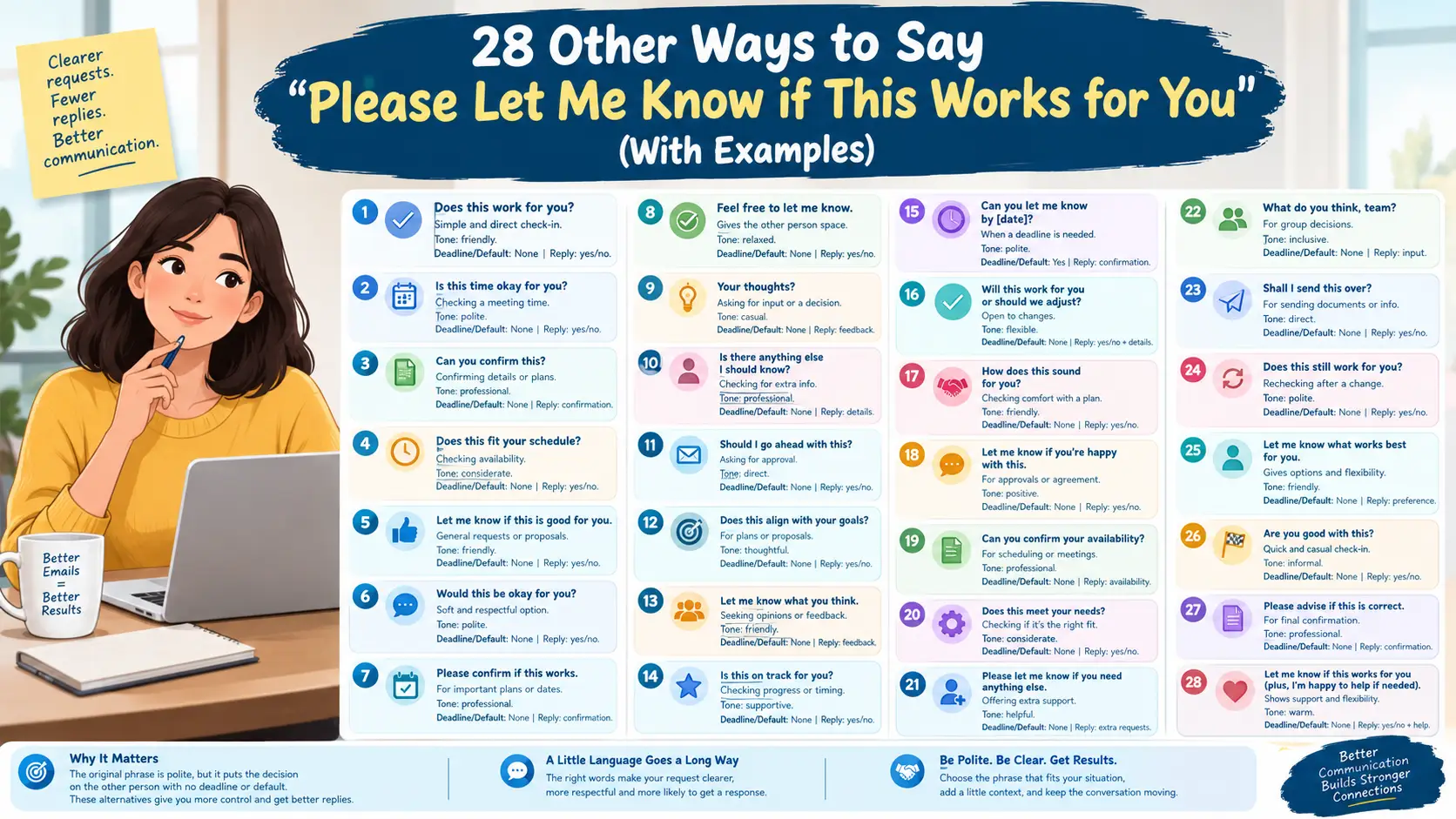
Looking for Other Ways to Say Please Let Me Know if This Works for You? Here are 28 alternatives, each with a scenario, five example sentences that contain the phrase, the tone it carries, and the two columns no other list on this subject includes — whether the phrase contains a deadline or a default, and what kind of reply it actually produces.
Those columns exist because the original is a request with no edge to it. Please let me know if this works for you hands the reader a decision, no date by which to make it, and no stated consequence for saying nothing — which is why the commonest response to it is silence, and why the sender ends up writing a second email a week later.
The phrase is doing real linguistic work, though, and it is worth knowing what. Under politeness theory, proposed by Penelope Brown and Stephen Levinson, politeness consists of efforts to redress the affronts to a person’s public self-image, or face — a concept derived from Chinese into English in the nineteenth century and brought into academia by the sociologist Erving Goffman. Brown and Levinson split face in two: positive face is the want to be liked, admired and approved of, while negative face is “the want of every competent adult member that his actions be unimpeded by others” — freedom of action and freedom from imposition.
Asking somebody to agree to your schedule is a textbook face-threatening act, and every word of the original phrase is there to soften it. Please is deference; let me know makes the reader the one who informs rather than the one who obeys; if builds in the possibility of refusal; and for you hands them the standard by which to judge it. That is negative-politeness redress in nine words, and it explains why the phrase feels safe to send — and why it so often produces nothing. Brown and Levinson proposed the model as universally applicable, and it has been challenged by other scholars both theoretically and on its cross-cultural applicability, which matters here: in much of East Asian business English the same softening is expected to go further, while in German and Dutch correspondence it reads as evasive.
The vocabulary has its own history, and please is the strangest item in it. Modern please is short for if you please, an ergative form taken from the older impersonal if it please you — so the politest word in English business writing began as a clause about what pleases the reader rather than what you want. It came through Middle English plesen from Old French plaisir and plaire, from the Latin placeō, to please, to seem good, from the Proto-Indo-European *pleHk-, pleasingness, permission. In that sense it displaced the native Old English līcian, which survives as modern like — and the texting form pls is simply the latest in a line of clipped spellings that runs back to Middle English pleace.
The business-English twin of the phrase, please advise, has a documentary past rather than a courteous one. To advise comes through Middle English avisen, to perceive, consider, inform, from Old French aviser, and from the Late Latin advisō, ad plus visō. Its formal sense is “to formally give information or notice to”, which is exactly how commercial and shipping correspondence used it, and in Scots law to advise still means to deliver judgment after a case has been reserved for further consideration. That is why please advise reads as cold: it is a notice-serving verb, and entry 16 inherits the whole of that history.
And the word doing most of the work in nine of the twenty-five standard alternatives is the most frequently spoken or written word on the planet. OK originated around Boston as part of a fad in the late 1830s for abbreviating comical misspellings, as an initialism of oll korrect for all correct — an origin established by the linguist Allen Walker Read in a series of six articles in the journal American Speech in 1963 and 1964. It reached national prominence in the 1840 United States presidential election, when supporters of Martin Van Buren, a native of Kinderhook, New York, claimed it stood for Old Kinderhook, while Whig opponents attributed the oll korrect sense to the bad spelling of his predecessor Andrew Jackson. The useful part for email is what the word now does: as an adjective OK can express acknowledgement without approval, and as a discourse marker it can seek confirmation or signal doubt depending only on intonation — which is precisely the ambiguity you inherit when you write please confirm if this is okay and get back a one-word okay.
28 Other Ways to Say “Please Let Me Know if This Works for You”
Every entry has a scenario, five example sentences containing the phrase, and an attribute line ending in whether it carries a deadline or a default and what sort of reply it produces.
This is the list in full, and it also answers other ways to say let me know if this works for you, another way to say please let me know if this works for you and another way of saying please let me know if this works for you — with dedicated sections below for scheduling, deliverables, pricing and approvals, feedback wording, short closers, the offer-of-help variant, the plural team version, email templates and before-and-after rewrites.
1. Does this work for you?
The shortest standard swap, and the one that sounds like a person rather than a template.
Scenario: Use this when you want a simple and direct check-in.
Examples:
- Could this time work for you tomorrow afternoon?
- Would this plan work for you this week?
- Please let me know whether this option works for you.
- I wanted to ask if this schedule works for you.
- Let me know if this arrangement works for you.
Why it works: Nine words collapse to five, and the question mark does what please was doing. A direct interrogative also gets answered more often than a conditional statement, because let me know if technically licenses silence while does this work for you? leaves a visible gap in the thread. The weakness is the pronoun this: on its own it points at nothing, so name the thing — the Tuesday slot, the revised fee, the draft — and the reply gets faster.
Tone: simple, polite, clear | Formality: neutral | Best for: quick checks, chat, internal email | Avoid in: very formal writing | Deadline or default: none | Reply it produces: yes or no
2. Let me know if this suits you.
Considerate and flexible, and markedly more British than the American alternatives.
Scenario: Use this when you want to sound considerate and flexible.
Examples:
- Could this meeting time suit you better than the previous one?
- Would this option suit you for the project review?
- Please tell me if this arrangement suits you well.
- I hope this plan suits you and your team.
- Let me know whether this schedule suits you today.
Why it works: Suit asks whether something fits the reader’s circumstances rather than whether they approve of it, which lowers the stakes of the answer. The register is regionally marked: does that suit you? is ordinary in British and Irish English and reads as faintly formal in American correspondence, where does that work? is the default. It is also the politest way to re-offer something after a first refusal, as the first example shows.
Tone: warm, respectful, flexible | Formality: neutral | Best for: scheduling, second offers, UK and Irish correspondence | Avoid in: highly technical email | Deadline or default: none | Reply it produces: yes, no, or a counter-offer
3. Please tell me if this is okay.
Relaxed and easy, and carrying the most ambiguous word in the language.
Scenario: Use this when you want a friendly and easy reply.
Examples:
- Could you tell me if this is okay with you?
- Would you say this version is okay for now?
- Please let me know if this is okay to send.
- I just wanted to check whether this is okay.
- Let me know if this is okay on your side.
Why it works: It is the most conversational of the approval checks and reads as low-pressure in internal messages. The catch is the word itself: as an adjective OK means adequate or acceptable in contrast with bad, but mediocre in contrast with good — so a reply of it’s okay covers approval, grudging tolerance and faint damnation alike. Use it when you want permission rather than an opinion, and ask entry 9 instead when quality is what you are checking.
Tone: friendly, informal | Formality: informal | Best for: internal chat, casual email, team threads | Avoid in: legal or official notices, client-facing writing | Deadline or default: none | Reply it produces: yes or no, often ambiguous
4. Let me know your thoughts.
It swaps a decision for an opinion, which is a different request entirely.
Scenario: Use this when you want feedback instead of a yes-or-no answer.
Examples:
- Could you share your thoughts on this proposal?
- Would you mind telling me what you think?
- Please let me know your thoughts when you have time.
- I would love to hear your thoughts on this idea.
- Let me know what you think about this update.
Why it works: It invites discussion instead of approval, which suits a draft that is genuinely still open. Sent about something already finished, it is the costliest phrase on this list: it reopens decisions you wanted closed and invites comment on parts you cannot change. Name the scope if you use it — thoughts on the pricing section only — and the replies come back usable. The full treatment is in Please let me know your thoughts.
Tone: open, inviting, thoughtful | Formality: neutral | Best for: live drafts, proposals, ideas | Avoid in: hard-deadline approvals, finished work | Deadline or default: none | Reply it produces: open-ended comment
5. Would this be convenient for you?
Formal, considerate, and built on the reader’s effort rather than their opinion.
Scenario: Use this when timing or ease matters.
Examples:
- Could this time be convenient for your schedule?
- Would a morning call be convenient for you?
- Please tell me if this is convenient for you.
- I wanted to see whether this would be convenient.
- Let me know if this option feels convenient.
Why it works: Convenient names the cost to the reader — travel, timing, effort — and asking about cost rather than preference is a mark of consideration. The conditional would adds a second layer of distance, which is why this is the right register for somebody senior or external. It is the wrong register in chat, where the conditional reads as stiff and the question takes longer to answer than the thing being asked.
Tone: polite, considerate | Formality: formal | Best for: appointments, calls, visits, senior or external contacts | Avoid in: very casual chats | Deadline or default: none | Reply it produces: yes, no, or an alternative time
6. Does this fit your schedule?
Narrow and practical: it asks about the diary and nothing else.
Scenario: Use this when you are talking about time or planning.
Examples:
- Could this meeting fit your schedule next week?
- Would Friday afternoon fit your schedule better?
- Please let me know if this fits your schedule.
- I hope this time fits your schedule well.
- Let me know whether this fits your schedule.
Why it works: Narrowing the question to the calendar is what makes it efficient, because the reader can answer by glancing at one screen. It also protects the rest of the proposal: a reader asked only about timing rarely reopens the agenda, the fee or the attendee list. Add the duration and the reply gets faster still — does Thursday at ten fit your schedule, for thirty minutes? answers the question they would otherwise ask back.
Tone: practical, polite | Formality: neutral | Best for: meetings, calls, deadlines, planning | Avoid in: emotional or sensitive subjects | Deadline or default: none, though the date in the question acts as one | Reply it produces: yes, no, or a better slot
7. Can you confirm if this is good?
Direct, efficient, and the first entry that asks for an action rather than a feeling.
Scenario: Use this when you need a clear confirmation.
Examples:
- Could you confirm if this is good for you?
- Would you confirm this is good before we proceed?
- Please confirm whether this is good on your end.
- I just need confirmation that this is good.
- Let me know if this is good to move ahead.
Why it works: Confirm names the act you want performed, and a named act is harder to leave undone than an invitation to let me know. It is the right verb when something downstream depends on the answer — a booking, a print run, a payment. Keep good out of client writing, where confirm the Tuesday slot or confirm the revised fee says the same thing and names the object. The confirmation register in full is in Please confirm receipt of this email.
Tone: direct but polite | Formality: neutral | Best for: final checks, bookings, anything with a downstream step | Avoid in: sensitive conversations, first contact with a client | Deadline or default: none | Reply it produces: an explicit confirmation
8. Please share if this works on your end.
Remote-work English: it asks about systems as much as about preferences.
Scenario: Use this in work messages, especially for remote tasks.
Examples:
- Could you share if this works on your end?
- Would you check whether this works on your end?
- Please let me know if this works on your end.
- I wanted to ask if this works on your end.
- Let me know whether this works on your end.
Why it works: On your end moves the question from taste to function, which is exactly right for a shared file, a calendar invitation, a link or a test environment. It carries a built-in acknowledgement that the fault is as likely to be at your end, and that is why it lands as collaborative rather than accusing. The phrase is distributed-team vocabulary: it is near-universal in technical and remote correspondence and almost absent from formal client letters.
Tone: professional, collaborative | Formality: neutral | Best for: files, links, systems, shared tasks, remote teams | Avoid in: formal external letters | Deadline or default: none | Reply it produces: a working or not-working report
9. I’d love your feedback on this.
Warm, personal, and the strongest phrase on the list for getting detail rather than assent.
Scenario: Use this when you want honest input.
Examples:
- Could you give me your feedback on this idea?
- Would you mind sharing feedback on this draft?
- Please send your feedback whenever you are ready.
- I would love your feedback on the final version.
- Let me know your feedback after reviewing this.
Why it works: I’d love puts the want on you rather than the duty on them, and people answer a stated want more readily than an implied obligation. The contraction is doing real work: I would love your feedback is noticeably stiffer, which makes this the one entry that is better informal than formal. Its cost is the same as entry 4 — it invites comment on everything unless you name the section — so pair it with a scope and a date. The returning courtesy is in Thank you for letting me know.
Tone: warm, open, inviting | Formality: informal to neutral | Best for: drafts, reviews, creative work, peers | Avoid in: urgent approvals, anything already signed off | Deadline or default: none | Reply it produces: detailed comment
10. Would this be acceptable to you?
The most formal entry in the standard set, and the one that signals the decision matters.
Scenario: Use this when you want a polite approval check.
Examples:
- Could this arrangement be acceptable to you?
- Would this solution be acceptable for your team?
- Please tell me if this is acceptable to you.
- I wanted to see whether this is acceptable.
- Let me know if this would be acceptable.
Why it works: Acceptable sets a floor rather than a target, so the reader is asked whether they can live with it rather than whether they are delighted. That is the correct question in a negotiation, which is why this wording turns up in fee discussions, contract variations and settlement letters. In warm correspondence it is too cold, and in a text message it reads as a solicitor’s letter.
Tone: formal, respectful | Formality: formal | Best for: business terms, fees, contract changes, formal clients | Avoid in: friendly texts, internal chat | Deadline or default: none | Reply it produces: acceptance or a counter-proposal
11. Let me know if this is suitable.
Neutral and calm, with the lowest emotional temperature of any entry here.
Scenario: Use this when you are checking fit or match.
Examples:
- Could this date be suitable for you?
- Would this location be suitable for the meeting?
- Please tell me if this is suitable for you.
- I hope this option is suitable for everyone.
- Let me know whether this feels suitable.
Why it works: Suitable asks about match to requirements, which keeps the exchange about the thing rather than about either person. That neutrality is the whole value: it is the safest wording when you do not know the reader well enough to judge the register, and the least likely of any entry to be misread as pushy or as chummy. The cost is that it is forgettable, so put the specifics in the sentence before it.
Tone: polite, balanced | Formality: neutral to formal | Best for: options, venues, dates, first contact with somebody new | Avoid in: very urgent messages | Deadline or default: none | Reply it produces: yes or no
12. Is this alright with you?
Soft, human, and spelt in a way that half of all style guides will mark.
Scenario: Use this when you want a soft and natural check.
Examples:
- Could this change be alright with you?
- Would this approach be alright with your team?
- Please let me know if this is alright.
- I just wanted to ask if this is alright.
- Let me know whether this is alright for you.
Why it works: With you makes it personal where acceptable and suitable are institutional, and that is why it works for a change somebody will not welcome. The spelling is the thing to watch: alright as a single word is standard in informal British usage and is still treated as nonstandard by many style guides and most academic editors, who require all right. In chat, write alright; in a document that will be proofread, write all right — the sound is identical and only one of them gets queried.
Tone: friendly, gentle | Formality: informal | Best for: small changes, internal messages, everyday checks | Avoid in: formal writing, published documents | Deadline or default: none | Reply it produces: yes or no
13. Please confirm if this is okay.
Clear and professional, and the entry most often sent when a signature is really what is wanted.
Scenario: Use this when you need a clear, polite confirmation.
Examples:
- Could you confirm if this is okay today?
- Would you please confirm if this is okay?
- Please confirm whether this is okay to proceed.
- I just need confirmation that this is okay.
- Let me know if this is okay to move forward.
Why it works: Confirm plus proceed gives the reader both the act and the consequence, which is why this is the standard approval line in workflow email. The grammatical flaw is worth fixing: confirm if should be confirm whether, since if introduces a condition and whether introduces the alternatives you actually want chosen between. The third example has it right, and in a formal document the difference is noticed. The thanking half of this exchange is in Thank you for your approval.
Tone: professional, clear | Formality: neutral to formal | Best for: approvals before action, workflow email | Avoid in: very casual chats | Deadline or default: none, though today in example one supplies one | Reply it produces: an explicit confirmation
14. Let me know what you think.
The most natural sentence on the list, and the vaguest request on it.
Scenario: Use this when you want a natural response.
Examples:
- Could you let me know what you think?
- Would you tell me what you think about this?
- Please let me know what you think when free.
- I would really like to know what you think.
- Let me know what you think of this idea.
Why it works: It is the phrase people actually say, so it reads as unforced in a way the formal entries never do. Its vagueness is both the appeal and the problem: the reader decides what counts as an answer, which means the replies arrive in every size from fine to a two-page critique. For other ways to say please let me know what you think, the fix is a scope and a shape — two lines on whether the pricing lands — and the whole set of those alternatives is in its own section below.
Tone: warm, conversational | Formality: informal to neutral | Best for: ideas, drafts, colleagues | Avoid in: strict yes-or-no decisions | Deadline or default: none | Reply it produces: anything from one word to an essay
15. Does this meet your needs?
Service English: it asks about requirements rather than about approval.
Scenario: Use this when you want to check practical fit.
Examples:
- Could this plan meet your needs better?
- Would this option meet your needs for now?
- Please tell me if this meets your needs.
- I hope this solution meets your needs.
- Let me know whether this meets your needs.
Why it works: It presupposes that the reader has stated requirements and that you have tried to satisfy them, which flatters the brief rather than the person. That makes it the right question for a proposal, a specification or a quotation, and the wrong one for anything subjective. It also invites a usefully specific refusal: a reader who answers no, we also need the weekend cover has told you exactly what to change, which is this okay? never does.
Tone: helpful, professional | Formality: neutral to formal | Best for: proposals, services, specifications, quotations | Avoid in: personal or emotional subjects | Deadline or default: none | Reply it produces: a specific gap, or assent
16. Please advise if this is workable.
Formal, feasibility-focused, and inherited whole from commercial correspondence.
Scenario: Use this when you want a practical answer.
Examples:
- Could you advise if this is workable for you?
- Would you say this plan is workable?
- Please advise whether this option is workable.
- I wanted to check if this is workable.
- Let me know if this becomes workable.
Why it works: Workable asks whether a thing is possible to do rather than whether it is liked, which is the right question for timelines, logistics and resourcing. The verb is the part to handle carefully: advise carries the formal sense to formally give information or notice to, it reached English through Middle English avisen and Late Latin advisō, and in Scots law it still means to deliver judgment on a reserved case. That documentary history is why bare please advise reads as curt or passive-aggressive to a great many readers — attach an object, as the third example does, and the coldness disappears.
Tone: formal, solution-focused | Formality: formal | Best for: feasibility, deadlines, logistics, suppliers | Avoid in: casual messages, and never as bare please advise | Deadline or default: none | Reply it produces: a feasibility answer
17. Could you check whether this is fine?
A gentle request for a review, and the entry that asks for the least work.
Scenario: Use this when you want a quick, polite review.
Examples:
- Could you check whether this is fine today?
- Would you mind checking if this is fine?
- Please check whether this is fine on your side.
- I wanted to ask if this is fine.
- Let me know once you check if this is fine.
Why it works: Could you plus check is a small, bounded ask, and small asks get done first. The modal also does something an imperative cannot: check this instructs, while could you check asks, and the two land very differently from a peer. It also uses whether correctly, which entry 13 does not. The word fine is the weak point: like okay, it covers everything from excellent to I have given up arguing, so in writing that matters, name the test — check the figures in column D beats check whether this is fine every time. The clarifying follow-up lives in Just to clarify.
Tone: polite, easygoing | Formality: neutral | Best for: drafts, updates, small checks, peers | Avoid in: official announcements, anything high-stakes | Deadline or default: none, unless you add the day | Reply it produces: a brief review
18. Tell me if you’d like any changes.
It assumes the work is done and offers revision, which closes more than it opens.
Scenario: Use this when you are open to edits.
Examples:
- Could you tell me if you’d like any changes?
- Would you like any changes before we finish?
- Please tell me if you’d like any changes.
- I can adjust this if you’d like changes.
- Let me know if you want any changes made.
Why it works: The presupposition is the clever part: it treats the deliverable as complete and the reader’s role as optional editing rather than judgement. That is a materially different starting point from what do you think?, and it produces shorter, more actionable replies. Silence then functions as approval, which is the nearest the standard twenty-five come to a default — and the reason this entry is the best of them for anything you need finished. The accompanying note is in Please see attached.
Tone: supportive, flexible | Formality: neutral | Best for: finished drafts, plans, delivered work | Avoid in: decisions that are genuinely closed | Deadline or default: an implied default: silence reads as approval | Reply it produces: a short edit list, or nothing
19. Let me know if this feels right.
It asks for an instinct rather than a judgement, which is the right question for creative work.
Scenario: Use this when you want a more personal, intuitive response.
Examples:
- Could this approach feel right to you?
- Would this version feel right for now?
- Please let me know if this feels right.
- I want to make sure this feels right.
- Let me know whether this feels right to you.
Why it works: Feels right gives a reader permission to object without having to build a case, and that is exactly what somebody reviewing a tone of voice, a design or a condolence message needs. It is the only entry in the standard set that licenses an answer like I cannot say why, but no, which in creative work is useful information rather than an obstruction. In technical or financial approvals it is the wrong question, because there the test is a specification and not a feeling.
Tone: warm, thoughtful | Formality: informal to neutral | Best for: creative work, tone, sensitive messages | Avoid in: technical approvals, audits, figures | Deadline or default: none | Reply it produces: an instinct, with or without reasons
20. Please say if this matches your needs.
Attentive and plain-spoken, and the one entry to use say rather than let me know.
Scenario: Use this when you want a clear fit check.
Examples:
- Could you say if this matches your needs?
- Would you say this matches what you need?
- Please say if this matches your needs.
- I hope this matches your needs well.
- Let me know whether this matches your needs.
Why it works: Say is shorter and more human than let me know, and in British English do say is a genuine invitation rather than a formality. Pairing a blunt verb with a requirements test is what makes this read as attentive rather than brusque. It also works well spoken, which most of the formal entries do not: read entry 10 aloud in a meeting and it sounds like a letter being dictated.
Tone: polite, attentive | Formality: neutral | Best for: offers, services, custom work, spoken checks | Avoid in: very informal chats, where say sounds abrupt | Deadline or default: none | Reply it produces: a fit answer, often with a condition
21. Does this sound good to you?
The best all-round entry in the standard list: natural aloud, acceptable in writing, and quick to answer.
Scenario: Use this when you want a quick and friendly approval.
Examples:
- Could this sound good to you for tomorrow?
- Would this plan sound good to your team?
- Please let me know if this sounds good.
- I think this sounds good, but your view matters.
- Let me know whether this sounds good to you.
Why it works: It is short, warm and unmistakably a question, which is the combination that gets answered on the same day. The verb is also doing something subtle: sound asks about the reader’s impression rather than their verdict, so agreeing commits them to less and refusing costs them nothing. Keep it out of anything that will be filed — contracts, formal notices, regulatory correspondence — where acceptable is the word that survives being quoted back.
Tone: friendly, relaxed | Formality: informal to neutral | Best for: plans, suggestions, everyday approvals, chat and email alike | Avoid in: legal documentation, formal notices | Deadline or default: none | Reply it produces: a fast yes or no
22. I’m happy to adjust if needed.
The only entry that is a statement rather than a question, and that changes what it does.
Scenario: Use this when you want to show flexibility.
Examples:
- Could you tell me if adjustments are needed?
- Would you like changes before we move ahead?
- Please let me know if anything needs adjusting.
- I am happy to adjust if this helps.
- Let me know if you need anything changed.
Why it works: It offers something instead of asking for something, which is why it reads as generous and why it reduces the pressure on the reader to respond at all. That is also its defect: a statement with no question mark in it invites no reply, so sent alone it produces silence more reliably than any other entry here. Use it as the second sentence, never the only one — pair it with entry 21 or entry 27 and you get both the flexibility and the answer.
Tone: helpful, cooperative | Formality: neutral | Best for: closing lines, revisions, service recovery | Avoid in: messages where you need a decision today | Deadline or default: none | Reply it produces: often nothing — it asks no question
23. Please respond if you approve this.
Formal and procedural, and the entry with the sharpest logical flaw.
Scenario: Use this when approval is important.
Examples:
- Could you respond if you approve this version?
- Would you please approve this when you can?
- Please respond if you approve this plan.
- I need your approval before moving forward.
- Let me know once you approve this.
Why it works: It names the act, the actor and the condition, which is what a sign-off line should do, and it is the correct register for anything that will be audited. The flaw is that it asks for a reply only in the event of approval, so a reader who disapproves is, on a literal reading, instructed to say nothing — and silence then means both yes and no. Write please reply either way, and the ambiguity disappears. Example four is the strongest of the five, because it states the dependency outright.
Tone: formal, direct | Formality: formal | Best for: sign-offs, workflows, anything audited | Avoid in: casual texting, warm client notes | Deadline or default: none, and the silence is genuinely ambiguous | Reply it produces: an approval, or dangerous quiet
24. Let me know if you are happy with this.
Warm and client-facing, and it asks about satisfaction rather than permission.
Scenario: Use this when you want a friendly satisfaction check.
Examples:
- Could you let me know if you are happy with this?
- Would you be happy with this arrangement?
- Please tell me if you are happy with this.
- I want to know if you are happy with this.
- Let me know whether you feel happy with this.
Why it works: Happy with is the standard British service formula, and asking about satisfaction rather than approval invites the small complaint before it becomes a large one. That is its real value: a reader who says almost, but the invoice address is wrong has saved you a week. In American correspondence it reads as slightly more personal than intended, where does this look right? carries the same meaning with less emotional freight. The reassurance that follows a small complaint is in No worries.
Tone: warm, caring | Formality: neutral | Best for: client delivery, service work, satisfaction checks | Avoid in: strict corporate notices | Deadline or default: none | Reply it produces: satisfaction, or a small fixable complaint
25. Please let me know if you’d like me to proceed.
The best of the twenty-five, because it names what happens next and who is holding it.
Scenario: Use this when you are ready to move forward.
Examples:
- Could you let me know if I should proceed?
- Would you like me to proceed with this?
- Please tell me if I should proceed now.
- I can proceed once you give the go-ahead.
- Let me know if you want me to proceed.
Why it works: It makes the cost of silence visible. Every other entry asks about the thing; this one states that work is paused until the reader answers, and a reader who understands that something is waiting on them replies faster. Example four is the sharpest wording, because once you give the go-ahead puts the delay plainly where it belongs without any accusation in it. Add a date and this becomes entry 26, which is the version that ends the waiting altogether.
Tone: professional, respectful, clear | Formality: neutral to formal | Best for: next-step permission, paused work, client sign-off | Avoid in: very personal chat | Deadline or default: no date, but it names the dependency | Reply it produces: a go-ahead
3 More Alternatives You Will Not Find on Other Lists
All twenty-five standard alternatives share three gaps: not one contains a date, not one offers a choice, and not one says what size of reply you want. These three fix exactly that.
26. If I don’t hear by Thursday, I’ll book the 2pm slot.
The default: it turns silence into a decision instead of a delay.
Scenario: Anything that will stall if the reader does nothing — bookings, print runs, bank transfers, venue holds, supplier orders.
Examples:
- If I don’t hear by Thursday, I’ll book the 2pm slot — easy to move afterwards if that is wrong.
- If I don’t hear from you by Friday, I’ll send the draft as it stands.
- If nothing comes back by the 14th, I’ll assume the revised fee is agreed and raise the invoice.
- If I don’t hear by close of play, I’ll go ahead with option B and let you know.
- If this is wrong, say so before Wednesday; otherwise I’ll proceed on the current plan.
Why it works: It is the only phrasing on this page that removes the sender’s dependency on a reply. Please let me know if this works for you leaves a decision open with no date and no consequence, so a busy reader can leave it open indefinitely at no cost — this version attaches a date and a stated outcome, and both are reversible, which is what keeps it from reading as a threat. Two details make it polite rather than pushy: the default should be the option the reader is most likely to want, and the sentence should say the decision is reversible. It is also the single most effective entry for anybody chasing a slow approver, because it converts waiting into progress without another email. The apology that so often precedes it is in Sorry for the short notice.
Tone: clear, practical | Formality: neutral to formal | Best for: bookings, deadlines, suppliers, slow approvers | Avoid in: matters where you have no authority to proceed, and with anybody senior who must sign personally | Deadline or default: both, explicitly | Reply it produces: a decision, or a usable silence
27. Does Tuesday at 10 or Wednesday at 2 work better?
The choice: it replaces an open question with two answers, and one of them is a tap.
Scenario: Scheduling, pricing options, draft directions — anywhere an open question makes the reader do your drafting for you.
Examples:
- Does Tuesday at 10 or Wednesday at 2 work better? Either is fine from my side.
- Would you rather have the full report on Friday or the summary tomorrow?
- Shall we keep the current scope at the quoted fee, or cut the research stage and save a fifth?
- Is it the warmer version or the formal one? One word is enough.
- Do you want me to fix it now, or wait until the next release?
Why it works: An open question asks the reader to generate an option, write it out and defend it; a closed pair asks them to pick. That is the whole difference, and it is why alternative questions get answered in a sentence while let me know what suits gets answered in a week. Two rules keep it from feeling like a sales technique: offer options you are genuinely happy with, and leave the door open for a third — or tell me what suits better — because a forced pair with no escape reads as manipulation. It also prevents the commonest scheduling failure, which is a polite exchange of four emails that still has no time in it.
Tone: efficient, considerate | Formality: neutral | Best for: scheduling, options, pricing tiers, creative directions | Avoid in: genuinely open consultations, where a pair would narrow the question unfairly | Deadline or default: the dates in the question act as both | Reply it produces: one of two answers, usually within the hour
28. I need a yes or no, not a review — one line is plenty.
Naming the reply you want, which is the request every version of the original leaves out.
Scenario: Sending something to a busy senior reader, or to anybody whose last reply was three pages when you needed one word.
Examples:
- I need a yes or no, not a review — one line is plenty.
- Two lines on whether the pricing lands is all I need; please ignore the formatting.
- No reply needed if the time suits — I only need to hear from you if it does not.
- A thumbs-up is enough; I am not asking you to read the annexe.
- Comments on section three only, please — the rest is signed off.
Why it works: It tells the reader how much of their time the answer costs, and an answer with a known price gets paid. Most unanswered email is not refusal but uncertainty of scope: a reader who cannot tell whether you want a word or an afternoon postpones the message, and postponed messages become forgotten ones. The third example is the most valuable sentence on this page for a busy recipient, because no reply needed if the time suits hands them a legitimate way to answer by doing nothing. And the fifth prevents the other failure mode, which is a reviewer reopening a section you closed last week.
Tone: direct, respectful of time | Formality: neutral | Best for: busy seniors, over-thorough reviewers, anything with a fixed scope | Avoid in: first contact with a client, where it is too blunt | Deadline or default: a default in the third example | Reply it produces: exactly the size of reply you asked for
Quick Comparison Table
All 28 alternatives, with whether the phrase carries a deadline or a default and what kind of reply it produces. Those two columns explain why some of these get answered the same morning and others sit unread for a fortnight.
| Phrase | Tone | Best for | Avoid in | Deadline or default | Reply it produces |
|---|---|---|---|---|---|
| 1. Does this work for you? | Simple | Quick checks | Very formal writing | None | Yes or no |
| 2. Let me know if this suits you. | Warm | Flexible plans, UK English | Highly technical emails | None | Yes, no, or a counter-offer |
| 3. Please tell me if this is okay. | Friendly | Casual messages | Legal or official notices | None | Yes or no, often ambiguous |
| 4. Let me know your thoughts. | Open | Feedback requests | Hard deadline approvals | None | Open-ended comment |
| 5. Would this be convenient for you? | Polite | Scheduling, senior contacts | Very casual chats | None | Yes, no, or another time |
| 6. Does this fit your schedule? | Practical | Meetings and timing | Emotional topics | The date in the question acts as one | Yes, no, or a better slot |
| 7. Can you confirm if this is good? | Direct | Final checks | Sensitive conversations | None | An explicit confirmation |
| 8. Please share if this works on your end. | Collaborative | Files, links, remote teams | Formal external letters | None | A working or not-working report |
| 9. I’d love your feedback on this. | Inviting | Reviews and opinions | Urgent approvals | None | Detailed comment |
| 10. Would this be acceptable to you? | Formal | Fees, contract changes | Friendly texts | None | Acceptance or a counter-proposal |
| 11. Let me know if this is suitable. | Balanced | General fit, new contacts | Very urgent messages | None | Yes or no |
| 12. Is this alright with you? | Gentle | Everyday use, small changes | Highly formal writing | None | Yes or no |
| 13. Please confirm if this is okay. | Clear | Approval requests | Very casual chats | Only if you add the day | An explicit confirmation |
| 14. Let me know what you think. | Conversational | General feedback | Strict yes/no decisions | None | One word to an essay |
| 15. Does this meet your needs? | Helpful | Client needs, proposals | Personal emotional topics | None | A specific gap, or assent |
| 16. Please advise if this is workable. | Formal | Feasibility checks | Casual messages; never bare | None | A feasibility answer |
| 17. Could you check whether this is fine? | Polite | Quick reviews | Official announcements | None | A brief review |
| 18. Tell me if you’d like any changes. | Supportive | Draft revisions | Final closed decisions | Implied: silence reads as approval | A short edit list, or nothing |
| 19. Let me know if this feels right. | Thoughtful | Personal and creative decisions | Technical approvals | None | An instinct |
| 20. Please say if this matches your needs. | Respectful | Service checks, spoken use | Very informal chats | None | A fit answer with a condition |
| 21. Does this sound good to you? | Friendly | Everyday approval | Legal documentation | None | A fast yes or no |
| 22. I’m happy to adjust if needed. | Cooperative | Flexible work, closing lines | One-way instructions | None | Often nothing — it asks no question |
| 23. Please respond if you approve this. | Formal | Sign-off | Casual texting | None, and the silence is ambiguous | An approval, or dangerous quiet |
| 24. Let me know if you are happy with this. | Caring | Satisfaction checks | Strict corporate notices | None | Satisfaction, or a small complaint |
| 25. Please let me know if you’d like me to proceed. | Professional | Next-step permission | Very personal chat | No date, but it names the dependency | A go-ahead |
| 26. If I don’t hear by Thursday, I’ll book the 2pm slot. | Practical | Bookings, slow approvers | Where you lack authority to proceed | Both, explicitly | A decision, or a usable silence |
| 27. Does Tuesday at 10 or Wednesday at 2 work better? | Efficient | Scheduling, options, pricing tiers | Genuinely open consultations | The dates act as both | One of two answers, fast |
| 28. I need a yes or no, not a review — one line is plenty. | Direct | Busy seniors, over-thorough reviewers | First contact with a client | A default, in the no-reply-needed form | Exactly the size you asked for |
Three patterns come out of the table, and the first is the finding no other list on this phrase reports.
First, not one of the twenty-five standard alternatives contains a date. Every one of them hands the reader a decision with no closing time and no stated consequence for ignoring it, which means a busy recipient can postpone the whole message at zero cost. Three come close: entry 18 makes silence read as approval, entry 25 names the dependency, and entry 6 smuggles a date into the question itself — and entries 26 and 27 are on this page precisely because the gap is otherwise total. If an email of yours has gone unanswered twice, this is almost always why.
Second, ten of the twenty-five hang the whole question on a vague adjective. Okay, good, fine, right, suitable, acceptable, workable, convenient and happy all ask the reader to apply a standard you have not stated, so the answer comes back in the same currency: fine, yes, looks good. Replace the adjective with the test and the reply becomes usable — check the figures in column D rather than check whether this is fine. The adjective problem is worst in entry 3, since okay means acceptable against bad and mediocre against good, and a one-word okay back tells you nothing about which was meant.
Third, the entries split into three kinds of request, and sending the wrong kind is the commonest mistake in the whole set. Twelve produce a yes or no, four produce open-ended comment, one produces nothing at all, and the rest produce a report or a confirmation. Asking what do you think? about something you need signed off invites a critique of work you cannot change, and sending entry 22 on its own, with no question in the message, is the most reliable way to get no reply at all. Decide first whether you want a decision, an opinion or a confirmation, and the choice of phrase stops being a matter of taste.
What Does “Please Let Me Know if This Works for You” Mean?
It is a polite way to ask somebody whether something is acceptable, suitable or convenient for them, used in emails, messages and professional chats when you want to sound respectful and open to feedback.
Under the surface it is four separate softeners stacked in one sentence. Please marks deference; let me know recasts the reader as the person who informs rather than the person who complies; the conditional if builds in the possibility that the answer is no; and for you hands over the standard of judgement. Each one reduces the imposition, and together they make the request almost impossible to take offence at — which is exactly why it is the most-sent line in business English and one of the least answered.
It is also an indirect speech act, and its literal meaning is not its real one. Read strictly, the sentence asks the reader to perform an act of notification in the event of a condition being met; what it actually means is agree to this, or tell me what to change. Readers decode the real meaning instantly, and the gap between the two is where the vagueness lives: nothing in the literal sentence specifies when, in what form, or what happens otherwise.
When to Use “Please Let Me Know if This Works for You”
Use this phrase when you want to:
- check someone’s availability — where entry 6 narrows it to the diary and gets a faster answer;
- confirm a plan, idea or suggestion — where entry 7 or 13 names the act of confirming;
- show that you are flexible — where entry 22 states the flexibility outright, and should never be the only sentence;
- sound polite and professional — the register the full form handles better than any short version;
- invite a quick response without pressure — the one job it does badly, because no-pressure and no-date together produce no reply.
Two timing rules matter more than the wording. Put the question in the last line of the message, not the middle, because a question buried above three paragraphs of context gets lost. And ask one thing: a message containing two questions reliably gets one answer, and it is rarely the one you needed.
Pros and Cons of “Please Let Me Know if This Works for You”
It sounds polite, clear and respectful, works in both professional and personal settings, and gives the other person space to respond comfortably. Against that, it sounds a little formal, it is overused, and in very friendly chats it feels less natural than a warmer or simpler phrase.
| Pros | Cons | The fix |
|---|---|---|
| It sounds polite, clear and respectful | It sounds a little formal in a message to somebody you speak to daily | Entry 1 or 21: five words and a question mark |
| It works in both professional and personal settings | It is overused, so it reads as a template rather than a question | Name the thing: does the Tuesday slot work for you? |
| It gives the other person space to respond comfortably | It gives them space to respond never — there is no date in it | Entry 26: add a day and a default |
| It invites a reply without pressure | In very friendly chats it feels less natural than a warmer or simpler phrase | Entry 12 or 21 in chat; save the full form for email |
| It shows you are flexible | It hides what kind of answer you want, so the reply arrives in the wrong size | Entry 28: say whether you need a word or a review |
| It softens a request that could sound demanding | The softening can read as evasive in German, Dutch and much Nordic correspondence | State the ask plainly and keep the courtesy to one clause |
Every item in that middle column traces back to one defect: the sentence is complete without containing any information. Formal, overused and impersonal are three descriptions of the same hole — no object, no date, no stated reply format. The repair is a clause, not a synonym, which is why please let me know if this works for you — if I hear nothing by Thursday I will book the 2pm slot outperforms every rewording on this page.
Why We Need to Use This Phrase
We use it because good communication is not only about sharing information — it is also about making others feel considered and valued. A thoughtful phrase reduces pressure, encourages replies and makes a message feel more human.
There is a structural reason as well, and politeness theory names it. Asking somebody to fit in with your plan threatens their negative face, the basic claim to freedom of action and freedom from imposition, and a request sent without redress reads as an instruction. The phrase is the standard English redress for that threat, which is why removing it altogether makes correspondence sound brusque and why the right move is to keep the courtesy and add the missing information.
Why Finding Alternatives Matters
Because the phrase is sent so often that it has stopped carrying meaning, and because the version you need depends on whether you want a decision, an opinion or a confirmation.
The Problem With Repetitive Email Language
Three costs, in ascending order of seriousness.
- It reads as a template. A reader who has seen the same closing line in nine messages this week processes it as formatting rather than as a question, and a question that looks like formatting does not get answered.
- It flattens urgency. If every message ends the same way, nothing in the inbox signals which decision is actually waiting on them — so the loudest sender wins rather than the most important one.
- It hides the ask. This is the real damage. Stock phrasing lets a sender feel they have asked clearly while leaving the object, the date and the reply format unstated.
The fix is not more vocabulary. A fresher synonym with the same four gaps in it performs exactly as badly as the original — which is why the entries that work on this page are the ones carrying a date, a choice or a named reply size.
How Tone Changes Meaning
The same request, eight ways, with what each one signals.
| Written as | Tone | What it signals |
|---|---|---|
| Please let me know if this works for you. | Neutral, professional | The default; polite and dateless |
| Does this work for you? | Direct, friendly | Shorter, warmer, more likely to be answered |
| Would this be acceptable to you? | Formal, distant | Signals that the decision carries weight |
| Is this alright with you? | Soft, personal | Asks permission rather than approval |
| Let me know what you think. | Open, collaborative | Invites debate; reopens closed questions |
| Please advise if this is workable. | Institutional, cold | Reads as a notice being served |
| If I don’t hear by Thursday, I’ll book the 2pm slot. | Practical, decided | Removes the delay without removing the choice |
| Let me know either way, even if it is a no. | Honest, generous | Makes refusal cheap, which speeds up a yes |
Tone here is set by three things: sentence length, the adjective, and whether there is a question mark. Short plus interrogative reads as warm and confident; long plus conditional reads as formal and careful; and a statement with no question mark reads as an offer rather than a request, which is why entry 22 produces silence. The last row is worth adopting as a habit: let me know either way, even if it is a no makes refusal cheap, and cheap refusals arrive quickly, which is better for you than an expensive yes that never comes.
Matching the Phrase to the Relationship
Ten relationships, with the three entries that fit each and why.
| Who you are writing to | Use entries | Why those three |
|---|---|---|
| A client you have not met | 5, 10, 15 | Formal register, requirements-based, no slang |
| A long-standing client | 21, 24, 27 | Warm, fast, and offers a choice |
| Your manager | 25, 28, 13 | Names the dependency and the size of reply needed |
| A direct report | 1, 18, 27 | Short, closed, and easy to answer honestly |
| A peer in your own team | 1, 21, 12 | Conversational; the full form sounds odd internally |
| A supplier or contractor | 16, 26, 7 | Feasibility, a date, and a confirmation |
| A busy senior you rarely email | 28, 27, 25 | Two options, one line, and the cost of silence |
| Someone who owes you a decision | 26, 25, 27 | A default, a dependency and a pair of options |
| Someone reviewing creative work | 19, 9, 28 | Instinct, detail, and a stated scope |
| A shared inbox or support queue | 8, 15, 24 | Functional, requirements-led, satisfaction-checking |
One rule covers the table: the closer the relationship, the shorter the phrase, and the more authority the reader has, the more precisely you should state what you need from them. With a peer, does this work for you? is complete; with a busy senior, the same question needs the size of the reply attached, because their constraint is time rather than politeness. The one relationship that reverses the rule is a client you have not met, where the full formal version is correct precisely because it signals care in a message that has nothing else to signal it with. And when the fast answer does arrive, the thanks for it is in Thank you for your quick response.
Quick Reference: Another Way of Saying “Please Let Me Know if This Works for You”
For another way of saying please let me know if this works for you and another way to say please let me know if this works for you, here are twenty-six ready-made lines grouped by register, with what each one does.
Professional and Neutral Options
| Write | Best for | What it does |
|---|---|---|
| Does this work for you? | Any internal message | Five words; the question mark does the work |
| Does this fit your schedule? | Meetings and calls | Narrows the question to the diary |
| Can you confirm the Tuesday slot? | Bookings and sign-offs | Names the act and the object |
| Happy to go with this unless you say otherwise. | Low-stakes decisions | Makes silence mean yes |
| Let me know either way, even if it is a no. | Anything you are chasing | Makes refusal cheap, so answers come faster |
| Does Tuesday at 10 or Wednesday at 2 work better? | Scheduling | Two answers, one tap |
| If I don’t hear by Thursday, I’ll proceed on the current plan. | Paused work | A date and a default |
| Shout if this is wrong; otherwise I’ll carry on. | Internal, informal | Brisk, and genuinely clear |
| Is this still the plan from your side? | Reviving a stalled thread | Asks for a status, not a decision |
| Anything you want changed before I send it out? | Final drafts | Closed question with a deadline implied |
Rows four, five, seven and eight are the ones worth adding to your own habits, because each solves the dateless problem in a different way. Happy to go with this unless you say otherwise makes silence mean yes; let me know either way makes a no cheap to send; if I don’t hear by Thursday attaches a deadline and a default. Row nine is the most useful line for a thread that has gone quiet, because asking for a status rather than a decision gives the other person something easy to answer and restarts the conversation.
Casual and Friendly Options
| Write | Best for | What it does |
|---|---|---|
| Does that work? | Chat, text | Three words; the shortest usable form |
| Sound good? | Internal chat | Two words; answered with an emoji |
| Works for me — you? | Messaging apps | Commits you first, which speeds up agreement |
| Alright with you? | Everyday checks | Soft, and spelt for informal use |
| Shall we say Tuesday? | Spoken and chat | A proposal rather than a question |
| Tuesday or Wednesday? | Scheduling by text | No sentence at all, and perfectly clear |
| Give me a thumbs-up if that is fine. | Team chat | Names the reply format |
| No need to reply unless it is a no. | Anybody busy | A default, in six words |
In chat, the full phrase is the wrong length: it signals formality the channel does not call for and makes a two-second decision look like a formal request. Two to four words is the register, and a bare alternative — Tuesday or Wednesday? — is not rude in messaging, it is native. Row seven and row eight carry the useful moves into the short form: naming the reply format, and stating that no reply is needed unless the answer is no.
Formal and Client-Facing Options
| Write | Best for | What it does |
|---|---|---|
| Would this be acceptable to you? | Fees, terms, contract changes | Sets a floor rather than a target |
| Would this be convenient for you? | Appointments with senior contacts | Names the cost to the reader |
| Please confirm whether this meets your requirements. | Proposals and specifications | Whether, and a stated test |
| I should be grateful if you would confirm by Friday. | Formal letters | Deference and a date together |
| Kindly confirm whether the enclosed terms are agreed. | Formal international correspondence | Standard in Indian and Nigerian business English |
| Please advise whether the revised timeline is workable. | Suppliers, contractors | Feasibility, with an object attached |
| If this is agreeable, no reply is necessary. | Routine formal notices | Formal register with a built-in default |
| I look forward to your confirmation in due course. | Letters of record | Polite, and deliberately undated |
Formal writing has room for both the courtesy and the deadline, and the best rows here carry both. I should be grateful if you would confirm by Friday is as deferential as English gets and still contains a date, which is the combination most formal correspondence misses. Kindly confirm is worth a note of its own: it is entirely standard and polite in Indian, Pakistani, Nigerian and much South-East Asian business English, and reads as faintly imperious to many readers of British and American English — so it is a question of audience rather than correctness. Row seven is the formal twin of entry 26, and the politest way to close a routine notice.
Other Ways to Say “Let Me Know if This Works for You” in Different Contexts
For other ways to say let me know if this works for you, the right phrase is decided by the context rather than by tone: a diary question, a deadline, a fee and a draft all want different wording.
Scheduling and Meeting Confirmations
| The situation | Write | Why it works |
|---|---|---|
| Proposing one time | Does Thursday at 10 work for you, for thirty minutes? | Time plus duration answers the next question too |
| Proposing two times | Tuesday at 10 or Wednesday at 2 — either is fine from my side. | A pair gets answered in one line |
| Across time zones | 14:00 London, which is 09:00 New York — does that work for you? | Both clocks, so nobody has to calculate |
| Re-offering after a refusal | Would next Tuesday suit you better? | Suit is the polite second attempt |
| Confirming a held slot | I have pencilled in Thursday at 10; let me know if that is wrong. | Silence confirms it |
| Chasing an unanswered invitation | Is Thursday still the plan from your side? | Asks for a status, not a decision |
| Booking something irreversible | If I don’t hear by Thursday, I’ll book the 2pm slot. | A date and a default |
| Cancelling and rebooking | I need to move Thursday — would Friday at 11 or Monday at 9 be easier? | Apology, then a closed choice |
Scheduling is the one context where the original phrase costs measurable time, because an open question hands the reader your drafting work. Rows two, three and five do the most: a pair of times gets answered in a line, both clocks remove a calculation, and a pencilled slot converts silence into confirmation. Row seven is the only version that cannot stall, and row six is the line to use when an invitation has gone quiet, since a status request is far easier to answer than a decision that has been avoided once already.
Project Timelines and Deliverables
| The situation | Write | Why it works |
|---|---|---|
| Sending a plan | Does this timeline work at your end, or is the 14th too tight? | Names the risky date yourself |
| Confirming a deadline | Can you confirm the 14th, so I can book the designer? | States what the answer unlocks |
| Flagging a dependency | I can hold the slot until Thursday; after that the build moves a week. | The cost of delay, stated without blame |
| Handing over work | This is with you now — anything you want changed before it goes out? | Closed question on finished work |
| Asking for slippage | Would Friday instead of Wednesday be workable for you? | Workable asks about feasibility |
| Reporting a delay | The draft will be with you Monday rather than Friday. Does that still work? | News first, then the check |
| Agreeing a sequence | Shall we do the research stage first and the build in May? | A proposal, so agreement is one word |
| Closing a phase | Unless I hear otherwise, I’ll treat stage one as signed off on Friday. | A default that closes the stage |
With timelines, the useful move is to say what the answer unlocks and what the delay costs. Can you confirm the 14th, so I can book the designer? gives the reader a reason that is about the work rather than about your convenience, and reasons of that kind get answered. Row eight is the single most effective line in project email: treating a stage as signed off on a stated date, unless somebody objects, closes phases that would otherwise drift for weeks. The attachment note that usually accompanies it is in Please see attached.
Proposals, Pricing, and Approvals
| The situation | Write | Why it works |
|---|---|---|
| Sending a quotation | Does the revised fee work for you, or shall I take out the research stage? | Choice between price and scope |
| Asking for sign-off | Please confirm whether the attached terms are agreed. | Whether, and a named document |
| Negotiating | Would a 10% deposit instead of 30% be acceptable to you? | Acceptable sets a floor |
| Offering tiers | Full scope at the quoted fee, or the lighter version at a fifth less — which fits better? | Two options, both viable |
| Chasing a decision | Is this still live at your end? A no is genuinely useful. | Makes refusal cheap |
| Before raising an invoice | If nothing comes back by the 14th, I’ll assume the fee is agreed and invoice. | A default with a money consequence |
| Needing a signature | I need a signature rather than an email, but one line to say it is coming is plenty. | Separates the act from the acknowledgement |
| Declining a change | I can do the extra round, but it moves delivery to the 21st. Shall I? | States the trade rather than refusing |
Money changes the arithmetic: here the phrase has to be unambiguous enough to be quoted back to you. Keep okay, good and fine out of fee correspondence entirely, and use acceptable, agreed and confirmed, which are the words that survive being read out in a dispute. Rows four and eight are the two that protect the relationship, because offering a cheaper scope or naming the delivery cost of an extra round turns a refusal into a choice. Row six is the version that gets invoices paid on time, and the thanks that follows the approval is in Thank you for your approval.
Feedback and Review Requests
| The situation | Write | Why it works |
|---|---|---|
| Early draft | I’d love your feedback on the structure — the wording is still rough. | Scopes what to ignore |
| Near-final draft | Comments on section three only, please; the rest is signed off. | Protects closed decisions |
| Creative work | Does this feel right to you? An instinct is useful even without reasons. | Licenses an answer with no case behind it |
| Checking facts | Could you check the figures in column D? | A named test instead of is this fine? |
| Asking a senior | Two lines on whether the pricing lands is all I need. | Prices the reply |
| Wanting a decision, not a critique | I need a yes or no, not a review. | Prevents a reopened debate |
| After a review | All four comments are in; anything else before I publish? | Closes the loop and sets a limit |
| Open consultation | Nothing is fixed yet — what would you do differently? | Genuinely open, and says so |
Feedback requests fail in two directions, and both are fixed by naming the scope. Ask too openly on finished work and you get comment on decisions you cannot change; ask too narrowly on an early draft and you get proofreading when you needed structural doubt. Rows one and two are the pair to learn: say what to ignore on an early draft, and say what is already closed on a late one. Row six is for the message that must not turn into a debate, and the softer way to register your own view in reply is covered in In my opinion.
Other Ways to Say “Please Let Me Know What You Think”
For other ways to say please let me know what you think, the first decision is whether you want an opinion or a decision — the original asks for both and reliably delivers the wrong one.
Inviting Honest Feedback
| Instead of | Write | Why it is better |
|---|---|---|
| Please let me know what you think | Tell me where this is weakest. | Presupposes a weakness, so saying so is not rude |
| Please let me know what you think | What would you change if it were yours? | Invites rewriting rather than rating |
| Please let me know what you think | I would rather hear the objection now than after it goes out. | Names the cost of politeness |
| Please let me know what you think | Be blunt — I have no attachment to the second half. | Points at the part you can lose |
| Please let me know what you think | Does this read as confident or as pushy? | A closed question about one risk |
| Please let me know what you think | What is missing? | Three words, and the most productive question here |
| Please let me know what you think | If you were the client, where would you push back? | Borrows the reader a role |
| Please let me know what you think | Two lines is plenty; I am not after a full review. | Prices the reply |
Honest feedback is hard to get because the polite answer is cheaper for the reader than the useful one. Every row above lowers that price: tell me where this is weakest presupposes a weakness, so naming one is compliance rather than criticism, and what is missing? asks for addition instead of judgement, which almost nobody finds awkward to answer. Row three is the one to use with somebody who has been too kind before, since naming the cost of politeness explicitly gives them permission to drop it.
Requesting Approval or a Decision
| Instead of | Write | Why it is better |
|---|---|---|
| Please let me know what you think | Can you approve this, or tell me what to change? | Two outcomes, both actionable |
| Please let me know what you think | Is this a yes? | Three words; impossible to misread |
| Please let me know what you think | Happy for me to send it? | Asks permission for a specific act |
| Please let me know what you think | Are we agreed on the 14th? | Names the object of agreement |
| Please let me know what you think | Please confirm whether I should proceed. | Formal, and uses whether |
| Please let me know what you think | I need a decision rather than comments on this one. | Rules out the wrong kind of reply |
| Please let me know what you think | Unless you object by Friday, I’ll treat it as approved. | A default with a date |
When you need a decision, the word think is the problem: it invites deliberation, and deliberation postpones. Ask for the act instead — approve, confirm, send, agree — and give two named outcomes where you can, because approve this or tell me what to change leaves no third option that looks like silence. Row seven is the strongest line in this table, and the thanks that should follow the confirmation is in Please confirm receipt of this email.
Softening the Ask
| Add | What it does | The note |
|---|---|---|
| No rush at all | Removes urgency | Only use it when it is true |
| Whenever you get a moment | Removes urgency | Soft, and the commonest closer in British email |
| If it is easier, a one-line answer is fine | Lowers the cost | Prices the reply downwards |
| No reply needed if you are happy with it | Removes the obligation | Turns silence into a valid answer |
| A no is genuinely useful | Makes refusal cheap | Speeds up answers of both kinds |
| I know this landed at a busy time | Acknowledges the imposition | Good for a second chase |
| Only if you have a view — otherwise I’ll go with my judgement | Makes the reply optional | Keeps the work moving |
| Say the word and I’ll take it off your plate | Offers to remove it | Generous, and often accepted |
Softeners are worth their space only when they remove an obligation rather than decorate one. No reply needed if you are happy with it and a no is genuinely useful both make the reader’s easiest action a legitimate answer, which is what politeness is actually for. No rush at all is the one to watch: sent about something that is in fact urgent, it guarantees the delay you cannot afford, and a reader who later discovers the hurry reads it as a small dishonesty.
Other Ways to Say “Please Let Me Know” (Shorter Alternatives)
For other ways to say please let me know, the whole phrase can usually come out: in a closing line, two to seven words do the same job with more force.
One-Line Email Closers
| Closer | Length | Best for |
|---|---|---|
| Does that work? | 3 words | Internal email and chat |
| Let me know either way. | 5 words | Anything you are chasing |
| Yes or no is plenty. | 5 words | Busy readers |
| Happy to change it — just say. | 7 words | Drafts and deliverables |
| Confirm and I’ll book it. | 5 words | Names what the reply unlocks |
| Shout if this is wrong. | 5 words | Informal internal use |
| Silence is a yes from my side. | 7 words | Low-stakes decisions |
| Over to you. | 3 words | Handovers, where the next move is theirs |
| One line by Thursday would help. | 6 words | A date and a size together |
| Any objection? | 2 words | Proposals to a group |
A closing line is read last and remembered first, which is why length matters there more than anywhere else in a message. Let me know either way is the most useful five words in business email, because it legitimises the refusal that most readers are quietly avoiding. Two rows carry information rather than courtesy: confirm and I’ll book it says what the reply unlocks, and one line by Thursday would help gives both the size and the date. Keep silence is a yes from my side for decisions you can reverse, and never use it where money or a signature is involved.
Bullet-Friendly Phrasing for Lists and Agendas
| Write | Where it goes | What it does |
|---|---|---|
| Decision needed: Tuesday 10:00 or Wednesday 14:00 | Agenda item | Puts the choice in the line itself |
| Owner: Priya — confirm by: Thursday | Action list | Names the person and the date |
| Your call: keep the research stage, or cut it | Options paper | Two outcomes, no prose |
| No action needed unless the date is wrong | Status update | A default in four words |
| Waiting on: your go-ahead (blocks the build) | Stand-up notes | States the dependency plainly |
| Reply format: yes/no, one line | Request to a senior | Prices the reply in the bullet |
In a bulleted list the sentence disappears and only the label survives, so the label has to carry the ask. Decision needed, your call, waiting on, confirm by and no action needed are the five labels that do the work of the whole original phrase, and each one is scannable in a document nobody reads closely. The last row is the one most agendas omit: stating the reply format inside the bullet is the only way to stop a one-line question returning as a meeting.
Other Ways to Say “Please Let Me Know if You Need Anything”
For other ways to say please let me know if you need anything, the honest problem is that the original offers nothing and puts the entire burden of asking on the person who is already struggling.
Offering Support Without Overpromising
| Instead of | Write | Why it is better |
|---|---|---|
| Please let me know if you need anything | I can take the Thursday report off you this week — shall I? | One named task, with a date |
| Please let me know if you need anything | I am free between two and four if you want a hand with the deck. | Offers a window, not infinity |
| Please let me know if you need anything | I’ll chase the supplier unless you would rather do it. | Acts first, asks second |
| Please let me know if you need anything | Two things I can do today: the invoices or the handover notes. Either? | A closed choice of help |
| Please let me know if you need anything | I am around all week if something comes up — no need to explain why. | Availability without a demand for reasons |
| Please let me know if you need anything | I have asked Priya to cover your inbox until Monday. | Help already arranged |
| Please let me know if you need anything | If it is useful, I can sit in on the call so you do not have to. | Specific, and removes an obligation |
| Please let me know if you need anything | I will check in on Friday rather than leave it to you to ask. | Moves the next move to you |
An open offer transfers three jobs to the recipient: working out what they need, deciding whether it is reasonable to ask, and asking. Anybody ill, bereaved, overloaded or new in a job is least able to do those three things, which is why the phrase so often produces a grateful thank you, I will and no request at all. A specific, bounded offer removes all three jobs, and the two strongest forms are a named task with a date and help that is already arranged. Row eight is the single best repair: promising to check in yourself means the other person never has to initiate, which is the barrier that stops most people accepting help.
The other advantage of specificity is that it does not overpromise. Anything is a commitment you cannot meet and both parties know it, while I am free between two and four is a promise you will keep — and a kept small promise builds more trust than an unlimited one. Keep the general version only as a second sentence, after the specific offer has done the work.
Closing Emails With a Helpful Tone
| Closer | Tone | Best for |
|---|---|---|
| Anything you need, I am a message away. | Warm, general | Colleagues, clients you know well |
| Happy to help if anything comes up. | Neutral, professional | Standard client sign-off |
| I’ll leave it with you — shout if that changes. | Informal, clear | Internal handovers |
| Do say if you would rather I handled it. | Generous, specific | After delegating something |
| I will follow up on Friday either way. | Reliable | Removes the duty to chase |
| No need to reply — I only wanted you to have it. | Considerate | Information-only messages |
| Thanks for bearing with us on this one. | Apologetic, warm | After a delay or an error |
A helpful closing line should do one of two things: promise a next move from you, or release the reader from making one. I will follow up on Friday either way does the first, and no need to reply — I only wanted you to have it does the second. Both are better than the generic offer, because each one reduces the reader’s workload instead of adding a decision to it. The acknowledgement that answers them is in Thank you for letting me know.
Please Let Us Know if This Works for You: Synonym Options for Teams
For please let us know if this works for you synonym, the plural changes two things: who is accountable, and where the reply lands.
Collective and Company-Voice Phrasing
| Instead of | Write | Why it is better |
|---|---|---|
| Please let us know if this works for you | Does this work for your team? We are flexible on the Friday slot. | Names where the flexibility is |
| Please let us know if this works for you | We can hold the booking until Thursday — after that it releases. | A deadline the sender does not control |
| Please let us know if this works for you | Would either of these dates suit you? | A pair, in the collective voice |
| Please let us know if this works for you | We are happy to proceed on this basis unless you tell us otherwise. | Institutional default |
| Please let us know if this works for you | If the terms are agreed, no reply is necessary. | Formal, and closes the loop |
| Please let us know if this works for you | Reply to this message and it reaches all three of us. | Explains the mechanics of the reply |
| Please let us know if this works for you | Anna is your contact for the dates; copy her on anything scheduling. | Replaces we with a name |
The institutional we buys authority and spends accountability. We can hold the booking until Thursday sounds like a policy rather than a favour, which makes the deadline easier to accept; but let us know leaves the reader unsure who is actually waiting, and a decision owed to an organisation gets postponed more readily than one owed to a named person. Row seven is the fix: put a name on the specific thing, and keep the we for the parts that genuinely belong to the company. Row four is the most useful collective form, because an institutional default is both polite and unambiguous.
Shared Inbox and Customer Support Wording
| Write | Where it goes | Why it works |
|---|---|---|
| Does that resolve it for you? | Support reply | Closes a ticket without assuming |
| Shall I close this, or leave it open a few days? | Support reply | A closed choice about the ticket itself |
| If we do not hear by Friday, we will close the ticket — reopening it is one click. | Queue management | A default, with the undo named |
| We have applied the credit; nothing further is needed from you. | Resolution | States that no reply is wanted |
| Two options from here: a refund or a replacement. Which would you prefer? | Service recovery | Gives the customer the decision |
| I am Daniel and I will stay on this one until it is sorted. | Shared inbox | Puts a name behind the we |
| Your ticket is with our billing team; they will reply by Wednesday. | Handover | A date rather than an assurance |
In a shared inbox the original phrase has a specific failure: the customer does not know whether let us know reaches the person who has been helping them. Naming the agent, as row six does, is what turns a queue into a conversation — and it costs one clause. Row three is the support version of entry 26: a stated closing date with the undo named keeps queues clean without appearing to dismiss anybody. Row four is the one most support teams miss, since telling a customer explicitly that nothing further is needed saves them a reply and you a ticket. The reassuring register that goes with it is in No worries.
How to Choose the Right Alternative
Three questions settle it: who is reading, on which channel, and whether you want a decision, an opinion or a confirmation.
Considering Audience and Formality
| Reader | Formality needed | The line that fits |
|---|---|---|
| Someone two levels above you | High | Two lines on whether the pricing lands is all I need. |
| Your own manager | Medium to high | I need a yes or no before I book the designer. |
| A peer internally | Low | Does that work? |
| A direct report | Low to medium | Anything you want changed before this goes out? |
| A new external client | High | Please confirm whether this meets your requirements. |
| A client of five years | Medium | Tuesday or Wednesday — which is easier? |
| A supplier you pay | Medium | Please advise whether the revised timeline is workable. |
| A regulator or auditor | Very high | I should be grateful if you would confirm receipt by Friday. |
| A candidate you are hiring | Medium to high | Would either of these interview slots suit you? |
| Someone who has gone quiet twice | Medium | If I don’t hear by Thursday, I’ll assume this is not going ahead. |
Seniority and distance pull in opposite directions, and that is the part most advice gets wrong. Distance raises formality — a new client gets the full sentence — while seniority raises precision, because a busy senior reader is constrained by time rather than by courtesy. So the right message to somebody two levels up is short, specific and priced, not elaborate. Row ten is the exception that proves useful: after two silences, the polite move is a stated default, since a third polite request is itself a small imposition.
Adapting for Email, Chat, and Messaging Apps
| Channel | What the channel wants | Example |
|---|---|---|
| Formal email | Full sentence, one question, a date | Please confirm whether the 14th works for you; I need to book the designer by Friday. |
| Internal email | One short question at the end | Does Thursday at 10 work for you? |
| Team chat | Two to five words | Thursday 10 — works? |
| Direct message to a senior | The ask plus its price | Yes or no on the 14th? One line is plenty. |
| Text message | No sentence at all | Tuesday or Wednesday? |
| Shared inbox reply | Named agent plus a default | I’m Daniel — if I don’t hear by Friday I’ll close this, and reopening is one click. |
| Agenda or action list | A label, not a question | Decision needed: Tuesday 10:00 or Wednesday 14:00 |
| Voice or video call | A proposal | Shall we say Thursday at ten? |
Channel sets length, and length is read as tone. The full nine-word phrase in a chat window looks like a formal letter arriving by text, while Thursday 10 — works? in a client email looks careless — the same words, two opposite failures. One rule carries across every channel: put the question last, because a question followed by explanation gets answered on the explanation.
Avoiding Ambiguity and Passive-Aggressive Tone
| Avoid | How it reads | Write instead |
|---|---|---|
| Please advise. | Reads as a notice being served | Add the object: please advise whether the 14th is workable |
| As per my last email… | Reads as a reprimand | Bringing this back up — I still need a yes or no on the 14th |
| Any update on this? | Reads as impatience with no information in it | Is this still live at your end? A no is useful |
| Just a friendly reminder… | The word friendly signals the opposite | The booking releases on Thursday, so I wanted to flag it |
| Just checking in. | Vague; gives the reader nothing to answer | Checking whether the 14th still stands — one line is plenty |
| Kindly revert at the earliest. | Formal but undated, and revert means go back | Please reply by Thursday |
| Let me know ASAP. | Urgency without a time | I need this by 2pm today, or the slot goes |
| Hope that’s okay! | Announces a decision as though asking | I have moved it to Thursday — tell me if that is a problem |
| Whenever suits you. | No date, so nothing happens | Any morning next week except Tuesday |
| Thoughts? | Invites comment when you may need a decision | Is this a yes?, if a decision is what you need |
Passive aggression in email is almost always the same mechanism: a sentence that carries a reproach while leaving nothing to answer. As per my last email, any update on this? and just a friendly reminder all tell the reader they are late and give them no new information, so the reply is either defensive or absent. Replacing the reproach with a consequence fixes it: the booking releases on Thursday is factual, impersonal and far more effective than any reminder.
Two of those rows deserve a usage note. Kindly revert is entirely standard and polite in Indian, Pakistani and much South Asian business English, where revert means reply; to British and American readers the verb means go back to a previous state, which is why it jars. And hope that’s okay is the most common accidental offence in office email, because it announces a decision in the grammar of a request — if the decision is made, say so and invite the objection.
Two short exchanges show how much the wording changes the outcome.
Ravi: I have put the revised schedule together — please let me know if this works for you.
Claudia: Thanks, I will take a look.
Ravi: No problem.
Nothing has happened. There is no date, no stated consequence and no reply format, so I will take a look is a perfectly polite way of postponing the message indefinitely — and the follow-up email in nine days is already written.
Ravi: Revised schedule attached. The only decision is the 14th or the 21st for the launch — one word is plenty. If I don’t hear by Thursday, I’ll book the 14th, which is easy to move.
Claudia: The 21st. The 14th clashes with the board meeting.
Ravi: Booked for the 21st — thank you.
Same courtesy, same length, and the decision is made in three lines. The second version adds four things the first lacked: the object of the question, a closed choice, a reply size and a dated default — and it is the whole argument of this page in one exchange.
Common Mistakes to Avoid
Three ways a rewritten version comes out worse than the original.
Overly Wordy Replacements
| Instead of this | Write this | What changed |
|---|---|---|
| I was just wondering whether it might be possible for you to let me know if this would perhaps work for you at all? | Does Thursday work for you? | Four hedges removed; the question survives |
| Please do not hesitate to let me know should you have any questions whatsoever. | Any questions, just ask. | Twelve words become four |
| I would be most grateful if you could kindly take the time to review and revert at your earliest convenience. | Could you review this by Thursday? | Adds the date the original lacked |
| At your earliest convenience, please advise as to whether the aforementioned is acceptable. | Please confirm by Friday whether the terms are agreed. | Names the document and the day |
| I just wanted to quickly check in to see if you had had a chance to look at this at all. | Is this still live at your end? | One question instead of four hedges |
Hedges stack, and each one makes the request easier to ignore. I was just wondering whether it might be possible contains four separate softeners before the ask arrives, and a reader skimming on a phone sees no question at all. One courtesy is enough: keep please or could you, drop the rest, and spend the saved words on the date. The same applies to every intensifier in the sentence — really, very, most and whatsoever all signal effort in the writer rather than importance in the request. Do not hesitate to is the commonest piece of dead formality in business English — nobody was hesitating, and just ask says it in two words.
Phrases That Sound Demanding
| Avoid | Why it lands badly | Write instead |
|---|---|---|
| Let me know ASAP. | Urgency with no reason or time | I need it by 2pm today — the slot goes after that |
| I need this today. | An order with no acknowledgement | Is today possible? If not, tell me and I will move the booking |
| Please confirm immediately. | Reads as a summons | Please confirm by close of play if you can |
| This is now urgent. | Makes your planning their emergency | Sorry — my timing, not yours. Can you manage Thursday? |
| I have asked three times. | Scorekeeping | If I don’t hear by Thursday I’ll proceed on the current plan |
| You need to approve this. | Instructs rather than asks | The build is waiting on your go-ahead |
What makes a request feel demanding is rarely the words; it is an unexplained deadline and an absent acknowledgement. I need this today with a reason attached is accepted without complaint, and the same four words alone are resented — because the reason is what tells the reader the urgency is real rather than your own poor planning. Row four is the move worth copying: owning the timing openly, my timing, not yours, costs nothing and buys genuine goodwill. The apology that formalises it is in Sorry for the short notice.
Losing the Actual Request
The most expensive mistake is rewriting the sentence beautifully and leaving out what you wanted.
- The object goes missing. Does this work for you? — does what work? Name the slot, the fee, the date, the draft.
- The date goes missing. No date means no decision; the reader is not being difficult, they are being ordinary.
- The reply format goes missing. A reader who cannot tell whether you want a word or an afternoon postpones the whole message.
- The consequence goes missing. If nothing happens when they say nothing, nothing happens.
- Two questions arrive together. One gets answered, and it is rarely the one that mattered.
- The question is buried. Put it in the last line, on its own, where the eye lands.
A message that names the object, the date, the reply size and the default is answered on the same day whatever phrase it is wrapped in. That is why the vocabulary on this page matters less than the four pieces of information — and why the original phrase, which contains none of them, has survived so long while working so badly.
Practical Examples and Templates
Copy-ready messages, with the four pieces of information every one of them carries: the object, the date, the reply size and what happens if nothing comes back.
Email Templates by Scenario
Scheduling a meeting.
Subject: Thursday 10:00 or Friday 14:00?
Hello Priya,
I have the draft agenda ready and need thirty minutes with you. Does Thursday at 10 or Friday at 2 work better for you? Either is fine from my side.
If I don’t hear by Wednesday, I’ll put Thursday in the diary — easy to move if that turns out to be wrong.
Sending a draft for feedback.
Subject: Draft report — two lines on the structure?
Hello Daniel,
Draft attached. I’d love your feedback on the structure — the wording is still rough, so please ignore the typos.
Two lines is plenty, and Thursday would be ideal. If the structure is fine as it stands, no reply is needed and I’ll carry on polishing.
Asking for an approval.
Subject: Approval needed: launch date 14th or 21st
Hello Claudia,
Please confirm whether the 14th or the 21st works for the launch. One word is plenty. I need the date to book the designer, who is holding both.
If I don’t hear by Thursday, I’ll take the 21st, which is the safer of the two.
Sending a quotation.
Subject: Revised fee, and a lighter option
Hello Mr Okafor,
The revised fee is attached. Does this work for you, or would you rather I took out the research stage? That version comes in a fifth lower and loses two weeks of work rather than any of the delivery.
Happy to talk it through on a call. If nothing comes back by the 14th, I’ll assume the full scope is agreed and start on the first stage.
Chasing a silent thread, politely.
Subject: Still live? Either answer helps
Hello Priya,
Bringing this one back up. Is the November workshop still live at your end? A no is genuinely useful — I can release the trainer and the room.
If I don’t hear by Friday I’ll release both, and we can look at it again in the new year.
Handing something over.
Subject: Handover — supplier contract
Hello Daniel,
This is with you from today. The only outstanding item is the delivery clause. Anything you want changed before I send it back to them?
I’ll check in on Friday rather than leave it to you to ask, and I can sit in on the call so you do not have to.
Opening a Monday message to a team.
Subject: This week: one decision, one deadline
Morning all,
Thursday is the only hard deadline this week. The one decision needed is the venue — Tuesday’s site or the Friday option, which works better for the group?
Reply with one word by tomorrow; silence means Tuesday. Nothing else from me needs an answer.
Every template above follows the same shape, and the shape matters more than the wording. Context in one line, the question on its own line, the reply size stated, and a default at the end — which is why each one takes a single word on a phone to answer. The subject line carries the ask as well, because a decision named in the subject is the only part of the message a very busy reader is guaranteed to see. The greeting that opens the last of them is covered in Happy Monday.
Before-and-After Rewrites
| Before | After | What was added |
|---|---|---|
| Please let me know if this works for you. | Does Thursday at 10 work for you, for thirty minutes? If I don’t hear by Tuesday, I’ll book it — easy to move. | Object, duration, date, default |
| Please let me know what you think. | Two lines on whether the pricing lands is all I need; the formatting is still rough. | Scope, reply size, what to ignore |
| Please advise. | Please advise whether the 14th is workable, so I can confirm the venue. | Object, plus what the answer unlocks |
| Any update on this? | Is this still live at your end? A no is genuinely useful. | Status question; refusal made cheap |
| Just a friendly reminder about the invoice. | The invoice falls due on Friday; let me know if the date is a problem. | Fact instead of reproach |
| Let me know if you need anything. | I can take the Thursday report off you this week — shall I? | One named task, with a date |
| Please confirm if this is okay. | Please confirm whether the attached terms are agreed. Reply by Friday and I’ll countersign. | Whether, named document, date, consequence |
| Hope that’s okay! | I have moved the call to Thursday — tell me if that is a problem. | Decision stated, objection invited |
| Please let us know if this works for you. | We can hold the booking until Thursday; after that it releases. Anna is your contact for dates. | External deadline, named person |
| Let me know ASAP. | I need this by 2pm today — the print slot goes after that. | Time, and the reason for it |
The right-hand column is longer in every row, and that is the point: the original is short because it is empty. None of the rewrites adds a courtesy — every one adds information, which is the single reliable way to make a polite request get answered. Row three is the clearest demonstration: please advise becomes warm and specific the moment an object and a reason are attached, without a single extra politeness marker.
Two of the rewrites also repair a factual problem rather than a tonal one. Row seven changes confirm if to confirm whether, which is the grammatically correct form when you are asking somebody to choose between alternatives, and row eight converts a decision disguised as a question into a decision with an invitation to object. Both read as more polite than the originals, which is the opposite of what most people expect from being more direct.
Final Thoughts
The phrase is polite, correct and almost empty, and everything that improves it is information rather than vocabulary.
Three things are worth carrying away. First, the original is four softeners in a row — please, let me know, if, for you — which is exactly why it feels safe to send and exactly why it produces silence. Second, not one of the twenty-five standard alternatives contains a date, a choice or a stated reply size, so swapping one for another changes the tone and nothing else. Third, the four pieces of information that get a message answered are the object, the date, the reply format and the default, and any phrase on this page works once it carries them.
The vocabulary itself records how much of business English is borrowed courtesy. Modern please is a clipped if you please, from the impersonal if it please you, by way of Middle English plesen and the Latin placeō, to seem good — displacing the native Old English līcian, which survives as like. Advise came in as a notice-serving verb and still means, in Scots law, to deliver judgment on a reserved case. And okay, the word carrying nine of the twenty-five alternatives, began as a Boston joke spelling of all correct in the late 1830s and now means acceptable, mediocre or acknowledged but not approved depending on nothing more than where it sits in a sentence.
Conclusion
Use does this work for you? for everyday internal messages, would this be acceptable to you? for fees and contract changes, does Tuesday at 10 or Wednesday at 2 work better? whenever you are scheduling anything, I need a yes or no, not a review for a busy senior reader, and if I don’t hear by Thursday, I’ll book the 2pm slot for anything that will stall without an answer.
The original is a good sentence doing half a job. Name the thing you are asking about, put a date on it, say how long the answer should take, and state what you will do if nothing comes back — then keep the courtesy to one clause, because the politeness was never the problem. And when you need an answer either way, say so outright: a cheap refusal arrives faster than an expensive yes.
FAQs: Frequently Asked Questions
1. What does “Please Let Me Know if This Works for You” mean?
It is a polite phrase used in emails, messages or proposals to request feedback or confirmation from somebody, and it signals respect, thoughtfulness and clarity. Structurally it is four softeners in one sentence: please for deference, let me know to recast the reader as the informer, if to allow refusal, and for you to hand over the standard of judgement. Its literal meaning is a request for notification; its real meaning is agree to this, or tell me what to change.
2. When should I use this phrase?
In professional or personal communication — business proposals, meetings, emails or casual chats — when you want a clear response and to make sure everybody is aligned. Two placement rules matter more than the wording: put the question in the last line, and ask one thing. A message with two questions reliably gets one answer, and it is rarely the one that mattered.
3. Are there alternatives to this phrase?
Yes — there are many, and they divide by what you actually want. For a decision: does this work for you?, can you confirm the Tuesday slot?, is this a yes? For an opinion: tell me where this is weakest, what is missing? For a confirmation: please confirm whether the terms are agreed. All 28 are above with tone, scenario, whether they contain a deadline and what kind of reply each one produces.
4. How can I make my messages more effective?
By choosing the right words, keeping the tone warm and approachable, and tailoring the message to the audience. Four pieces of information do most of the work: the object you are asking about, a date, the size of reply you need, and what you will do if nothing comes back. A message carrying all four is answered the same day whatever phrase it is wrapped in, and the original phrase contains none of them.
5. Can this phrase be used in casual contexts?
Yes — it works in casual chats or emails with friends, colleagues and clients, as long as the tone stays thoughtful and respectful. In a chat window it is the wrong length, though: nine words signal formality the channel does not call for, so does that work?, sound good? or simply Tuesday or Wednesday? read as native there. A bare alternative is not rude in messaging, it is the register.
6. What is the best synonym for “Please Let Me Know if This Works for You”?
Does Tuesday at 10 or Wednesday at 2 work better? It beats every one-for-one synonym because it names the object, offers a closed choice and takes one word on a phone to answer. If you need a single drop-in replacement, does this work for you? is the best of the short forms and would this be acceptable to you? the best of the formal ones — and either becomes far stronger with a date attached.
7. Is the phrase too formal or too casual?
Neither: it sits in the middle, which is why it is sent so often and why it fits badly at both ends. For a regulator, an auditor or a first letter to a client it is too light, and I should be grateful if you would confirm by Friday is the register. For team chat it is too heavy, and two to five words is the register. It is correct for ordinary email to people you know a little and not well.
8. Can I use these alternatives in client emails?
Yes, with three exceptions. Keep the vague adjectives — okay, good, fine — out of client and fee correspondence, because acceptable, agreed and confirmed are the words that survive being quoted back in a dispute. Avoid bare please advise, which reads as a notice being served. And save I need a yes or no, not a review for people you know; on first contact it is too blunt.
9. What are other ways to say “let me know if this works for you”?
For other ways to say let me know if this works for you, pick by context. Scheduling: does Thursday at 10 work for you, for thirty minutes? Timelines: can you confirm the 14th, so I can book the designer? Pricing: does the revised fee work, or shall I take out the research stage? Drafts: anything you want changed before this goes out? Each one names the object, which the original never does.
10. What is another way of saying “please let me know if this works for you”?
For another way of saying please let me know if this works for you and another way to say please let me know if this works for you, the three most useful are happy to go with this unless you say otherwise, let me know either way, even if it is a no, and if I don’t hear by Thursday, I’ll proceed on the current plan. Each solves the dateless problem differently: one makes silence mean yes, one makes refusal cheap, one attaches a deadline and a default.
11. What are other ways to say “please let me know what you think”?
For other ways to say please let me know what you think, decide first whether you want an opinion or a decision. For honest feedback: tell me where this is weakest, what would you change if it were yours?, what is missing? For a decision: can you approve this, or tell me what to change?, is this a yes? The word think is the problem in a decision request, because it invites deliberation, and deliberation postpones.
12. What are shorter ways to say “please let me know”?
For other ways to say please let me know: does that work?, let me know either way, yes or no is plenty, confirm and I’ll book it, shout if this is wrong, over to you, any objection? Let me know either way is the most useful five words in business email, because it legitimises the refusal most readers are quietly avoiding. In a list, use a label instead of a sentence: Decision needed, Confirm by, Waiting on, No action needed.
13. What are other ways to say “please let me know if you need anything”?
For other ways to say please let me know if you need anything, replace the open offer with a specific one. I can take the Thursday report off you this week — shall I? I am free between two and four if you want a hand with the deck. I have asked Priya to cover your inbox until Monday. An open offer transfers three jobs to the recipient — working out what they need, judging whether asking is reasonable, and asking — and anybody ill, bereaved or overloaded is least able to do all three.
14. What is a synonym for “please let us know if this works for you”?
For please let us know if this works for you synonym: we can hold the booking until Thursday; after that it releases, we are happy to proceed on this basis unless you tell us otherwise, or would either of these dates suit you? The institutional we buys authority and spends accountability, so put a name on the specific item — Anna is your contact for dates — because a decision owed to an organisation is postponed more readily than one owed to a person.
15. Is “please advise” rude?
Bare please advise reads as curt to a great many readers, and the history explains why. To advise came through Middle English avisen, to perceive, consider, inform, and Late Latin advisō; its formal sense is “to formally give information or notice to”, and in Scots law it means to deliver judgment after a case has been reserved. It is a notice-serving verb. Attach an object and the coldness goes: please advise whether the 14th is workable is perfectly warm.
16. Is it “confirm if” or “confirm whether”?
Confirm whether is the correct form when you are asking somebody to choose between alternatives. If introduces a condition, so please confirm if this is okay literally asks for confirmation only in the event that it is okay — which is the same logical hole as entry 23, where a reader who disapproves is technically instructed to say nothing. In speech nobody notices; in a document that will be read carefully, write whether, and add either way.
17. Why does nobody reply to my emails?
Almost always because the message contains no date and no consequence. A request with no closing time costs nothing to postpone, and a busy reader postpones it correctly rather than rudely. The second commonest cause is uncertainty of scope: a reader who cannot tell whether you want one word or an afternoon defers the decision, and deferred messages become forgotten ones. Add a date, a closed choice and a reply size, and the same request gets answered the same day.
18. Is setting a deadline or a default rude?
No, provided the default is reversible and you say so. If I don’t hear by Thursday, I’ll book the 2pm slot — easy to move afterwards removes the reader’s obligation to act rather than imposing one, and most readers are grateful for it. Two rules keep it polite: make the default the option they are most likely to want, and never use a default where money, a signature or anybody’s authority is involved.
19. Is “please let me know” passive-aggressive?
On its own, no — it is neutral and extremely common. What reads as passive-aggressive is a sentence that carries a reproach while giving the reader nothing to answer: as per my last email, any update on this?, just a friendly reminder, gentle nudge. Replace the reproach with a consequence — the booking releases on Thursday — which is factual, impersonal and far more effective than a reminder.
20. Why is a two-option question answered faster than an open one?
Because an open question asks the reader to generate an option, write it out and defend it, while a closed pair asks them to pick one. Let me know what suits is unpaid drafting work; Tuesday at 10 or Wednesday at 2? is a tap. Two rules keep it from feeling like a sales technique: offer only options you are genuinely happy with, and leave room for a third — or tell me what suits better.
21. What does politeness theory say about this phrase?
That it is negative-politeness redress for a face-threatening act. Under politeness theory, proposed by Penelope Brown and Stephen Levinson, politeness consists of efforts to redress affronts to a person’s public self-image, or face — a notion derived from Chinese into English in the nineteenth century and brought into academia by Erving Goffman. Negative face is “the want of every competent adult member that his actions be unimpeded by others”, and asking somebody to fit your schedule threatens exactly that.
22. Where does the word “please” come from?
From a clause about the reader rather than the speaker. Modern please is short for if you please, an ergative form taken from the older impersonal if it please you, and it came through Middle English plesen from Old French plaisir and plaire, from Latin placeō, to please, to seem good, from Proto-Indo-European *pleHk-. In that sense it displaced the native Old English līcian, which survives as modern like.
23. Where does “OK” come from, and why does it matter here?
It began as a joke spelling and it matters because ten of the twenty-five standard alternatives rest on a vague adjective like it. OK originated around Boston in the late 1830s as part of a fad for abbreviating comical misspellings, as an initialism of oll korrect, and the etymology was established by the linguist Allen Walker Read in six articles in American Speech in 1963 and 1964. It reached national prominence in the 1840 United States presidential election through Martin Van Buren’s nickname Old Kinderhook. Today it means adequate against bad and mediocre against good, so a one-word okay back tells you nothing.
24. Is it “alright” or “all right”?
Both are in use, and only one is safe in formal writing. Alright as a single word is standard in informal British usage and is still treated as nonstandard by many style guides and most academic editors, who require all right. In chat, write alright; in anything that will be proofread, write all right — the sound is identical and only one of them gets queried.
25. Is “kindly confirm” or “kindly revert” correct?
Both are standard and polite in Indian, Pakistani, Nigerian and much South and South-East Asian business English. To British and American readers kindly can sound faintly imperious, and revert jars because in those varieties it means go back to a previous state rather than reply. This is a question of audience rather than correctness: writing across varieties, please confirm by Thursday is understood identically everywhere.
26. How do I word this for somebody much more senior than me?
Short, specific and priced. Seniority raises the need for precision rather than for formality, because a senior reader is constrained by time and not by courtesy — so two lines on whether the pricing lands is all I need beats a paragraph of deference. Name what the answer unlocks, as in I need the date to book the designer, and give them a default so they can answer by doing nothing if that suits.
27. How do I chase a decision without nagging?
Ask for a status rather than a decision, and attach a consequence rather than a reproach. Is this still live at your end? A no is genuinely useful gives the reader something easy to answer and legitimises the refusal they have been avoiding. After a second silence, the polite move is a stated default — if I don’t hear by Thursday I’ll assume this is not going ahead — because a third polite request is itself an imposition.
28. Is it acceptable to write “no reply needed”?
Yes, and it is one of the most considerate things you can put in an email. No reply needed if the time suits — I only need to hear from you if it does not turns silence into a legitimate answer, which removes work from the reader instead of adding it. Use it for reversible, low-stakes matters; where a signature, a payment or somebody’s formal authority is involved, ask for the explicit confirmation instead.