28 Other Ways to Say “Good Morning” (With Examples)
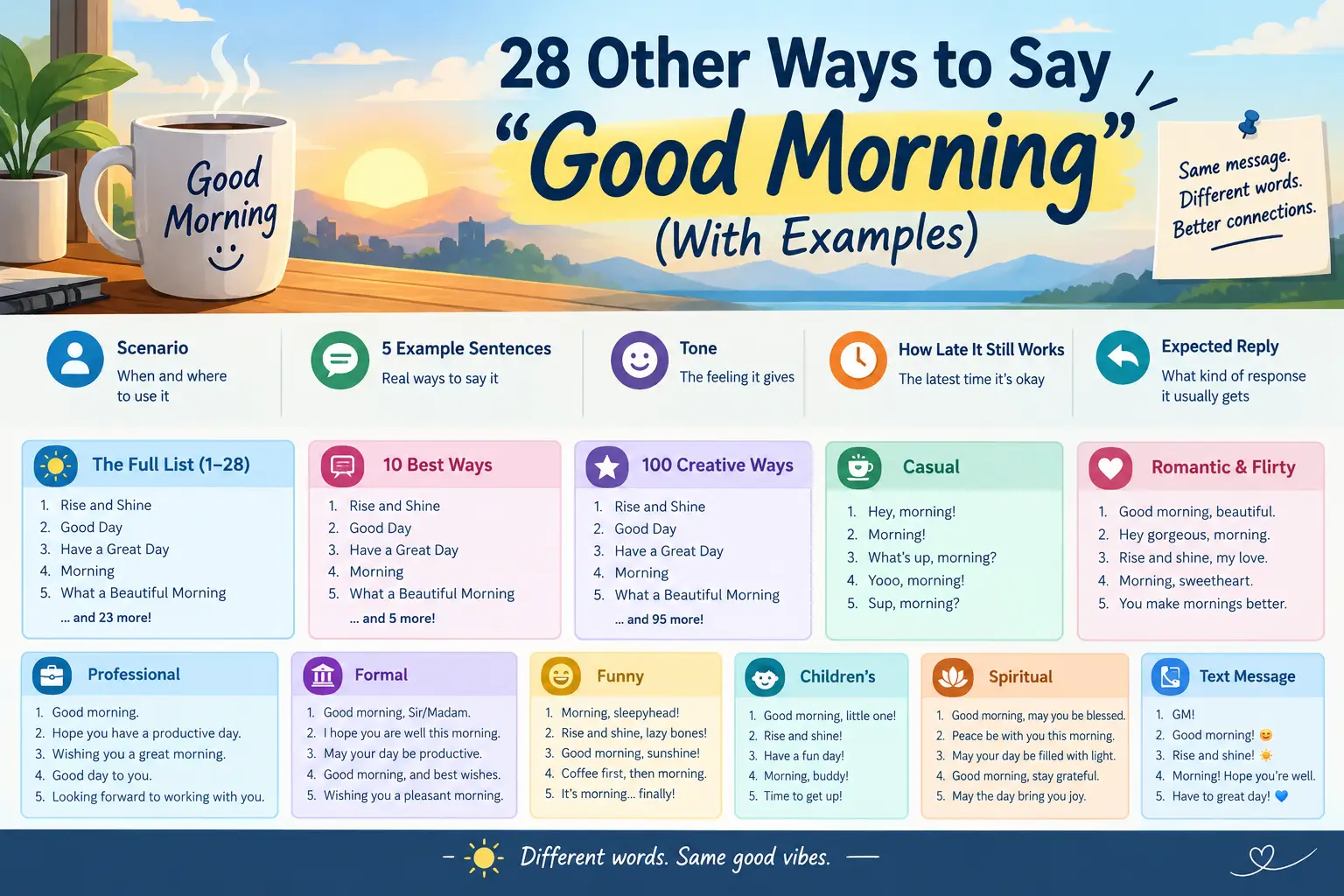
Looking for Other Ways to Say Good Morning? Here are 28 alternatives, each with a scenario, five example sentences that contain the phrase, the tone it carries, and the two columns no other list on this subject includes — how late in the day the phrase still works, and what kind of reply it expects.
Those columns matter because a morning greeting is the one piece of English with a deadline attached. Good morning sent at two in the afternoon is a joke, rise and shine sent to a colleague you have never met is an intrusion, and morning, sunshine sent to a client ends a working relationship — so timing and register do more work here than vocabulary.
The phrase itself is a fragment of a longer sentence that English stopped saying about five hundred years ago. good morning comes from Middle English gud mornynge — also recorded as goode morne and gode morne — from the Old English *gōdne morgen, and it is an ellipsis for an expression such as I wish you a good morning. The -ne on *gōdne morgen is an accusative ending, which is the grammatical fossil proving the words were once the object of a verb that has since dropped away. The cognates run straight across the Germanic family: West Frisian goeie moarn, Dutch goedemorgen, German guten Morgen, Danish god morgen, Swedish god morgon and Icelandic góðan morgunn.
Its archaic twin is still readable, and still useful for anybody who wants the Shakespearean register. good morrow comes from Middle English good morow and good morwe, and it is the form you will find in Elizabethan and Jacobean drama — which is exactly what the searches for a medieval or old-fashioned greeting are reaching for. The modern descendant went the other way entirely: Japanese borrowed the English phrase whole as グッモーニン.
Four facts from the dictionary entry change how you should use the phrase, and three of them are almost unknown. First, in casual speech it is routinely shortened to morning. Second, as a greeting it is used by anyone in almost any setting, from the most casual to the most formal, to a close friend or a stranger, regardless of age or social group — which makes it the single most universally safe greeting in the language. Third, less commonly and more formally, it is a parting rather than a greeting: good morning said on the way out of a room is a dismissal, and in nineteenth-century usage a sharp one. Fourth, by extension it is used humorously to greet somebody who has just woken up irrespective of the actual time, and informally to somebody who has come to a belated realisation — which is the oh, good morning you say when a colleague finally grasps the point. There is even a fifth sense that has nothing to do with greeting at all: in weightlifting, a good morning is an exercise performed by bending forward at the waist and returning to a standing posture with a barbell across the shoulders.
Greeting itself is a human universal, and that is the reason this list runs to twenty-eight rather than three. Greeting is an act of communication in which people intentionally make their presence known to each other, to show attention, and to suggest a type of relationship or social status — formal or informal — between the individuals or groups coming into contact. Greetings exist in all known human cultures, and greeting customs are highly culture- and situation-specific, changing within a single culture according to social status, relationship and etiquette. In writing they have their own name: a greeting expressed in a letter or an email is a salutation. And in some languages the same word serves for both hello and goodbye, which is why ciao, salut and aloha behave so differently from good morning.
Grammatically it is an interjection, and that is part of why it carries so little. An interjection stands outside the sentence and makes no claim, which is exactly what lets two words serve a stranger and a spouse alike. Which sets up the honest frame for this page: the greeting is doing social work rather than carrying information. Nobody is reporting that the morning is good; they are signalling attention, status and the kind of relationship they take themselves to be in — and that is why the right alternative depends almost entirely on who is reading it and at what hour.
28 Other Ways to Say “Good Morning”
Every entry has a scenario, five example sentences containing the phrase, and an attribute line ending in how late in the day it still works and what sort of reply it expects.
This is the list in full, and it also answers ways to say good morning, different ways to say good morning, what are other ways to say good morning, other words to say good morning in english, a different way to say good morning, how to say good morning differently, other ways how to say good morning, the other ways to say good morning, what other ways to say good morning, what other words to say good morning, what’s another way to say good morning, what’s different ways to say good morning, another way 2 say good morning, what is a nice way to say good morning, what to say instead of good morning, what do you say instead of good morning, what should we say instead of good morning and what can you say other than good morning — with dedicated sections below for the 10 and 100 lists, casual, romantic, flirty, professional, formal, funny, children’s, spiritual and text-message wording, plus twenty-six languages.
1. Rise and Shine
The most energetic entry on the list, and the one with a sergeant somewhere in its history.
Scenario: Use this when you want to sound upbeat, playful and encouraging.
Examples:
- Rise and shine, the coffee is already waiting for you.
- Today is yours, so rise and shine with confidence.
- Hey, rise and shine, we have a big day ahead.
- Now is the perfect time to rise and shine.
- Morning feels lighter when you say rise and shine.
Why it works: It is affectionate between people who live together and faintly bossy from anybody else, because the phrase belongs to military and summer-camp wake-up calls and has never quite shaken the tone. Attach an offer and the bossiness disappears — the coffee already made, in the first example, is doing more work than the greeting. It is also an imperative, which is the grammatical source of the bossiness: rise and shine are both commands. For other ways to say good morning like rise and shine, the nearest equivalents are up and at them, wakey wakey and the day is wasting, all of which carry the same cheerful command and the same risk with anybody who has not slept.
Tone: cheerful, energetic, friendly | Formality: informal | Best for: partners, housemates, family, close friends | Avoid in: very formal messages, and with anybody exhausted | How late it works: until about nine, and only while somebody is actually getting up | Reply it expects: a groan, or an echo
2. Top of the Morning to You
Charming, old-fashioned, and almost never said by an actual Irish person.
Scenario: Use this when you want a charming, old-fashioned greeting.
Examples:
- Top of the morning to you, my dear friend.
- Well, top of the morning to you and your family.
- Ah, top of the morning to you on this bright day.
- Hello, top of the morning to you from all of us.
- Indeed, top of the morning to you, kind neighbour.
Why it works: The archaic shape of it is the appeal: it sounds like something from a doorway in a village, and it raises a smile precisely because nobody says it unselfconsciously. The usage note is the part worth knowing: top of the morning is Hiberno-English in origin and survives mainly in American portrayals of Irishness rather than in Ireland, where an Irish speaker greets you with Dia duit, God be with you, or maidin mhaith, good morning. Said to an Irish colleague on 17 March it reads as a costume, so keep it for people who will take it as the joke it now is.
Tone: warm, traditional, a little playful | Formality: informal | Best for: friends who enjoy a flourish, neighbours, playful notes | Avoid in: business writing, and with Irish readers | How late it works: until noon, since the joke carries it | Reply it expects: the traditional and the rest of the day to yourself
3. Morning
One word, and the most-used greeting in the English-speaking working world.
Scenario: Use this when you want a short, simple greeting.
Examples:
- Morning, hope you are doing well today.
- Morning, the meeting notes are on your desk.
- Morning — good weekend?
- Morning, all. Kettle is on.
- Morning, I will be five minutes late.
Why it works: The dictionary records the clipping plainly: good morning is routinely shortened in casual speech to morning, and that is now the default in corridors, shops and team chats. Dropping good removes the small ceremony of the full phrase, which is why the short form reads as collegial and the long form, said in passing, can sound stiff. The third example is the most useful sentence in the first ten entries, because a question after the greeting opens a conversation that good morning on its own closes.
Tone: casual, simple, natural | Formality: informal | Best for: colleagues, passing greetings, group chats | Avoid in: deeply warm messages, formal letters | How late it works: until noon, and later as a joke | Reply it expects: an echo: morning
4. Good Day
Formal, slightly dated in Britain, entirely ordinary in Australia and much of Africa and Asia.
Scenario: Use this when you want a polite greeting that feels a little formal.
Examples:
- Good day, I hope this message finds you well.
- Good day to you, and thank you for the quick reply.
- Good day, everyone, and welcome to the briefing.
- Good day, Sir — the committee will see you at eleven.
- Good day, and please pass my regards to your team.
Why it works: It covers the whole working day, which makes it the safe choice when you do not know what time your message will be read. That is its real value in international email: a message written at nine in Lagos and opened at four in Vancouver is never wrong-footed by good day. The register is regionally split — in British English it leans formal and faintly Victorian, in Australian English it is unremarkable, and in Indian, Nigerian and South African business English it is a standard professional opener. For other ways to say a good day and another way to say good day everyone, see the group greetings further down, and for the farewell sense the set in Have a great weekend applies.
Tone: polite, respectful, formal | Formality: formal | Best for: business writing, international email, formal address | Avoid in: very close, casual chats | How late it works: all day — the only entry with no clock on it | Reply it expects: a matching formality
5. Wishing You a Lovely Morning
The polished written form: warmer than the original and usable to almost anybody.
Scenario: Use this when you want to sound sweet and caring.
Examples:
- Wishing you a lovely morning and an easy start.
- Wishing you a lovely morning before the long drive.
- Wishing you a lovely morning — nothing from me needs an answer today.
- Wishing you a lovely morning, and good luck at eleven.
- Wishing you a lovely morning from all of us here.
Why it works: Wishing you restores the verb that good morning dropped, and that restoration is what makes it sound considered rather than automatic. It is the strongest entry for a written greeting to somebody you like but do not know well — a client, a new colleague, a neighbour — because it carries warmth without presuming intimacy. The third example adds the most useful clause available in a morning email, which is that nothing is owed today. The full-length version of that courtesy is in I hope you are doing well.
Tone: kind, gentle, thoughtful | Formality: neutral | Best for: email, cards, new colleagues, clients you like | Avoid in: quick chat messages, where it is too stately | How late it works: until about eleven | Reply it expects: nothing — it is a gift, not a question
6. Hope Your Morning Is Going Well
The only entry written for a morning already in progress, which makes it the late-sender’s friend.
Scenario: Use this when you want to check in politely.
Examples:
- Hope your morning is going well so far.
- Hope your morning is going well — the figures arrived at eight, so you are covered.
- Hope your morning is going well despite the trains.
- Hope your morning is going well, and the audit is off your desk now.
- Hope your morning is going well; no need to reply to this one.
Why it works: Every other greeting here assumes the day has not started. This one assumes it has, which is why it is the correct phrase at half past ten — the hour at which good morning starts to look as though it was drafted the night before. It also opens a door without demanding anything through it: the reader can answer with news or ignore it entirely, and both are polite. Example three is the version that lands best, because naming a shared annoyance does more for a reader than any wish.
Tone: caring, calm, considerate | Formality: neutral | Best for: mid-morning messages, colleagues, clients | Avoid in: first-thing greetings, where it is premature | How late it works: from nine until noon — the widest window of any entry | Reply it expects: an optional update
7. Have a Beautiful Morning
Aesthetic rather than practical, and strongest when something in the message is actually beautiful.
Scenario: Use this when you want to sound warm and uplifting.
Examples:
- Have a beautiful morning — the frost on the field was worth the early start.
- Have a beautiful morning, and take the long way to the station.
- Have a beautiful morning; the blossom on your road is finally out.
- Have a beautiful morning, and I hope you get the window seat.
- Have a beautiful morning — first clear sky in a fortnight.
Why it works: Beautiful praises the morning rather than instructing the reader, so it carries warmth with no demand attached. As a bare phrase it reads as decoration, which is why all five examples tie it to something seen — frost, blossom, a clear sky, a window seat. In a client email it is too lyrical; in a text, a card or a caption it is exactly right.
Tone: uplifting, warm, soft | Formality: informal to neutral | Best for: texts, cards, family, captions | Avoid in: business correspondence, status updates | How late it works: until about ten | Reply it expects: nothing
8. Hope You Slept Well
It greets the night rather than the morning, which is a more intimate thing to know about somebody.
Scenario: Use this when you want to show care for someone’s rest.
Examples:
- Hope you slept well — you were asleep before the film ended.
- Hope you slept well in the new flat.
- Hope you slept well; the baby was quiet for once, by the sound of it.
- Hope you slept well after yesterday.
- Hope you slept well, and the kettle has just gone on.
Why it works: Knowing where somebody slept is knowing something personal, so the phrase itself signals closeness before any of the words do. That is why it is warm from a partner, a parent or a host and slightly odd from a colleague — the information it presumes is not information a workmate should have. The one professional exception is a conference or a work trip, where everybody knows which hotel everybody is in and the question is simply hospitality. The arrival version of the same hospitality is in Welcome home.
Tone: caring, thoughtful, personal | Formality: informal | Best for: partners, family, houseguests, work trips | Avoid in: strictly formal settings, ordinary office email | How late it works: until about nine, while the night is still the subject | Reply it expects: an answer about the night
9. How Did You Sleep?
The same ground as entry 8, turned into a question — and a question changes the whole exchange.
Scenario: Use this when you want a friendly, natural conversation starter.
Examples:
- How did you sleep? The spare mattress is not famous for comfort.
- How did you sleep — any better than Tuesday?
- How did you sleep? You were up at four by the sound of it.
- How did you sleep in the end? You looked shattered.
- How did you sleep? There is toast if you want it.
Why it works: A greeting that is also a question gets an answer, and an answer starts a conversation; a wish gets an echo and ends one. That is the single most useful distinction on this page, and it is why hosts, partners and good interviewers all open with questions. The risk is that it obliges a reply, so with somebody who plainly wants silence at breakfast, entry 5 or entry 7 is the kinder choice.
Tone: warm, casual, interested | Formality: informal | Best for: houseguests, partners, family, close colleagues on a trip | Avoid in: email to anybody you do not know well | How late it works: until about ten | Reply it expects: a real answer
10. Sending You Morning Vibes
Social-media English: fine as a caption or a text, out of place in an email.
Scenario: Use this when you want a modern and positive greeting.
Examples:
- Sending you morning vibes from a very wet Manchester.
- Sending you morning vibes — coffee is on, inbox is not.
- Sending you morning vibes and a photograph of the dog who is still asleep.
- Sending you morning vibes to carry you through the nine o’clock.
- Sending you morning vibes, and good luck with the first day.
Why it works: Vibes is addressed to a mood rather than a person, which is exactly what a caption should do: supply atmosphere instead of content. The word also dates the sender — it reads as native in chat, captions and texts and as borrowed in an email to anybody outside that register. The first and third examples are the ones worth copying, because one specific, slightly silly detail turns a stock phrase into a message.
Tone: casual, modern, positive | Formality: informal | Best for: captions, texts, group chats | Avoid in: formal business writing | How late it works: until noon | Reply it expects: an emoji, or nothing
11. Here’s to a Great Day Ahead
A toast rather than a greeting, which makes it the right phrase for a day that matters.
Scenario: Use this when you want to sound encouraging and hopeful.
Examples:
- Here’s to a great day ahead — the contract was signed at eight.
- Here’s to a great day ahead, with the whole team in for once.
- Here’s to a great day ahead; the shop reopens this morning.
- Here’s to a great day ahead, and the first clear diary in a fortnight.
- Here’s to a great day ahead — results at noon, and you have earned them.
Why it works: Here is to is toast grammar, so it implies something worth toasting and works best when the sentence names it. It is more natural aloud than on paper, which makes it the entry to open a Monday meeting or a shift briefing with rather than an email. Without a reason attached it is the emptiest phrase in this stretch of the list, because a toast to nothing is noticed. The week-opening version is in Happy Monday.
Tone: encouraging, optimistic, friendly | Formality: neutral | Best for: spoken openers, team meetings, good news | Avoid in: formal written correspondence, ordinary days | How late it works: until mid-morning, while the day is still ahead | Reply it expects: agreement
12. May Your Day Start Well
The optative form, written out in full, which is the oldest shape a greeting can take.
Examples:
- May your day start well and stay that way.
- May your day start well, and the hospital appointment go kindly.
- May your day start well — the whole parish is thinking of you.
- May your day start well, and the term bring good news.
- May your day start well, with nothing in the diary before ten.
Scenario: Use this when you want a gentle and respectful wish.
Why it works: May plus a verb is the English optative, the construction behind may you live long and may it please the court, and restoring it makes the greeting sound deliberate and slightly ceremonial. That is why it fits condolence, illness, exams and anything where a jaunty phrase would be wrong. It is also the register of blessing, so between people who share a faith it carries more than the secular alternatives, and in a corporate update it will sound like scripture.
Tone: gentle, respectful, calm | Formality: formal | Best for: cards, condolence, faith communities, serious days | Avoid in: office banter, quick chat | How late it works: until about ten | Reply it expects: nothing — a blessing closes rather than opens
13. Wishing You a Productive Morning
The office default, and the one entry that asks for output rather than wishing somebody well.
Scenario: Use this when you want to encourage focus and success.
Examples:
- Wishing you a productive morning — the only thing due today is the forecast.
- Wishing you a productive morning; I have cleared the ten o’clock for everybody.
- Wishing you a productive morning, and do not feel obliged to clear the whole backlog.
- Wishing you a productive morning, with the stand-up moved to tomorrow.
- Wishing you a productive morning — one priority each, and that is enough.
Why it works: It suits a workplace where cheerfulness would feel forced and a bare wish would feel thin. The hidden edge is worth naming: productive is a request from the organisation rather than a kindness to the person, so from a manager it can read as pressure dressed as a greeting. Every example above repairs that by removing something — a cancelled meeting, a moved stand-up, one priority instead of ten.
Tone: motivating, professional, supportive | Formality: neutral to formal | Best for: work, study, team messages | Avoid in: relaxed social chats, messages to anybody overloaded | How late it works: until about eleven | Reply it expects: nothing, though it implies effort
14. Hope Your Day Begins Beautifully
Poetic and deliberately unhurried, and the most card-like phrase in the standard set.
Scenario: Use this when you want a poetic and kind greeting.
Examples:
- Hope your day begins beautifully, and the garden is worth the early start.
- Hope your day begins beautifully on your birthday.
- Hope your day begins beautifully — you have earned a slow one.
- Hope your day begins beautifully, with the window open and no alarm.
- Hope your day begins beautifully, and the news today is kind.
Why it works: The adverb does something the adjective cannot: beautifully describes the beginning, which is a smaller and more believable thing to wish for than a beautiful day. That makes it the gentlest of the aspirational entries, and the one to use when somebody has had a run of bad mornings. In professional writing it is too lyrical, and in a text to somebody rushing for a train it will be read as a wind-up. The celebratory cousin is in Happy birthday in advance.
Tone: graceful, warm, kind | Formality: neutral | Best for: cards, birthdays, family, slow mornings | Avoid in: office email, hurried exchanges | How late it works: until about nine, while the day is still beginning | Reply it expects: nothing
15. Lovely to See You This Morning
The only entry on the list that cannot be sent — it has to be said to somebody’s face.
Scenario: Use this when you are greeting someone in person.
Examples:
- Lovely to see you this morning — it has been months.
- Lovely to see you this morning, and thank you for coming in early.
- Lovely to see you this morning; the others are in the back room.
- Lovely to see you this morning, and congratulations on the news.
- Lovely to see you this morning — you are the first friendly face I have had.
Why it works: It greets the person rather than the hour, which is a different and warmer thing to do, and it is almost impossible to say insincerely without being caught. That is why it works so well at a reception desk, a school gate, a clinic or a shop counter: the greeting names the arrival as welcome. In writing it reads as odd, since see is doing literal work; in an email, lovely to hear from you is the equivalent. The anticipatory version is in Looking forward to seeing you.
Tone: friendly, warm, personal | Formality: neutral | Best for: face-to-face greetings, reception, shops, schools, clinics | Avoid in: email and chat, where it cannot be literally true | How late it works: until noon, spoken | Reply it expects: the same warmth back
16. Nice Morning, Isn’t It?
Weather talk, which is not small talk at all but the engine of British conversation.
Scenario: Use this when you want to start a relaxed conversation.
Examples:
- Nice morning, isn’t it? First time I have seen the sun all week.
- Nice morning, isn’t it — shame we are both indoors.
- Nice morning, isn’t it? The frost has gone at last.
- Nice morning, isn’t it? Though they are promising rain by two.
- Nice morning, isn’t it? Good day for the walk you mentioned.
Why it works: The question tag is the whole mechanism: isn’t it? invites agreement and therefore a reply, which is what turns a greeting into a conversation. This is textbook phatic communion — language whose purpose is contact rather than content, and the weather is used for it because it is the one subject that cannot possibly offend. It is also the most reliable opener with a stranger: a neighbour, a dog walker, somebody at a bus stop. In writing the tag falls flat, because the reader cannot agree in the moment.
Tone: casual, chatty, friendly | Formality: informal | Best for: spoken small talk, strangers, neighbours, queues | Avoid in: written greetings, formal settings | How late it works: until noon | Reply it expects: agreement, then a conversation
17. Morning, Sunshine
Affectionate, slightly teasing, and the entry most likely to be misread by one degree.
Scenario: Use this when you want to sound sweet and affectionate.
Examples:
- Morning, sunshine — you were asleep across the whole bed again.
- Morning, sunshine, there is toast if you want it.
- Morning, sunshine. Ready for school in ten minutes, please.
- Morning, sunshine — the kettle has boiled twice waiting for you.
- Morning, sunshine, and happy Saturday.
Why it works: For other ways to say good morning sunshine, the pet name is doing all the work: sunshine is warm from a partner or a parent and ironic from anybody else. In British English it has a second, sharper life as a mild term of address to somebody being difficult — all right, sunshine — which is exactly why it is the wrong word for a colleague. Keep it for people who already have a pet name for you, and for children, where it is unambiguous.
Tone: affectionate, playful, loving | Formality: informal | Best for: partners, close family, children | Avoid in: professional settings, and with anybody who would hear the ironic sense | How late it works: until about ten | Reply it expects: an affectionate groan
18. Wishing You Peace This Morning
The one alternative that wishes for less rather than more, and the right phrase when cheer would be cruel.
Scenario: Use this when you want to sound calm and soothing.
Examples:
- Wishing you peace this morning — nothing from me until Wednesday.
- Wishing you peace this morning, and I have declined the optional meetings for you.
- Wishing you peace this morning after the week you have had.
- Wishing you peace this morning; the phone can stay on silent as far as I am concerned.
- Wishing you peace this morning, and we will pick the hard conversation up on Thursday.
Why it works: It inverts the whole genre. Every other entry wishes for energy, productivity or happiness; this one wishes for quiet, which is what a person who is grieving, ill, exhausted or newly bereaved actually wants. It is the correct phrase to send when you know something is wrong and cannot say so directly, and every example above pairs it with a removal rather than a request. It also carries a religious echo — peace be with you is liturgical in several traditions — which is part of why it reads as gentle rather than flat.
Tone: calm, soothing, compassionate | Formality: neutral | Best for: stressful days, comforting notes, illness, bereavement | Avoid in: high-energy group chats, launch mornings | How late it works: all morning, and it still reads well at noon | Reply it expects: nothing at all, deliberately
19. Hope This Morning Treats You Kindly
The most considerate wording in the standard list, because it puts the morning in charge rather than the reader.
Scenario: Use this when you want a gentle, caring greeting.
Examples:
- Hope this morning treats you kindly — I know the results come through today.
- Hope this morning treats you kindly; no reply needed to this one.
- Hope this morning treats you kindly, and the figures can wait until Thursday.
- Hope this morning treats you kindly after the fortnight you have had.
- Hope this morning treats you kindly, and I will take the nine o’clock myself.
Why it works: Every other entry asks the reader to produce something — energy, cheer, productivity. This one asks the morning to behave and leaves the reader out of it entirely, which makes it the safest phrase on this page for somebody whose situation you do not know. The dropped I helps as well: it reads as a note rather than a declaration, and it sits comfortably in an email, a text or a card.
Tone: gentle, kind, thoughtful | Formality: neutral | Best for: anybody, especially anybody struggling | Avoid in: celebratory messages, where it is too mild | How late it works: all morning | Reply it expects: nothing, by design
20. Have an Amazing Start to Your Day
High energy, and the entry that most needs a reason attached.
Scenario: Use this when you want to sound enthusiastic and uplifting.
Examples:
- Have an amazing start to your day — first day in the new job.
- Have an amazing start to your day; the pitch is at ten and you are ready.
- Have an amazing start to your day, and tell me how the interview goes.
- Have an amazing start to your day — the sun is out and the diary is empty.
- Have an amazing start to your day, and save me a seat at lunch.
Why it works: It matches somebody who is already looking forward to the day, and matching their energy is the whole job of a morning greeting. The risk runs the other way: sent to somebody dreading the morning, enthusiasm reads as an instruction — the commonest misfire in this entire genre. Reserve the superlatives for mornings you know something about, and use entry 19 or entry 28 when you do not.
Tone: positive, energising, friendly | Formality: informal to neutral | Best for: first days, interviews, good news, friends | Avoid in: messages to anybody exhausted or anxious | How late it works: until about nine, while the start is still available | Reply it expects: thanks
21. Wishing You a Calm Morning
Entry 18’s practical twin: it wishes for quiet without the liturgical echo.
Scenario: Use this when you want to promote peace and ease.
Examples:
- Wishing you a calm morning — the ten o’clock is cancelled.
- Wishing you a calm morning before the inspection this afternoon.
- Wishing you a calm morning; I have answered the supplier so you do not have to.
- Wishing you a calm morning on your first day back.
- Wishing you a calm morning, and the handover notes are already in the folder.
Why it works: Calm is a secular, workplace-safe version of peace, which makes it the one gentle entry that does not sound devotional in a business email. It is the right phrase for the morning before something difficult — an inspection, a hearing, a difficult conversation — because it wishes for a steady hour rather than a happy one. Like entry 18, it needs a removal attached to be believed, and four of the five examples supply one.
Tone: peaceful, soft, reassuring | Formality: neutral | Best for: hard days, returns from leave, anybody overloaded | Avoid in: high-energy group chats | How late it works: all morning | Reply it expects: nothing
22. Good Morning to You and Yours
It greets the household rather than the person, which is older and warmer than it looks.
Scenario: Use this when you want a respectful and broader greeting.
Examples:
- Good morning to you and yours — I hope the whole family is well.
- Good morning to you and yours, and thank you again for Sunday.
- Good morning to you and yours on this Easter Monday.
- Good morning to you and yours from everybody at the shop.
- Good morning to you and yours, and best wishes for the new term.
Why it works: And yours is an old English possessive doing a social job: it extends the greeting to a reader’s family without naming anybody, which is useful precisely when you do not know who is at home. That makes it the right phrase for neighbours, long-standing clients, village and parish correspondence and messages across generations. In a corporate email it reads as courtly, and to somebody living alone it can land awkwardly, so keep it for households you know exist.
Tone: respectful, warm, inclusive | Formality: neutral to formal | Best for: families, neighbours, cards, older relatives, long-standing clients | Avoid in: corporate updates, messages to colleagues you barely know | How late it works: until noon | Reply it expects: the same greeting back
23. Hope Today Brings You Joy
It drops the morning altogether and wishes on the whole day, which is a bigger and kinder promise.
Scenario: Use this when you want to focus on happiness and encouragement.
Examples:
- Hope today brings you joy — the christening photographs came out beautifully.
- Hope today brings you joy, and the grandchildren are as loud as ever.
- Hope today brings you joy; it has been a heavy few weeks for all of us.
- Hope today brings you joy, and congratulations again on the news.
- Hope today brings you joy, whatever shape the day turns out to be.
Why it works: Joy sits a register above happiness and carries a strong association with family, faith and celebration, which makes it excellent after good news and slightly grand on an ordinary Tuesday. Wishing on the day rather than the morning also removes the clock, so the message is still correct when it is opened at four in the afternoon. The fifth example is the one to keep for anybody whose day you know nothing about, because whatever shape it turns out to be withdraws the demand to be cheerful.
Tone: hopeful, cheerful, uplifting | Formality: neutral | Best for: family, faith communities, after good news, cards | Avoid in: transactional email, corporate updates | How late it works: all day, since it never names the morning | Reply it expects: thanks
24. Warm Wishes for Your Morning
Card English: formal, affectionate, and the right register for somebody older than you.
Scenario: Use this when you want a gentle, caring greeting in writing.
Examples:
- Warm wishes for your morning — the results come on Wednesday, so I will ring then.
- Warm wishes for your morning, and no need to write back.
- Warm wishes for your morning; the parcel should reach you before noon.
- Warm wishes for your morning from all of us at the office.
- Warm wishes for your morning, and for the whole of a quiet week.
Why it works: Warm wishes is established letter-closing English, so borrowing it as a greeting makes a message feel composed rather than dashed off. It carries affection without intimacy, which is exactly what is wanted for a grandparent, a former colleague, a long-standing client or a neighbour. The second example contains the kindest clause in correspondence of this kind: an explicit release from the obligation to reply.
Tone: gentle, kind, thoughtful | Formality: formal | Best for: cards, letters, older relatives, formal clients | Avoid in: chat messages, where it is too stately | How late it works: until about eleven | Reply it expects: nothing
25. May This Morning Bring You Good Things
The fullest blessing in the list, and the only entry that wishes for events rather than feelings.
Scenario: Use this when you want a hopeful and encouraging wish.
Examples:
- May this morning bring you good things — the decision is due before noon.
- May this morning bring you good things, and the offer you have been waiting for.
- May this morning bring you good things; you are owed a few.
- May this morning bring you good things, and the news be better than last week’s.
- May this morning bring you good things, and the whole family is thinking of you.
Why it works: Wishing for good things rather than a good mood is the shrewdest move in the standard twenty-five, because events are outside the reader’s control and moods are not. Nobody is blamed for failing to receive good things, which is why this phrase never reads as pressure. It is the right greeting for a morning with a result in it — a verdict, an offer, a diagnosis, an exam — and the third example is the warmest sentence in the whole list.
Tone: hopeful, positive, warm | Formality: neutral to formal | Best for: waiting days, results, decisions, family | Avoid in: brisk office exchanges | How late it works: until about eleven | Reply it expects: thanks, and often news later
3 More Alternatives You Will Not Find on Other Lists
All twenty-five standard alternatives share three blind spots: every one of them names the morning, every one assumes the reader is starting their day, and every one assumes the reader wants to be spoken to. These three fix exactly that.
26. You’re up early
A greeting with no morning in it at all, which is what the searches are actually asking for.
Scenario: For other ways to say good morning without saying morning, without using morning, without using the word morning and without morning — greeting somebody at the start of the day while avoiding the word entirely.
Examples:
- You’re up early — the kettle has only just boiled.
- You’re up early. Big day, or just the neighbours again?
- You’re up before me for once, which I am choosing to admire.
- You beat me to the desk today — anything I should know before nine?
- Look who is vertical. Coffee?
Why it works: It is the only construction here that greets the person and their situation instead of announcing the time of day, and it solves the real problem behind the search: good morning is a formula, and formulas sound automatic. There is a whole family of these: you’re up early, you beat me to it, look who is vertical, first one in?, how are we all doing?, ready for this?, and the plain hello — none of which mentions the morning and all of which work before noon. Two practical advantages follow. It cannot be wrong about the hour, which matters in international teams and on shift rotas; and it works with people who dislike morning cheer, because it comments on a fact rather than prescribing a mood. The one caution is that it must be true: you’re up early said at eleven is a dig.
Tone: observant, natural, unforced | Formality: informal to neutral | Best for: colleagues, housemates, family, anybody tired of stock greetings | Avoid in: formal letters, first contact with a client | How late it works: any hour, since it names no time of day | Reply it expects: a real answer
27. Whenever this reaches you, hope it’s a good one
The asynchronous greeting: correct in every time zone and on every shift pattern.
Scenario: Writing to colleagues abroad, to night-shift workers, or to anybody whose inbox you cannot time.
Examples:
- Whenever this reaches you, hope it’s a good one — it is nine here in Leeds.
- Whenever this reaches you, hope it’s a good one; nothing in here needs an answer today.
- Whenever this lands — morning, evening or the middle of your night — hope it finds you well.
- Whenever you pick this up, hope the shift was a quiet one.
- Whenever this reaches you, hope it’s a good one, and the figures are attached either way.
Why it works: A greeting that names the hour is wrong for most of the people who read it. A message written at nine in London arrives in the evening in Sydney, at four in the morning in Auckland and in the middle of a night shift in a hospital two streets away — so good morning is a small, repeated signal that the sender has not thought about the reader’s day. This version is the only one on the page that is accurate whenever it is opened, and it is why experienced distributed teams drift towards it. Add your own local time, as the first example does, and you also save the reader working out if you are awake. The dateless-request problem it is cousin to is covered in Please let me know if this works for you.
Tone: considerate, practical | Formality: neutral | Best for: international teams, shift workers, healthcare, support queues | Avoid in: face-to-face greetings, where it is absurd | How late it works: permanently | Reply it expects: nothing, and says so
28. I won’t ask you anything until you’ve had your coffee
The greeting that respects the fact that a great many people are not morning people, and nobody chose which they are.
Scenario: Partners, housemates, family and colleagues who are plainly not awake yet — and anybody on a schedule that fights their body clock.
Examples:
- I won’t ask you anything until you’ve had your coffee.
- Morning. Nothing from me for twenty minutes — I know the rules.
- No questions before the second cup, I promise.
- I have put the kettle on and I am saying nothing else.
- Here when you are ready; there is no rush and nothing is urgent.
Why it works: It is the only entry that offers silence instead of words, and to the right person silence is the greeting. The reason it lands is physiological rather than social: people differ systematically in chronotype, the body’s preferred timing for sleep and waking, which runs from strongly morning-preferring to strongly evening-preferring with most of the population in between. Because working and school hours are set to suit the early end of that range, late chronotypes live with a standing mismatch between their body clock and their alarm clock — the effect the chronobiologist Till Roenneberg named social jetlag. So a bright rise and shine at seven is not neutral: to an evening type it is cheerfulness aimed at the worst hour of their day, and a greeting that explicitly withholds demands is the most considerate thing available. Among people who live together it is also the single most domestically useful sentence on this page, because it prevents the argument that starts with a reasonable question asked eight minutes too early.
Tone: wry, considerate, affectionate | Formality: informal | Best for: partners, housemates, family, close colleagues, night-shift returners | Avoid in: formal writing, and with anybody who takes it as an accusation | How late it works: whenever the person has just surfaced, irrespective of the clock | Reply it expects: nothing — that is the entire point
Quick Comparison Table
All 28 alternatives, with how late in the day each one still works and what kind of reply it expects. Those two columns are the difference between a greeting that starts a conversation and one that quietly announces you were not paying attention.
| Phrase | Tone | Best for | Avoid in | How late it works | Reply it expects |
|---|---|---|---|---|---|
| 1. Rise and shine | Energetic | Friends, family, playful texts | Very formal messages; the exhausted | Until nine, while somebody is getting up | A groan or an echo |
| 2. Top of the morning to you | Traditional, playful | Friends who enjoy a flourish | Business writing; Irish readers | Until noon, the joke carries it | And the rest of the day to yourself |
| 3. Morning | Casual | Quick chats, coworkers | Deeply warm messages | Until noon, later as a joke | An echo |
| 4. Good day | Formal | Business, international email | Very close, casual chats | All day — no clock on it | Matching formality |
| 5. Wishing you a lovely morning | Kind, gentle | Email, cards, new colleagues | Quick chat messages | Until eleven | Nothing |
| 6. Hope your morning is going well | Caring, calm | Mid-morning messages | First-thing greetings | Nine to noon — the widest window | An optional update |
| 7. Have a beautiful morning | Uplifting, soft | Texts, cards, captions | Business correspondence | Until ten | Nothing |
| 8. Hope you slept well | Caring, personal | Loved ones, houseguests, work trips | Strictly formal settings | Until nine | An answer about the night |
| 9. How did you sleep? | Warm, interested | Houseguests, partners, family | Email to near-strangers | Until ten | A real answer |
| 10. Sending you morning vibes | Casual, modern | Captions, texts, group chats | Formal business writing | Until noon | An emoji, or nothing |
| 11. Here’s to a great day ahead | Encouraging | Spoken openers, meetings, good news | Formal writing; ordinary days | Until mid-morning | Agreement |
| 12. May your day start well | Gentle, ceremonial | Cards, condolence, faith communities | Office banter | Until ten | Nothing — a blessing closes |
| 13. Wishing you a productive morning | Motivating | Work, study, team messages | Relaxed social chats; the overloaded | Until eleven | Nothing, but implies effort |
| 14. Hope your day begins beautifully | Graceful, warm | Cards, birthdays, slow mornings | Office email, hurried exchanges | Until nine | Nothing |
| 15. Lovely to see you this morning | Friendly, personal | Face to face only | Email and chat | Until noon, spoken | The same warmth back |
| 16. Nice morning, isn’t it? | Chatty | Strangers, neighbours, queues | Written greetings | Until noon | Agreement, then conversation |
| 17. Morning, sunshine | Affectionate, teasing | Partners, close family, children | Professional settings | Until ten | An affectionate groan |
| 18. Wishing you peace this morning | Calm, compassionate | Stressful days, illness, bereavement | High-energy group chats | All morning, and still fine at noon | Nothing, deliberately |
| 19. Hope this morning treats you kindly | Gentle, kind | Anybody, especially the struggling | Celebratory messages | All morning | Nothing, by design |
| 20. Have an amazing start to your day | Energising | First days, interviews, good news | The exhausted or anxious | Until nine | Thanks |
| 21. Wishing you a calm morning | Peaceful, reassuring | Hard days, returns from leave | High-energy group chats | All morning | Nothing |
| 22. Good morning to you and yours | Respectful, inclusive | Families, neighbours, older relatives | Corporate updates | Until noon | The greeting back |
| 23. Hope today brings you joy | Hopeful, cheerful | Family, faith, after good news | Transactional email | All day — it never names the morning | Thanks |
| 24. Warm wishes for your morning | Gentle, formal | Cards, letters, formal clients | Chat messages | Until eleven | Nothing |
| 25. May this morning bring you good things | Hopeful, warm | Results, decisions, waiting days | Brisk office exchanges | Until eleven | Thanks, and news later |
| 26. You’re up early | Observant, unforced | Anybody tired of stock greetings | Formal letters, first client contact | Any hour — it names no time | A real answer |
| 27. Whenever this reaches you, hope it’s a good one | Considerate, practical | International teams, shift workers | Face-to-face greetings | Permanently | Nothing, and says so |
| 28. I won’t ask you anything until you’ve had your coffee | Wry, considerate | Late chronotypes, housemates, partners | Formal writing | Whenever they have just surfaced | Nothing — that is the point |
Three patterns come out of the table, and the first is the one every other list on this phrase misses.
First, twenty-two of the twenty-eight have an expiry time, and most of them expire before you have finished your own breakfast. Rise and shine, have an amazing start to your day and hope your day begins beautifully are all wrong by half past nine, because each one presumes the day has not begun. Only six survive the whole working day: entries 4, 6, 18, 23, 26 and 27 — and the last two survive because they never name a time at all, which is exactly why they belong on a list that other guides end at twenty-five.
Second, only five of the twenty-eight expect a real answer, and those five are the ones that build a relationship. Entries 9, 16 and 26 ask a question; entry 8 asks about the night; entry 15 greets the person rather than the hour. Everything else invites either an echo or silence, which is fine for a corridor and useless for a conversation you actually wanted. If the aim is to open something, pick a question: morning — good weekend? outperforms every wish in the table.
Third, the entries that fail do so by demanding a mood, and the entries that work offer something instead. Cheer-demanding phrases — 1, 17, 20 — are the ones that misfire with anybody ill, exhausted or on a late body clock, while the ones people remember receiving contain a removal, an offer or a fact: a cancelled meeting in 21, a kettle already boiled in 26, twenty minutes of silence in 28. That is the whole technique, and it holds in every register from a text message to a client email.
What Does “Good Morning” Mean?
It is a friendly greeting used early in the day. It shows politeness, respect and kindness, and people use it at work, at home, in texts and in casual conversation. It is simple, but it can also feel a little plain — which is why so many people look for other ways to say it with more warmth and personality.
Literally, it is a wish with the wishing cut off. The phrase descends from an ellipsis for I wish you a good morning, and the Old English accusative *gōdne morgen is the grammatical proof — the words were the object of a verb English stopped saying. Nobody is reporting that the morning is good; the sentence is a social signal, which is why it survives being obviously untrue on a wet Tuesday in February.
It also has four senses beyond the greeting, and three of them are worth knowing before you use it. Shortened to morning in casual speech; used less commonly, and more formally, as a parting rather than a greeting; used humorously to greet somebody who has just woken up whatever the hour; and used informally to somebody who has come to a belated realisation. That last sense is the one that trips people up in writing, because oh, good morning in a reply can read as sarcasm where none was meant.
When to Use “Good Morning”
You can use good morning when you want to:
- greet someone politely — the one job it does perfectly, in any setting from the most casual to the most formal;
- start a conversation on a positive note — though a question does this far better, as entries 9, 16 and 26 show;
- sound respectful in formal or professional settings — where the full form, not the clipped morning, is the one to use;
- keep things simple and clear — which is why it works in emails, texts, calls, meetings and everyday greetings alike.
Two timing rules decide most of it. Send it before noon, and stop at eleven in writing, because an email that opens with good morning and arrives at half past twelve tells the reader it was drafted and then forgotten. And check whose morning it is: across time zones and shift patterns, entry 27 is correct where good morning is simply wrong.
Pros and Cons of “Good Morning”
It is clear, polite and easy to understand; it works almost everywhere and never feels confusing. Against that, it can feel a little common, formal or automatic — and in close relationships a more personal phrase often feels warmer.
| Pros | Cons | The fix |
|---|---|---|
| It is clear, polite and easy to understand | It feels common — the reader has already had it three times before nine | Entry 26: greet the person, not the hour |
| It works almost everywhere and never confuses anybody | It can feel automatic, so it is read as formatting rather than as a greeting | Add one true detail: the kettle, the trains, the eleven o’clock |
| It is safe in every direction — senior, junior, stranger, friend | In close relationships a more personal phrase is warmer | Entries 8, 9 and 17 for people who know you |
| It signals respect without any effort | It is faintly formal between people who speak daily | Clip it to morning, as most of the working world does |
| It opens a message without asking for anything | It closes the exchange — a wish gets an echo and nothing else | Ask a question: morning — good weekend? |
| It is correct in writing and in speech | It has an expiry time, and it is wrong in half the world’s inboxes | Entries 4, 23 or 27, none of which can be late |
Every item in that middle column has the same root: the phrase contains no information about the sender, the reader or the day. Common, automatic and impersonal are three descriptions of one hole. The repair is a clause rather than a synonym, which is why morning — the trains are a disaster, so I will be ten minutes late beats every rewording on this page.
Why We Need to Use Different Ways to Say “Good Morning”
Using different phrases helps your words feel more human. It can make someone smile, feel valued or feel noticed, and in messages small changes in wording often create a bigger emotional impact. A kind greeting does more than open a conversation — it builds trust, warmth and connection.
There is a structural reason as well. A greeting is an act of communication in which people make their presence known and signal what kind of relationship they take themselves to be in, so the choice of words is a statement about the relationship whether the sender intends it or not. Morning to a client reads as casual, good morning to a partner reads as cool, and morning, sunshine to a colleague reads as a serious misjudgement — identical goodwill, three different outcomes. The group-address version of the same problem is in Hey everyone.
Introduction: Why a Simple Greeting Deserves Variety
Because it is the single most repeated sentence in your working life, and the only one you can improve for nothing.
A person in an ordinary office says or writes some form of morning greeting between five and twenty times a day. Over a year that is several thousand repetitions of a phrase that, as written, tells the reader nothing at all — which makes it the best-value sentence in the language to get right.
The Power of a Fresh Morning Greeting
Three things a well-chosen greeting does that the stock phrase cannot.
- It proves attention. Hope this morning treats you kindly — I know the results come today contains evidence that you remembered something. No synonym achieves this; only a detail does.
- It sets the register for everything that follows. The first line of a message tells the reader how formal the rest will be, and readers reply in the register they were greeted in.
- It opens or closes the exchange. A wish gets an echo; a question gets an answer. If you want the conversation, ask something.
And one thing a fresh greeting cannot do, which is worth saying plainly. It cannot compensate for a message that then asks for something unreasonable, and a warm opener in front of a cold request reads as softening, which readers discount immediately.
How to Use This Guide
Start from the relationship, not from the vocabulary.
- Everyday and casual: the 10-item shortlist and the casual section, plus entries 3, 16 and 26.
- Romantic: the affectionate sections for my love, baby, beautiful, handsome, girlfriends, boyfriends, partners, crushes and flirty text wording.
- Work: the professional and formal sections, plus entries 4, 6 and 13 and the presentation and email wording.
- Funny, children and spiritual: the humour section, the wording children answer to, and the grand rising explanation.
- Languages: twenty-six of them, with pronunciation, literal meanings and the formality rules that matter in Japanese, Korean and Arabic.
- Choosing: the framework and the mistakes section at the end, if what you want is a rule rather than a list.
One habit carries the whole page: pick the register from the channel, then add one true detail. The register decides whether you write good day, morning or morning, sunshine; the detail is what turns any of the three into a message rather than a formality — and the detail is always something you know and the stock phrase does not.
Quick Lists: 10 and 100 Different Ways to Say Good Morning
For 10 different ways to say good morning and 100 different ways to say good morning, both lists are here in full — the ten chosen to cover every register, and the hundred grouped so you can scan to the one you need.
10 Different Ways to Say Good Morning
Ten phrases that between them cover casual, warm, formal, affectionate and time-zone-proof.
| # | Say | Register | Best for |
|---|---|---|---|
| 1 | Morning | Casual | The default in corridors, shops and team chats |
| 2 | Morning — good weekend? | Casual, open | The best opener in the list: it asks something |
| 3 | Good day | Formal | International email, formal address, any hour |
| 4 | Wishing you a lovely morning | Warm, written | New colleagues, clients, cards |
| 5 | Hope your morning is going well | Caring | Anything sent after nine o’clock |
| 6 | Wishing you a productive morning | Professional | Teams, study groups, work email |
| 7 | Hope this morning treats you kindly | Gentle | Anybody whose day you know nothing about |
| 8 | Morning, sunshine | Affectionate | Partners, children, close family only |
| 9 | You’re up early | Observant | Greets the person and never names the hour |
| 10 | Whenever this reaches you, hope it’s a good one | Considerate | International teams and shift workers |
If you only remember three from this table, make them numbers 2, 7 and 9. Morning — good weekend? opens a conversation where every wish closes one; hope this morning treats you kindly is the only phrase that is safe when you do not know what the reader is dealing with; and you’re up early greets the person without naming an hour that is often wrong. Number 10 is the one that matters most in distributed work, and number 3 is the only entry with no clock on it at all.
100 Different Ways to Say Good Morning
A hundred, in ten groups of ten, so the right register is one glance away.
Everyday and short (1–10)
- 1. Morning
- 2. Morning, all
- 3. Good morning to you
- 4. Morning — good weekend?
- 5. Hello there
- 6. Hi — morning
- 7. Top of the morning to you
- 8. Good day
- 9. Morning, team
- 10. Morning, folks
Warm and kind (11–20)
- 11. Wishing you a lovely morning
- 12. Hope your morning is going well
- 13. Have a beautiful morning
- 14. Hope this morning treats you kindly
- 15. Warm wishes for your morning
- 16. Hope today brings you joy
- 17. May your day start well
- 18. Have a gentle morning
- 19. Wishing you an easy start
- 20. Hope the day is kind to you
Workplace (21–30)
- 21. Wishing you a productive morning
- 22. Hope you have a focused morning
- 23. Good morning, and welcome back
- 24. Morning — one priority today
- 25. Hope the week has started well
- 26. Good morning, everyone, and thank you for coming in early
- 27. Morning, the notes are in the shared folder
- 28. Hope you had a good break
- 29. Good morning — nothing from me before noon
- 30. Morning, and the deadline has moved to Friday
Questions that start a conversation (31–40)
- 31. How did you sleep?
- 32. Nice morning, isn’t it?
- 33. You’re up early — big day?
- 34. How are we all doing?
- 35. Ready for this?
- 36. Good weekend?
- 37. Did the trains behave?
- 38. Anything I should know before nine?
- 39. Coffee first, or shall I start?
- 40. How is the morning treating you?
Playful and funny (41–50)
- 41. Rise and shine
- 42. Wakey wakey
- 43. Up and at them
- 44. Look who is vertical
- 45. Good morning, I think
- 46. The sun is up and so, regrettably, are we
- 47. Morning — one coffee in and I am dangerous
- 48. Another day, another alarm
- 49. Good morning to everybody except my alarm clock
- 50. We survived the night
Romantic (51–60)
- 51. Morning, my love
- 52. Good morning, beautiful
- 53. Good morning, handsome
- 54. Morning, sunshine
- 55. Waking up to you is the best part of this
- 56. First thought of the day is you
- 57. Morning, gorgeous
- 58. Good morning, my favourite person
- 59. The coffee is made — come back to bed
- 60. Morning, love. I missed you.
For children (61–70)
- 61. Rise and shine, sleepyhead
- 62. Good morning, sunshine
- 63. Wakey wakey, eggs and bakey
- 64. Morning, superstar
- 65. Up you get, the day is waiting
- 66. Good morning, little one
- 67. Who is ready for pancakes?
- 68. Morning, champion
- 69. The birds are up and so are you
- 70. Time to shine today
Calm and comforting (71–80)
- 71. Wishing you peace this morning
- 72. Wishing you a calm morning
- 73. Take the morning slowly
- 74. No rush at all today
- 75. Hope you got some rest
- 76. Thinking of you this morning
- 77. One thing at a time today
- 78. Hope the morning is a quiet one
- 79. Be gentle with yourself today
- 80. I am here if you need anything
Without the word morning (81–90)
- 81. You’re up early
- 82. You beat me to it
- 83. First one in?
- 84. Hello, hello
- 85. Look who is awake
- 86. The kettle has just boiled
- 87. Hope you slept
- 88. Hey — all set for today?
- 89. Lovely to see you
- 90. Here when you are ready
In other languages (91–100)
- 91. buenos días
- 92. bonjour
- 93. guten Morgen
- 94. buongiorno
- 95. bom dia
- 96. доброе утро
- 97. καλημέρα
- 98. おはようございます
- 99. 早上好
- 100. صباح الخير
Two things are worth noticing about the hundred. Ten of them never mention the morning at all, which is the group most people are really looking for — a greeting that sounds like a person rather than a formula. And the questions in the fourth group produce more replies than the other ninety combined, because a question obliges an answer while a wish invites an echo. The children’s group works on adults too, in the right household, and the comforting group is the one to reach for on the mornings that matter.
Casual and Everyday Alternatives
For everyday use the rule is short: one to four words, and a question if you want an answer.
Another Way to Say Good Morning to Someone
For another way to say good morning to someone and other ways to say good morning to someone, these eight cover almost every one-to-one situation.
| Say | Best for | Why it works |
|---|---|---|
| Morning | Anybody, any channel | The clipped form; universally safe |
| Morning — good weekend? | Colleagues, neighbours | Opens a conversation instead of closing one |
| Hello there | Strangers, shops, queues | Warm without presuming anything |
| Hope your morning is going well | Anything after nine | Assumes the day has started, so it cannot be late |
| Hope this morning treats you kindly | Anybody whose day you do not know | Asks nothing of the reader |
| You’re up early | Housemates, colleagues, family | Greets the person rather than the hour |
| Lovely to see you | Face to face only | Names the arrival as welcome |
| Hey — all set for today? | Friends, teammates | Slang-light, and asks something real |
Rows two, six and eight are the ones that change the exchange, because each asks or observes something. A greeting that contains a question gets an answer; a greeting that contains a wish gets an echo — and that single distinction explains why some colleagues feel like friends after a month and others never do. Row five is the one to keep for a reader you cannot read: it wishes well without presuming the morning is good or that the person wants cheering.
Another Way to Say Good Day Everyone
For another way to say good day everyone, other ways to say good morning everyone, different ways to say good morning everyone and another way to say good morning everyone, a group greeting has one extra job: it has to include people who joined late.
| Say | Best for | Why it works |
|---|---|---|
| Morning, all | Team chat, office floor | The commonest British group greeting |
| Morning, team | Stand-ups, shift handovers | Names the group, costs nothing |
| Good morning, everyone | Meetings, presentations, webinars | The safe formal opener for a room |
| Good day, everyone | International meetings | Works whatever hour people are joining from |
| Good morning, all — one decision today | Project channels | Greeting plus scope in six words |
| Hello everybody, and welcome | Training, open sessions, events | Warm and inclusive for mixed audiences |
| Morning, folks | Informal teams | Relaxed; American-leaning but widely understood |
| Good morning and thank you all for being here | Formal presentations | Greeting, thanks and respect for their time |
In a meeting or a presentation the greeting is also a signal that the session has started, which is why the formal versions still earn their place. Good morning, everyone is the safest opener for a room or a webinar, and good day, everyone is the right one when the audience is spread across continents. For other ways to say good morning in a presentation, follow the greeting immediately with the purpose: good morning, everyone — twenty minutes, three decisions, and I will take questions at the end does more for a room than any amount of warmth. The full set of ways to address a group is in Hey everyone.
Email wants the same thinking in fewer words.
| Say | Where it goes | Why it works |
|---|---|---|
| Good day | Email opener | Covers any hour the message is opened in |
| Good day to you | Formal letters | Courtly, and still used in formal correspondence |
| I hope this message finds you well | First contact | The standard neutral formal opener |
| I hope your day is going well | Mid-day email | Honest about the hour; never premature |
| Greetings | Mass email, unknown recipients | Impersonal but never wrong |
| Hello, and good day | Cross-time-zone email | Greeting plus a nod to the clock difference |
For other ways to say good morning in email, other ways to say good day in email and how to say good morning john in an email, the rule is to put the name in and the clock out. Good morning, John is warmer than good morning and costs one word; good day, John or hello John, I hope this message finds you well cannot be wrong-footed by the hour it is opened. Never open a first email with the clipped morning, which reads as a text message that escaped.
Different Ways How to Say Good Morning
For different ways how to say good morning and other ways how to say good morning, text and chat deserve their own set, because the channel changes the right length.
| Write | Best for | Why it works |
|---|---|---|
| Morning 👋 | Any text | Two characters, and it does the whole job |
| Morning! Coffee first, then I will answer properly. | Group chats | Honest about your own state |
| You up? | Close friends | Context decides this one entirely |
| Morning — look at this sky | Partners, friends | A photograph carries the greeting |
| Morning. Nothing urgent, just saying hello. | Anybody busy | Removes the obligation to reply quickly |
| Up and at them — good luck today | Friends with something on | Energy plus a specific wish |
| Morning, how’s the head? | Friends, the morning after | Funny, specific, affectionate |
| Hope you slept — text me when you’re up | Partners, family | Patient, and it hands over the timing |
For other ways to say good morning in a text, over text, via text and in text, two to five words is the register, and an image counts as a greeting. A photograph of the sky, the dog or the queue says I thought of you more convincingly than any phrase, which is why row four outperforms the written alternatives. For other ways to say good morning slang, the current everyday forms are morning, mornin’, yo, hey, what’s good, wagwan in British and Jamaican-influenced English, and rise and grind — all of which are fine between friends and none of which belong in a work message. And the honest answer to other ways to say good morning reddit is that the most-upvoted suggestions are usually the shortest: morning, hey, or nothing at all with a cup of coffee handed over.
The day-long farewell cluster sits next to all of this, so it is worth having in the same place.
| If you searched | Say | Why it works |
|---|---|---|
| other ways to say have a good day | Hope the rest of the day is a kind one | Works at any hour, unlike good day |
| other ways to say have a good day at work | Hope the shift is a quiet one | The version shift workers actually want |
| other ways to say have a good work day | Hope today is a short one | Honest, and welcome on a long rota |
| other ways to say have a good day professionally | I hope the rest of your day goes smoothly | Formal, warm, no slang |
| other ways to say have a great day professionally | Wishing you a successful day | Standard in client email and sign-offs |
| other ways to say good morning have a good day | Morning — hope the whole day goes your way | Greeting and farewell in one line |
| other ways to say best day ever | One of the best days I have had | Keeps the superlative believable |
| other ways to say best day of my life | I will remember today for the rest of my life | Specific, and far stronger than the cliche |
Two rows there are worth adopting permanently. Hope the shift is a quiet one is what a nurse, a paramedic, a shop assistant or a hotel receptionist actually wants to hear, and hope today is a short one is the only honest wish for anybody on a twelve-hour rota. For the superlative pair, keep the scale believable: one of the best days I have had is heard as true where best day ever is heard as a figure of speech. The complete farewell set is in Have a great weekend.
And for the exact phrasings people search for, a quick index into the sections above.
| If you searched | Use | Where it is covered |
|---|---|---|
| other ways to say good morning over text, different ways to say good morning over text | Morning — look at this sky | The texting table above; an image counts as a greeting |
| other ways to say good morning text, other ways to say good morning in text, how to say good morning via text | Morning. Nothing urgent, just saying hello. | Two to five words, and no obligation to reply fast |
| other ways to say good morning without using morning, other ways to say good morning without using the word morning, other ways to say good morning without morning | You’re up early | Entry 26 and its family: no time of day named |
| different ways to say good morning to coworkers, other ways to say good morning at work | Morning — good weekend? | Clipped, with a question; the workplace table above |
| other ways to say good morning in english, different ways to say good morning in english, other words to say good morning in english | The grouped list of 100 | Ten registers, ten phrases each |
| another good way to say good morning, a different way to say good morning | Hope this morning treats you kindly | The 10-item shortlist covers every register |
| other ways to say have good day, other ways to say a good day | Hope the rest of the day is a kind one | The farewell table above |
| ways to say good morning or hello | Hello there, hey — all set for today? | Plain hello works at any hour |
Romantic and Affectionate Ways to Say Good Morning
One rule runs through the whole of this section: a romantic morning greeting is stronger when it reports something — a detail you remember, a thing already done, a plan for later — than when it reaches for a bigger adjective.
The reason is that affectionate vocabulary is cheap and specifics are not. Good morning, beautiful fits anybody; good morning — good luck with the interview at ten can only be sent to one person, and that is the whole difference between a greeting and a message. Pet names also need calibration: the right one is whatever you already call each other, and a new one tested first thing in the morning rarely lands.
Another Way to Say Good Morning My Love
For another way to say good morning my love, other ways to say good morning my love, other words to say good morning my love, other ways to say good morning love and different ways to say good morning love.
| Write | Best for | Why it works |
|---|---|---|
| Morning, my love | Everyday | The plain form, and the warmest of the short ones |
| Good morning, my love — I let you sleep | Weekends | Names a small kindness already done |
| First thought of the day was you | Any morning | Specific, and impossible to say automatically |
| Morning, my love. Coffee is on your side of the bed. | Living together | An object beats an adjective |
| Good morning to the best part of my day | Anniversaries, after time apart | Compliments the person at the day’s expense |
| Woke up missing you — good morning from here | Long distance | Names the distance without complaint |
| Morning, my love. Same time tomorrow? | Everyday, playful | Turns the morning into a standing plan |
| Still my favourite person to wake up next to | Years in | Duration is the compliment |
Rows two, four and eight are the ones that carry real weight. I let you sleep and coffee is on your side of the bed both report an act rather than a feeling, and acts are what long relationships actually run on. Row eight is the single strongest line here for a couple years in, because duration is the compliment: anybody manages charm for a fortnight. Row six is the one for distance, and naming the distance plainly is better than pretending it does not exist.
Another Way to Say Good Morning Baby
For another way to say good morning baby, other ways to say good morning babe and the playful pet-name register generally.
| Write | Best for | Why it works |
|---|---|---|
| Morning, baby | Everyday | The plain pet-name form |
| Morning, babe — you were asleep across the whole bed again | Living together | Teasing, affectionate, specific |
| Good morning, baby. Did you dream about me? | Playful | Invites a reply, which most greetings do not |
| Morning, babe. Ten more minutes, then I am making breakfast. | Weekends | A gift of ten minutes |
| Hey you — morning | Early relationships | Pet-name-free, so it risks nothing |
| Morning, trouble | Playful couples | Affectionate insult, which is its own dialect |
Baby and babe are intimacy markers rather than compliments, which is why they work only once a relationship has settled into them. Row five is the safe option early on: hey you carries the same warmth with none of the commitment to a label, and it is the phrasing most people reach for in the first weeks. Row three earns its place by asking a question — did you dream about me? gets a reply, and a greeting that gets a reply has done more than one that gets a heart emoji.
Another Way to Say Good Morning Beautiful
For other ways to say good morning beautiful, another way to say good morning beautiful, ways to say good morning beautiful, ways to say good morning pretty and what are other ways to say good morning handsome’s counterpart.
| Write | Best for | Why it works |
|---|---|---|
| Good morning, beautiful | Everyday | The standard form, and still effective |
| Morning, gorgeous | Playful | Slightly bolder than beautiful |
| Good morning to the most beautiful part of my day | Special mornings | Compliments the person above the morning |
| You looked beautiful asleep, and now the day gets you | Living together | Observed rather than asserted |
| Morning, beautiful. The world is lucky you are up. | Playful, warm | Grand, and said with a smile |
| Good morning, my beautiful girl | Established couples | Possessive and warm; read the relationship first |
| Hope the mirror tells you what I would | Confident couples | A compliment with a joke inside it |
The strongest versions move the compliment from the adjective to the observation. You looked beautiful asleep is something only you could have seen, which makes it evidence rather than flattery — and evidence is what the stock phrase lacks. Row three is worth keeping for mornings that matter, and row seven for couples who prefer a joke to a sonnet. Keep this whole register out of workplace messages, in both directions and without exception; the praise set that is sometimes confused with it is discussed in Good girl.
Another Way to Say Good Morning Handsome
For other ways to say good morning handsome, another way to say good morning handsome and what are other ways to say good morning handsome.
| Write | Best for | Why it works |
|---|---|---|
| Good morning, handsome | Everyday | The standard form |
| Morning, good-looking | Playful | Lighter, and works in a text |
| Good morning to the best-looking man in this flat | Living together | Funny because the field is small |
| Morning, handsome — the coffee is as strong as you asked | Everyday | Compliment plus an object |
| You are far too handsome to be up this early | Weekends | Teasing, and an invitation to go back to bed |
| Morning, my handsome man | Established couples | Warm and openly possessive |
Men receive compliments on their appearance far less often than women do, which is precisely why this register lands harder than its sender expects. A single specific compliment outperforms a repeated general one, so rows three, four and five — each of which attaches the compliment to something concrete — are the ones that get remembered. Row two travels best in a text, because good-looking is light enough to carry on a screen without sounding staged.
Another Way to Say Good Morning to Your Girlfriend
For other ways to say good morning to your girlfriend, another way to say good morning to your girlfriend, different ways to say good morning to a girl, to a girlfriend, to girl, to her, ways to say good morning for her, to your wife and how to say good morning your girlfriend.
| Write | Best for | Why it works |
|---|---|---|
| Morning, you | Early days | Affectionate with no label attached |
| Good morning — hope you slept better than Tuesday | Any stage | Proves you remembered something |
| Morning. Thinking about you, and about breakfast. | Playful | Warm and funny at once |
| Good morning, gorgeous. What is the plan for tonight? | Any stage | Greeting plus a forward step |
| Morning — your coffee order is already in | Living nearby | A small act, already done |
| Hope today is kind to you. Text me at lunch? | Any stage | Care plus a specific next contact |
| Morning, my girl | Established couples | Short, warm, and read the relationship first |
| Good morning — good luck with the interview at ten | Her big day | The strongest of all: it is about her day |
The last row is the most effective morning message in this entire section, and it contains no compliment at all. A greeting that names what is happening in her day — the interview, the scan, the exam, the difficult meeting — proves attention in a way that no adjective can. Rows five and six add the two things that make a morning text genuinely useful: something already done on her behalf, and a specific time for the next contact, which removes the small anxiety of not knowing when you will next be in touch. For a wife or a long partnership, row seven and the duration lines above it work better than the superlatives, because after a decade the compliment that counts is that you are still choosing to say it.
Another Way to Say Good Morning to Your Love
For another way to say good morning to your love, different ways to say good morning to your love, to a loved one, to your partner and different ways to say good morning to partner.
| Write | Best for | Why it works |
|---|---|---|
| Good morning to the person I am luckiest to know | Anniversaries | Devotion stated plainly |
| Another morning with you, which is all I wanted | Any morning | Simple and unarguable |
| Morning, my heart | Established couples | Older register, and warmer for it |
| I hope your day is as good as you are | Everyday | Compliment folded into a wish |
| Good morning — six hundred mornings and counting | Milestones | Arithmetic as affection |
| Waking up is better since you | Any stage | Short, and it reports a change |
Devotion-forward phrasing works best when it is rationed. Sent every morning, the person I am luckiest to know becomes wallpaper; sent on an anniversary or after a hard week, it carries. Row five is the move most couples under-use — counting the mornings, the months or the miles turns affection into evidence, which is harder to dismiss than any superlative.
The boyfriend and husband register is the same technique with different vocabulary. For other ways to say good morning to your boyfriend, different ways to say good morning to boyfriend, to bf, to him, to a man, to your man, other ways to say good morning to boyfriend over text and other ways to say good morning to your boyfriend over text:
| Write | Best for | Why it works |
|---|---|---|
| Morning — good luck with the presentation at nine | His big day | About his day, not your feelings |
| Morning, you. Hope the gym did not win. | Playful | Teasing about something real |
| Good morning — I have put the match on the calendar | Any stage | A plan, already made |
| Morning. Still thinking about last night. | Established couples | Warm, and the subtext does the work |
| Morning, handsome. Lunch at one? | Living nearby | Greeting plus a specific invitation |
| Hope you slept — you were up at four again | Living together | Observed care rather than stated care |
| Morning, my man | Established couples | Short, warm, informal |
| Good morning — text me when the shift ends | Shift workers | Fits his hours rather than yours |
Rows one and eight do the heavy lifting here, and neither is a compliment. Naming what is in his day, or fitting the message to his shift pattern rather than your own, is the clearest possible proof of attention — and it is what most morning texts leave out. Row six is the quiet one: noticing that somebody was awake at four says more than any adjective about how closely you are paying attention.
Another Way to Say Good Morning Romantically
For another way to say good morning romantically and other romantic ways to say good morning, the method is sensory, domestic and specific — not poetic.
| The move | The line | Why it works |
|---|---|---|
| Name a sense | The flat smells of coffee and you are still asleep — best part of the day | Sensory detail beats adjectives |
| Report a thought | Woke up at five and thought of you, then went back to sleep | Honest, specific, funny |
| Hand over an object | Tea is on your side. Do not move. | An act, not a sentiment |
| Name the ordinary | Morning. Your socks are on the stairs again, and I love you anyway | Domestic detail is the real romance |
| Promise the evening | Morning — dinner is on me tonight, and no cooking for you | Greeting that carries the whole day |
| Count something | Three mornings until you are home | Puts the distance into a countdown |
| Say the small truth | I slept better with you here | Reports an effect rather than a feeling |
| Use the archaic register | Good morrow, my love | Playful, literary, and it always raises a smile |
Row four is the whole argument of this section in one line. Romance in a long relationship is domestic rather than lyrical: the socks on the stairs, the tea on the correct side, the cooking you have been let off — and a morning greeting built out of those details is read as true because only one person could have written it. Row eight is the one to keep in reserve: good morrow is archaic English, it comes from Middle English good morwe, and used deliberately in a text it is charming rather than pretentious.
Another Way to Say Good Morning to Your Crush
For other ways to say good morning to your crush, another way to say good morning to your crush and different ways to say good morning to your crush, the aim is warmth with an exit.
| Write | Best for | Why it works |
|---|---|---|
| Morning — hope today is a good one | Very early days | Warm, and risks nothing |
| Morning! Good luck with the thing at eleven | Early days | Proves you listened |
| Hey — thought of you when I saw this | Early days | A link or a photograph carries it |
| Morning. Still thinking about that terrible film. | After a first meeting | Builds on a shared joke |
| Morning — coffee this week? | When you are ready | Greeting plus a low-stakes ask |
| Hope you slept better than I did | Playful | Light, and invites a reply |
Every row above leaves the other person a comfortable way to answer briefly, and that is deliberate. An early-stage morning message that demands a long reply puts the recipient in the position of either over-committing or seeming cold, which is how promising conversations die. Row two is the strongest opener in the table: remembering a detail from a previous conversation is the single most attractive thing a message can do, and it costs nothing.
Different Ways to Say Good Morning Flirty
For different ways to say good morning flirty, ways to say good morning flirty and flirty ways to say good morning via text, the safest flirting leaves room to be read as a joke.
| Write | Best for | Why it works |
|---|---|---|
| Morning. You were in my dream, which was unfair of you. | Playful and safe | Compliment with deniability |
| Woke up smiling and it is your fault | Light flirting | Blames them for a good thing |
| Morning — do you always look like that this early? | Confident | Teasing compliment |
| Good morning to the reason I checked my phone first | Early relationships | Flattering and specific |
| Morning. Coffee, then you, in that order. Possibly. | Playful couples | Funny, and warm underneath |
| Hope your morning is as good as you looked last night | Established flirting | Bold; read the room |
| Morning — I am told I am unbearable before nine, so consider this brave | Any stage | Self-deprecating, which lowers the stakes |
Deniability is the mechanism that makes flirting comfortable rather than pressurising. You were in my dream, which was unfair of you invites either a laugh or interest, and both are easy — whereas a declaration can only be accepted or refused. Row seven is the most underrated line here, because self-deprecation lowers the stakes for both people. Two cautions: keep flirty wording out of any channel your employer owns, and never send it to somebody who has not flirted back first.
Two short exchanges show how much the specifics matter.
Amara: Good morning, beautiful! Hope you have an amazing day!
Lena: Morning! You too.
Nothing has been exchanged. The greeting is warm, generic and could have been copied from a card, so the reply matches it in length and in temperature.
Amara: Morning — good luck with the panel at eleven. I put your charger in the side pocket of your bag, and the coffee is made. Text me after?
Lena: You absolute legend. I was going to turn the flat over looking for that charger. Will ring you the second I am out.
Same affection, same length, and the second message has actually changed her morning. It names her day, reports two things already done, and asks for one specific contact later — which is the three-part shape behind every strong romantic greeting on this page.
A quick index for the exact phrasings, since this cluster is searched in a hundred different shapes.
| If you searched | Use | Where it is covered |
|---|---|---|
| different ways to say good morning to a girlfriend, different ways to say good morning to girl, other ways to say good morning to a girl, other ways to say good morning to her | Morning — good luck with the interview at ten | The girlfriend table: her day beats any adjective |
| different ways to say good morning to a boyfriend, different ways to say good morning to bf, different ways to say good morning to your boyfriend, other ways to say good morning to him | Morning — good luck with the presentation at nine | The boyfriend table above |
| other ways to say good morning to a man, different ways to say good morning to your man | Morning, my man | Short, warm, informal |
| other ways to say good morning to your partner, different ways to say good morning to partner | Another morning with you, which is all I wanted | The your love table; rationed, not daily |
| different ways to say good morning to your wife | Still my favourite person to wake up next to | Duration is the compliment |
| different ways to say good morning to a girl over text | Morning! Good luck with the thing at eleven | Warm, specific, and easy to answer briefly |
| other ways to say good morning gorgeous | Morning, gorgeous | The beautiful table; bolder than beautiful |
Professional and Formal Alternatives
At work the greeting should be followed by something: a name, a thanks, a status, or the reason you are writing.
Another Way to Say Good Morning Professionally
For other ways to say good morning professionally and another way to say good morning professionally.
| Write | Where it goes | Why it works |
|---|---|---|
| Good morning, Priya | Internal email | The name is worth more than any adjective |
| Good morning — the figures are attached | Working email | Greeting plus the substance in one line |
| Good morning, and thank you for the quick turnaround | After somebody helped | Greeting carrying thanks |
| Good morning. I hope the week has started well. | Monday client email | Warm, professional, no slang |
| Good morning, everyone, and welcome | Meetings, webinars | Signals that the session has begun |
| Good morning — nothing in here needs an answer today | Any morning email | States what is not owed |
| Good day | Cross-time-zone email | Cannot be wrong about the hour |
| Hope your morning is going well | Anything sent after nine | Honest about the clock |
The cheapest professional upgrade is the name. Good morning, Priya is warmer than good morning, takes one word, and makes a group email read as though it were written to one person. Row six is the clause that makes a morning email genuinely welcome, because telling somebody that nothing is owed today answers the question they opened the message with. Keep the clipped morning for people you already work with daily, and keep entries 17 and the whole affectionate register out of work entirely. The follow-up courtesy is in I hope you are doing well.
Different Ways to Say Good Morning Formally
For different ways to say good morning formally and other ways to say good morning formal, formality is carried by the address rather than by the greeting.
| Write | Where it goes | Why it works |
|---|---|---|
| Good morning, Mr Okafor | First contact, senior contacts | Title and surname set the register |
| Good morning, and thank you for your time | Interviews, panels, hearings | Respect for the reader’s schedule |
| Good morning. I hope this message finds you well. | Formal letters and email | The standard neutral opener |
| Good day to you | Formal correspondence | Courtly, and still in use |
| Good morning, Chair, and members of the committee | Committees, boards, tribunals | Addresses the office, not the person |
| Greetings, and good morning | Formal mass email | Impersonal and never wrong |
| Good morning, Your Excellency | Diplomatic and civic settings | The honorific carries the formality |
| I should like to begin by wishing you all a good morning | Speeches, formal openings | Full-sentence formality for a lectern |
Three devices do all the work: the title and surname, the office rather than the person, and the full sentence. Good morning, Chair, and members of the committee is formal not because of the greeting but because it addresses roles, which is the convention in committees, boards, courts and tribunals. For anything spoken from a lectern, the full-sentence version in the last row is the one that sounds composed, and for a letter, I hope this message finds you well remains the neutral standard for a reason: it is impossible to object to.
Funny and Playful Ways to Say Good Morning
Morning humour has one rule: aim it at the hour, the coffee, the alarm clock or yourself — never at the person you are greeting.
For other cute ways to say good morning, other ways to say good morning cute, ways to say good morning cute, what are some cute ways to say good morning, other cool ways to say good morning, ways to say good morning sweet and other fun ways to say good morning, the cute register sits just below the funny one:
| Write | Best for | Why it works |
|---|---|---|
| Morning, sleepyhead | Partners, children | Affectionate and entirely safe |
| The kettle and I have been waiting | Living together | Patient, funny, domestic |
| Good morning from your favourite person | Playful couples | Confident and light |
| Morning! Two slices or three? | Households | A greeting that is also breakfast |
| Hello, you | Any closeness | Two words, and it does everything |
| Morning — the cat says hello too | Pet owners | The animal carries the warmth |
| Up you get, the day wants you | Children, partners | Gentle encouragement with no pressure |
| Morning, partner in crime | Friends, siblings | Playful and non-romantic |
Different Ways to Say Good Morning Funny
For other ways to say good morning funny, different ways to say good morning funny, funny ways to say good morning via text and ways to say good morning silly.
| Write | Register | Why it works |
|---|---|---|
| Good morning, I think | Deadpan | Admits the obvious before anybody else does |
| The sun is up and so, regrettably, are we | Office floor | Shared complaint, nobody blamed |
| Morning — one coffee in and I am dangerous | Colleagues | Warns and amuses at once |
| We survived the night. Congratulations to us. | Group chats | Low bar, cheerfully met |
| Good morning to everybody except my alarm clock | Any channel | Punches at an object, which is always safe |
| Another day, another alarm | Dry | Honest, and oddly comforting |
| Wakey wakey, eggs and bakey | Households, children | Silly rhyme that has outlived every critic |
| Morning. I have been awake for two hours and have achieved nothing. Join me. | Friends | Self-deprecating and specific |
| Rise and whine | Playful | One-letter joke, endlessly reusable |
| Good morning. The coffee is doing what it can. | Office | Blames the hour, not the person |
Rows five and ten are the two that work in any workplace, because the target is an object. A joke about the alarm clock or the coffee machine includes everybody and accuses nobody, while a joke about how little anybody wants to be at work is funny from a peer and reads as sarcasm from a manager — who, after all, set the hours. Row eight is the best of them between friends, since a specific confession is funnier than a general complaint. And wakey wakey, eggs and bakey survives every attempt to retire it, which is its own kind of recommendation.
Greetings for Kids and Family
With children, the greeting usually has a job attached — shoes, breakfast, a bus — and the trick is to keep the warmth and the instruction in the same sentence.
Different Ways to Say Good Morning for Kids
For different ways to say good morning for kids, sing-song, silly and encouraging all work; what does not work is a cheerful greeting followed immediately by a list of demands.
| Say | Best for | Why it works |
|---|---|---|
| Rise and shine, sleepyhead | Any age | Warm, familiar, and expected |
| Morning, superstar — big day today | School mornings | Names the day as theirs |
| Who is ready for pancakes? | Weekends | A question with a reward in it |
| The birds are up and so are you | Small children | Puts them in good company |
| Good morning, little one | Toddlers and babies | Soft, and the tone carries it |
| Up you get — ten minutes, then shoes | School runs | Greeting and instruction in one breath |
| Morning, champion. How did the dragon dream end? | Imaginative children | Picks up last night’s conversation |
| Time to shine today | Older children, exam days | Encouraging without pressure |
Row six is the one that saves actual arguments. Putting the warmth and the requirement in one breath — up you get, ten minutes, then shoes — is kinder than a bright greeting followed by escalating instructions, because the child knows at once what the morning expects. Row seven is the strongest for connection: picking up something from the night before tells a child you were listening, which is the same technique that works on adults in entry 19. And on exam or match mornings, row eight is better than enthusiasm, since time to shine encourages without demanding a performance before breakfast.
Spiritual and Alternative Greetings
Several large communities greet the morning without using the word at all — and in one case, deliberately avoid it.
For other ways to say good morning spiritual, twelve greetings that carry an intention rather than a time of day.
| Say | Where it belongs | The note that matters |
|---|---|---|
| Grand rising | Afrocentric and conscious communities | Replaces morning to avoid the sound of mourning |
| Blessed morning to you | Christian and interfaith settings | Warm, and widely understood |
| New mercies this morning | Christian communities | Echoes the new every morning of Lamentations 3:23 |
| Peace and blessings | Muslim and interfaith settings | Peace first, which is the convention |
| السلام عليكم — as-salamu alaykum | Muslim communities | Peace be upon you; the reply is وعليكم السلام |
| שָׁלוֹם — shalom | Jewish communities | One word for peace, hello and goodbye |
| नमस्ते — namaste | Hindu and yoga settings | Used all day; not morning-specific |
| ओम् शान्ति — om shanti | Meditation communities | Invokes peace rather than the hour |
| ਸਤਿ ਸ੍ਰੀ ਅਕਾਲ — sat sri akal | Sikh communities | The standard Punjabi Sikh greeting at any hour |
| Rise in grace today | New Age and wellness settings | Intention-led, with no clock in it |
| May your morning be light | Interfaith, condolence | Gentle, and safe across traditions |
| Morning blessings to you and yours | Families, parishes | Household-wide, like entry 22 |
Two conventions are worth knowing before borrowing from this table. As-salamu alaykum, shalom, namaste and sat sri akal are not morning greetings at all — each works at any hour, so pairing them with good morning is redundant rather than polite. And a religious greeting assumes a shared frame: warm inside the community, and a declaration rather than a courtesy in a mixed workplace, which is why rows eleven and twelve are the safer interfaith choices. The household-wide form of the same instinct is entry 22, and its week-opening cousin is in Happy Sunday.
Another Way to Say Good Morning or Grand Rising
For other ways to say good morning grand rising, another way to say good morning or grand rising, other ways to say good morning like grand rising, different ways to say good morning like grand rising and other ways to say good morning besides grand rising: grand rising is a greeting used chiefly in African-American, Afrocentric and conscious communities, and it exists because morning is a homophone of mourning.
The reasoning is explicit in the communities that use it. Saying good morning is heard as speaking good mourning over somebody’s day, so rising is substituted to bless the act of waking instead — and grand replaces good to raise the register further. It is used as both greeting and affirmation, and the usual reply is grand rising back.
The practice behind it is older and better documented than the phrase, which is the part most explainers miss. Rastafari speech — Iyaric, also called Dread Talk or Rasta Talk — is a deliberately constructed form of English in which vocabulary is altered to remove colonial and negative connotations, created, as its speakers describe it, in defiance of a language that was imposed during the slave trade. Some Rastas avoid English words whose phonetic sounds invoke negative connotations, and replace them through a system called Iformation, which is how earthquake becomes itesquake, creation becomes Iration, continually becomes itinually and unity becomes inity. Grand rising follows exactly that logic: a word is rejected for what it sounds like rather than for what it means, and a positive substitution is built in its place.
Three practical notes for using it. It is appropriate when you are part of a community that uses it, or replying to somebody who has greeted you that way — in which case echoing it back is the courtesy. It is not a general-purpose synonym for the office, where it will read as borrowed. And the nearest secular equivalents, for anybody who wants the idea without the cultural borrowing, are entry 26’s family of phrases: you’re up early, look who is vertical, rise in grace today or simply hello — all of which greet the waking rather than the hour.
For how to say good morning quotes, five that are short enough to send and strong enough to be worth sending:
| The line | Source | Best for |
|---|---|---|
| “Every morning we are born again. What we do today matters most.” | Attributed to the Buddha | Short enough to text |
| “With the new day comes new strength and new thoughts.” | Attributed to Eleanor Roosevelt | Encouraging without pressure |
| “The morning steals upon the night, melting the darkness.” | Shakespeare, The Tempest | For the literary register |
| “New every morning is the love our wakening and uprising prove.” | John Keble, after Lamentations 3:23 | Hymn English; strong in a card |
| “Morning without you is a dwindled dawn.” | Emily Dickinson | The best romantic quotation in the set |
A quotation works as a greeting only when it is shorter than the message around it. Emily Dickinson’s morning without you is a dwindled dawn is the strongest romantic option available, because it is six words long and does what no stock phrase can. Keep attributions honest: the every morning we are born again line is widely attributed to the Buddha and the new day, new strength line to Eleanor Roosevelt, and in both cases the attribution is traditional rather than documented, so as the saying goes is the safer frame.
Saying Good Morning in Other Languages
Twenty-six languages are covered on this page, and one rule holds across nearly all of them: the morning greeting is tied to the hour far more loosely in other languages than it is in English, and the formality rules matter far more.
For different ways to say good morning in different languages, different ways to say good morning in other languages, different ways to say good morning languages and different ways to say good morning in languages, two patterns are worth having in advance. Romance and Greek greetings name the day rather than the morning — bonjour, buongiorno, bom dia and καλημέρα are all good day — while Germanic and Slavic languages name the morning, as English does. And in Japanese, Korean and Arabic, choosing the wrong level of politeness is a far more serious error than choosing the wrong time of day.
Another Way to Say Good Morning in Spanish
For other ways to say good morning in spanish, different ways to say good morning in spanish, another way to say good morning in spanish, other ways to say good morning spanish, different ways to say good morning spanish, ways to say good morning spanish and what are other ways to say good morning in spanish: the answer is buenos días, and the interesting part is the plural.
| Say | Pronunciation | The note |
|---|---|---|
| buenos días | BWEH-nos DEE-as | Good days, plural — the standard everywhere |
| buen día | bwen DEE-a | Singular; standard in Argentina, Uruguay and parts of Mexico |
| buenas | BWEH-nas | Clipped and informal; works morning, noon or evening |
| que tengas un buen día | keh TEN-gas oon bwen DEE-a | Have a good day; a farewell rather than a greeting |
| ¿cómo dormiste? | KOH-mo dor-MEES-teh | How did you sleep? — entry 9 in Spanish |
| buenos días, amigo mío | a-MEE-go MEE-o | Good morning, my friend |
Note the lower-case d and the plural días. Spanish greets you with good days, which is a fossil of longer religious formulas such as buenos días le dé Dios, may God give you good days — the same kind of shortening that produced English good morning from I wish you a good morning. The singular buen día is not an error: it is the normal form in Argentina and Uruguay and is heard in Mexico too.
Another Way to Say Good Morning Spanish: Variations and Nuances
| The situation | Say | Why it matters |
|---|---|---|
| Formal, to one person | buenos días, ¿cómo está usted? | Usted for respect, distance or age |
| Informal, to one person | buenos días, ¿cómo estás? | Tú for friends, peers and children |
| To a group, Spain | buenos días a todos | Vosotros country, but the greeting is the same |
| To a group, Latin America | buenos días a todos ustedes | Ustedes covers both registers |
| Why it is plural | buenos días, not buen día | A fossil of longer wishes like buenos días le dé Dios |
| Regional swap | buen día in the River Plate | Singular is the norm in Argentina and Uruguay |
| Time boundary | buenos días until about 14:00 | Spanish mornings run to lunch, which is late |
| Daddy and royalty | buenos días, papi — buenos días, reina — buenos días, rey | Papi, reina and rey are affectionate, not literal |
The decision that actually matters in Spanish is tú or usted, not which greeting you pick. Buenos días, ¿cómo está usted? to a shopkeeper, an older neighbour or a client is correct; the same sentence with estás can read as familiar, and in Spain the balance tips informal much faster than in Colombia or Peru. The clock is generous: Spanish buenos días runs until lunch, which in Spain means around two in the afternoon, so a greeting that would be absurd in English is unremarkable there.
Different Ways to Say Good Morning Beautiful in Spanish
For different ways to say good morning beautiful in spanish, how to say good morning gorgeous in spanish, how to say good morning handsome in spanish, how to say good morning cutie in spanish, how to say good morning my love in spanish, how to say good morning daddy in spanish, how to say good morning queen in spanish, how to say good morning king in spanish and how to say good morning my friend in spanish.
| Say | Pronunciation | The note |
|---|---|---|
| buenos días, hermosa | BWEH-nos DEE-as, er-MOH-sa | Beautiful; warm and standard |
| buenos días, preciosa | pre-see-OH-sa | Precious, gorgeous; stronger than hermosa |
| buenos días, guapa | GWA-pa | Good-looking; everyday in Spain, less so in Latin America |
| buenos días, hermoso | er-MOH-so | The masculine form, for a boyfriend or husband |
| buenos días, guapo | GWA-po | Handsome — the answer to how to say good morning handsome in spanish |
| buenos días, mi amor | mee a-MOR | My love; the commonest romantic form |
| buenos días, lindura | leen-DOO-ra | Cutie — for how to say good morning cutie in spanish |
| Buenos días, mi cielo | mee see-EH-lo | My sky, my heaven; tender and very common |
Match the gender of the adjective to the person, not to yourself: hermosa and guapa to a woman, hermoso and guapo to a man. Guapa is everyday in Spain and lands as stronger in much of Latin America, while preciosa and mi cielo travel everywhere. Two words need care: papi is affectionate between partners and in several countries also ordinary slang for a man, and reina and rey are compliments rather than claims — sweet from a partner, jarring from a stranger.
Another Way to Say Good Morning in Japanese
For different ways to say good morning japanese, another way to say good morning in japanese, ways to say good morning japanese, how to say good morning japanese, how to say good morning japanese formal, how to say good morning japan and how to say good morning japan in japanese: the difference between おはよう and おはようございます is the whole lesson.
| Say | Pronunciation | When to use it |
|---|---|---|
| おはよう | o-ha-YOH | Informal; family, close friends, people below you |
| おはようございます | o-ha-YOH go-zai-mas | Polite; colleagues, seniors, strangers, customers |
| Ohayō gozaimasu, senseı | sen-SAY | Add the title for a teacher, doctor or mentor |
| Ohayō! | o-ha-YOH | Clipped; between friends, and common among young people |
| お早く | o-HA-ya-ku | The root: haya, early, with the honorific o- |
| グッモーニン | gum-MOH-nin | The English phrase, borrowed wholesale into Japanese |
おはよう is informal and おはようございます is polite, and the gap between them is socially sharp. Use the long form with colleagues, seniors, customers, teachers and anybody you have just met; use the short form with family, close friends and people junior to you — and when in doubt, use the long one, because excess politeness in Japanese is a venial error and insufficient politeness is not. The etymology is pleasing: the phrase comes from お早く, built on haya, early, with the honorific prefix o-, so the literal sense is closer to it is early, honourably than to good morning. English went the other way — Japanese also borrowed the English phrase outright as グッモーニン.
Another Way to Say Good Morning in French
For other ways to say good morning in french, another way to say good morning in french, different ways to say good morning in french, how to say good morning my love in french, how to say good morning king in french and how to say good morning queen in french: bonjour covers the whole day, and bonne matinée is a goodbye.
| Say | Pronunciation | The note |
|---|---|---|
| bonjour | bon-ZHOOR | Good day — the all-purpose greeting until evening |
| salut | sa-LOO | Informal hi; friends only, and it also means bye |
| coucou | koo-KOO | Very informal and affectionate; family, partners, children |
| bonne matinée | bon ma-tee-NAY | Have a good morning — a farewell, not a greeting |
| bien dormi ? | byan dor-MEE | Slept well? — entry 9 in French |
| bonjour, mon amour | mon a-MOOR | My love, for how to say good morning my love in french |
| bonjour, ma belle / bonjour, mon beau | ma BELL / mon BOH | My beautiful one / my handsome one |
| bonjour, ma reine / bonjour, mon roi | ma REN / mon RWA | My queen / my king |
The mistake English speakers make in French is reaching for a literal good morning. There is no everyday French equivalent: bonjour serves from waking until early evening, and bonne matinée means enjoy the rest of your morning and is said on parting, which is why using it as a greeting marks you out instantly. Two further notes: salut does duty as both hi and bye and belongs only between friends, and coucou is the warm, slightly childlike greeting used with partners, children and close family.
Different Ways to Say Good Morning in Chinese
For different ways to say good morning in chinese and how to say good morning chinese: 早上好 is the full form, and in ordinary life people simply say 早.
| Say | Pronunciation | The note |
|---|---|---|
| 早上好 | dzao-shang HAO | Morning good — the full, standard form |
| 早 | dzao | Just early: the everyday clipped greeting |
| 早安 | dzao-AN | Morning peace; common in Taiwan and in writing |
| Ni zǎo | nee dzao | You early; friendly and informal |
| Dàjiā zǎo | da-jya dzao | Morning, everybody — for a room or a group chat |
The clipped 早 is the one to learn, because it is what you will actually hear. It means early rather than good morning, and it functions exactly as English morning does — an abbreviation that has become the standard. 早安 leans literary and is commoner in Taiwan and in writing than in mainland speech, and dàjiā zǎo is the version for greeting a room or a group chat. The time boundary is tighter than in Spanish: Mandarin zǎoshang covers roughly dawn until nine or ten, after which shàngwǔ, late morning, takes over.
More European Languages: German, Italian, Portuguese, Dutch, Polish, Russian and Greek
For ways to say good morning german, how to say good morning german, other ways to say good morning in german, other ways to say good morning in italian, other ways to say good morning in portuguese, how to say good morning dutch, how to say good morning danish, how to say good morning norwegian, different ways to say good morning in polish, other ways to say good morning in russian, how to say good morning ukrainian, how to say good morning greek and how to say good morning class in afrikaans.
| Language | Say | Pronunciation | The note |
|---|---|---|---|
| German | guten Morgen | GOO-ten MOR-gen | Standard everywhere; clipped to Morgen! among colleagues |
| German (north) | Moin | moyn | Used all day in Hamburg and Schleswig-Holstein |
| German (south) | Grüß Gott | grooss GOT | God greet you; Bavaria and Austria, any hour |
| German (romantic) | guten Morgen, mein Schatz | mine SHATS | My treasure — for how to say good morning my love in german |
| Italian | buongiorno | bwon JOR-no | Good day; used from waking until mid-afternoon |
| Italian (romantic) | buongiorno, amore mio | a-MOH-reh MEE-o | My love — for how to say good morning my love in italian |
| Portuguese | bom dia | bong DEE-a | Good day; Portugal and Brazil alike |
| Portuguese (romantic) | bom dia, meu amor | meh-oo a-MOR | My love |
| Dutch | goedemorgen / goeiemorgen | KHOO-de-MOR-ghen | The second is the relaxed spoken form |
| Afrikaans | goeiemôre | KHOY-a-MAW-re | Goeiemôre, klas is good morning, class |
| Polish | dzień dobry | jen DOH-bri | Polish has no everyday good morning: this is good day |
| Russian | доброе утро | DOH-bro-ye OO-tra | Good morning; the adjective agrees with utro |
| Ukrainian | добрий ранок / доброго ранку | DOH-briy RAH-nok | The genitive second form is the commoner wish |
| Greek | καλημέρα | ka-li-MEH-ra | From καλός, good, plus ἡμέρα, day |
| Danish | godmorgen | go-MORN | Often collapses to morn in speech |
| Norwegian | god morgen | goo MOR-gen | Cognate with English, as the etymology predicts |
Two of those rows will save you from a common mistake. Polish has no everyday morning-specific greeting at all: dzień dobry, good day, is what you say from breakfast until evening, so searching for a Polish good morning produces textbook forms that nobody uses. And Moin is not a shortening of Morgen — in Hamburg, Bremen and Schleswig-Holstein it is an all-day greeting, so hearing it at six in the evening is entirely normal. The Germanic set also shows the etymology working: Dutch goedemorgen, Danish godmorgen and Norwegian god morgen are the same construction as the English phrase, inherited rather than translated.
More Asian Languages: Korean, Hindi, Urdu, Kannada, Nepali, Khmer and Vietnamese
For different ways to say good morning in korean, how to say good morning korean, how to say good morning korean language, different ways to say good morning in hindi, how to say good morning urdu, different ways to say good morning in kannada, how to say good morning kannada, how to say good morning nepali, how to say good morning khmer, how to say good morning vietnamese, how to say good morning vietnam and how to say good morning vietnam in vietnamese.
| Language | Say | Pronunciation | The note |
|---|---|---|---|
| Korean | 좋은 아침 | JOH-eun AH-chim | A calque; Koreans greet with 안녕하세요 instead |
| Korean (polite) | 안녕하세요 | an-NYONG-ha-se-yo | Are you at peace? — used at any hour |
| Hindi | सुप्रभात | su-pra-BHAAT | Sanskritic and formal; written more than spoken |
| Hindi (everyday) | नमस्ते | na-mas-TAY | What people actually say, morning or not |
| Urdu | صبح بخیر | SU-bah ba-KHAIR | Morning of goodness; Persian-derived |
| Kannada | ಶುಭೋದಯ | shu-BHOH-da-ya | Auspicious dawn; formal and warm |
| Nepali | शुभ प्रभात | SHU-bha pra-BHAAT | Auspicious morning; namaste in daily use |
| Khmer | អរុណសួស្តី | a-roon SUOS-dey | Dawn greetings; Cambodia |
| Vietnamese | chào buổi sáng | chow boo-oy SANG | Textbook; in life, chào plus the right pronoun |
The Korean and Vietnamese rows carry the important lesson: a literal translation is grammatically correct and still wrong. 좋은 아침 is a direct calque of good morning and is understood, but Koreans greet each other with 안녕하세요 at any hour, so the textbook phrase marks you as a learner. Vietnamese works the same way: chào buổi sáng appears in phrasebooks, while in life people say chào followed by the pronoun that matches the person’s age and status — chào anh, chào chị, chào em — and choosing that pronoun correctly matters far more than the time of day. In Hindi, Urdu, Kannada and Nepali the Sanskritic forms are genuine but formal, used in writing, broadcasting and on cards, while नमस्ते or a religious greeting does the everyday work.
Arabic, Darija, Zulu, Māori and Jamaican Greetings
For how to say good morning arabic, how to say good morning darija, how to say good morning zulu, how to say good morning new zealand, how to say good morning jamaica and how to say good day ukrainian’s southern-hemisphere equivalents.
| Language | Say | Pronunciation | The note |
|---|---|---|---|
| Arabic | صباح الخير | sa-BAAH al-KHAYR | Morning of goodness; the reply is صباح النور, morning of light |
| Moroccan Darija | sbaḥ l-khir | sbah l-KHEER | The same phrase, compressed in Darija pronunciation |
| Zulu | sawubona / sanibonani | sa-woo-BOH-na | I see you / we see you; no separate morning form |
| Zulu (morning) | ulale kahle? | oo-LA-le KAH-hle | Did you sleep well? — the real morning question |
| Māori (New Zealand) | mōrena | MOH-re-na | Morning, borrowed from English and naturalised |
| Māori (any hour) | kia ora | kee-a OR-a | Be well; greeting, thanks and agreement at once |
| Jamaican Patois | gud mawnin | gud MAW-nin | The Patois form, and mawnin on its own |
| Jamaican (informal) | wah gwaan | wah GWAAN | What is going on? — any hour, friends only |
Arabic has the most elegant greeting-and-reply pair on this page. صباح الخير, morning of goodness, is answered with صباح النور, morning of light — the reply raises the greeting rather than echoing it, which is a convention English lost somewhere after good morrow. Zulu is the opposite case and just as instructive: sawubona means I see you, sanibonani is the plural, and there is no separate morning formula at all, so the morning-specific thing to ask is ulale kahle?, did you sleep well? Māori mōrena is a loan from English that has been fully naturalised, and kia ora serves as hello, thank you and agreement at once.
Old English, Medieval and Very Fancy Greetings
For different ways to say good morning in old english, ways to say good morning old english, ways to say good morning medieval and how to say good morning very fancy.
| Say | Where it comes from | The note |
|---|---|---|
| Good morrow | Middle English good morow, good morwe | The standard archaic form; Shakespeare uses it constantly |
| God yive you good morwe | Middle English blessing-greeting | God give you good morrow; the fuller medieval version |
| Give you good morrow | Early modern English | Clipped from the blessing above |
| gōdne morgen | Old English, reconstructed | The accusative ancestor of good morning |
| wes hāl | Old English | Be well — the greeting that became wassail |
| Hail and well met | Early modern English | Now purely theatrical, and deliberately so |
| A very good morning to you | Formal modern English | The answer to how to say good morning very fancy |
| I trust you slept soundly | Formal modern English | Entry 8 in a dinner jacket |
The honest historical answer is that good morning itself is the medieval phrase, worn down. Middle English had gud mornynge and good morwe, from the Old English gōdne morgen — an ellipsis for I wish you a good morning — and the fuller medieval greeting put God in it: God yive you good morwe. wes hāl, be well, is the other great Old English greeting, and it survives in modern English as wassail. For the merely fancy rather than the genuinely old, the last two rows are the ones that work: a very good morning to you is formal, warm and entirely usable today, and I trust you slept soundly is entry 8 in evening dress.
Choosing the Right Greeting: A Practical Framework
Three questions settle it: who is reading, what hour will it be where they are, and do you want an answer or just a signal?
Matching Tone to Relationship and Setting
| Who you are greeting | What the greeting needs | Example |
|---|---|---|
| A partner you live with | Affectionate plus an act | Morning, my love — coffee is on your side |
| A partner at a distance | Affectionate plus a plan | Morning — three mornings until you are home |
| A crush or a new interest | Warm with an easy exit | Morning — good luck with the thing at eleven |
| A close friend | Short, funny, specific | Morning, how’s the head? |
| A child | Warmth and the requirement together | Up you get — ten minutes, then shoes |
| A parent or grandparent | Formal warmth | Good morning to you and yours |
| A colleague you see daily | Clipped, with a question | Morning — good weekend? |
| Your whole team | Greeting plus scope | Morning, all — Thursday is the only deadline |
| A manager or a senior | Greeting plus what is owed | Good morning — the figures are attached, nothing needed from you today |
| A client you know well | Warm and professional | Good morning, and thank you for Friday’s call |
| A client you have not met | Full formal | Good morning, Ms Adeyemi. I hope this message finds you well. |
| A room, a webinar or a panel | Formal, then the purpose | Good morning, everyone — twenty minutes, three decisions |
| Someone grieving or ill | A wish for less, plus a removal | Wishing you peace this morning — nothing from me this week |
| Someone abroad or on shift | No clock at all | Whenever this reaches you, hope it’s a good one |
| Someone who hates mornings | Silence, offered out loud | No questions before the second cup, I promise |
One pattern runs down that whole table: the register comes from the relationship, and the substance comes from what you know. Every strong example contains something the stock phrase cannot — a coffee already made, a deadline, an interview at eleven, ten minutes before shoes, nothing owed today. The three rows at the bottom are the ones most people get wrong, because grief, shift work and a late body clock all call for a greeting that offers less rather than more. The chasing-and-dependency version of the same courtesy is in I hope everything is going well.
Common Mistakes to Avoid
| The mistake | Why it misfires | Write instead |
|---|---|---|
| Good morning in an email opened at 3pm | It reads as drafted and forgotten | Entry 4, 23 or 27 — none of them has a clock |
| Morning, sunshine to a colleague | Affectionate register at work; in British English it also carries a sharp sense | Morning, or entry 6 |
| Rise and shine to somebody exhausted | Cheer aimed at the worst hour of their day | Entry 19, 21 or 28 |
| Morning as a first line to a new client | Chat register in a first impression | Good morning, Ms Adeyemi |
| Top of the morning to an Irish reader | It is stage Irish, not Hiberno-English in current use | maidin mhaith, or plain morning |
| Ohayō to a Japanese senior | Informal where polite is required | おはようございます |
| bonne matinée as a greeting in French | It is a farewell | bonjour |
| 좋은 아침 to a Korean colleague | A calque nobody uses | 안녕하세요 |
| A cheerful greeting in front of a demand | Readers discount softening and resent it | Greet, then state the ask plainly |
| The same greeting to the same person twice in a day | It makes the first one look automated | Say something else, or nothing |
| Good morning to somebody finishing a night shift | Their day is ending, not beginning | Hope the shift was a quiet one |
| Any pet name you have not used before | First thing in the morning is the worst time to test one | Use what you already call each other |
Three of those are cross-cultural, and they are the ones that cost most. Insufficient politeness in Japanese, a French farewell used as a greeting, and a Korean calque that no Korean says are all errors a dictionary will not catch, because each phrase is perfectly grammatical. The commonest mistake in English is simpler: the clock. An email that opens with good morning and is read at three in the afternoon tells the reader something about your attention, and entry 4, 23 or 27 removes the problem entirely.
Final Thoughts
The phrase is a fragment of a wish, and everything that improves it is information rather than vocabulary.
Three things are worth carrying away. First, good morning is an ellipsis for I wish you a good morning, with the Old English accusative *gōdne morgen still visible in it, so the sentence has been shedding content for a thousand years and now carries almost none. Second, it has an expiry time, and twenty-two of the twenty-eight alternatives on this page share it — only six survive a whole working day, and two of those work by never naming an hour. Third, a greeting that asks something gets an answer and a greeting that wishes something gets an echo, which is the entire difference between a colleague you talk to and one you merely pass.
And the languages section answers a question English speakers rarely think to ask. English is unusual in tying a greeting so tightly to the clock: French, Italian, Portuguese, Greek and Polish greet the day, Zulu greets the person — I see you — and Arabic answers a morning of goodness with a morning of light. Greeting the person rather than the hour is the older and more generous habit, and entry 26 is simply that habit in modern English.
Conclusion: Make Every Morning Greeting Count
Use morning — good weekend? with colleagues you see daily, good morning, [name] plus one line of substance at work, hope this morning treats you kindly for anybody whose day you do not know, morning, my love with an act attached at home, and whenever this reaches you, hope it’s a good one for anybody abroad or on shift.
The original is two words doing social work and carrying no content. Pick the register from the relationship, check what hour it will be where the reader is, add one true detail only you could know, and ask a question if you want the conversation rather than the echo — and if the person is grieving, exhausted or simply not a morning person, offer them less instead of more. That is the whole craft, and it costs nothing but attention.
Key Takeaways
| If you want | Use | Why |
|---|---|---|
| Casual | Morning, morning — good weekend?, hello there | Short, and a question if you want a reply |
| Warm written | Wishing you a lovely morning, warm wishes for your morning | Restores the verb the stock phrase dropped |
| Safe for anybody | Hope this morning treats you kindly | Asks nothing of the reader |
| Professional | Good morning, [name] plus one line of substance | The name is the cheapest upgrade available |
| Formal | Good morning, Mr Okafor, good day to you | Formality lives in the address |
| Romantic | Morning, my love plus an act or a plan | Specifics beat superlatives |
| Funny | Good morning to everybody except my alarm clock | Aim the joke at an object |
| Children | Up you get — ten minutes, then shoes | Warmth and the requirement in one breath |
| Comforting | Wishing you peace this morning | Wishes for less rather than more |
| No morning in it | You’re up early, look who is vertical | Cannot be wrong about the hour |
| Across time zones | Whenever this reaches you, hope it’s a good one | Correct whenever it is opened |
| Spanish | buenos días | Plural, lower case, and it runs until lunch |
| French | bonjour | All day; bonne matinée is a goodbye |
| Japanese | おはようございます | Use the long form unless you are sure |
| Chinese | 早 | What people actually say |
| Arabic | صباح الخير | Answered with صباح النور |
If you remember only one line from this page, make it the last row of the framework table: a greeting that offers silence is sometimes the kindest one available. And if you remember two, add the name — good morning, Priya outperforms every synonym on this page, costs one word, and works in every language on it.
FAQs: Frequently Asked Questions
1. What are other ways to say “Good Morning”?
They are different expressions, phrases and greetings used instead of a simple good morning to make your morning wishes more creative, friendly and unique. The 28 above cover casual, warm, formal, affectionate, funny, comforting and time-zone-proof registers — from the clipped morning to hope this morning treats you kindly, you’re up early and whenever this reaches you, hope it’s a good one. Each entry above also states how late in the day it still works and what kind of reply it expects.
2. Why should we use different morning greetings?
Using different ways helps create a positive tone, builds a good habit, and makes your message feel more personal and warm. There is a practical reason too: the stock phrase contains no information, so a reader who has already had it three times before nine processes it as formatting rather than as a greeting. One clause fixes it — a name, a detail, a cancelled meeting, a cup of coffee already made.
3. Can I use these greetings in messages?
Yes — they work in a text message, in short notes and in daily conversation to show encouragement and care. The channel decides the length: two to five words in chat and text, one or two lines in email, a full sentence in a formal letter. In a text, an image counts as a greeting: a photograph of the sky, the queue or the dog says I thought of you more convincingly than any phrase.
4. Are these greetings formal or informal?
They are both. Some are formal, while others are informal greetings, cute phrases, or even flirty and motivational styles depending on the situation. The comparison table above marks each one, and the rough split is simple: full sentences and titles are formal, clipped forms and pet names are informal. The one entry that is formal in every setting is good day, and the one that is informal in every setting is morning, sunshine.
5. Where can I learn more morning expressions?
From blogs, articles and lists that explore English expressions and friendly expressions for daily use — and, for the etymology and the usage notes, from dictionaries. This page draws its historical material from the recorded forms: Middle English gud mornynge, the Old English *gōdne morgen, the archaic good morwe, and the languages section from the standard greeting conventions of each language rather than from word-for-word translation.
6. How many ways are there to say good morning?
For how many ways to say good morning: practically speaking, hundreds — and this page lists 128 of them. There are the 28 full entries with examples, a tight list of 10, a grouped list of 100, and greetings in 26 languages. The number matters less than the sorting, which is why each one here is tagged by register, by how late it works and by the reply it produces.
7. What can I say instead of good morning without saying “morning”?
For other ways to say good morning without saying morning, without using morning, without using the word morning and without morning: you’re up early, you beat me to it, first one in?, look who is vertical, hello there, the kettle has just boiled, all set for today?, lovely to see you and here when you are ready. Every one of them greets the person instead of announcing the hour, which has two advantages: it cannot be wrong about the time, and it does not sound like a formula.
8. What does “grand rising” mean?
It is a greeting used chiefly in African-American, Afrocentric and conscious communities, and it exists because morning is a homophone of mourning. Saying good morning is heard as speaking good mourning over the day, so rising is substituted to bless the waking instead, and grand lifts it further. The underlying practice is well documented in Rastafari speech, Iyaric, where words whose sounds carry negative connotations are replaced through a system called Iformation — earthquake becoming itesquake, creation becoming Iration, unity becoming inity.
9. Where does the phrase “good morning” come from?
From a wish with the wishing cut off. The phrase comes from Middle English gud mornynge, also recorded as goode morne and gode morne, from the Old English *gōdne morgen, and it is an ellipsis for an expression such as I wish you a good morning. The accusative ending on *gōdne morgen is the proof: the words were once the object of a verb English has since dropped. The cognates are Germanic throughout — goeie moarn, goedemorgen, guten Morgen, god morgen, god morgon and góðan morgunn.
10. Is “good morrow” still correct English?
It is correct and archaic, which makes it useful on purpose. Good morrow comes from Middle English good morow and good morwe, and it is the form that fills Elizabethan and Jacobean drama. For ways to say good morning medieval, the fuller period greeting put God in it: God yive you good morwe, God give you good morrow. Sent deliberately in a text today it reads as charming rather than pretentious.
11. Can “good morning” be used as a goodbye?
Yes — less commonly and more formally, it is a parting rather than a greeting. Said on the way out of a room it functions as a dismissal, and in nineteenth-century usage a pointed one. Two further senses are worth knowing: humorously, it greets somebody who has just woken up whatever the hour, and informally it is said to somebody who has come to a belated realisation — the oh, good morning aimed at a colleague who has finally caught up.
12. Is it rude to shorten it to just “morning”?
No. The dictionary records the clipping plainly: good morning is routinely shortened in casual speech to morning, and that short form is now the default in corridors, shops and team chats across the English-speaking world. The one place to avoid it is a first message to a client or a senior stranger, where it reads as a text that escaped into an email.
13. What is another way to say good morning to someone?
For another way to say good morning to someone, other ways to say good morning to someone, other ways to say good morning to a friend and other ways to say good morning to a loved one: morning — good weekend?, hello there, hope your morning is going well, hope this morning treats you kindly, you’re up early and lovely to see you. Pick a question if you want a conversation and a wish if you want a signal — that single choice does more than any synonym.
14. What should I say to my girlfriend or boyfriend in the morning?
Something about their day rather than about your feelings. Morning — good luck with the panel at eleven beats good morning, beautiful every time, because only one person could have written it. The three-part shape that works is: name their day, report something already done, and ask for one specific contact later — the coffee is made, your charger is in the side pocket, text me after? Pet names should be the ones you already use, and a new one tested first thing rarely lands.
15. What are good flirty morning messages for a crush?
For different ways to say good morning flirty, flirty ways to say good morning via text, different ways to say good morning via text to your girlfriend and other ways to say good morning to your crush: keep an exit in the message. Morning. You were in my dream, which was unfair of you. invites either a laugh or interest, and both are comfortable — whereas a declaration can only be accepted or refused. The strongest early-stage opener is not flirty at all: remembering a detail from a previous conversation, as in good luck with the thing at eleven.
16. What are some cute ways to say good morning?
For other cute ways to say good morning, ways to say good morning cute, what are some cute ways to say good morning and other cool ways to say good morning: morning, sleepyhead, hello, you, the kettle and I have been waiting, two slices or three?, the cat says hello too and morning, partner in crime. Cute built only out of adjectives reads as a greeting card; cute attached to an object or a small act reads as somebody thinking about you.
17. What are funny ways to say good morning?
For other ways to say good morning funny, different ways to say good morning funny and ways to say good morning silly: good morning, I think, the sun is up and so, regrettably, are we, good morning to everybody except my alarm clock, we survived the night, rise and whine and wakey wakey, eggs and bakey. One rule decides whether workplace morning humour lands: aim it at the hour, the coffee or the alarm clock, never at the person — and a joke about not wanting to be at work is funny from a peer and reads as sarcasm from the manager who set the hours.
18. How do you say good morning professionally?
For other ways to say good morning professionally and another way to say good morning professionally: good morning, [name], followed by one line of substance. The name is the cheapest upgrade available and makes a group email read as though it were written to one person. In a presentation, follow the greeting with the purpose: good morning, everyone — twenty minutes, three decisions, questions at the end. For email, good day or hope your morning is going well cannot be wrong-footed by the hour the message is opened.
19. What are unique text greetings I can use instead?
For recommend other ways to say good morning using unique text greetings: the ones that work are observational rather than decorative. You’re up early, look who is vertical, the kettle has just boiled, morning — look at this sky, here when you’re ready, whenever this reaches you, hope it’s a good one. A photograph is the most underrated option, and no need to reply, just saying hello is the most considerate.
20. How do you say good morning in Spanish?
buenos días — plural, and lower case. The plural is a fossil of longer religious wishes such as buenos días le dé Dios, may God give you good days, the same kind of shortening that produced the English phrase. buen día is standard in Argentina and Uruguay, and buenas is the clipped informal form. Spanish mornings run until lunch, which in Spain means about two in the afternoon.
21. How do you say good morning beautiful in Spanish?
buenos días, hermosa, buenos días, preciosa or buenos días, guapa to a woman; buenos días, hermoso or buenos días, guapo to a man. Match the adjective’s gender to the person, not to yourself. For the rest of the cluster: buenos días, mi amor for my love, buenos días, lindura for cutie, mi cielo for my sky, buenos días, papi for daddy, and buenos días, reina and buenos días, rey for queen and king — all affectionate, and none of them literal.
22. How do you say good morning in French?
bonjour, which covers the whole day rather than the morning. There is no everyday French equivalent of good morning, and bonne matinée is a farewell meaning enjoy the rest of your morning, so using it as a greeting marks you out at once. salut is informal and does duty as both hello and goodbye; coucou is warm and slightly childlike. For romance: bonjour, mon amour, bonjour, ma belle, bonjour, mon beau, bonjour, ma reine and bonjour, mon roi.
23. How do you say good morning in Japanese?
おはよう informally and おはようございます politely — and the gap between them is socially sharp. Use the long form with colleagues, seniors, customers, teachers and strangers, and the short form with family and close friends; when in doubt use the long one, since excess politeness is a venial error in Japanese and insufficient politeness is not. The phrase comes from お早く, built on haya, early, with the honorific o-, so it literally says something closer to it is early, honourably.
24. How do you say good morning in Chinese and Korean?
早上好 in Mandarin, usually clipped to 早, which just means early and works exactly as English morning does. 早安 is commoner in Taiwan and in writing. In Korean, 좋은 아침 is a direct calque that Koreans do not use: the real greeting is 안녕하세요, literally are you at peace?, and it works at any hour.
25. How do you say good morning in Arabic, and what is the reply?
صباح الخير — sabah al-khayr, morning of goodness — and the reply is صباح النور, sabah an-nur, morning of light. The convention is that the answer raises the greeting rather than echoing it, which is a courtesy English lost somewhere after good morrow. In Moroccan Darija the same phrase compresses to sbaḥ l-khir, and as-salamu alaykum works at any hour.
26. Which languages have no separate word for “good morning”?
More than you would expect, and three are worth knowing. Polish uses dzień dobry, good day, from breakfast until evening; French uses bonjour the same way; and Zulu has no morning formula at all — sawubona means I see you, sanibonani is its plural, and the morning-specific question is ulale kahle?, did you sleep well? Korean, Hindi and Nepali all have morning forms that exist mainly in writing, with 안녕하세요 and नमस्ते doing the daily work.
27. Is it wrong to say good morning to somebody on a night shift?
It is not wrong, but it tells them you have not thought about their day. For a nurse, a baker, a paramedic or a hotel receptionist coming off nights, your morning is the end of their working day, so hope the shift was a quiet one or whenever this reaches you, hope it’s a good one is both accurate and noticed. The same applies across time zones: a message written at nine in London lands in the evening in Sydney.
28. What do you say to somebody who hates mornings?
Offer silence, out loud: I won’t ask you anything until you’ve had your coffee. People differ systematically in chronotype, the body’s preferred timing for sleep and waking, and because school and work hours suit the early end of that range, late chronotypes live with a standing mismatch between their body clock and their alarm clock — the effect the chronobiologist Till Roenneberg named social jetlag. So a bright rise and shine at seven is cheerfulness aimed at the worst hour of their day, and a greeting that explicitly withholds demands is the most considerate thing available.