28 Other Ways to Say “Well Noted” in an Email (With Examples)
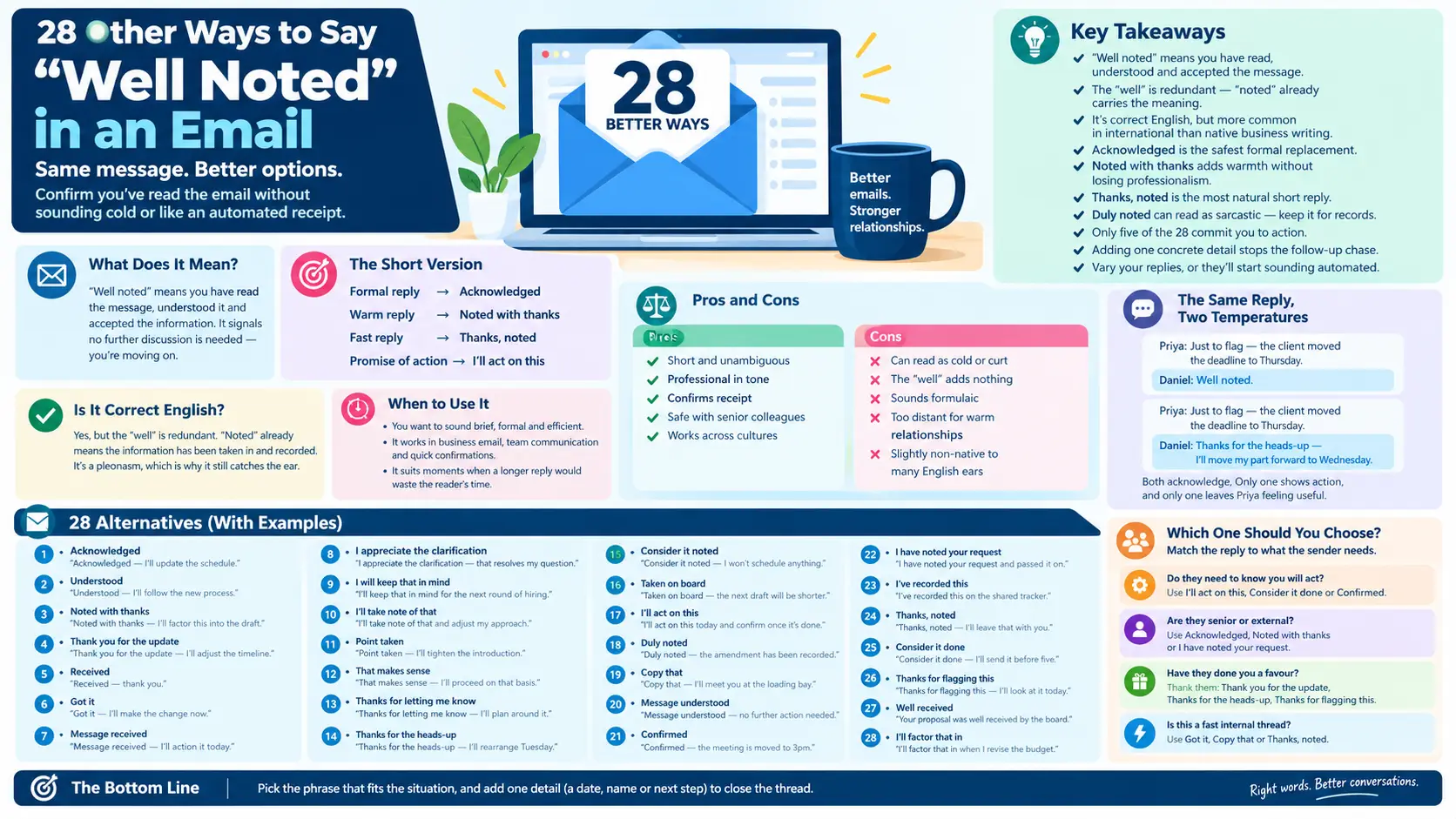
The best other ways to say well noted are “noted with thanks”, “understood”, “acknowledged” and simply “thanks, noted”. Each one confirms you have read the message without sounding like an automated receipt.
There is a reason people go looking for alternatives. “Well noted” is short, correct and slightly cold — and the “well” does no work at all. Below are 28 replacements, each with real examples, the reason it works, and the situations it fits.
What Does “Well Noted” Mean?
“Well noted” means you have read the message, understood it, and accepted the information. In email it signals that no further discussion is needed — you have taken it in and you are moving on.
It turns up most in workplace messages, formal replies and quick confirmations. It is grammatically fine. It can also read as stiff, clipped or faintly impatient, which is why so many people want something better.
⚡ The Short Version
Formal reply → “Acknowledged”. Warm reply → “Noted with thanks”. Fast reply → “Thanks, noted”. Promise of action → “I’ll act on this”.
Is “Well Noted” Correct English?
It is correct, and the “well” is redundant. “Noted” already means the information has been taken in and recorded. Adding “well” intensifies something that has no degrees — a point is either noted or it is not.
Linguists call that kind of redundancy a pleonasm, and English is full of them: free gift, safe haven, null and void. Most pass unnoticed because they have hardened into idiom. “Well noted” has not quite hardened, which is why it still catches the ear.
That redundancy is why the phrase sounds slightly off to many native readers, even though nobody can call it an error. It is far more common in international business English than in everyday British or American usage, where “Noted”, “Noted, thanks” or “Understood” do the same job with less ceremony.
If your reader is a global audience, the plain forms travel better. That is a register judgement rather than a grammar rule — the same kind of judgement that decides whether a casual abbreviation belongs in a client email at all.
When to Use Well Noted
Use it when you want to sound brief, formal and efficient. It works in business email, team communication and replies to instructions, where the message needs an acknowledgment and nothing more.
It suits the moment when a longer reply would waste the reader’s time. It also keeps you from sounding too casual with someone you barely know.
Pros and Cons of Well Noted
| Pros | Cons |
|---|---|
| Short and unambiguous | Can read as cold or curt |
| Professional in tone | The “well” adds nothing |
| Confirms receipt with no extra words | Sounds formulaic when repeated |
| Safe with senior colleagues | Too distant for warm working relationships |
| Works across cultures | Slightly non-native to many English ears |
Why We Use Well Noted in Emails
Because acknowledging a message is a real obligation, and most people want to discharge it in three words. Silence reads as rudeness or as a message lost, so something has to be sent.
Tone still matters, though. A slightly softer phrase builds goodwill, shows respect and makes the sender feel their message mattered. The difference between “Well noted” and “Noted with thanks — I’ll take it from here” costs four seconds and changes the whole temperature of a thread.
📧 The Same Reply, Two Temperatures
Priya: Just to flag — the client moved the deadline to Thursday.
Daniel: Well noted.
Priya: Just to flag — the client moved the deadline to Thursday.
Daniel: Thanks for the heads-up — I’ll move my part forward to Wednesday.
Both replies acknowledge. Only one tells Priya that anything will happen, and only one leaves her feeling useful for having written.
28 Other Ways to Say “Well Noted”
Each entry leads with real examples that actually use the phrase, then explains why it works and where it belongs. Pick by tone, by formality, and by how much you are willing to commit to.
1. Acknowledged
Confirms formally that the message arrived and was registered.
Examples:
- “Acknowledged — I’ll update the schedule this afternoon.”
- “Acknowledged, and the file is already with the finance team.”
- “Your request is acknowledged and logged under ticket 4412.”
Why it works: It is the closest one-word equivalent of “well noted” without the redundant intensifier, which is why it survives in formal threads where warmth is optional.
Tone: Professional, clear, direct | Formality: Formal
Best for: Task confirmations and status updates | Avoid in: Warm personal emails | Commits you to action: No
2. Understood
Confirms you grasped the content, not just that it arrived.
Examples:
- “Understood — I’ll follow the new process from Monday.”
- “Understood, and I’ll flag anything that looks off.”
- “That’s understood; no further clarification needed.”
Why it works: It answers the question the sender actually has after giving instructions: did this land? “Received” never answers that.
Tone: Calm, respectful, simple | Formality: Professional
Best for: Instructions and feedback | Avoid in: Emotional or sensitive messages | Commits you to action: No
3. Noted with thanks
Acknowledges and thanks in the same breath.
Examples:
- “Noted with thanks — I’ll factor this into the draft.”
- “Noted with thanks, and I’ll circulate the revised version.”
- “Your comments are noted with thanks.”
Why it works: The gratitude does the work “well” was failing to do, turning a cold confirmation into a courteous one at no extra length.
Tone: Polite, warm, professional | Formality: Professional
Best for: Client emails and team updates | Avoid in: Very casual chats | Commits you to action: No
4. Thank you for the update
Thanks the sender for new information.
Examples:
- “Thank you for the update — I’ll adjust the timeline.”
- “Thank you for the update; that changes my estimate slightly.”
- “Thank you for the update on the delivery date.”
Why it works: It rewards the person for bothering to tell you, which makes them likelier to keep you informed next time.
Tone: Warm, friendly, appreciative | Formality: Neutral
Best for: Progress reports and changes | Avoid in: Short urgent replies | Commits you to action: No
5. Received
States plainly that the item arrived.
Examples:
- “Received — thank you.”
- “Received, and I’ll review it before Thursday.”
- “All three documents received.”
Why it works: The shortest honest acknowledgment in business English. It promises nothing, which is sometimes exactly right.
Tone: Brief, neutral, efficient | Formality: Professional
Best for: Document and file confirmations | Avoid in: Friendly conversations | Commits you to action: No
6. Got it
Casual confirmation between people who know each other.
Examples:
- “Got it — I’ll make the change now.”
- “Got it, thanks for explaining.”
- “Got it. I’ll have the numbers over by lunch.”
Why it works: It sounds like a human being rather than a mail server, which is why it dominates internal chat.
Tone: Casual, friendly, easygoing | Formality: Casual
Best for: Team emails and internal chat | Avoid in: Client or executive email | Commits you to action: No
7. Message received
Neutral confirmation with a touch of formality.
Examples:
- “Message received — I’ll action it today.”
- “Message received, and I’ve forwarded it to procurement.”
- “Message received; no changes needed on my side.”
Why it works: Useful when you want to close a thread politely without inviting further discussion.
Tone: Professional, neutral | Formality: Professional
Best for: General acknowledgment | Avoid in: Personal messages | Commits you to action: No
8. I appreciate the clarification
Thanks someone for explaining something you queried.
Examples:
- “I appreciate the clarification — that resolves my question.”
- “I appreciate the clarification on the billing cycle.”
- “I appreciate the clarification; I’d misread the original brief.”
Why it works: It admits you needed the explanation, which costs nothing and makes the other person glad they gave it.
Tone: Thoughtful, courteous | Formality: Professional
Best for: After a correction or detailed answer | Avoid in: Fast back-and-forth threads | Commits you to action: No
9. I will keep that in mind
Stores the information for later rather than now.
Examples:
- “I will keep that in mind when I draft the proposal.”
- “I’ll keep that in mind for the next round of hiring.”
- “Noted — I’ll keep that in mind going forward.”
Why it works: It is honest about timing. You are not acting today, and saying so prevents the sender expecting movement.
Tone: Considerate, forward-looking | Formality: Neutral
Best for: Advice and future guidance | Avoid in: Urgent requests | Commits you to action: Implied
10. I’ll take note of that
A softer, less final version of “noted”.
Examples:
- “I’ll take note of that and adjust my approach.”
- “I’ll take note of that for the next review.”
- “Thanks — I’ll take note of that before we go live.”
Why it works: The verb phrase slows the sentence down, which reads as considered rather than clipped.
Tone: Gentle, attentive | Formality: Neutral
Best for: Feedback you intend to use | Avoid in: Formal legal correspondence | Commits you to action: Implied
11. Point taken
Accepts a fair criticism without argument.
Examples:
- “Point taken — I’ll tighten the introduction.”
- “Point taken, and I’ll be clearer in future updates.”
- “Fair point taken; I’ll rework that section.”
Why it works: It concedes gracefully. Nothing defuses a critical email faster than agreeing with it in two words.
Tone: Honest, a little informal | Formality: Casual
Best for: Accepting internal feedback | Avoid in: Client-facing replies | Commits you to action: Implied
12. That makes sense
Confirms the reasoning, not just the message.
Examples:
- “That makes sense — I’ll proceed on that basis.”
- “That makes sense, thanks for walking me through it.”
- “That makes sense now that I’ve seen the figures.”
Why it works: It tells the sender their explanation worked, which is more reassuring than a bare acknowledgment.
Tone: Conversational, warm | Formality: Neutral
Best for: After a decision or rationale | Avoid in: Formal records | Commits you to action: No
13. Thanks for letting me know
Warm acknowledgment with minimal formality.
Examples:
- “Thanks for letting me know — I’ll plan around it.”
- “Thanks for letting me know about the delay.”
- “Thanks for letting me know; I’ll tell the rest of the team.”
Why it works: The default polite reply in most workplaces. Impossible to misread and almost impossible to overuse.
Tone: Friendly, easy, human | Formality: Casual
Best for: Schedule changes and small updates | Avoid in: Formal reports | Commits you to action: No
14. Thanks for the heads-up
Thanks someone for advance warning.
Examples:
- “Thanks for the heads-up — I’ll rearrange Tuesday.”
- “Thanks for the heads-up on the system downtime.”
- “Appreciate the heads-up; I’ll brief the client before they call.”
Why it works: It specifically credits the timing of the warning, not just the information, which is what the sender went out of their way to give you.
Tone: Informal, appreciative | Formality: Casual
Best for: Advance notice between colleagues | Avoid in: External or formal email | Commits you to action: No
15. Consider it noted
Light, confident acknowledgment.
Examples:
- “Consider it noted — I won’t schedule anything that week.”
- “Consider it noted and added to the requirements list.”
- “Consider it noted; I’ll work around the constraint.”
Why it works: The imperative gives it a bit of personality, so it lands as friendly rather than procedural.
Tone: Confident, slightly playful | Formality: Neutral
Best for: Internal messages | Avoid in: Serious or formal matters | Commits you to action: Implied
16. Taken on board
Shows you have absorbed feedback, not merely received it.
Examples:
- “Taken on board — the next draft will be shorter.”
- “Your comments are taken on board and reflected in version three.”
- “All taken on board, thank you.”
Why it works: It implies the feedback changed something, which is what a reviewer actually wants to hear.
Tone: Receptive, professional | Formality: Professional
Best for: Substantive feedback you will act on | Avoid in: American audiences unfamiliar with it | Commits you to action: Implied
17. I’ll act on this
Promises movement rather than receipt.
Examples:
- “I’ll act on this today and confirm once it’s done.”
- “I’ll act on this before the end of the week.”
- “Understood — I’ll act on this straight away.”
Why it works: It converts an acknowledgment into a commitment, which closes the thread instead of inviting a chase.
Tone: Decisive, accountable | Formality: Professional
Best for: When the sender needs certainty | Avoid in: Anything you cannot deliver | Commits you to action: Yes
18. Duly noted
Formal, official acknowledgment for the record.
Examples:
- “Duly noted — the amendment has been recorded.”
- “Your objection is duly noted in the minutes.”
- “Duly noted, and the policy has been updated accordingly.”
Why it works: Correct and slightly archaic in writing. In speech it has drifted towards sarcasm, so the context has to carry it.
Tone: Formal, official | Formality: Formal
Best for: Minutes and formal records | Avoid in: Replies to a genuine concern | Commits you to action: No
19. Copy that
Crisp operational confirmation.
Examples:
- “Copy that — I’ll meet you at the loading bay.”
- “Copy that, moving to plan B.”
- “Copy that; I’ll hold until you confirm.”
Why it works: Borrowed from radio procedure, it confirms receipt in the fewest possible syllables under time pressure.
Tone: Brisk, informal, radio-style | Formality: Casual
Best for: Fast operational exchanges | Avoid in: Clients and formal email | Commits you to action: Implied
20. Message understood
Formal confirmation of comprehension.
Examples:
- “Message understood — no further action needed from you.”
- “Message understood, and the instruction has been passed on.”
- “Message understood; I’ll confirm once it’s complete.”
Why it works: Separates comprehension from receipt explicitly, which matters when a misunderstanding would be costly.
Tone: Formal, precise | Formality: Formal
Best for: Instructions where accuracy is critical | Avoid in: Casual conversation | Commits you to action: No
21. Confirmed
Verifies a fact, time or figure.
Examples:
- “Confirmed — the meeting is moved to 3pm.”
- “Confirmed, and the booking reference is attached.”
- “Receipt confirmed; thank you.”
Why it works: It does something no other phrase here does: it verifies a specific detail, so the sender can stop worrying about it.
Tone: Crisp, transactional | Formality: Professional
Best for: Bookings, times and figures | Avoid in: Open-ended discussions | Commits you to action: Yes
22. I have noted your request
Formal reply naming what you received.
Examples:
- “I have noted your request and passed it to the relevant team.”
- “I have noted your request for an extension.”
- “Your request has been noted and will be reviewed this week.”
Why it works: Repeating what was asked proves you read it, which is the whole point in customer-facing replies.
Tone: Formal, service-oriented | Formality: Formal
Best for: Customer service, HR, official replies | Avoid in: Quick internal chat | Commits you to action: Implied
23. I’ve recorded this
States the information went into a system or file.
Examples:
- “I’ve recorded this on the shared tracker.”
- “I’ve recorded this against your account.”
- “Thank you — I’ve recorded this in the project log.”
Why it works: It names where the information now lives, which is far more reassuring than a vague promise to remember.
Tone: Administrative, precise | Formality: Formal
Best for: When a genuine record exists | Avoid in: When nothing was actually recorded | Commits you to action: Yes
24. Thanks, noted
The shortest polite option available.
Examples:
- “Thanks, noted — I’ll leave that with you.”
- “Thanks, noted. I’ll come back to you tomorrow.”
- “Thanks, noted — nothing further from me.”
Why it works: Two words, and the comma does all the softening that “well” fails to do. The most natural everyday replacement.
Tone: Brief, polite, natural | Formality: Neutral
Best for: Everyday professional email | Avoid in: Long or serious messages | Commits you to action: No
25. Consider it done
Commits to the action, not the message.
Examples:
- “Consider it done — I’ll send it before five.”
- “Consider it done; the invoice is already raised.”
- “Consider it done, and I’ll copy you on the confirmation.”
Why it works: The strongest promise on this list, and the easiest to regret. Only use it when the task is small and certain.
Tone: Confident, willing | Formality: Neutral
Best for: Small, certain tasks | Avoid in: Anything uncertain or complex | Commits you to action: Yes
26. Thanks for flagging this
Thanks someone for spotting a problem or risk.
Examples:
- “Thanks for flagging this — I’ll look at it this morning.”
- “Thanks for flagging this; I’ve raised it with the supplier.”
- “Good spot, and thanks for flagging this before it went out.”
Why it works: It treats the warning as a favour rather than a complaint, which keeps people willing to raise problems early.
Tone: Appreciative, collaborative | Formality: Professional
Best for: Errors and risks a colleague spotted | Avoid in: Routine information | Commits you to action: Implied
27. Well received
The formal cousin of “well noted”, for things of substance.
Examples:
- “Your proposal was well received by the board.”
- “The documents were well received — thank you for sending them.”
- “Well received, and I’ll respond in detail on Friday.”
Why it works: Here “well” earns its place: it says the thing was received and regarded positively, which “noted” cannot carry.
Tone: Formal, warmer than “well noted” | Formality: Formal
Best for: Documents, proposals and submissions | Avoid in: Quick factual updates | Commits you to action: No
28. I’ll factor that in
Says the information will change work already underway.
Examples:
- “I’ll factor that in when I revise the budget.”
- “Understood — I’ll factor that in before the next draft.”
- “Thanks; I’ll factor that in and send you the updated version.”
Why it works: It names the consequence of the message, which is the most useful thing an acknowledgment can do.
Tone: Practical, work-focused | Formality: Professional
Best for: Constraints affecting a live task | Avoid in: Information with no bearing on your work | Commits you to action: Yes
Detailed Comparison Table
All 28 alternatives, scored on formality, tone, where they belong, where they do not, and whether they commit you to doing something. That last column is the one most people get wrong.
| Phrase | Formality | Tone | Best for | Avoid in | Commits to action? |
|---|---|---|---|---|---|
| Acknowledged | Formal | Professional, clear, direct | Task confirmations and status updates | Warm personal emails | No |
| Understood | Professional | Calm, respectful, simple | Instructions and feedback | Emotional or sensitive messages | No |
| Noted with thanks | Professional | Polite, warm, professional | Client emails and team updates | Very casual chats | No |
| Thank you for the update | Neutral | Warm, friendly, appreciative | Progress reports and changes | Short urgent replies | No |
| Received | Professional | Brief, neutral, efficient | Document and file confirmations | Friendly conversations | No |
| Got it | Casual | Casual, friendly, easygoing | Team emails and internal chat | Client or executive email | No |
| Message received | Professional | Professional, neutral | General acknowledgment | Personal messages | No |
| I appreciate the clarification | Professional | Thoughtful, courteous | After a correction or detailed answer | Fast back-and-forth threads | No |
| I will keep that in mind | Neutral | Considerate, forward-looking | Advice and future guidance | Urgent requests | Implied |
| I’ll take note of that | Neutral | Gentle, attentive | Feedback you intend to use | Formal legal correspondence | Implied |
| Point taken | Casual | Honest, a little informal | Accepting internal feedback | Client-facing replies | Implied |
| That makes sense | Neutral | Conversational, warm | After a decision or rationale | Formal records | No |
| Thanks for letting me know | Casual | Friendly, easy, human | Schedule changes and small updates | Formal reports | No |
| Thanks for the heads-up | Casual | Informal, appreciative | Advance notice between colleagues | External or formal email | No |
| Consider it noted | Neutral | Confident, slightly playful | Internal messages | Serious or formal matters | Implied |
| Taken on board | Professional | Receptive, professional | Substantive feedback you will act on | American audiences unfamiliar with it | Implied |
| I’ll act on this | Professional | Decisive, accountable | When the sender needs certainty | Anything you cannot deliver | Yes |
| Duly noted | Formal | Formal, official | Minutes and formal records | Replies to a genuine concern | No |
| Copy that | Casual | Brisk, informal, radio-style | Fast operational exchanges | Clients and formal email | Implied |
| Message understood | Formal | Formal, precise | Instructions where accuracy is critical | Casual conversation | No |
| Confirmed | Professional | Crisp, transactional | Bookings, times and figures | Open-ended discussions | Yes |
| I have noted your request | Formal | Formal, service-oriented | Customer service, HR, official replies | Quick internal chat | Implied |
| I’ve recorded this | Formal | Administrative, precise | When a genuine record exists | When nothing was actually recorded | Yes |
| Thanks, noted | Neutral | Brief, polite, natural | Everyday professional email | Long or serious messages | No |
| Consider it done | Neutral | Confident, willing | Small, certain tasks | Anything uncertain or complex | Yes |
| Thanks for flagging this | Professional | Appreciative, collaborative | Errors and risks a colleague spotted | Routine information | Implied |
| Well received | Formal | Formal, warmer than “well noted” | Documents, proposals and submissions | Quick factual updates | No |
| I’ll factor that in | Professional | Practical, work-focused | Constraints affecting a live task | Information with no bearing on your work | Yes |
Five phrases on that list commit you to something: I’ll act on this, Confirmed, I’ve recorded this, Consider it done and I’ll factor that in. Send one of those and the sender stops chasing. Send any of the other twenty-three and they may well write again.
Which One Should You Choose?
Match the reply to what the sender actually needs from you. Four questions settle it.
Do They Need to Know You Will Act?
Then use I’ll act on this, Consider it done or Confirmed. Pure acknowledgment leaves them wondering.
Are They Senior or External?
Then use Acknowledged, Noted with thanks or I have noted your request.
Have They Done You a Favour?
Then thank them: Thank you for the update, Thanks for the heads-up, Thanks for flagging this.
Is This a Fast Internal Thread?
Then Got it, Copy that or Thanks, noted will do, and anything longer slows everyone down.
⚠️ Three Phrases to Handle Carefully
“Duly noted”
In writing it is formal and correct. In speech, and increasingly in email, it carries a sarcastic edge — the sense of I have heard you and I am ignoring you. Use it for minutes and records; avoid it when someone has raised a genuine concern.
“Copy that”
It comes from radio procedure and keeps a military flavour. Excellent between colleagues under time pressure, odd in a message to a client who has just sent a contract.
“Consider it done”
Only use it when the thing is genuinely simple and genuinely going to happen. Promising completion and then missing it does more damage than a plain “noted” ever would.
Formal to Casual: The Full Scale
| Register | Phrases | Send to |
|---|---|---|
| Most formal | I have noted your request, Duly noted, Message understood, Well received, I’ve recorded this | Clients, legal, HR, official records |
| Professional | Acknowledged, Received, Confirmed, Understood, Taken on board, I’ll act on this, I’ll factor that in | Managers, external contacts |
| Warm professional | Noted with thanks, Thank you for the update, I appreciate the clarification, Thanks for flagging this | Colleagues and clients you know |
| Everyday | Thanks, noted, That makes sense, Consider it noted, Consider it done, I’ll take note of that, I will keep that in mind | Your team |
| Casual | Got it, Copy that, Point taken, Thanks for the heads-up, Thanks for letting me know | Close colleagues |
What to Avoid When Acknowledging an Email
- ❌ Replying with one word to a long, careful message. The effort mismatch reads as dismissal.
- ❌ Using the same phrase every time. Three “Noted” replies in one thread sound automated.
- ❌ Acknowledging without answering the actual question. “Noted” is not a reply to “which option do you prefer?”
- ❌ Promising action you have not scheduled.
- ✅ Adding one concrete detail. “Noted — I’ll have it Thursday” ends the thread; “Noted” invites a follow-up chase.
Does the Phrase You Choose Actually Matter?
Yes, because acknowledgment is where most working relationships are quietly built or damaged. Nobody remembers a well-written project plan. People do remember being left on read for two days, or being answered with one cold word after sending something they worked on.
Warmth in a three-word reply is not decoration. It is the cheapest signal available that you value the person writing to you — and it reads as genuine only when it matches how you actually behave afterwards, which is the real difference between sounding sincere and being sincere.
Key Points to Remember
- “Well noted” means you have read, understood and accepted the message.
- The “well” is redundant — “noted” already carries the meaning.
- It is correct English, and more common in international than native business writing.
- Acknowledged is the safest formal replacement.
- Noted with thanks adds warmth without losing professionalism.
- Thanks, noted is the most natural short reply.
- Duly noted can read as sarcastic — keep it for records.
- Only five of the 28 commit you to action — choose deliberately.
- Adding one concrete detail stops the follow-up chase.
- Vary the phrase, or your replies start sounding automated.
The Bottom Line
Looking for other ways to say well noted usually means the phrase has started to feel cold in your own outbox — and that instinct is correct. It confirms receipt and communicates nothing else.
Pick by what the sender needs: Acknowledged for formality, Noted with thanks for warmth, Thanks, noted for speed, and I’ll act on this when something genuinely has to happen. Then add the one detail that makes the reply worth opening — a date, a name, a next step. A confirmation that answers the next question before it is asked is worth more than any polished phrase, in exactly the way a proper reply to an invitation is worth more than a vague maybe.
Frequently Asked Questions
What does “well noted” mean in email communication?
It means you have read the message, understood it and accepted the information. It signals that no further discussion is needed, which is why it suits confirmations and replies to instructions.
Is “well noted” rude?
Not rude, but cold. It confirms receipt and gives the sender nothing else, so in a warm working relationship it can read as curt. Adding thanks or one concrete detail fixes it instantly.
Why should I avoid using “well noted” too often?
Repeating the same three words makes your replies sound automated. Varying the phrasing keeps your email sounding like a person rather than a receipt.
What are better alternatives to “well noted”?
“Acknowledged” for formal replies, “Noted with thanks” for warmth, “Thanks, noted” for speed, “Understood” for instructions, and “I’ll act on this” when you are committing to do something.
Is “well noted” grammatically correct?
Yes, though the “well” is redundant because “noted” already means the information has been taken in. Linguists call that a pleonasm, and the doubled form is more common in international business English than in everyday native usage.
Is “duly noted” the same as “well noted”?
They mean the same thing, and “duly noted” is more formal and carries a sarcastic edge in casual use. Keep it for minutes, records and formal correspondence rather than replies to a colleague’s concern.
How can I sound more professional in emails?
Match the register to the reader, acknowledge what the person actually sent rather than sending a stock phrase, and include one concrete detail such as a date or a next step so the thread can close.
What is the shortest polite way to acknowledge an email?
“Thanks, noted.” Two words, warm enough for almost any professional context, and more natural to most English readers than “well noted”.