28 Other Ways to Say “I Wish You the Best Professionally” (With Examples)
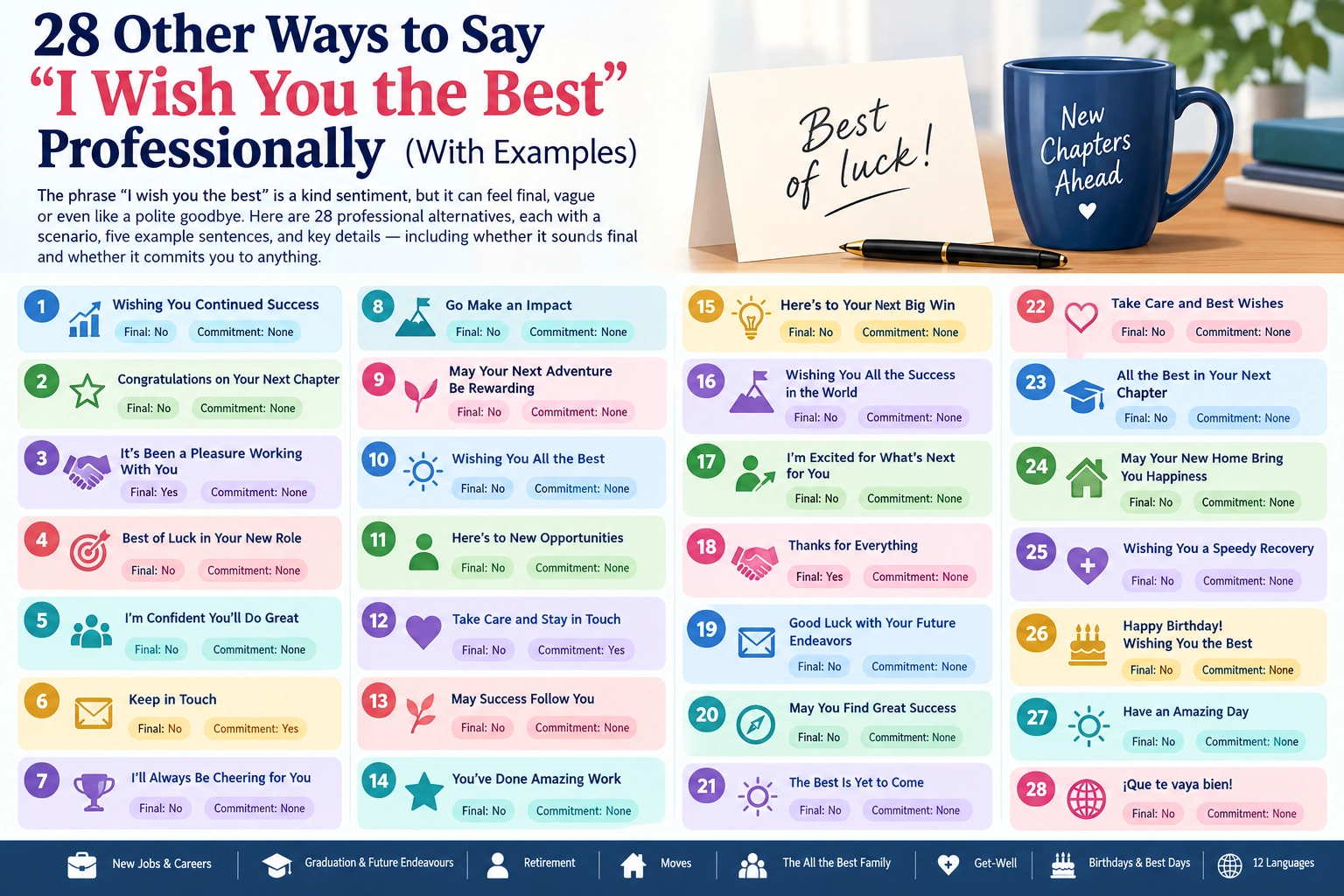
Looking for Other Ways to Say I Wish You the Best Professionally? Here are 28 alternatives, each with a scenario, five example sentences that contain the phrase, the tone it carries, and the two columns no other list on this subject includes — whether the phrase sounds final, and whether it commits you to anything.
Those two columns matter more here than in any other phrase of this kind. I wish you the best is not a neutral good wish in English: it is a closing move, and depending on where it lands it reads as a warm send-off, a polite full stop or the sentence somebody uses when they have decided not to see you again.
The grammar explains the finality. A valediction — from the Latin vale dicere, to say farewell — is a parting phrase or, in American English, a complimentary close: an expression used to say farewell, especially a word or phrase that ends a letter or a message, or a speech made at a farewell. Its counterpart is the greeting, called a salutation. I wish you the best belongs to that class, which is why it closes a conversation whether or not you meant it to.
Parting phrases are also culturally specific, and most of the great ones are religious in origin. Goodbye is a contraction of God be by ye; as-salamu alaykum, peace be upon you, is used among Muslims and Arabs; Khuda Hafiz, God protect you, among Iranians and South Asian Muslims; namaste is of Indian origin; and shalom, peace, serves Jewish speakers as both greeting and farewell. English’s own literary version is Godspeed, a univerbation of God speed, elliptical for God speed you, where speed carries the archaic sense help, further, cause to prosper — from the Old English spēd, success. It is used particularly at a moment of departure, to convey a wish that somebody’s forthcoming actions yield favourable outcomes, and its listed synonyms are exactly the phrases this article is about: all the best, fare thee well, farewell, goodbye, good luck.
In writing, the professional register has a rule the lists never mention. In British English, valedictions have largely been replaced by Yours sincerely and Yours faithfully — sincerely when the recipient is addressed by name, faithfully when they are not. Best wishes sits below both and is defined simply as a polite way to end a letter or see somebody off, which is why it is the safest sign-off in ordinary business email and the wrong one for a formal letter to an institution.
And there is one phrase in this family that has become a corporate euphemism so thoroughly that it is now a verb. To future endeavor is professional wrestling slang meaning to release a wrestler from their contract, and it comes from the fact that the wrestling promotion WWE, when announcing a wrestler’s release, wishes them all the best in their future endeavors. That is the most useful warning on this page: we wish you the best in your future endeavors is the standard wording of rejection letters, redundancy notices and quiet dismissals, so to a great many readers the phrase now means you are leaving and we are not sorry.
Which sets the honest frame for the twenty-eight alternatives below. A good professional wish does one of three things the stock phrase cannot: it names something specific the person did, it makes a concrete offer such as a reference or an introduction, or it says plainly whether the relationship continues. Everything else is decoration — and the comparison table marks which entries sound final, which carry a commitment, and which merely sound pleasant. The general-purpose version of this phrase, outside work, is covered in I wish you the best.
28 Other Ways to Say “I Wish You the Best Professionally”
Every entry has a scenario, five example sentences containing the phrase, and an attribute line ending in whether it sounds final and what it commits you to.
This is the list in full, and it also answers other ways to say i wish you the best, other ways to say i wish u the best, another way to say i wish you the best, alternative ways to say i wish you the best, alternative to i wish you the best, wish you the best alternatives, other phrases for wish you the best, what are other ways to say i wish you the best, what is another way to say i wish you the best, what to say instead of i wish you the best, better ways to say i wish you the best, how to say i wish you the best in another way, how to say i wish you the best professionally, professional way to say i wish you the best and poetic way to say i wish you the best — with dedicated sections below for new jobs, graduation and future endeavours, retirement, moves, the all the best family, get-well wording, birthdays and best-day messages, and twelve languages.
1. Wishing You Continued Success
The safest professional upgrade: it credits the past as well as the future.
Scenario: A coworker receives a promotion.
Examples:
- Congratulations on the promotion — wishing you continued success in the new role.
- Wishing you continued success; the Hartley account was yours from start to finish.
- Wishing you continued success as you take on the northern region.
- Wishing you continued success, and do call if you ever want a second opinion on a tender.
- Wishing you continued success — I will be watching the team’s numbers with interest.
Why it works: Continued is the whole value of the phrase: it presupposes success that has already happened, so the sentence contains a compliment as well as a wish. That makes it the correct wording for a promotion, where good luck would imply the person needs it. It is also the one entry in the standard list that does not sound like a goodbye, because the success it names is ongoing rather than ahead. Add the specific achievement, as example two does, and it stops being a formula.
Tone: professional, encouraging | Formality: formal to neutral | Best for: promotions, career milestones, achievements | Avoid in: casual chats, first jobs where there is no past success to continue | Sounds final: no | Commitment it carries: none, unless you add one
2. Best Wishes for Your Career Journey
Warm, forward-looking, and the phrase to use when somebody is changing direction rather than climbing.
Scenario: Someone starts a new job.
Examples:
- Best wishes for your career journey — the agency is lucky to have you.
- Best wishes for your career journey, and congratulations on getting there so quickly.
- Best wishes for your career journey; I hope the new commute is kinder than this one.
- Best wishes for your career journey, and my number has not changed.
- Best wishes for your career journey in what sounds like a much better fit.
Why it works: Journey frames a career as a sequence rather than a ladder, which is why it suits a sideways move, a return to study or a change of industry where success would be the wrong measure. Best wishes is defined in the dictionary as a polite way to end a letter or see somebody off, so this is squarely a send-off phrase. Example four is the one that matters, because saying your number has not changed turns a farewell into a maintained relationship. The first-day equivalent is in I am excited to join the team.
Tone: warm, supportive | Formality: neutral | Best for: new jobs, career changes, people leaving well | Avoid in: urgent messages, mid-project notes | Sounds final: yes, mildly | Commitment it carries: yes, with example four
3. May Your Career Thrive
The optative mood, which is what makes it sound like a blessing rather than a pleasantry.
Scenario: A colleague launches a new business.
Examples:
- May your career thrive — and may the first invoice be paid on time.
- May your career thrive now you are finally working for yourself.
- May your career thrive; you have taken the risk the rest of us talk about.
- May your career thrive, and send me the website when it is live.
- May your career thrive in a market that plainly needs you.
Why it works: May plus a verb is the English optative, the construction behind may you live long and may it please the court, and restoring it raises the register noticeably. That makes it the best answer to poetic way to say i wish you the best, and the right form for a toast, a card or a speech. In an ordinary email it is a degree too grand, and from a manager to a junior colleague it can read as theatrical rather than warm. Example four is the practical version: a request for the website is a small act of support.
Tone: inspirational | Formality: formal | Best for: new ventures, entrepreneurship, speeches, cards | Avoid in: formal reports, routine email | Sounds final: no | Commitment it carries: none
4. Wishing You Great Success Ahead
Plain, positive and entirely safe — which also makes it the most forgettable of the first ten.
Scenario: A friend changes careers.
Examples:
- Wishing you great success ahead in a field that suits you far better.
- Wishing you great success ahead — the retraining took real nerve.
- Wishing you great success ahead, and let me know when you are taking clients.
- Wishing you great success ahead; I will pass your name to anybody who asks.
- Wishing you great success ahead, and thank you for the handover notes.
Why it works: It is unobjectionable in every direction — upward, downward, internal, external — and that universality is its only real property. The weakness is that ahead places all the value in the future and credits nothing already done, which is why entry 1 outperforms it with anybody who has achieved something. Examples three and four repair it the only way this phrase allows, by attaching an offer: clients sent, a name passed on.
Tone: positive, motivating | Formality: neutral | Best for: career changes, transitions, general goodwill | Avoid in: technical writing, where it is filler | Sounds final: yes, mildly | Commitment it carries: yes, with an offer attached
5. I Know You’ll Do Amazing Things
Confidence rather than a wish, which is a different and stronger gift.
Scenario: A talented employee leaves for another company.
Examples:
- I know you’ll do amazing things — I have watched you rescue two projects nobody else would touch.
- I know you’ll do amazing things there, and they are getting a bargain.
- I know you’ll do amazing things; put me down as a reference any time.
- I know you’ll do amazing things, and I will say so to anybody who asks.
- I know you’ll do amazing things — keep me posted, genuinely.
Why it works: A wish asks the universe for something; a statement of belief reports evidence. That is why I know lands harder than I hope, and why it is the correct phrasing from a manager or a mentor — their confidence is worth something in a way that their good wishes are not. It needs the evidence attached to be believed, as example one shows. And it is the only entry in the first nine that naturally carries an offer of a reference, which is the most valuable thing you are able to give a departing colleague. The appraisal register beside it is in A great asset to the team.
Tone: personal, encouraging | Formality: neutral | Best for: close colleagues, mentees, departures you are sorry about | Avoid in: formal letters, references to somebody you barely know | Sounds final: no | Commitment it carries: yes — a reference, in examples three and four
6. Here’s to Your Future Success
Toast grammar, which is why it belongs in a room rather than an inbox.
Scenario: A farewell gathering.
Examples:
- Here’s to your future success — eleven years, and the place will not be the same.
- Here’s to your future success, and to whoever has to fill your diary.
- Here’s to your future success; the training programme was entirely your idea.
- Here’s to your future success, and to the pub on Fridays, which continues.
- Here’s to your future success — raise a glass, everybody.
Why it works: Here is to is the grammar of a toast, so it assumes an audience and a glass, and in writing it reads as a speech transcribed. Spoken at a leaving party it is close to perfect, because a toast credits the person in front of the group, which is a public act rather than a private courtesy. Name the achievement in the toast, as example three does, and it becomes the sentence people repeat afterwards.
Tone: friendly, celebratory | Formality: neutral | Best for: farewell events, speeches, leaving cards | Avoid in: serious business documents, written notices | Sounds final: yes — it is a send-off | Commitment it carries: none, unless you keep the Friday pub
7. Best of Luck in Your New Role
The everyday workplace standard, and the only entry that mentions luck.
Scenario: A coworker starts a new position.
Examples:
- Best of luck in your new role — the first ninety days are the hardest.
- Best of luck in your new role, and shout if you want a sounding board.
- Best of luck in your new role; the handover is in the shared folder and it is thorough.
- Best of luck in your new role, and congratulations again on a very good appointment.
- Best of luck in your new role — you are going to be very good at it.
Why it works: It is short, warm and unmistakably ordinary, which is exactly right for a colleague you like and do not know well. The one caution is the word itself: luck implies chance, so to somebody who has worked hard for a promotion it can faintly suggest the appointment was fortunate — which is why entry 1 or entry 5 is better for a hard-won step up. For other ways to say i wish you the best of luck, the stronger forms replace luck with belief: you are ready for this, they have made a good decision, I have no doubt.
Tone: friendly, professional | Formality: neutral | Best for: new positions, internal moves, job changes | Avoid in: executive reports, formal letters | Sounds final: no | Commitment it carries: yes, with example two
8. Wishing You All the Success You Deserve
It makes a judgement as well as a wish, and that judgement is the compliment.
Scenario: Recognising hard work.
Examples:
- Wishing you all the success you deserve — nobody worked harder on the merger.
- Wishing you all the success you deserve after three years of carrying that team.
- Wishing you all the success you deserve, and I have said as much to the board.
- Wishing you all the success you deserve; the recognition was overdue.
- Wishing you all the success you deserve, and thank you for everything you taught me.
Why it works: You deserve asserts that the person has earned something, so the sentence is partly an argument on their behalf. That makes it the right wording when somebody has been overlooked, and the wrong wording when they have just been handed something easily — where it sounds like faint praise of the wrong thing. Example three is the strongest version in this whole stretch of the list, because telling somebody you have advocated for them upward is worth more than any adjective. The ongoing version is in Keep up the good work.
Tone: appreciative | Formality: neutral to formal | Best for: recognition, overdue promotions, long service | Avoid in: formal contracts, routine notices | Sounds final: no | Commitment it carries: yes — advocacy, in example three
9. May You Reach New Heights
Grand, metaphorical and best kept for an audience.
Scenario: Career advancement.
Examples:
- May you reach new heights — the directorship is only the start of it.
- May you reach new heights, and remember who taught you the pricing model.
- May you reach new heights in a role that finally matches the work.
- May you reach new heights; the whole department is pleased for you.
- May you reach new heights, and keep the door open behind you.
Why it works: The height metaphor is doing the work, so it suits a vertical move — a promotion, a directorship, a leadership appointment — and sits oddly on a sideways one. Like entry 3 it is optative and therefore ceremonial, which makes it excellent in a speech, a card or a LinkedIn post and slightly much in an email. Example five is the one worth borrowing: asking somebody to keep the door open behind them is both a compliment and a quiet request.
Tone: inspirational | Formality: formal | Best for: promotions, leadership roles, speeches, cards | Avoid in: technical or routine correspondence | Sounds final: no | Commitment it carries: none
10. Wishing You a Bright Professional Future
Written for somebody at the beginning, where there is no track record to praise yet.
Scenario: Graduation or a first job.
Examples:
- Wishing you a bright professional future — congratulations on the degree.
- Wishing you a bright professional future, and well done on landing the graduate scheme.
- Wishing you a bright professional future; your dissertation was the best I read this year.
- Wishing you a bright professional future, and do keep in touch as you settle in.
- Wishing you a bright professional future — and my inbox is open if you want advice on the first year.
Why it works: Bright future is the right register for a person whose career is still potential rather than record, which is why it belongs on graduation cards and at the bottom of reference letters. To somebody twenty years in it is condescending, because it implies their future is still the interesting part. Example five contains the single most useful offer you can make to a graduate, and it costs nothing.
Tone: optimistic | Formality: formal to neutral | Best for: graduations, first jobs, apprenticeships, references | Avoid in: messages to senior or long-serving colleagues | Sounds final: no | Commitment it carries: yes, with the open inbox
11. Good Luck With Your Next Adventure
The friendliest entry on the list, and the one that assumes the move was chosen.
Scenario: A career move.
Examples:
- Good luck with your next adventure — Lisbon will suit you.
- Good luck with your next adventure, and tell us how the freelance life compares.
- Good luck with your next adventure; the leaving card is being passed round the floor.
- Good luck with your next adventure, and the team WhatsApp group is not letting you go.
- Good luck with your next adventure — brave, and about time.
Why it works: Adventure frames the change as exciting rather than risky, which is warm and informal and exactly what a friendly workplace goodbye should be. The one place it fails badly is a departure that was not voluntary: calling redundancy an adventure reads as mockery, so for anybody who has been let go, use entry 19 or entry 26 instead. Example four is the version that keeps a friendship, because naming a group chat is a concrete form of continued contact. The travel version is in Safe travels.
Tone: casual, supportive | Formality: informal | Best for: friendly workplace relationships, voluntary moves, relocations | Avoid in: redundancies, dismissals, formal letters | Sounds final: yes, mildly | Commitment it carries: yes, with example four
12. May Your Hard Work Pay Off
It names the effort rather than the outcome, which is why it suits the end of something difficult.
Scenario: Completing a major project.
Examples:
- May your hard work pay off — eighteen months is a long time to hold a project together.
- May your hard work pay off; I know what the last fortnight cost you.
- May your hard work pay off, and I have put the detail in writing to the partners.
- May your hard work pay off in the appraisal, where it belongs.
- May your hard work pay off — and take the leave you are owed first.
Why it works: Effort is the one thing a colleague can genuinely vouch for, so a wish attached to it reads as witnessed rather than polite. It also carries an honest implication the other entries avoid: that the payment has not arrived yet — which is why it is the right phrase after an unrecognised slog and the wrong one after a public win. Examples three and four turn the wish into action, since putting effort on the record is what makes it pay off at all.
Tone: encouraging | Formality: neutral | Best for: after hard projects, unrecognised effort, appraisal season | Avoid in: celebrations of a clear success, where it undersells the result | Sounds final: no | Commitment it carries: yes — a written record, in example three
13. Wishing You Growth and Success
Two nouns where one would do, which is what makes it sound like a corporate card.
Scenario: A new opportunity.
Examples:
- Wishing you growth and success in the new division.
- Wishing you growth and success — the secondment is a genuine opportunity.
- Wishing you growth and success, and the training budget conversation is worth having early.
- Wishing you growth and success; you have outgrown this role twice already.
- Wishing you growth and success, and I will make the introduction to Priya this week.
Why it works: Growth is the vocabulary of development rather than achievement, so it suits a step taken for learning — a secondment, a lateral move, a stretch assignment. The doubling is the problem: two abstract nouns in a row read as decoration, and most readers process the phrase as a greeting card. Example five is the fix and the lesson: a named introduction is worth more than both nouns combined. The incoming-colleague version is in I look forward to working with you.
Tone: positive | Formality: neutral to formal | Best for: secondments, development moves, internal transfers | Avoid in: personal messages, where it is cold | Sounds final: no | Commitment it carries: yes — an introduction, in example five
14. I Hope Your Career Flourishes
The most literary of the sincere entries, and it makes a career sound like something grown rather than built.
Scenario: A new business launch.
Examples:
- I hope your career flourishes — the studio looks wonderful in the photographs.
- I hope your career flourishes now you are the one choosing the work.
- I hope your career flourishes; the first two clients came from this office, which says something.
- I hope your career flourishes, and I will send anybody who needs that service straight to you.
- I hope your career flourishes, and I expect to be reading about it.
Why it works: Flourish is agricultural in origin and carries the sense of something thriving in good conditions, which is a gentler and more generous image than succeed. That makes it the right verb for creative and independent work, where success is uneven and growth is the honest measure. Example four is the one that counts for a new business, because promised referrals are the only wish that converts into revenue.
Tone: sincere | Formality: neutral to formal | Best for: new ventures, creative work, freelancers | Avoid in: brisk internal notes | Sounds final: no | Commitment it carries: yes — referrals, in example four
15. May You Achieve All Your Goals
It wishes on somebody’s own stated targets, which is more respectful than wishing on yours.
Scenario: A goal-setting conversation.
Examples:
- May you achieve all your goals — and the chartered qualification is the one to start with.
- May you achieve all your goals this year, and the first review is in April if you want it earlier.
- May you achieve all your goals; three of the five are within reach already.
- May you achieve all your goals, and I will hold the budget for the course.
- May you achieve all your goals, including the one you have not told anybody about.
Why it works: Wishing somebody well on their own objectives rather than yours is a small act of respect, and in an appraisal or a planning conversation it lands as support rather than pressure. The phrasing is empty without the goals named, though — which is why four of the five examples name one. Example four is the version that managers should use: a wish with a budget attached is a plan.
Tone: motivational | Formality: neutral | Best for: appraisals, planning conversations, coaching, mentoring | Avoid in: farewells, where goals are no longer your business | Sounds final: no | Commitment it carries: yes — a budget or a review date
16. Wishing You Prosperity and Success
Formal to the point of ceremony, and the right register for ending a commercial relationship well.
Scenario: A business partnership ending.
Examples:
- Wishing you prosperity and success — six years of good business between us.
- Wishing you prosperity and success, and the final accounts will be with you on Friday.
- Wishing you prosperity and success; the door remains open on our side.
- Wishing you prosperity and success in the next phase of the company.
- Wishing you prosperity and success, and thank you for a partnership that never needed a lawyer.
Why it works: Prosperity is commercial rather than personal, which is why it fits a company and not a colleague, and the formality signals that the ending is being handled properly. It is the standard register in international business correspondence, and in East Asian and Middle Eastern business writing a wish for prosperity is close to obligatory. Examples three and five are the ones that keep a door open, which is the entire purpose of a dignified ending.
Tone: formal, supportive | Formality: very formal | Best for: partnerships ending, supplier changes, formal letters, international correspondence | Avoid in: casual messages, where it sounds pompous | Sounds final: yes — and that is appropriate here | Commitment it carries: yes, with an open door
17. Best Wishes in Your Future Endeavors
The most-used phrase in this family, and the one with a problem nobody warns you about.
Scenario: An employee departure.
Examples:
- Best wishes in your future endeavours — and specifically, best wishes with the move to Edinburgh.
- Best wishes in your future endeavours; you leave the archive in better order than you found it.
- Best wishes in your future endeavours, and I am happy to act as a reference at any point.
- Best wishes in your future endeavours, and the Thursday lunch invitation stands.
- Best wishes in your future endeavours — and I mean that in the ordinary sense, not the corporate one.
Why it works — and when it does not: As a sentence it is impeccably professional, which is why it appears in every leaving email ever sent. The difficulty is what it has come to signal: we wish you the best in your future endeavors is the standard wording of rejection letters, redundancy notices and quiet dismissals, and the association is now so strong that English has made a verb of it. To future endeavor is professional-wrestling slang meaning to release a wrestler from their contract, from the wrestling promotion WWE’s habit of wishing released wrestlers all the best in their future endeavors. So the phrase alone reads as a form letter — and the repair is always the same: name a specific endeavour, as example one does, or attach a reference, as example three does.
Tone: professional | Formality: formal | Best for: formal goodbyes, references, HR correspondence | Avoid in: warm personal farewells, and anywhere it will be read as a form letter | Sounds final: yes — emphatically | Commitment it carries: none by itself
18. I’m Excited to See Your Success
It promises to keep watching, which quietly says the relationship continues.
Scenario: A mentoring relationship.
Examples:
- I’m excited to see your success — send me the first annual report.
- I’m excited to see your success, and I will be at the launch if you will have me.
- I’m excited to see your success; four years ago you would not present to six people.
- I’m excited to see your success, and I am still only an email away.
- I’m excited to see your success — and I expect to be asked for advice far less often now.
Why it works: Every other entry in this stretch of the list wishes something and then ends; this one implies a future in which you are present to see it. That makes it the strongest mentoring phrase available, because continued interest is the thing a mentee actually wants. Example three is the version that will be remembered, since naming how far somebody has come is a more precise compliment than any adjective. Keep it for people you genuinely intend to follow, because the promise is checkable.
Tone: personal, enthusiastic | Formality: neutral | Best for: mentoring, long-standing colleagues, people you have trained | Avoid in: formal HR letters, relationships that are in fact ending | Sounds final: no — the opposite | Commitment it carries: yes — continued contact
19. May Every Opportunity Lead You Forward
It wishes on direction rather than outcome, which is the honest thing to wish during an uncertain stretch.
Scenario: A career transition.
Examples:
- May every opportunity lead you forward — even the ones that look sideways at first.
- May every opportunity lead you forward, and the contract work counts as experience whatever anybody says.
- May every opportunity lead you forward; three people I know changed field at forty and none regret it.
- May every opportunity lead you forward, and send me the shortlist if you want a second read.
- May every opportunity lead you forward — this gap will look like a sentence, not a chapter.
Why it works: It is the one entry in the standard list that works for somebody between jobs, because it does not presume a role, a title or a success to build on. That makes it the correct phrase after a redundancy, a resignation without a plan, or a career change in progress, where wishing you success in your new role would land as a reminder that there is no new role yet. Example five is the sentence to remember for anybody out of work, since the fear is almost always about how the gap will look.
Tone: encouraging | Formality: neutral | Best for: career changes, people between jobs, uncertain transitions | Avoid in: celebrations of a clear appointment | Sounds final: no | Commitment it carries: yes, with the offer in example four
20. Wishing You Endless Career Opportunities
Networking English: warm, forgettable, and entirely appropriate for somebody you have just met.
Scenario: A networking event.
Examples:
- Wishing you endless career opportunities — and do send the deck we discussed.
- Wishing you endless career opportunities; I will introduce you to Daniel, who runs procurement.
- Wishing you endless career opportunities, and the conference in March is worth your time.
- Wishing you endless career opportunities, and I have connected with you on LinkedIn.
- Wishing you endless career opportunities after a very good session this evening.
Why it works: It is the right temperature for a first contact: friendly without claiming a relationship that does not exist yet. Said to a close colleague it is oddly impersonal, because endless opportunities is a wish for a category rather than a person. Examples one to four carry the only things that make a networking goodbye useful — a document promised, an introduction named, an event recommended, a connection actually made. Without one of those, this phrase is the conversational equivalent of a business card left on a table.
Tone: optimistic | Formality: neutral to formal | Best for: networking, introductions, conference follow-ups | Avoid in: messages to close colleagues, where it is too general | Sounds final: no | Commitment it carries: yes — an introduction or a document
21. I Have No Doubt You’ll Succeed
Certainty offered as a gift, and the most useful thing to say to somebody who is frightened.
Scenario: Encouraging a colleague.
Examples:
- I have no doubt you’ll succeed — you have done harder things than this interview.
- I have no doubt you’ll succeed; the panel will ask about the migration, and you ran it.
- I have no doubt you’ll succeed, and I said so in the reference without being asked to.
- I have no doubt you’ll succeed, and if it goes badly it will be their mistake rather than yours.
- I have no doubt you’ll succeed — and ring me afterwards either way.
Why it works: Somebody who is nervous does not need a wish; they need a second opinion from a person whose judgement they trust. I have no doubt supplies exactly that, and it is far stronger than good luck, which concedes that the outcome is chance. Examples two and four are the two moves worth copying: naming the specific evidence, and removing the shame from a bad outcome in advance. Do not use it where you do have doubts, since the sentence is a promise about your own belief and it is checkable later.
Tone: confident | Formality: neutral | Best for: interviews, exams, presentations, anybody anxious | Avoid in: formal letters; and anywhere you are not sincere | Sounds final: no | Commitment it carries: yes — your judgement, and a reference
22. May Your Future Be Filled With Achievements
Ceremonial, card-shaped and entirely at home at a graduation.
Scenario: A graduation ceremony.
Examples:
- May your future be filled with achievements — starting with the one we celebrated today.
- May your future be filled with achievements, and the family is extremely proud of you.
- May your future be filled with achievements; four years of work and it shows.
- May your future be filled with achievements, and the first job will be the hardest to find.
- May your future be filled with achievements, and remember the people who got you here.
Why it works: The optative plus a plural abstract noun is the standard architecture of a formal good wish, which is why this reads as a card and functions perfectly as one. In an email it is too grand, and in a workplace it would mark you out; at a ceremony, in a card or in a speech it is pitched exactly right. Example one is the version that avoids the usual flaw, which is that a wish aimed entirely at the future quietly skips the achievement everybody is standing there to mark.
Tone: inspirational | Formality: formal | Best for: graduations, milestone events, cards, speeches | Avoid in: routine professional correspondence | Sounds final: no | Commitment it carries: none
23. Wishing You Professional Fulfilment
The only entry that wishes for satisfaction rather than success, which is a genuinely different thing.
Scenario: Career counselling.
Examples:
- Wishing you professional fulfilment — which is not the same as the next promotion, and you know that better than I do.
- Wishing you professional fulfilment in work that finally uses the languages.
- Wishing you professional fulfilment; the money was never the problem here.
- Wishing you professional fulfilment, and the part-time route is worth pricing properly.
- Wishing you professional fulfilment, whatever shape that turns out to take.
Why it works: It separates two things the rest of the list conflates: doing well and feeling well about it. That makes it the right wish for somebody leaving a successful job they disliked, or turning down a promotion, or stepping back deliberately — situations in which a wish for success would miss the point entirely. Example one is the sentence that makes it land, because naming the distinction out loud is the whole value of the phrase.
Tone: thoughtful | Formality: neutral to formal | Best for: career counselling, deliberate downshifts, meaningful conversations | Avoid in: brisk congratulations, where it sounds like a question mark | Sounds final: no | Commitment it carries: none
24. Here’s Wishing You Continued Growth
Appraisal English, and the register in which growth is a technical term rather than a compliment.
Scenario: A performance review.
Examples:
- Here’s wishing you continued growth — and the two development points are both achievable this year.
- Here’s wishing you continued growth; the presenting has improved beyond recognition.
- Here’s wishing you continued growth, and I have signed off the course budget.
- Here’s wishing you continued growth, with a review in April rather than waiting twelve months.
- Here’s wishing you continued growth, and thank you for taking the feedback as well as you did.
Why it works: In a review the word growth is heard as a judgement about current performance, so this phrasing is only kind when it is paired with something concrete. Said alone at the end of an appraisal, continued growth is heard as you are not there yet — which is why examples one, three and four all attach a specific, funded, dated commitment. That is the difference between a review that motivates and one that deflates, and it is entirely in the second half of the sentence.
Tone: supportive | Formality: formal | Best for: reviews, coaching, development conversations | Avoid in: farewells and congratulations, where it sounds like criticism | Sounds final: no | Commitment it carries: yes — a budget and a review date
25. May Success Follow You Everywhere
The warmest of the ceremonial entries, and the standard close of a final farewell.
Scenario: A final farewell message.
Examples:
- May success follow you everywhere — eleven years, and you taught half this department.
- May success follow you everywhere, and the leaving book is full of people saying the same thing.
- May success follow you everywhere; the induction handbook you wrote is still in use.
- May success follow you everywhere, and my door and my inbox stay open.
- May success follow you everywhere — with thanks, from all of us.
Why it works: Follow you turns success into something that attends the person rather than something they chase, which is generous and faintly old-fashioned in a way that suits a goodbye. It is unmistakably a parting phrase, so it is the right close for a leaving card and the wrong one for anybody who is staying. Example three is the one worth stealing for any farewell: naming something the person built that outlasts them is the most durable compliment available. The gratitude it pairs with is in It means a lot to me.
Tone: warm, uplifting | Formality: neutral to formal | Best for: farewell notes, leaving cards, professional goodbyes | Avoid in: ordinary correspondence with colleagues who are staying | Sounds final: yes, by design | Commitment it carries: yes, with example four
3 More Alternatives You Will Not Find on Other Lists
All twenty-five standard alternatives share three gaps: not one makes a concrete offer, not one says whether the relationship continues, and not one works when the departure was not the person’s choice. These three fix exactly that.
26. I’ll say yes to any reference request, today or in five years’ time.
The only wish on this page with a cash value.
Scenario: Anybody leaving a job, finishing a contract, or going out on their own.
Examples:
- I’ll say yes to any reference request, today or in five years’ time.
- Put me down as a referee, now and whenever — and I will take the call rather than send a form.
- Any reference, any time: I have kept notes on the Hartley project so the detail will be specific.
- If you ever need somebody to confirm what you actually did here, it is me and the answer is yes.
- Reference, introduction or a quiet word with a hiring manager — ask, and the answer is yes.
Why it works: A good wish costs the sender nothing, which is exactly why it is discounted. An open-ended reference offer is the one sentence in a professional farewell that has measurable value to the person receiving it, and it is remembered years later when the stock phrases are not. Three details make it credible: a time span, as in five years; a promise to speak rather than tick a box, since a phone reference is worth more than a template; and evidence kept, as in example three, because a specific reference beats a warm one. It also solves the problem with entry 17 completely — best wishes in your future endeavours plus a standing reference offer cannot be read as a form letter. Only say it if you mean it, because this is the one promise on this page that will be tested.
Tone: practical, generous | Formality: neutral to formal | Best for: departures, contract endings, people you have managed or worked closely with | Avoid in: cases where you would not in fact recommend the person | Sounds final: no — it explicitly extends the relationship | Commitment it carries: yes, and a real one
27. This isn’t a goodbye — lunch in a month? I’ll send the invitation today.
It answers the question every farewell leaves open: are we still in contact or not?
Scenario: A colleague you genuinely want to keep, as distinct from one you are being polite to.
Examples:
- This isn’t a goodbye — lunch in a month? I’ll send the invitation today.
- Not a goodbye. I have put a note in my diary to ring you in six weeks.
- You are keeping the group chat, and I am keeping your number. Same as before, different building.
- Let us do this properly: dinner once you have survived the first month.
- I will see you at the industry day in March, so this is an interval rather than an ending.
Why it works: Every valediction in English is ambiguous about continuation, and I wish you the best is the most ambiguous of all — which is why people read it as a full stop. Naming a date, a mechanism or an event removes the ambiguity, and a reader who knows the relationship continues receives the wish completely differently. The mechanism is the load-bearing part: let us keep in touch is a phrase, while I will send the invitation today is a calendar entry. It is also the honest test of a farewell — if you are not willing to name a date, the stock phrase is the right choice after all, and there is no shame in that.
Tone: warm, specific | Formality: informal to neutral | Best for: colleagues you like, mentors, long collaborations | Avoid in: formal HR correspondence, and relationships you do not intend to maintain | Sounds final: no — it is built to say so | Commitment it carries: yes — a diary entry
28. For what it’s worth, this place is losing something. I’m sorry it ended this way.
For the departures all twenty-five standard phrases get wrong: the ones nobody chose.
Scenario: Redundancy, dismissal, a contract not renewed, a restructure, or a resignation forced by circumstances.
Examples:
- For what it’s worth, this place is losing something. I’m sorry it ended this way.
- This was not a decision about your work, and I will say so to anybody who asks me.
- I think the restructure got this wrong. My reference offer stands whatever the company says.
- I am not going to pretend this is an exciting new chapter. It is a rotten outcome and you did nothing to earn it.
- No career advice from me today — just that you were good at this, and I am sorry.
Why it works: A large share of professional farewells are involuntary, and every phrase on the standard list assumes otherwise. Sent to somebody who has just been made redundant, good luck with your next adventure and wishing you success in your future endeavours both read as a company press release — particularly the second, which is literally the wording of release announcements. What a person in that position needs is the opposite of cheerfulness: an acknowledgement that the outcome was bad and not their fault, and a concrete offer. Example two is the most valuable sentence here, because the fear after an involuntary exit is what future employers will be told. Keep the optimism out of it: the time for may every opportunity lead you forward is a fortnight later, not the afternoon the news lands.
Tone: honest, plain | Formality: neutral | Best for: redundancies, dismissals, non-renewals, restructures | Avoid in: official HR correspondence, and anywhere you are speaking for the employer rather than yourself | Sounds final: no | Commitment it carries: yes — advocacy and a reference
Quick Comparison Table
All 28 alternatives, with whether the phrase sounds final and what it commits you to. Those two columns are the difference between a farewell that is remembered and one that is read as a form letter.
| Phrase | Tone | Best for | Avoid in | Sounds final | Commitment it carries |
|---|---|---|---|---|---|
| 1. Wishing You Continued Success | Professional | Promotions, milestones | Casual chats; first jobs | No | None, unless added |
| 2. Best Wishes for Your Career Journey | Warm | New jobs, career changes | Urgent messages | Yes, mildly | Yes, with a kept number |
| 3. May Your Career Thrive | Inspirational | Startups, speeches, cards | Formal reports | No | None |
| 4. Wishing You Great Success Ahead | Positive | Career changes, general goodwill | Technical writing | Yes, mildly | Yes, with an offer |
| 5. I Know You’ll Do Amazing Things | Personal | Close colleagues, mentees | Formal letters | No | Yes — a reference |
| 6. Here’s to Your Future Success | Celebratory | Farewell events, speeches | Serious business documents | Yes | None |
| 7. Best of Luck in Your New Role | Friendly | New positions, internal moves | Executive reports | No | Yes, as a sounding board |
| 8. Wishing You All the Success You Deserve | Appreciative | Recognition, overdue promotions | Formal contracts | No | Yes — advocacy |
| 9. May You Reach New Heights | Inspirational | Promotions, leadership roles | Routine correspondence | No | None |
| 10. Wishing You a Bright Professional Future | Optimistic | Graduations, first jobs, references | Senior colleagues | No | Yes, an open inbox |
| 11. Good Luck With Your Next Adventure | Casual | Voluntary moves, relocations | Redundancies, dismissals | Yes, mildly | Yes, a group chat kept |
| 12. May Your Hard Work Pay Off | Encouraging | Unrecognised effort, after hard projects | Clear public wins | No | Yes — a written record |
| 13. Wishing You Growth and Success | Positive | Secondments, development moves | Personal messages | No | Yes — an introduction |
| 14. I Hope Your Career Flourishes | Sincere | New ventures, freelancers | Brisk internal notes | No | Yes — referrals |
| 15. May You Achieve All Your Goals | Motivational | Appraisals, coaching, planning | Farewells | No | Yes — a budget or a date |
| 16. Wishing You Prosperity and Success | Very formal | Partnerships ending, international letters | Casual messages | Yes | Yes, an open door |
| 17. Best Wishes in Your Future Endeavors | Formal | Formal goodbyes, HR letters | Warm personal farewells | Yes, emphatically | None by itself |
| 18. I’m Excited to See Your Success | Enthusiastic | Mentoring, people you trained | Formal HR letters | No — the opposite | Yes — continued contact |
| 19. May Every Opportunity Lead You Forward | Encouraging | People between jobs | Clear appointments | No | Yes, a second read |
| 20. Wishing You Endless Career Opportunities | Optimistic | Networking, conference follow-ups | Close colleagues | No | Yes — an introduction |
| 21. I Have No Doubt You’ll Succeed | Confident | Interviews, exams, the anxious | Where you are not sincere | No | Yes — your judgement |
| 22. May Your Future Be Filled With Achievements | Inspirational | Graduations, cards, speeches | Routine work email | No | None |
| 23. Wishing You Professional Fulfilment | Thoughtful | Downshifts, counselling | Brisk congratulations | No | None |
| 24. Here’s Wishing You Continued Growth | Supportive | Reviews, coaching | Farewells and congratulations | No | Yes — budget and review date |
| 25. May Success Follow You Everywhere | Warm | Farewell notes, leaving cards | Colleagues who are staying | Yes, by design | Yes, an open door |
| 26. I’ll say yes to any reference request, today or in five years’ time. | Practical | Any departure | Where you would not recommend them | No | Yes — and a real one |
| 27. This isn’t a goodbye — lunch in a month? | Specific | Colleagues you want to keep | Relationships you will not maintain | No, explicitly | Yes — a diary entry |
| 28. This place is losing something. I’m sorry it ended this way. | Honest | Redundancies and dismissals | Official HR correspondence | No | Yes — advocacy and a reference |
Three patterns come out of the table, and the first is the one no other list on this phrase reports.
First, not one of the twenty-five standard alternatives commits the sender to anything. Every one of them is a wish, which costs nothing to send and is therefore discounted by the person receiving it — and the entries that are remembered years later are the ones with something attached: a reference, an introduction, a referral, a budget, a written record, a date in the diary. That is why entries 26 and 27 exist, and why the strongest versions of entries 5, 8, 13, 14 and 20 are the ones whose examples carry an offer.
Second, six of the twenty-eight sound final, and one of them sounds like a dismissal. Entries 2, 4, 6, 11, 16, 17 and 25 all read as send-offs, which is correct at a leaving party and wrong in a Tuesday email to somebody who is staying. Entry 17 is the special case: best wishes in your future endeavours is the standard wording of rejection and release notices, to the point where English has coined a verb from it — so sent without a specific detail attached it reads as a template. If the relationship continues, say so explicitly, because no reader infers it.
Third, the register splits into three bands that do not mix. The optative entries — 3, 9, 15, 19, 22, 25, with may — are ceremonial and belong in cards, speeches and toasts; the wishing you entries are the written workplace standard; and the I know and I have no doubt entries are personal statements of belief. The third band is the strongest and the least used, because a wish asks the universe for something while a statement of confidence reports evidence — and from a manager or a mentor, evidence is the valuable thing.
What Does “I Wish You the Best Professionally” Mean?
The phrase I wish you the best professionally is a polite and supportive way to express hope for somebody’s future career success. It communicates goodwill, encouragement and confidence in a person’s abilities as they move forward in their professional journey, and it is commonly used in farewell messages, recommendation letters, networking conversations and workplace communications.
Structurally it is a valediction: a parting phrase, or in American English a complimentary close. That is why it ends conversations whether or not the sender intends it to — the class of phrase it belongs to is defined by the fact that it comes last. The adverb professionally does one job: it limits the scope of the good wish to work, which is useful when you do not know somebody personally and faintly cold when you do.
It is also, grammatically, the full form of a phrase English usually clips. All the best, best wishes and best regards are all shortenings of the same wish, and the unclipped version survives mainly in speech, in references and at the end of letters where the formality is deliberate.
When to Use “I Wish You the Best Professionally”
You can use I wish you the best professionally when:
- A coworker is leaving the company.
- Someone gets a promotion.
- A colleague starts a new career path.
- A business partner moves on to a new opportunity.
- You want to end a professional conversation positively.
One rule governs all five: the phrase should be the last thing in the message, and it should not be the only thing. A valediction with nothing in front of it is read as a formality, and a valediction in the middle of a paragraph confuses the reader about whether the message has ended.
Pros and Cons of “I Wish You the Best Professionally”
It is professional, respectful, suitable for most workplace situations, easy to understand and clearly well-meant. Against that, it can sound generic, it lacks a personal touch, it feels formal in casual settings and it does not always feel memorable.
| Pros | Cons | The fix |
|---|---|---|
| Professional and respectful | Can sound generic — it is the default, so it carries no information | Name what the person did: the project, the account, the handover |
| Suitable for most workplace situations | Lacks personal touch, because nothing in it could only have been written by you | Entry 5 or 21: say what you believe, with the evidence |
| Easy to understand | May feel formal in casual settings | Entry 7 or 11 for a colleague you actually know |
| Shows goodwill and support | Doesn’t always feel memorable | Entry 26: attach a standing reference offer |
| Works in writing and in speech | Reads as final, even when you did not mean it to | Entry 27: name a date and a mechanism |
| Safe with anybody, at any level | Is the wording of rejection letters, in its future endeavors form | Entry 28 when the departure was not their choice |
Every item in that middle column has one root: the sentence contains no information. Generic, impersonal and unmemorable are three descriptions of the same hole — no named achievement, no stated belief, no offer. The repair is never a better adjective, which is why I wish you every possible success performs exactly as the original does.
Why Do We Need to Use “I Wish You the Best Professionally”?
Professional relationships matter, and thoughtful communication helps strengthen them. Using phrases like I wish you the best professionally shows respect, appreciation and encouragement, and it helps leave a positive impression while demonstrating that you genuinely care about somebody’s future success.
There is a practical reason as well, and it is worth being blunt about: the people you work with now are the people who will be asked about you later. A career is a long sequence of overlapping networks, and the farewell is the point at which a working relationship either converts into a lasting contact or quietly lapses — which is why the entries on this page that carry a reference, an introduction or a date do more for both parties than any amount of warmth. The incoming version of the same courtesy is in I look forward to working with you.
Why We Need Alternatives to “I Wish You the Best”
Because the standard phrase is the default, and defaults carry no information — and because in its commonest professional form it has become the wording of a rejection letter.
When the Classic Phrase Falls Flat
| The situation | Why it falls flat | Use instead |
|---|---|---|
| The departure was involuntary | Good luck with your next adventure reads as mockery | Entry 28: name the outcome honestly |
| You are the one who ended it | A warm wish from the decision-maker reads as self-serving | Say what you will do, not what you hope for |
| It is the fourth leaving email they have had today | Identical wording from five colleagues cancels itself out | One specific memory each; nobody else has yours |
| The relationship is actually continuing | I wish you the best implies a full stop | Entry 27, with a date in it |
| You are writing a reference | A wish proves nothing; evidence does | Entry 5 or 12, with the specifics |
| The person is anxious rather than celebrating | A wish concedes the outcome is chance | Entry 21: state your confidence |
| They are between jobs | Phrases about your new role point at a gap | Entry 19, which presumes nothing |
| It is a close friend | Formality reads as distance | Drop to all the best and say something true |
Rows one and three are the two failures that do real damage. An upbeat wish sent to somebody who has just been made redundant reads as a press release, because that is literally where the wording comes from; and five colleagues sending the identical sentence on the same afternoon produce less effect between them than one person naming one specific memory. Row four is the quiet one: if you intend to stay in touch and do not say so, the reader assumes the opposite, because the phrase belongs to the class of English that means this is the end of the conversation.
Matching Your Words to the Occasion
Three filters decide the phrase: the occasion, the relationship and the medium.
| The occasion | Use | Why |
|---|---|---|
| Promotion | Entries 1, 8, 9 | Credit the past; luck would imply chance |
| New job elsewhere | Entries 2, 5, 7 | Warmth plus a reference offer |
| Graduation or first job | Entries 10, 22 | Future-facing; there is no record yet |
| Retirement | Entries 6, 25 | A send-off, spoken or in a card |
| Redundancy or dismissal | Entries 19, 26, 28 | Honesty and a concrete offer, not optimism |
| Business partnership ending | Entry 16 | Formal, commercial, door left open |
| New venture or freelancing | Entries 3, 14 | Referrals are the only wish that pays |
| Performance review | Entries 15, 24 | Attach a budget and a date, or do not say it |
| Networking first contact | Entry 20 | An introduction or a document promised |
| Interview or exam tomorrow | Entries 21, 7 | Confidence beats luck |
| Mentee moving on | Entries 18, 26, 27 | Continued contact, stated as a mechanism |
| Someone deliberately stepping back | Entry 23 | Fulfilment, not success |
The medium then sets the length. A card takes one sentence and a specific memory; an email takes two lines and an offer; a speech or a toast takes the ceremonial may forms; a text takes all the best and something true. And a reference letter takes none of them — there, a wish is wasted space and the evidence is the whole document.
Alternative Ways to Say “I Wish You the Best” (General)
Outside the twenty-eight, the general-purpose alternatives split cleanly into three registers: warm, clipped and formal — and each one fails in the other two settings.
Warm and Sincere Alternatives
For alternative ways to say i wish you the best, other phrases for wish you the best and wish you the best alternatives, the warm versions work by stating a position rather than a hope.
| Say | Best for | Why it works |
|---|---|---|
| I’m rooting for you | Friends, colleagues you like | States allegiance rather than hope |
| Wishing you every happiness | Weddings, retirements, cards | Warmer than success, and not work-bound |
| I’m in your corner | Somebody facing something hard | Boxing metaphor; implies you stay |
| Nothing but good things for you | Warm goodbyes | The spoken form of nothing but the best |
| You deserve every bit of it | After a win | Judgement, which is the compliment |
| I’ll be cheering from here | Mentees, friends, former colleagues | Promises continued attention |
| Go and be brilliant | Close colleagues, informal | An instruction, which is bolder than a wish |
| Take all of it — you have earned it | Promotions, long service | Warm, and faintly defiant on their behalf |
Rows one, three and six are the three to learn, and they share a mechanism. I’m rooting for you, I’m in your corner and I’ll be cheering from here all declare where the speaker stands, which is a commitment rather than a wish — and a reader can check it later, which is precisely why it is believed. Row seven is the boldest: go and be brilliant is an instruction, and instructions carry confidence that wishes cannot.
Short and Casual Alternatives
For other ways to say i wish u the best and another way to say wish u all the best, the clipped forms are the native register of chat and texts.
| Say | Best for | Why it works |
|---|---|---|
| All the best | Email sign-off, texts, cards | The universal clipped form |
| All the very best | Slightly warmer | One word, noticeably more affectionate |
| Wish u all the best | Texts, chat | Fine in chat; never in email |
| Best of luck | Before an event | Short, friendly, and about chance |
| Good luck with everything | Vague situations | Covers what you do not know |
| Knock it out of the park | American English, informal | Confidence, not luck |
| You’ve got this | Chat, before a hard thing | The commonest modern encouragement |
| Smash it | British English, informal | Blunt, warm, and strictly for friends |
| Onwards | Endings of all kinds | One word; carries momentum and no fuss |
All the best is the workhorse, and it is listed in the dictionary as a synonym of Godspeed along with farewell, goodbye and good luck — which tells you plainly that it is a parting phrase rather than a general compliment. Row three is worth a note: wish u all the best is entirely normal in a text message and reads as careless in an email, so the channel rather than the sentiment decides it. Row seven is the phrase that has displaced most of the others in the last decade, because you’ve got this asserts capability instead of hoping for luck.
Formal and Professional Alternatives
For how to say i wish you the best professionally and professional way to say i wish you the best, the formal set is organised around evidence and gratitude rather than good wishes.
| Say | Where it goes | Why it works |
|---|---|---|
| I wish you every success in your new position | Letters, formal email | The full formal form |
| Please accept my best wishes for the future | Very formal letters | Courtly, and suitable for institutions |
| It has been a pleasure working with you | Farewells | States the value of the past, which a wish does not |
| I have no hesitation in recommending you | References | Evidence, not sentiment |
| With every good wish for your future career | Letter close | Formal register for a signature line |
| I look forward to following your progress | Senior to junior | Implies continued attention |
| Thank you for your contribution, and best wishes | Departures | Gratitude first, wish second |
| Yours sincerely / Yours faithfully | Letter sign-off | Sincerely when named, faithfully when not |
Row three is the most under-used sentence in professional farewells. It has been a pleasure working with you reports something that actually happened, where a wish gestures at something that has not — and a statement about the past is harder to dismiss than a hope about the future. Row four belongs in references and nowhere else, since I have no hesitation in recommending you is a form of words hiring managers read as a specific signal. And row eight is the rule most people get wrong: in British English, valedictions have largely been replaced by Yours sincerely when the recipient is addressed by name and Yours faithfully when they are not — Dear Mr Hartley takes sincerely, Dear Sir or Madam takes faithfully.
Better Ways to Say “I Wish You the Best” in Specific Situations
The occasion decides almost everything: a promotion wants credit for the past, a graduation wants the future, a retirement wants thanks, and a forced exit wants honesty.
For a New Job or Career Move
For how to say i wish you the best in your career and the ordinary new-job goodbye.
| Say | Best for | Why it works |
|---|---|---|
| Wishing you every success in your new role | Email, cards | The formal standard, and never wrong |
| They are lucky to have you | Warm goodbyes | A judgement about them, which flatters the leaver |
| Here’s to your next chapter | Toasts, cards | Celebratory; assumes the move was chosen |
| You will be very good at this | Close colleagues | Confidence, with no luck in it |
| Go and show them what you showed us | Spoken, informal | Credits the past and the future at once |
| The first ninety days are the hardest — shout if you need a sounding board | Mentoring register | Practical, and carries an offer |
| I’ll say yes to any reference request, now or later | Any departure | The only version with a cash value |
| Keep my number — I expect to use yours | Peers, collaborators | Mutual, which removes the hierarchy |
Rows two and five are the two that get quoted back years later. They are lucky to have you is a judgement about the new employer, which flatters the leaver far more efficiently than a wish does, and go and show them what you showed us credits the work already done in the same breath. Rows six to eight are the ones with value attached — an offer of help through the first three months, a standing reference, or an explicitly mutual exchange of numbers. The arrival-side version is in I am excited to join the team.
For Graduation and Future Endeavors
For another way to say i wish you the best in your future endeavors and another way to say i wish you all the best in your future endeavors: the phrase is professional, extremely common, and carries baggage — so the fix is always to name the endeavour.
| If you searched | Say | Why it is better |
|---|---|---|
| another way to say i wish you the best in your future endeavors | Wishing you every success in whatever comes next | Plainer, and not the HR formula |
| another way to say i wish you all the best in your future endeavors | All the best with the move to Edinburgh and everything after it | Names the actual endeavour |
| For a graduate | Wishing you a bright professional future — and my inbox is open | Future-facing plus an offer |
| For a leaver you liked | It has been a pleasure — and this is not a goodbye | Past value plus continuation |
| For a formal reference | I have no hesitation in recommending her for any similar role | Evidence rather than a wish |
| For a leaving card | May success follow you everywhere | Ceremonial, and designed for a card |
| When the exit was involuntary | This was not a decision about your work, and I will say so | Avoids the release-notice wording entirely |
| how to say i wish you the best in your career | I hope the whole of your career is as good as the last two years have been to work alongside | Specific, warm, and verifiable |
The baggage is worth stating plainly. We wish you all the best in your future endeavors is the standard wording of release and rejection notices, and English has turned it into a verb: to future endeavor is professional-wrestling slang for releasing a wrestler from their contract, directly from WWE’s announcement formula. So the bare phrase signals form letter to a large number of readers, and a single specific detail — the city, the course, the company, the project — removes the signal entirely. Row seven is the version for an exit nobody chose, and it is the one case where the standard phrase should not be used at all.
For Retirement and Farewells
| Say | Best for | Why it works |
|---|---|---|
| Thank you for thirty-one years — the place is built on work like yours | Speeches, cards | Gratitude with a number in it |
| Here’s to your future success | Toasts | Celebratory, spoken, public |
| May success follow you everywhere | Leaving cards | The warm ceremonial close |
| Enjoy every minute of it — you have earned the time | Retirement specifically | Wishes time rather than success |
| The induction handbook you wrote is still in use | Any long service | Names something that outlasts them |
| Do come back for the Christmas lunch; you are on the list permanently | Retirements | A standing invitation, which is a commitment |
| I will be asking your advice long after you have gone | Mentors retiring | Flattering, and usually true |
| Wishing you a long, healthy and extremely idle retirement | Informal cards | Funny, and the joke is the warmth |
Retirement is the one occasion where the wish should not be about success at all. Somebody leaving work after thirty years does not want continued professional growth; they want their contribution acknowledged and their time returned to them — which is why rows one, four and five outperform every career wish on this page in that setting. Row six is the gesture people remember: a standing invitation keeps a person inside the group after their badge stops working. The service-long praise it pairs with is in A great asset to the team.
For Travel, Moves, and New Beginnings
| Say | Best for | Why it works |
|---|---|---|
| Wishing you every happiness in the new city | Relocations | Happiness, not success, which fits a move |
| Good luck with your next adventure | Voluntary moves | Friendly; assumes the change was chosen |
| Safe travels, and let me know when you land | Departures abroad | Practical, and asks for contact |
| New country, same friendship — the time difference is the only change | Close friends moving | States that nothing ends |
| May every opportunity lead you forward | Starting over | Presumes no role, which is the point |
| I hope it is everything you hoped for and nothing you feared | Big risky moves | Acknowledges the fear as well |
| Send an address when you have one — there will be a parcel | Friends, family | A promise, with an object in it |
| Godspeed | Literary, ceremonial | Used particularly at a moment of departure |
For a move, the right wish is happiness rather than success, because the risk being taken is personal rather than professional. Row six is the most honest sentence in the table — everything you hoped for and nothing you feared acknowledges that a big move contains dread as well as excitement, which almost nobody says out loud. Row eight is the literary option: Godspeed is used particularly at a moment of departure to convey a wish that somebody’s forthcoming actions yield favourable outcomes, and in a card it is striking precisely because nobody says it any more. The practical version is in Have a safe trip.
Other Ways to Say “I Wish You All the Best”
For other ways to say i wish you all the best, different ways to say i wish you all the best, another way to say i wish you all the best and ways to say i wish you all the best: the all the best family is the most used and the most elastic set in the language, and the variants are not interchangeable.
| Say | Best for | The note |
|---|---|---|
| All the best | Email sign-off, texts | The clipped standard; neutral in every direction |
| All the best with everything | When you do not know the details | Covers what you have not been told |
| Wishing you all the best, as always | Long relationships | As always implies a history |
| All the best — and specifically, all the best with the viva | Any occasion | General wish plus the actual event |
| Everything good, in everything you do | Warm, informal | Plainer English than the original |
| All the best from all of us | Team cards, group messages | The collective form, done properly |
| I wish you well | Formal, slightly distant | Correct, and noticeably cooler |
| Only good things ahead for you | Encouraging a friend | Confident rather than hopeful |
Row seven is the one to watch. I wish you well is perfectly correct and noticeably cooler than all the best — it is the phrasing used when a relationship has ended without warmth, which is why it turns up in formal letters and after disagreements. Row three is the warmest cheap upgrade available: as always implies a history of wishing the same thing, which no adjective can fake.
Variations with “Very Best” and “Nothing But the Best”
For another way to say i wish you the very best, another way to say i wish you all the very best, how to say i wish you the very best, other ways to say i wish you nothing but the best and another way to say i wish you nothing but the best.
| Say | Register | The note |
|---|---|---|
| I wish you the very best | One degree warmer than the best | Very is the cheapest intensifier that still works |
| I wish you all the very best | Warmest of the standard forms | Cards, retirements, long service |
| I wish you nothing but the best | Emphatic, and often post-breakup | Excludes the bad; implies there was some |
| Nothing but good things for you | Spoken, warm | The same move, without the formality |
| I wish you every success | Professional | Narrows the wish to achievement |
| I wish you every happiness | Personal, weddings, retirements | Narrows it to contentment instead |
| I wish you the absolute best | Informal, emphatic | American-leaning; strong in speech |
| I could not wish you more than I do | Rare, sincere | For moments that need the full weight |
The three forms are not the same strength, and the difference is worth knowing. The very best is simply warmer; all the very best is the warmest of the conventional forms and belongs on cards and at retirements; but nothing but the best is doing something different — it defines the wish by excluding the bad, which quietly implies that something bad was available. That is why I wish you nothing but the best is so strongly associated with breakups and with partings after conflict: it reads as magnanimous, and magnanimity presupposes a grievance. In a straightforward professional farewell, every success or all the very best is the cleaner choice.
“I Want the Best for You” and “I Wish the Best for You”
For other ways to say i wish the best for you, another way to say i wish the best for you, other ways to say i hope the best for you and another way to say i want the best for you: wish is about the future, and want is about the speaker.
| Say | What it means | The note |
|---|---|---|
| I wish the best for you | A hope about your future | Neutral; the speaker is a bystander |
| I want the best for you | A statement about the speaker’s own motive | Used to justify a decision, often a hard one |
| I hope the best for you | Softest of the three | Hope, with no claim to influence |
| I only ever wanted the best for you | Past tense, defensive | Almost always said during or after a rupture |
| I want what is best for you, even if it is not me | Breakups | Explicit, and the honest version of the above |
| I want the best for you, and I am going to help | Mentoring, parenting | Converts motive into action |
| I hope it all works out for you | Cool, final | Polite distance; a full stop |
| I genuinely wish you well | After a difficult parting | Genuinely does the work well cannot |
The distinction is small on the page and large in use. I wish the best for you reports a hope and claims nothing; I want the best for you reports the speaker’s own motive, which is why it appears so often immediately before or after a difficult decision — a parent explaining a refusal, a manager explaining a restructure, a partner ending a relationship. Readers hear that function instantly, which is why row four, I only ever wanted the best for you, is almost never heard as warmth. Row six is the version that rescues it: a stated motive followed by a stated action is a commitment rather than a defence.
For how to say i wish you the best to an ex, this section contains the whole answer. Keep it short, keep it final, and avoid both the magnanimous and the explanatory forms: I hope it all works out for you and I genuinely wish you well are the two that close cleanly, while I wish you nothing but the best sounds like a score being settled and I only ever wanted the best for you reopens the argument. And for how to say i wish you the best in life, the plain forms carry further than the elaborate ones: I wish you every happiness, only good things ahead for you, or simply all the best, in everything. The full non-professional set is in I wish you the best.
The plural is a separate problem, and the lists almost never cover it. For other ways to say we wish you the best and other ways to say we wish you all the best:
| Say | Where it goes | The note |
|---|---|---|
| We wish you all the best | Team cards, HR letters | The institutional standard |
| We all wish you the best | Group messages | Slightly warmer: the people, not the body |
| Everyone here wishes you well | Spoken, on behalf of a team | Natural, and names the group |
| The whole department is sorry to see you go | Departures | Regret, which a wish does not express |
| From all of us at Hartley & Co, every good wish | Formal company letters | Signed on behalf of the organisation |
| We are all rooting for you | Informal teams | Allegiance in the plural |
| We hope this is not the last we see of you | Warm farewells | Leaves the door open on behalf of everyone |
| On behalf of the team, thank you and good luck | Speeches | Thanks first, which is the correct order |
The institutional we buys authority and spends warmth, which is the trade-off to decide consciously. We wish you all the best is what a company says; we all wish you the best is what the people say, and the second is received far better because it names a group of humans rather than an entity. Rows four and seven are the two that make a collective farewell feel real, because regret and an open door are things an organisation can state and a form letter never does.
Other Ways to Say “I Hope You Feel Better”
The get-well family sits next to this phrase for a reason: both are wishes, and both work far better with something concrete attached.
For Someone Who Is Unwell
For other ways to say i hope you feel better, other ways to say i hope you feel better soon, different ways to say i hope you feel better, another way to say i hope you feel better, other ways to say i hope you get better, other ways to say i hope you get better soon, different ways to say i hope you get better and another way to say i hope you get better soon.
| Say | Best for | Why it works |
|---|---|---|
| Hope you are back on your feet soon | Ordinary illness | Idiomatic, warm, and not clinical |
| Wishing you a quick recovery | Formal, colleagues | The professional standard |
| Wishing you a steady recovery | Longer illnesses | Steady beats quick when quick is not possible |
| Take whatever time you need — the work will wait | Managers | An instruction that removes pressure |
| Get well soon, and do not reply to this | Any | Releases the obligation to answer |
| Rest properly. That is the whole job this week. | Close colleagues | Permission, stated plainly |
| Hope the treatment is kinder than you expect | Serious illness | Acknowledges the treatment, not just the illness |
| I have covered the Thursday meeting; there is nothing outstanding | Working colleagues | The most useful get-well message there is |
Row eight is worth more than the other seven combined when the person is a colleague. Somebody signed off sick is usually worrying about work, so a message confirming that a meeting is covered and nothing is outstanding relieves the actual anxiety, which a wish cannot. Row three is the correction most people need: wishing you a quick recovery is kind for a cold and quietly cruel for a long illness, where steady or as comfortable as possible is the accurate word. And row five removes the hidden cost of a get-well message, which is that the recipient now has to reply from bed. The full set is in I hope you are feeling better.
For Someone Going Through a Hard Time
When the trouble is not medical, feel better is the wrong frame altogether — grief, redundancy and crisis are not conditions that improve on a schedule.
| Say | Best for | Why it works |
|---|---|---|
| Thinking of you | Grief, crisis | Says everything and asks nothing |
| I am sorry you are going through this | Any hard time | Acknowledges without explaining it away |
| No advice from me — just that I am here | Grief, divorce, diagnosis | Refuses the usual mistake |
| You do not have to be all right about this | Bereavement | Removes the duty to cope visibly |
| I will check in on Friday rather than leave it to you | Anybody overwhelmed | Takes the initiative away from them |
| Dinner is arriving Tuesday at six; say no if you would rather not | Practical support | A specific offer with an easy refusal |
| Whatever you need, and no explanation required | Close friends | Open offer, no cost of asking |
| This is rotten and you did nothing to deserve it | Unfair situations | Takes a side, which comfort rarely does |
Rows one, three and four are the three to learn by heart. Thinking of you is the most-used phrase in this situation because it is the only one that carries no implied timetable; no advice from me refuses the commonest error, which is to offer solutions to a situation that has none; and you do not have to be all right about this cancels the social demand to appear to be coping. Row six is the practical pattern worth copying — a specific offer with a built-in refusal is accepted far more often than let me know if you need anything, because it costs nothing to receive.
Checking In: “I Hope You’re Doing Better”
For another way to say i hope you’re doing better, other ways to say i hope you re feeling better and another way to say i hope you’re feeling better today: the follow-up message is where most support quietly stops, and it is the one that matters.
| If you searched | Say | Why it works |
|---|---|---|
| another way to say i hope you’re doing better | How are things this week, compared with last? | Invites comparison rather than a verdict |
| another way to say i hope you’re feeling better today | Any better today? | Three words; costs nothing to answer |
| other ways to say i hope you’re feeling better | Hope today is an easier one | Day-sized, so it is believable |
| other ways to say i hope you get better soon | Hoping the next scan brings better news | Names the actual next step |
| other ways to say i hope you feel better soon | Hope you are a little more yourself today | Gentle, and true of recovery |
| For a long illness | No need to update me — I will keep sending these | Removes the reporting burden |
| For a returning colleague | Good to have you back, and we have paced the first week deliberately | Practical welcome |
| When you do not know the situation | Hope things are a bit kinder this week | Safe, warm, and presumes nothing |
The second message is harder to send than the first, and it is the one people remember receiving. A check-in a week later proves the first message was not a formality, and the smallest version — any better today? — is the easiest of all to answer, which is exactly why it works. Row six is the most considerate line here: for a long illness, telling somebody they do not have to keep you updated removes a real and rarely acknowledged burden, while the messages keep arriving.
Other Ways to Say “I Hope You Have the Best Day”
For another way to say hope you have the best day and how to say i hope you have the best day: the superlative is the problem, because the best is a bar almost no ordinary day clears.
Everyday Versions
| Say | Best for | Why it works |
|---|---|---|
| Have the best day | Texts, mornings | The clipped form; warm and current |
| Make today a great one | Friends, colleagues | Hands the day over rather than wishing on it |
| Hope today is a good one | Anybody | Safe, and achievable on an ordinary day |
| Hope today treats you well | Anybody whose day you do not know | Puts the day in charge |
| Have a day as good as you are | Partners, close friends | Compliment folded into the wish |
| Hope today is everything you want it to be | Big days | Open, and lets them define it |
| Enjoy every bit of today | Celebrations | Permission rather than instruction |
| Hope the day is kind to you | Hard days | Wishes for less rather than more |
Rows three and eight are the two that work on an ordinary Tuesday. Hope today is a good one wishes something achievable, where the best day sets a target the day will almost certainly miss — and an unachievable wish is read as a formality. Row two is the strongest construction in the table: make today a great one hands the day to the reader instead of wishing on their behalf, which is why it reads as confident rather than hopeful. Row eight is the version for somebody who is struggling, and wishing for kindness rather than greatness is the whole technique.
Birthday Variations
For another way to say wishing you the best birthday: a birthday is the one day where the superlative is appropriate, so the escalation is allowed — but it still lands better with something specific attached.
| Say | Best for | Why it works |
|---|---|---|
| Wishing you the best birthday | Cards, messages | The standard form |
| Hope you have the best birthday | Texts | The spoken version of the same |
| Have the best birthday — you more than anybody deserve a good one | Close friends | Adds a judgement, which is the gift |
| Happy birthday, and I hope today is the best day of your year | Any | Escalates without the cliche |
| Hope this is the best one yet | Milestone birthdays | Comparative, so it is believable |
| Wishing you a birthday as good as the fuss everybody is making | Group cards | Funny, and warm underneath |
| Happy birthday — and the celebration is on me this year | Friends, family | A wish with an offer in it |
| Many happy returns | Formal, traditional British | Older form; literally wishes more such days |
Rows three and seven are the two that get remembered. You more than anybody deserve a good one turns a wish into a judgement about the person, and a judgement is harder to dismiss than a superlative; the celebration is on me turns it into a plan. Row eight is worth knowing for its literal sense: many happy returns is an older British formula wishing the person many more returns of the same day, which is why it sits naturally alongside happy birthday rather than replacing it. The early-greeting version is in Happy birthday in advance.
How to Say “I Wish You the Best” in Other Languages
Twelve languages are covered here, and one pattern holds across almost all of them: the professional farewell is about success or smoothness rather than the best, and a word-for-word translation is usually the least idiomatic option available.
Spanish
For how to say i wish you the best in spanish, how to say i wish you the best of luck in spanish, how to say i hope you have the best day in spanish, how to say i hope you have the best day ever in spanish and how to say i hope you have the best birthday in spanish.
| Say | Pronunciation | The note |
|---|---|---|
| te deseo lo mejor | teh deh-SEH-o lo meh-HOR | I wish you the best — the direct equivalent, informal tú |
| le deseo lo mejor | leh deh-SEH-o lo meh-HOR | The usted form, for formal and professional use |
| te deseo todo lo mejor | TOH-do lo meh-HOR | I wish you all the best |
| mucho éxito | MOO-cho EK-see-to | Much success — the professional standard |
| mucha suerte | MOO-cha SWEHR-teh | Lots of luck — for i wish you the best of luck in spanish |
| ¡éxitos! | EK-see-tos | Successes! — common in Latin American work messages |
| que te vaya bien | keh teh VY-a byen | May it go well for you — the warmest parting form |
| que tengas el mejor día | keh TEN-gas el meh-HOR DEE-a | I hope you have the best day |
| que tengas el mejor día de tu vida | … de too VEE-da | The best day of your life — for best day ever |
| ¡feliz cumpleaños! que tengas el mejor día | feh-LEETH koom-pleh-AN-yos | Happy birthday — have the best day |
The decision that matters in Spanish is not the wording but the pronoun. te deseo lo mejor uses the informal te, and in a professional letter or a message to somebody senior the correct form is le deseo lo mejor with usted. For work specifically, mucho éxito is the idiomatic choice — Spanish wishes success where English wishes the best. And que te vaya bien is the one to learn for a goodbye: literally may it go well for you, it is the warmest everyday parting wish in the language.
French
For how to say i wish you the best in french: the literal translation exists, and the phrase French speakers actually use at a professional parting is bonne continuation.
| Say | Pronunciation | The note |
|---|---|---|
| je te souhaite le meilleur | zhuh tuh SWETT luh may-YUR | I wish you the best, informal tu |
| je vous souhaite le meilleur | zhuh voo SWETT luh may-YUR | The vous form, for professional use |
| bonne continuation | bon kon-tee-noo-a-SYON | The real French professional farewell: good continuation |
| tous mes vœux de réussite | too may VUH duh ray-oo-SEET | All my wishes for your success — formal letters |
| bonne chance | bon SHONSS | Good luck; for an event rather than a career |
| bonne route | bon ROOT | Safe journey — literal and figurative |
bonne continuation has no neat English equivalent, which is exactly why it is worth knowing. Literally good continuation, it is what a French colleague says to somebody moving on — a wish that the rest of their path goes well, without claiming to know what it should contain. The formality split is the same as in Spanish: je te souhaite le meilleur with tu for friends, je vous souhaite le meilleur with vous for everybody else, and tous mes vœux de réussite for a formal letter.
Arabic
For how to say i wish you the best in arabic and how to say i wish you the best in muslim — which is a question about Islamic expressions rather than a language, since Muslims speak hundreds of languages and the set phrases below travel across all of them.
| Say | Transliteration | The note |
|---|---|---|
| بالتوفيق | bit-tow-FEEQ | With success — the everyday wish for exams, work and ventures |
| الله يوفقك | al-LAH yu-WAF-fi-qak | May God grant you success |
| ربنا يوفقك | RAB-buh-na yu-WAF-fi-qak | May our Lord grant you success; warm, Egyptian and Levantine |
| كل التمنيات الطيبة | kull at-ta-ma-NEE-yat at-tay-YI-ba | All good wishes — formal written register |
| بارك الله فيك | BA-ra-kal-LAH FEE-k | May God bless you — thanks and blessing at once |
| إن شاء الله | in-SHA-al-LAH | God willing; attached to wishes about the future |
بالتوفيق, bi’t-tawfīq, is the phrase to learn first. It means with success and is said before exams, interviews, journeys and new ventures across the Arabic-speaking world — the exact slot English fills with good luck, except that tawfīq carries the sense of success granted rather than success earned. That is why the religious forms are so common and so warmly received: الله يوفقك and ربنا يوفقك both ask God to grant it. إن شاء الله is routinely attached to any statement about the future, and its absence from a confident prediction can sound presumptuous to a religious listener. بارك الله فيك does double duty as thanks and blessing, and is the safest single phrase for a non-Arabic speaker to use with a Muslim colleague.
Chinese
For how to say i wish you the best in chinese: Mandarin wishes smoothness rather than bestness, and the standard professional form is 祝你一切顺利.
| Say | Pronunciation | The note |
|---|---|---|
| 祝你一切顺利 | joo nee ee-chyeh shwun-lee | I wish you everything goes smoothly — the standard |
| 祝你成功 | joo nee cherng-gong | I wish you success; direct and professional |
| 万事如意 | wan-shir roo-ee | May ten thousand things go as you wish — formal, festive |
| 前程似锦 | chyen-cherng sz jin | May your future be like splendid brocade — for graduates |
| 生日快乐 | shung-rr kwhy-luh | Happy birthday |
The organising idea in Mandarin good wishes is shunli, smoothness — things proceeding without obstruction. 祝你一切顺利, I wish you everything goes smoothly, is the everyday professional wish, and it is both warmer and less boastful than a wish for success. 前程似锦 is the one worth keeping for graduates: literally may your future road be like splendid brocade, it is a four-character idiom of exactly the kind Chinese reserves for formal good wishes, and it is a close answer to the English poetic way to say i wish you the best. 万事如意, may ten thousand things go as you wish, belongs on cards and at New Year.
German, Greek, Italian, Russian and Turkish
For how to say i wish you the best in german, how to say i wish you the best in greek, how to say i wish you the best in italian, how to say i wish you the best in russian and how to say i wish you the best in turkish.
| Language | Say | Pronunciation | The note |
|---|---|---|---|
| German | ich wünsche dir alles Gute | ikh VUEN-sheh deer AL-les GOO-teh | I wish you all the best; Ihnen replaces dir formally |
| German | viel Erfolg | feel er-FOLK | Much success — the workplace standard |
| German | viel Glück | feel GLUEK | Good luck; for events, not careers |
| Greek | σου εύχομαι τα καλύτερα | soo EF-kho-meh ta ka-LEE-te-ra | I wish you the best |
| Greek | καλή επιτυχία | ka-LEE e-pee-tee-KHEE-a | Good success — said before exams and interviews |
| Italian | ti auguro il meglio | tee ow-GOO-ro eel MEH-lyo | I wish you the best |
| Italian | tanti auguri | TAN-tee ow-GOO-ree | Many good wishes; birthdays and celebrations |
| Italian | in bocca al lupo | een BOK-ka al LOO-po | Into the wolf’s mouth — answered with crepi il lupo |
| Russian | желаю тебе всего наилучшего | zhe-LA-yu te-BYEH vse-VO nigh-LOOCH-she-vo | I wish you all the very best |
| Russian | удачи | oo-DA-chee | Good luck; short and extremely common |
| Turkish | sana en iyisini diliyorum | sa-NA en ee-yee-see-NEE dee-lee-YO-room | I wish you the best |
| Turkish | başarılar dilerim | ba-sha-ree-LAR dee-LEH-rim | I wish you successes — the professional form |
| Turkish | kolay gelsin | ko-LIE GEL-sin | May it come easy — said to anybody working |
Two of those rows are worth learning for their own sake. Italian in bocca al lupo means into the wolf’s mouth and is the standard way to wish somebody luck before an exam or a performance; the required reply is crepi il lupo, may the wolf die — and answering with grazie instead is considered bad luck, in the same way that thanking somebody for break a leg misses the point in English. Turkish kolay gelsin has no English equivalent at all: it means may it come easy and is said to anybody you find working — a shopkeeper, a colleague, a builder in the street — which makes it one of the most useful phrases in this entire article. And note the German formality split: ich wünsche dir alles Gute uses dir for friends, where a professional letter takes Ihnen.
Japanese and Korean
For how to say i wish you the best in japanese and how to say i wish you the best in korean: both languages have a business-standard form that is considerably more formal than anything English uses.
| Language | Say | Pronunciation | The note |
|---|---|---|---|
| Japanese | ご活躍をお祈りしております | go-kat-SOO-ya-ku o o-ee-NO-ree shteh o-ree-mas | The standard business farewell: I pray for your continued success |
| Japanese | 頑張って | gan-BAT-teh | Do your best; encouragement, not a wish |
| Japanese | お元気で | o-GEN-kee deh | Keep well — for a parting of some length |
| Korean | 잘 되길 바랍니다 | jal dweh-gil ba-RAM-ni-da | I hope it goes well for you; polite form |
| Korean | 화이팅 | HWAI-ting | Fighting! — from English, and the commonest encouragement |
The Japanese business farewell is the most formal construction on this page. ご活躍をお祈りしております — roughly I pray for your continued success and activity — is the set phrase used in professional emails and leaving speeches, and its humble verb form is what marks it as business Japanese rather than ordinary speech. 頑張って is not a wish at all: it tells the other person to do their best, which is encouragement rather than luck, and it is said to colleagues, athletes and children alike. Korean 화이팅 works the same way — borrowed from English fighting, it is the standard shout of support and has no equivalent in the English it came from.
Choosing the Right Phrase: A Quick Reference
Three questions settle it: what is the occasion, how close are you, and are you willing to attach anything to the wish?
Match the Tone to the Relationship
| Who you are writing to | What the message needs | Example |
|---|---|---|
| A close friend | Drop all formality | Go and be brilliant. Dinner when you have survived week one. |
| A close colleague leaving | Belief plus a mechanism | I know you’ll do amazing things — and lunch in a month? |
| Someone you managed | A reference, stated openly | I’ll say yes to any reference request, today or in five years. |
| Your own manager | Gratitude before the wish | Thank you for the last three years. Wishing you every success. |
| A mentor retiring | Name what they built | The handbook you wrote is still in use. Enjoy every minute. |
| A peer in another team | Warm and ordinary | Best of luck in the new role — shout if you want a sounding board. |
| A client or supplier | Formal, commercial, door open | Wishing you prosperity and success; the door remains open on our side. |
| A distant colleague | Short and safe | All the best. |
| A new contact from an event | An introduction or a document | Wishing you endless career opportunities — I’ll introduce you to Daniel. |
| A graduate or apprentice | Future-facing plus an open inbox | Wishing you a bright professional future — my inbox is open. |
| Someone made redundant | Honesty, then an offer | This place is losing something. My reference offer stands. |
| An ex, or after a rupture | Short and final | I genuinely wish you well. |
One pattern runs down the table: the closer the relationship, the shorter the phrase and the larger the offer. A distant colleague gets three words, a close one gets a date in the diary, and somebody you managed gets a standing reference — which is the opposite of how most people write farewells, where the warmth goes up with formality rather than with closeness. The last two rows are the ones to get right, because a forced exit and a personal rupture are the two cases in which the standard phrase actively damages the relationship.
Two short exchanges show the difference an attachment makes.
Ingrid: Sorry to hear you’re leaving. I wish you the best in your future endeavours!
Tobias: Thank you, that is kind.
Correct, warm and completely weightless. The phrase is the wording of a release notice, so Tobias reads it as a formality and answers in kind — and nothing has been exchanged except courtesy.
Ingrid: Sorry you’re going. You turned the supplier audit round in three weeks when the rest of us had written it off — I’ll say yes to any reference request, today or in five years’ time. And this isn’t a goodbye: lunch in a month? I’ll send the invitation today.
Tobias: That means a great deal, genuinely. Yes to lunch, and I will almost certainly take you up on the reference — the new place wants two by the end of the month.
Ingrid: Send them my details today, then. I will take the call rather than fill in a form.
Same goodwill, same length, and this time the farewell has done something. It names a specific achievement, offers a standing reference, states that the relationship continues and supplies the mechanism — the four-part shape behind every professional good wish anybody remembers receiving.
Common Mistakes to Avoid
| The mistake | Why it misfires | Write instead |
|---|---|---|
| We wish you the best in your future endeavors to somebody sacked | It is the wording of release notices | Entry 28, and no optimism at all |
| Good luck on a hard-won promotion | Luck implies the appointment was chance | Entry 1 or 8: credit the work |
| Here’s wishing you continued growth at the end of an appraisal | Heard as you are not there yet | Attach a budget and a date, or say nothing |
| Wishing you success in your new role to somebody between jobs | Points straight at the gap | Entry 19, which presumes no role |
| I wish you nothing but the best in an ordinary farewell | Implies a grievance being risen above | All the very best, or every success |
| Let us keep in touch with no date | A phrase, not a plan | Entry 27: name the mechanism |
| Yours sincerely to Dear Sir or Madam | Named recipient takes sincerely; unnamed takes faithfully | Match the salutation |
| A word-for-word translation into French or Mandarin | The idiom is continuation and smoothness, not best | bonne continuation / 祝你一切顺利 |
| Grazie in reply to in bocca al lupo | The required answer is crepi il lupo | Learn the reply with the phrase |
| Five colleagues sending the identical sentence | They cancel each other out | One specific memory each |
| A wish in place of evidence in a reference | Hiring managers read for specifics | I have no hesitation in recommending…, with examples |
| A warm wish from the person who made the decision | Reads as self-serving | Say what you will do, not what you hope |
The first row is the most consequential mistake in this entire subject. Because we wish you all the best in your future endeavors is the standard formula of release and rejection notices — to the point where English coined a verb from it — sending it to somebody who has just been let go reads as the company line rather than a human message. Row three is the one managers repeat annually: continued growth at the end of a review is heard as a verdict unless something funded and dated follows it. And rows eight and nine are the translation traps — French wishes continuation, Mandarin wishes smoothness, and Italian expects a specific reply that English speakers never give.
Final Thoughts
This phrase belongs to a class of language defined by position rather than meaning, and that is why it behaves the way it does.
Three things are worth carrying away. First, I wish you the best is a valediction — from the Latin vale dicere, to say farewell — a parting phrase or complimentary close whose counterpart is the salutation, so it signals an ending whether or not the sender means one. Second, its commonest professional form has become a euphemism: future endeavors is the wording of release notices, and the verb coined from it is proof of how thoroughly readers have learned that. Third, every version that is actually remembered carries something a wish cannot — a named achievement, a stated belief, a reference, an introduction, a date.
And the oldest member of this family says plainly what the modern ones only imply. Godspeed is a univerbation of God speed, elliptical for God speed you, where speed carries the archaic sense help, further, cause to prosper — from Old English spēd, success. It asks for somebody to be helped on their way rather than merely wished well, which is the distinction this whole page turns on: the good farewells help, and the rest are decoration. The day-to-day version of the same courtesy is in How is your day going.
Conclusion
Use wishing you continued success for a promotion, I know you’ll do amazing things for a close colleague leaving, wishing you prosperity and success for a commercial relationship ending well, I’ll say yes to any reference request, today or in five years’ time for anybody you have managed, and this place is losing something — I’m sorry it ended this way when the departure was not their choice.
The original is a correct sentence that costs nothing to send and is valued accordingly. Name what the person actually did, say what you believe rather than what you hope, attach one concrete thing — a reference, an introduction, a date — and state plainly whether the relationship continues, because no reader infers it. And keep the standard phrase for what it is genuinely good at: closing a message to somebody you do not expect to see again, politely and without pretending otherwise.
FAQs: Frequently Asked Questions
1. What does “I Wish You the Best” mean?
It is a polite and heartfelt expression used to convey good wishes, success, happiness and good fortune to somebody in personal or professional situations. Structurally it is a valediction — from the Latin vale dicere, to say farewell — a parting phrase or complimentary close whose counterpart is the greeting, called a salutation. That is why it signals an ending even when the sender does not intend one.
2. Is “I Wish You the Best” professional?
Yes — it is considered a professional and respectful phrase, and it is commonly used in business emails, farewell messages and formal conversations to end communication on a positive note. Its one professional weakness is that it commits the sender to nothing, which is why the versions that are remembered attach something: a named achievement, a reference offer, an introduction or a date.
3. When should I use “I Wish You the Best”?
When somebody is starting a new job, graduating, relocating, retiring or facing a new opportunity — it suits both formal and informal communication. Two placement rules matter: put it last, and do not let it be the only thing in the message. And avoid it in one case entirely: after a redundancy or dismissal, where the future endeavors form reads as the company line.
4. What are some alternatives to “I Wish You the Best”?
Common alternatives include best wishes, wishing you success, all the best, good luck, take care and warm regards, depending on the tone and situation. The stronger professional versions are wishing you continued success for a promotion, I know you’ll do amazing things for a close colleague, and I’ll say yes to any reference request for anybody you have managed. All 28 are above with tone, finality and what each one commits you to.
5. Can “I Wish You the Best” be used in emails?
Absolutely — it is widely used in professional emails, thank-you messages, resignation letters, farewell notes and networking communication, because it sounds courteous, positive and sincere. In a formal letter, mind the sign-off rule instead: in British English, valedictions have largely been replaced by Yours sincerely when the recipient is addressed by name and Yours faithfully when they are not.
6. How do you say “I wish you the best” professionally?
For how to say i wish you the best professionally and professional way to say i wish you the best: wishing you every success in your new position, it has been a pleasure working with you, wishing you continued success, or please accept my best wishes for the future. The strongest professional version is not a wish at all: I have no hesitation in recommending you, or a standing offer to act as a reference.
7. What can I say instead of “I wish you the best”?
For what to say instead of i wish you the best, wish you the best alternatives, other phrases for wish you the best, alternative to i wish you the best and alternative ways to say i wish you the best: I’m rooting for you, all the very best, you’ve got this, go and be brilliant, I’m in your corner, onwards, or it has been a pleasure working with you. Pick by register: warm, clipped or formal, since each one fails in the other two settings.
8. What is another way to say “I wish you the best”?
For another way to say i wish you the best, what is another way to say i wish you the best, what’s another way to say i wish you the best, what are other ways to say i wish you the best and how to say i wish you the best in another way: the single best swap is a statement of belief rather than a wish. I know you’ll do amazing things and I have no doubt you’ll succeed both report evidence, where a wish reports a hope — and from a manager or a mentor, evidence is the thing that is actually worth something.
9. How do you text it informally?
For other ways to say i wish u the best and another way to say wish u all the best: all the best, wish u all the best, best of luck, you’ve got this, smash it, knock it out of the park or simply onwards. The clipped forms are native to chat and read as careless in email, so the channel rather than the sentiment decides which to use.
10. What are other ways to say “I wish you all the best”?
For other ways to say i wish you all the best, different ways to say i wish you all the best, another way to say i wish you all the best and ways to say i wish you all the best: all the best with everything, wishing you all the best, as always, everything good, in everything you do, all the best from all of us, or only good things ahead for you. As always is the cheapest genuine upgrade, because it implies a history that no adjective can fake.
11. What is the difference between “the very best” and “nothing but the best”?
For another way to say i wish you the very best, another way to say i wish you all the very best, how to say i wish you the very best, other ways to say i wish you nothing but the best and another way to say i wish you nothing but the best: very simply raises the warmth, while nothing but defines the wish by excluding the bad. That exclusion implies something bad was available, which is why I wish you nothing but the best is so strongly associated with breakups and partings after conflict. In an ordinary farewell, all the very best or every success is cleaner.
12. What is the difference between “I want the best for you” and “I wish the best for you”?
For other ways to say i wish the best for you, another way to say i wish the best for you, other ways to say i hope the best for you and another way to say i want the best for you: wish reports a hope about their future, and want reports the speaker’s own motive. That is why I want the best for you turns up immediately before or after hard decisions — a refusal, a restructure, the end of a relationship. The version that rescues it is I want the best for you, and I am going to help, which converts motive into action.
13. What are other ways to say “we wish you the best”?
For other ways to say we wish you the best and other ways to say we wish you all the best: we all wish you the best, everyone here wishes you well, the whole department is sorry to see you go, we are all rooting for you, or we hope this is not the last we see of you. The institutional we buys authority and spends warmth, so we all wish you — which names people rather than an entity — is received noticeably better.
14. What are other ways to say “I wish you the best of luck”?
For other ways to say i wish you the best of luck and how to say i wish you the best of luck: best of luck, good luck with everything, you’ve got this, I have no doubt you’ll succeed, you are ready for this, or knock it out of the park. The stronger forms replace luck with belief, because luck concedes that the outcome is chance — which is the wrong thing to say to somebody who has prepared.
15. Is “best wishes in your future endeavors” a bad thing to say?
It is impeccably professional and it carries baggage. To future endeavor is professional-wrestling slang meaning to release a wrestler from their contract, and it comes from the wrestling promotion WWE wishing released wrestlers all the best in their future endeavors — which tells you how thoroughly readers have learned the phrase as the wording of a release notice. The repair is one specific detail: name the city, the course, the company or the project.
16. What is another way to say “I wish you the best in your future endeavors”?
For another way to say i wish you the best in your future endeavors and another way to say i wish you all the best in your future endeavors: wishing you every success in whatever comes next, all the best with the move and everything after it, it has been a pleasure — and this is not a goodbye, or I have no hesitation in recommending you for any similar role. Every one of those names something the original leaves blank.
17. How do you wish somebody the best in their career or in life?
For how to say i wish you the best in your career and how to say i wish you the best in life: for a career, I hope the whole of your career is as good as the last two years have been to work alongside, or wishing you continued success; for life, I wish you every happiness, only good things ahead for you, or all the best, in everything. Career wishes want specifics and life wishes want plainness — the elaborate forms sound hollow in the second case.
18. What is a poetic way to say “I wish you the best”?
For poetic way to say i wish you the best, use the optative: may your career thrive, may you reach new heights, may success follow you everywhere, may every opportunity lead you forward, or the literary Godspeed. May plus a verb is the English optative, the construction behind may you live long, and it is the register of cards, toasts and speeches rather than email. The finest version in any language here is the Mandarin 前程似锦, may your future road be like splendid brocade.
19. How do you say it to an ex?
For how to say i wish you the best to an ex: keep it short, keep it final, and avoid both the magnanimous and the explanatory forms. I hope it all works out for you and I genuinely wish you well close cleanly; I wish you nothing but the best sounds like a score being settled, and I only ever wanted the best for you reopens the argument. Say it once and do not elaborate, since in that situation length itself reads as unfinished business.
20. What are better ways to say “I hope you feel better”?
For other ways to say i hope you feel better, other ways to say i hope you feel better soon, different ways to say i hope you feel better, another way to say i hope you feel better, other ways to say i hope you get better, other ways to say i hope you get better soon, different ways to say i hope you get better and another way to say i hope you get better soon: hope you are back on your feet soon, wishing you a steady recovery, take whatever time you need, or get well soon, and do not reply to this. For a colleague, the most useful message is practical: I have covered Thursday; there is nothing outstanding.
21. What do you say to somebody going through a hard time?
Thinking of you, I am sorry you are going through this, no advice from me — just that I am here, or you do not have to be all right about this. When the trouble is grief, redundancy or crisis, feel better is the wrong frame, because none of those improve on a schedule. A specific offer with an easy refusal works best: dinner is arriving Tuesday at six; say no if you would rather not.
22. How do you check in later?
For another way to say i hope you’re doing better, other ways to say i hope you re feeling better and another way to say i hope you’re feeling better today: any better today?, how are things this week, compared with last?, hope today is an easier one, or no need to update me — I will keep sending these. The second message is the one people remember, because it proves the first was not a formality.
23. What are other ways to say “I hope you have the best day”?
For another way to say hope you have the best day and how to say i hope you have the best day: have the best day, make today a great one, hope today is a good one, hope today treats you well, or hope the day is kind to you. The superlative is the problem — the best day sets a bar an ordinary Tuesday will miss, so the achievable versions are read as sincere where the grand one is read as a formality.
24. What is another way to say “wishing you the best birthday”?
For another way to say wishing you the best birthday: hope you have the best birthday, have the best birthday — you more than anybody deserve a good one, hope this is the best one yet, many happy returns, or happy birthday, and the celebration is on me this year. A birthday is the one occasion where the superlative is appropriate, so the escalation is allowed — and it still lands better with a judgement or an offer attached.
25. How do you say “I wish you the best” in Spanish?
te deseo lo mejor informally, and le deseo lo mejor with usted for professional use. For work, mucho éxito — much success — is the idiomatic choice, and mucha suerte is i wish you the best of luck in spanish. que te vaya bien, may it go well for you, is the warmest everyday parting wish, and for a day or a birthday: que tengas el mejor día, que tengas el mejor día de tu vida, ¡feliz cumpleaños! que tengas el mejor día.
26. How do you say it in French, German, Greek, Italian, Russian or Turkish?
bonne continuation in French — literally good continuation, and the real professional farewell; viel Erfolg in German; καλή επιτυχία in Greek; ti auguro il meglio in Italian; желаю тебе всего наилучшего in Russian; başarılar dilerim in Turkish. Two are worth learning for their own sake: Italian in bocca al lupo, into the wolf’s mouth, which must be answered with crepi il lupo, and Turkish kolay gelsin, may it come easy, said to anybody you find working.
27. How do you say it in Arabic, and what do Muslims say?
For how to say i wish you the best in arabic and how to say i wish you the best in muslim: بالتوفيق, bi’t-tawfīq, with success, is the everyday wish before exams, interviews and new ventures. The religious forms are equally common and warmly received: الله يوفقك and ربنا يوفقك, may God grant you success, بارك الله فيك, may God bless you, and إن شاء الله attached to anything about the future. Muslims speak hundreds of languages, and these set phrases travel across all of them.
28. How do you say it in Chinese, Japanese or Korean?
祝你一切顺利 in Mandarin — I wish you everything goes smoothly, since Chinese wishes smoothness rather than bestness; ご活躍をお祈りしております in Japanese, the formal business farewell meaning I pray for your continued success; and 잘 되길 바랍니다 in Korean. Two encouragements are not wishes at all: Japanese 頑張って, do your best, and Korean 화이팅, borrowed from English fighting and the standard shout of support.