28 Other Ways to Say “How Is Your Day Going” (With Examples)
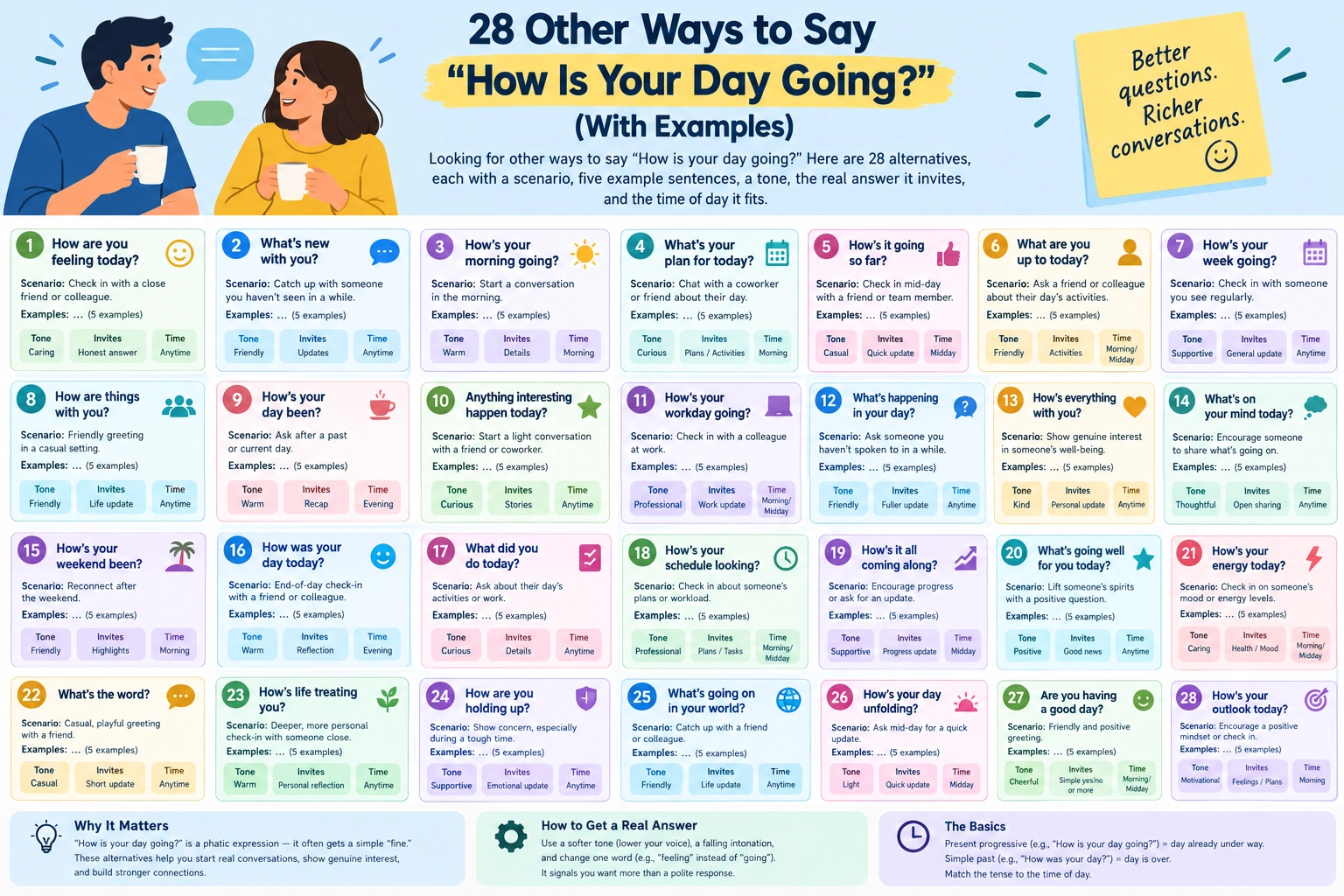
Looking for Other Ways to Say How Is Your Day Going? Here are 28 alternatives, each with a scenario, five example sentences that contain the phrase, the tone it carries, and the two columns no other list on this subject includes — the answer the question actually invites, and the time of day it fits.
Those columns exist because this question has a hidden design flaw. Asked as it usually is, how is your day going produces the word fine and nothing else, and the reason is not rudeness on the answerer’s part — it is that the question has been built, over several centuries of use, to be answered without content.
Linguistics has a name for that design, and knowing it is the most useful thing on this page. A phatic expression is a communication which primarily serves to establish or maintain social relationships; in other words, phatic expressions have mostly socio-pragmatic rather than semantic functions — they are exchanges of social pleasantries that do not seek or offer information of intrinsic value, but signal willingness to observe conventional local expectations for politeness. The category also covers small talk, conversation for its own sake, which is sometimes called social grooming. In Roman Jakobson’s typology of communication functions, the phatic function concerns the channel, which is why I can’t hear you, you’re breaking up belongs to the same family as how’s your day going?
The term itself is a century old. Phatic communion, meaning bonding by language, was coined by the anthropologist Bronisław Malinowski in his essay “The Problem of Meaning in Primitive Languages”, which appeared in 1923 as a supplementary contribution to The Meaning of Meaning by C. K. Ogden and I. A. Richards. The word comes from the Greek φατός, phatós, spoken, that may be spoken, from φημί, phēmí, I speak, say.
And here is the part that explains the useless answers. Phatic communication denotationally breaks Grice’s conversational maxims, because it gives information that is unnecessary, untrue or irrelevant — fine, thanks from somebody having a terrible day is a plain example — but it carries connotational meanings that do not break those maxims, and is best understood as language doing the work of establishing, maintaining and managing bonds of sociality, creating solidarity and familiarity, and putting the participants at ease. So the empty answer is not a failure of the exchange. It is the exchange working exactly as designed.
Which means the real question is how to signal that you want a genuine answer, and the research gives three specific levers. In British English, how are you? is a phatic expression used when greeting somebody you know, especially when a participant wants to initiate conversation — but it can also be asked sincerely, and the sincerity is inferrable from context, such as when a friend has given bad news. It is also inferrable from tone: falling intonation marks it as a genuine question, as with wh-word questions, as does speaking more quietly. And authenticity is emphasised by adding one word — feeling: how are you feeling? is heard as real where how are you? is heard as ritual. Everything on this page is built on those three levers: lower the volume, drop the intonation, and change one word.
The dictionary is equally blunt about the literal form. How are you? is an informal greeting, not requiring a literal response, in form a question and thus followed by a question mark — with the standard synonym set running how do you do? formally, then how are you doing?, how’s it going?, how’s things?, how’s tricks?, what’s up? and the slangy how’s it hanging? In Irish English — Hiberno-English — the same words have a second life as derision: following a noun phrase, with the stress on are, Justice, how are you! means the thing named is unworthy of the name, a usage recorded in the Dáil in 1967.
One grammatical point decides half the choices on this page. How is your day going is present progressive, so it presupposes a day already under way and invites a report from the middle of it; how was your day is simple past and asks for a verdict once the thing is over. Mixing them is the commonest error in the whole cluster — how was your day? at nine in the morning is nonsense, and how’s your day going? at eleven at night asks somebody to narrate a day they have finished with. The alternatives below are sorted accordingly, and the comparison table marks the time of day each one fits.
Other languages solve the same social problem with different content, which is worth knowing before you translate. Spanish asks ¿Qué tal tu día?; French Comment se passe ta journée ?; German Wie läuft dein Tag?; Japanese 調子はどう, how is your condition? Mandarin’s classic daily greeting asks about food altogether — 吃了吗, have you eaten? And English’s own phatic workhorse, all right, has travelled further than any of them: it is the source of Jamaican Creole irie and Tok Pisin orait, and in British use you all right? is a greeting rather than an enquiry about your health — which is why American visitors so often answer it as though something were wrong.
28 Other Ways to Say “How Is Your Day Going”
Every entry has a scenario, five example sentences containing the phrase, and an attribute line ending in the answer it really invites and the time of day it fits.
This is the list in full, and it also answers other ways to ask how is your day going, different ways to say how is your day going, different ways to ask how is your day going, ways to say how is your day going, other ways to say how is your day, other ways to say how’s your day going, other ways to say hows your day going, other ways of saying how’s your day going, another way of saying how’s your day going, another way to say how’s your day going, another way to say hows your day going, a different way to say how’s your day going, different ways to say how’s your day going, how to say how’s your day going, what is another way to say how is your day going, what’s another way to say how is your day going, what to say instead of how is your day going, better way to say how is your day going, better ways to ask how is your day going and best way to say how’s your day going — with dedicated sections below for small talk, past-tense check-ins, mornings, work, email, caring wording, answers, flirty and funny versions, British English, Spanish and six other languages.
1. How’s Everything Going?
Wider than the original: it asks about the whole situation rather than the single day.
Scenario: Friendly conversation with a close friend after a busy morning.
Examples:
- How’s everything going after that meeting this morning?
- How’s everything going with the new flat — are you in properly yet?
- How’s everything going now the builders have finally gone?
- How’s everything going this week? You had three deadlines, if I remember.
- How’s everything going — and I mean the real answer, not the polite one.
Why it works: Everything opens the frame beyond today, which is why it suits somebody in the middle of a move, a project or a difficult patch. The width is also the weakness: a question about everything is easy to answer with nothing, since the answerer gets to choose the scale. Example two shows the repair — naming the thing you actually mean turns a pleasantry into a question, and example five does it by licensing the honest version outright.
Tone: warm, casual | Formality: neutral | Best for: friends, coworkers, anybody mid-upheaval | Avoid in: very formal meetings | Answer it invites: good, thanks — unless you name the subject | Time of day: any
2. How Have You Been Today?
The present perfect does something the original cannot: it covers the whole day so far.
Scenario: Checking on someone after they mentioned feeling tired earlier.
Examples:
- How have you been today, after the night you had?
- How have you been today — any better than yesterday?
- How have you been today? You looked shattered at the nine o’clock.
- How have you been today, now the medication has settled?
- How have you been today? No need for the short answer.
Why it works: Have you been is present perfect, so it asks about a stretch of time still in progress — which is exactly the right aspect for somebody who was struggling this morning. It also carries a presupposition the original lacks: that there is a history worth asking about, which is why it reads as care rather than courtesy. Lower your voice and let the intonation fall, and this is the version that gets a real answer. The illness register it borders on is in I hope you are feeling better.
Tone: caring, thoughtful | Formality: neutral | Best for: emotional check-ins, illness, recovery, hard weeks | Avoid in: fast conversations, passing greetings | Answer it invites: a real report on the day so far | Time of day: midday onwards
3. What’s Your Day Been Like?
The best open question in the standard twenty-five, because it asks for a description rather than a rating.
Scenario: Talking with a coworker during a lunch break.
Examples:
- What’s your day been like — busier than mine, by the look of it?
- What’s your day been like so far? Mine has been nothing but calls.
- What’s your day been like since the system went down?
- What’s your day been like with half the team off?
- What’s your day been like? I have twenty minutes and genuinely want to know.
Why it works: What questions resist one-word answers in a way how questions do not. How is your day going? closes with fine; what’s your day been like? asks for a noun, an event, a description — and that single grammatical difference is the most reliable upgrade in this whole article. Offering your own answer first, as example two does, makes it easier still, because it shows the length of reply you are expecting.
Tone: conversational, interested | Formality: neutral | Best for: meaningful chats, lunch breaks, catch-ups | Avoid in: formal emails, hurried exchanges | Answer it invites: a description, not a rating | Time of day: midday to evening
4. How Are Things With You?
The reconnection question: it skips the day and asks about the person’s life.
Scenario: Reconnecting with an old friend online.
Examples:
- How are things with you? It has been far too long.
- How are things with you — still at the same firm?
- How are things with you and the family these days?
- How are things with you since the move north?
- How are things with you? Start anywhere; I have all evening.
Why it works: It does not mention the day at all, which is the right choice when you have not spoken for months and today is not the relevant unit of time. With you is doing quiet work: it makes the question personal without demanding a particular subject, so the answerer chooses what matters. The last example removes the usual obstacle, which is not knowing how much detail is wanted. The anticipation of meeting again is in Looking forward to seeing you.
Tone: friendly, relaxed | Formality: neutral | Best for: reconnecting, old friends, former colleagues | Avoid in: strict business settings, first contact | Answer it invites: a general update, chosen by them | Time of day: any
5. How’s Life Treating You Today?
Playful and slightly theatrical, and it hands the blame for a bad day to life rather than the person.
Scenario: Lighthearted conversation with a cheerful friend.
Examples:
- How’s life treating you today — kindly, I hope?
- How’s life treating you today? Mine has been a comedy since eight.
- How’s life treating you today, now the exams are done?
- How’s life treating you today? You look suspiciously cheerful.
- How’s life treating you today — better than the printer is treating me?
Why it works: The grammar does something genuinely clever: making life the subject and the person the object means a bad answer is not a confession of failure, which is why this phrasing gets a wry truth where a direct question gets fine. It is too arch for serious moments — sent to somebody who has just had bad news it reads as flippant — and that is the one place to avoid it.
Tone: cheerful, playful | Formality: informal | Best for: close friends, long-standing colleagues, group chats | Avoid in: serious situations, bad news, formal writing | Answer it invites: a wry complaint, which is often the truth | Time of day: any
6. How’s Everything on Your Side?
Remote-work English: it asks about conditions rather than feelings.
Scenario: Professional conversation with a remote coworker.
Examples:
- How’s everything on your side — did the files come through?
- How’s everything on your side this morning? The London office is quiet.
- How’s everything on your side with the client calls?
- How’s everything on your side now the new system is live?
- How’s everything on your side? Shout if anything is blocked.
Why it works: On your side frames the question as logistical, which lowers the social cost of answering honestly: reporting that a system is broken is easier than reporting that you are tired. That makes it the right opener in distributed teams, where it is near-universal, and in any conversation where you want a status rather than a mood. Example five is the version that gets used, because it names what you will do with the answer. The group check-in equivalent is in I hope everything is going well.
Tone: professional yet friendly | Formality: neutral | Best for: remote teams, cross-office chats, project calls | Avoid in: personal emotional conversations | Answer it invites: a status report | Time of day: working hours
7. What’s Going on With You Today?
Direct, curious, and one word away from sounding like an accusation.
Scenario: Casual text conversation with a sibling.
Examples:
- What’s going on with you today — anything exciting?
- What’s going on with you today? You have been quiet in the group chat.
- What’s going on with you today, apart from the usual chaos?
- What’s going on with you today? Free for a call at six?
- What’s going on with you today — are you still on for Saturday?
Why it works: It asks for events rather than a verdict, so the answer arrives as news. The caution is tonal: with rising intonation and stress on you, what’s going on with you? is the English for what is the matter with you? — and the difference between affectionate curiosity and criticism is carried entirely by the voice. In writing, add today and a second clause, as every example above does, and the ambiguity disappears.
Tone: curious, casual | Formality: informal | Best for: siblings, close friends, text messages | Avoid in: formal communication, tense conversations | Answer it invites: news and plans | Time of day: any
8. How’s Your Day Treating You?
The kindest wording in the standard list, because it assumes the day itself is the problem.
Scenario: Checking on someone after a stressful event.
Examples:
- How’s your day treating you after this morning?
- How’s your day treating you — gently, I hope.
- How’s your day treating you? I can take the afternoon call if it helps.
- How’s your day treating you since the news came through?
- How’s your day treating you? Say badly if it is badly.
Why it works: Like entry 5 it makes the day the agent, but without the comic register — so it carries the same permission to complain while staying serious. That combination is rare and genuinely useful: it is the phrase to send when you suspect the answer is bad and do not want to force cheerfulness. Pair it with an offer, as example three does, and it stops being a question and becomes help. The sympathy that follows a bad answer is in Sorry to hear that.
Tone: supportive, caring | Formality: neutral | Best for: emotional support, stressful days, people you manage | Avoid in: official workplace reports, celebratory moments | Answer it invites: an honest answer, including a bad one | Time of day: midday onwards
9. How Are You Doing So Far Today?
So far is the most useful two words in the whole cluster: they date the question and limit it.
Scenario: Talking to a coworker halfway through the workday.
Examples:
- How are you doing so far today — survived the morning?
- How are you doing so far today? Two more hours and the week is done.
- How are you doing so far today, with the inspection in the building?
- How are you doing so far today? The hard part is behind you now.
- How are you doing so far today — and is there anything I can take off you?
Why it works: So far acknowledges that the day is unfinished, which makes a middling answer easy to give: nobody has to pretend a half-finished day is good. It also marks the question as a mid-point check rather than a greeting, so it is read as attention rather than ritual. Example five is the strongest closing clause on this page, because an offer to remove work turns the check-in into something the other person gains from.
Tone: thoughtful, attentive | Formality: neutral | Best for: colleagues, direct reports, long shifts | Avoid in: first-thing greetings, where there is no so far yet | Answer it invites: a partial, honest report | Time of day: mid-morning to late afternoon
10. What Have You Been Up to Today?
It asks for activity rather than feeling, which is the easiest thing in the world to answer.
Scenario: Friendly afternoon chat with a cousin.
Examples:
- What have you been up to today — anything more interesting than spreadsheets?
- What have you been up to today? I have been in the garden since nine.
- What have you been up to today, now the children are back at school?
- What have you been up to today? Tell me something that is not work.
- What have you been up to today — did you get to the market in the end?
Why it works: Activity is concrete, so the answer writes itself; moods are abstract, so they collapse into fine. That is why this entry reliably produces a longer reply than the original question does, and why it suits relatives and friends you speak to irregularly. The one place it misfires is a hard day, where what have you been up to? sounds like an enquiry into productivity — use entry 8 or entry 11 instead.
Tone: curious, relaxed | Formality: informal | Best for: family, friends, afternoon catch-ups | Avoid in: professional email, difficult days | Answer it invites: a list of activities | Time of day: afternoon and evening
11. Is Your Day Going Well?
A yes-or-no question, which is both its weakness and, in one situation, its entire value.
Scenario: Supportive check-in message to a friend.
Examples:
- Is your day going well? One word is plenty.
- Is your day going well, or shall I ring you?
- Is your day going well so far — or is it one of those?
- Is your day going well? No need to explain either way.
- Is your day going well? I am about if it is not.
Why it works: Closed questions are usually the wrong tool for a check-in, because yes ends the conversation. But a closed question is exactly right for somebody who has no energy to narrate — illness, grief, a brutal week — since it costs one syllable to answer honestly. Examples two and five add the thing that makes it genuinely kind: an offer attached to the no, so the bad answer has somewhere to go.
Tone: gentle, caring | Formality: neutral | Best for: anybody exhausted, ill or overloaded | Avoid in: conversations you want to open up | Answer it invites: yes or no — and that is the point | Time of day: any
12. How’s Your Afternoon Going?
Narrowing the window to the afternoon makes the question specific and honest at once.
Scenario: Afternoon text to a coworker or friend.
Examples:
- How’s your afternoon going — better than the morning?
- How’s your afternoon going? The three o’clock slump has me.
- How’s your afternoon going now the meetings are done?
- How’s your afternoon going? I can cover the five o’clock handover.
- How’s your afternoon going — still on for a walk at six?
Why it works: Dividing the day into halves is the simplest way to stop a check-in sounding generic, and it has an extra advantage: a reader who had a terrible morning can honestly report a decent afternoon, which the whole-day version makes awkward. It is also correctly timed, which the original so often is not: sent at two o’clock it is accurate, and how is your day going at two o’clock is already half wrong.
Tone: casual, friendly | Formality: neutral | Best for: coworkers, friends, afternoon messages | Avoid in: morning greetings, evening conversations | Answer it invites: a short, accurate report | Time of day: noon to five
13. How’s Your Morning Been?
The morning half of the same technique, and the answer to another way to say how’s your morning going.
Scenario: Morning office conversation with a teammate.
Examples:
- How’s your morning been — did the trains behave?
- How’s your morning been? You were in before me, which is unusual.
- How’s your morning been with the system down?
- How’s your morning been? Nothing from me needs you before lunch.
- How’s your morning been — and did the nursery drop-off go all right?
Why it works: It greets and enquires in one move, which is why it is the most natural thing to say to somebody at half past ten. For another way to say how’s your morning going, the present perfect version is the better one: how’s your morning been covers the hours already spent, while how’s your morning going asks about a morning still running — and at eleven o’clock the first is the accurate question. Example five is the one that builds relationships, because remembering the nursery run is proof of attention. The greeting that precedes it is covered in Good morning.
Tone: friendly, approachable | Formality: neutral | Best for: teammates, mornings, shift starts | Avoid in: afternoon and evening messages | Answer it invites: a report on the morning | Time of day: nine to noon
14. What’s Been the Highlight of Your Day?
The best question in the standard twenty-five, because it cannot be answered with fine.
Scenario: Meaningful evening conversation with a partner or friend.
Examples:
- What’s been the highlight of your day? Mine was the dog in the lift.
- What’s been the highlight of your day — and the low point, while we are at it?
- What’s been the highlight of your day? It can be very small.
- What’s been the highlight of your day, other than finishing it?
- What’s been the highlight of your day? I want the actual answer, not the tidy one.
Why it works: It asks for a single specific thing, so the answer has to contain content — and that is the whole trick. Parents use the same mechanism on children who answer fine to everything, and it works on adults for the same reason. Example two is the version to adopt as a habit: asking for the high point and the low point together makes the bad half reportable, which is what turns a nightly ritual into a real conversation. Example three removes the last obstacle by lowering the bar to something small.
Tone: positive, engaging | Formality: informal | Best for: partners, families, evening conversations, children | Avoid in: brisk professional exchanges | Answer it invites: one specific event — it cannot be closed with a word | Time of day: evening
15. How Are Things Going Today?
The neutral default: no warmer and no cooler than the original, and it fits everywhere.
Scenario: Casual office or family conversation.
Examples:
- How are things going today — any better than yesterday?
- How are things going today? I have the figures when you want them.
- How are things going today with the two of you on shift?
- How are things going today? No rush on the report, by the way.
- How are things going today — anything you need from me?
Why it works: Things is impersonal, which is precisely why it is safe: it asks about circumstances rather than feelings, so nobody has to disclose anything. That makes it the right question for a colleague you like but do not know well, and the wrong one for somebody you want to open up. It is also the most natural of the lot in a corridor, because it is short and expects a short answer.
Tone: neutral, friendly | Formality: neutral | Best for: colleagues, acquaintances, everyday use | Avoid in: deep conversations, emotional check-ins | Answer it invites: a brief, safe answer | Time of day: any
16. How’s Work Treating You Today?
It names the subject, which is the single most effective change you can make to the original.
Scenario: Asking a coworker about their workload.
Examples:
- How’s work treating you today — is the backlog moving?
- How’s work treating you today, with two people off sick?
- How’s work treating you today? Say the word and I will take the Friday report.
- How’s work treating you today, now the audit is finished?
- How’s work treating you today — honestly, not the management answer.
Why it works: Naming work tells the answerer which part of their life you are asking about, so they do not have to guess at the scale of the reply. Keeping treating you from entry 8 means the question still permits a complaint, which is why this is the most useful check-in a manager has. Example three is the version that earns trust: an offer to remove a task proves the question was not rhetorical.
Tone: professional, caring | Formality: neutral | Best for: colleagues, direct reports, workload conversations | Avoid in: social settings, where it drags work in | Answer it invites: a workload report, often a complaint | Time of day: working hours
17. How’s Everything Coming Along?
A progress question dressed as a check-in, and the one entry that is really about the work.
Scenario: Checking progress on a project or personal plan.
Examples:
- How’s everything coming along — on track for Thursday?
- How’s everything coming along with the extension?
- How’s everything coming along? No wrong answer; I would rather know now.
- How’s everything coming along since the supplier changed the dates?
- How’s everything coming along — anything I can unblock?
Why it works: Coming along presupposes something in progress, so it is the natural question for a build, a thesis, a renovation or a recovery. Said by a manager it is heard as a deadline enquiry whatever the tone, which is worth knowing before you use it as a pleasantry — and example three is the sentence that defuses that, because inviting bad news early is cheaper than discovering it late. The feedback register that follows is in Please let me know your thoughts.
Tone: encouraging, supportive | Formality: neutral | Best for: projects, plans, studies, long builds | Avoid in: purely social check-ins | Answer it invites: a progress update | Time of day: working hours
18. Are You Having a Good Day?
Cheerful and closed, and it quietly asks for the answer yes.
Scenario: Friendly check-in during a busy afternoon.
Examples:
- Are you having a good day — or at least a tolerable one?
- Are you having a good day? You have earned one.
- Are you having a good day so far, now the hard meeting is over?
- Are you having a good day? Say no if the answer is no.
- Are you having a good day — and what would make the rest of it easier?
Why it works: It is warm, it is short, and it fits a passing moment in a corridor or a shop. The hidden problem is that it is a leading question: are you having a good day? makes yes the polite answer and no a small act of defiance, which is why it produces the least honest replies of any entry here. Examples one and four fix it by writing the escape route into the question, and example five turns it into something actionable.
Tone: cheerful, caring | Formality: neutral | Best for: passing greetings, shops, light check-ins | Avoid in: conversations where you need the truth | Answer it invites: yes, whether or not it is true | Time of day: any
19. What’s Keeping You Busy Today?
It presumes the person is busy, which is flattering, accurate and occasionally a trap.
Scenario: Casual conversation with a friend or coworker.
Examples:
- What’s keeping you busy today — anything interesting?
- What’s keeping you busy today? I have a gap at three if you want a hand.
- What’s keeping you busy today, now the tender is submitted?
- What’s keeping you busy today — still the migration?
- What’s keeping you busy today? Say nothing much if that is the answer; it is allowed.
Why it works: It asks for a subject rather than a feeling, which gets a real answer, and it treats the other person’s time as full, which most people hear as respect. The trap is the presumption: to somebody having a quiet day it can land as an enquiry into whether they are doing enough, particularly from a manager. Example five removes that in nine words, and it is worth keeping.
Tone: curious, engaging | Formality: neutral | Best for: colleagues, friends, catch-ups | Avoid in: messages to anybody at risk of feeling underused | Answer it invites: a subject, not a mood | Time of day: working hours
20. How’s Today Been for You?
The evening version of the original, and the for you is doing more than it looks.
Scenario: Evening conversation after a long day.
Examples:
- How’s today been for you? Mine was long but all right.
- How’s today been for you — better than you expected?
- How’s today been for you, with the hospital appointment in the middle of it?
- How’s today been for you? No need for the highlights reel.
- How’s today been for you — shall I cook, or shall we give up and order?
Why it works: For you signals that you know the same day was different for each of you, which is why this phrasing suits couples, housemates and colleagues who have been through the same meeting. The present perfect keeps it open while the evening is still happening, so it works from about six o’clock without becoming the full retrospective of how was your day. Example five is the one that households should steal, because a question with a decision attached is easier to answer than a question alone.
Tone: calm, thoughtful | Formality: neutral | Best for: partners, housemates, evening calls | Avoid in: morning messages | Answer it invites: a summary of the day | Time of day: evening
21. What’s New With You Today?
It asks for news, which is the lowest-effort honest answer anybody can give.
Scenario: Casual chat after not speaking for a few days.
Examples:
- What’s new with you today — anything since Friday?
- What’s new with you today? I have been off the grid all week.
- What’s new with you today, now the house sale is through?
- What’s new with you today? Even small news counts.
- What’s new with you today — any word on the job?
Why it works: News is a category everybody can search quickly, so the question is easy to process and easy to answer. It also assumes a gap in contact, which makes it the natural opener after a few days of silence — where how is your day going would skip over the fact that you have not spoken. Example five is the strongest form, because asking about a specific pending thing proves you remembered it was pending.
Tone: lighthearted, curious | Formality: informal | Best for: friends, relatives, reconnecting after a gap | Avoid in: formal writing, hourly check-ins | Answer it invites: news, large or small | Time of day: any
22. How Are Things Going at Your End?
Entry 6’s more formal cousin, and the phrase distributed teams reach for by default.
Scenario: Remote workplace or online conversation.
Examples:
- How are things going at your end — did the deployment finish?
- How are things going at your end? It is quiet here, so shout if you need cover.
- How are things going at your end with the client in the building?
- How are things going at your end, now the figures have been signed off?
- How are things going at your end? I have nothing urgent, so no rush.
Why it works: At your end is explicitly about location and conditions, which is why it reads as professional rather than personal and why it survives in writing where the warmer entries do not. It is also the politest way to ask whether something you handed over has gone wrong, because it asks about the situation and not the person’s competence. Example five is worth copying into any status message: saying that nothing is urgent removes the implied deadline that this phrasing otherwise carries. The reassurance that pairs with it is in No worries.
Tone: professional, polite | Formality: formal to neutral | Best for: remote teams, cross-office email, client updates | Avoid in: personal conversations, emotional check-ins | Answer it invites: a status report | Time of day: working hours
23. How’s Your Schedule Looking Today?
Not really a check-in at all: it is a request for access to somebody’s time.
Scenario: Planning activities with a coworker or friend.
Examples:
- How’s your schedule looking today — any chance of twenty minutes?
- How’s your schedule looking today? I can work around you.
- How’s your schedule looking today, with the two site visits?
- How’s your schedule looking today? If it is full, tomorrow is fine.
- How’s your schedule looking today — before I ask you for a favour.
Why it works: It is honest about what it wants, and that honesty is the courtesy. The failure mode is using it as a pleasantry when a meeting request is coming, which readers spot immediately and resent, because a question used as a preamble is not a question. Examples four and five are the fix: naming the alternative, or naming the favour outright, converts it from a trap into a genuine enquiry.
Tone: practical, friendly | Formality: neutral | Best for: planning, booking time, coordinating | Avoid in: emotional check-ins, and as disguised softening | Answer it invites: a diary answer, and then a request | Time of day: working hours
24. Is Everything Going Smoothly Today?
It asks about friction, which is a more answerable thing than mood.
Scenario: Checking on someone handling a difficult task.
Examples:
- Is everything going smoothly today — or has the supplier been difficult again?
- Is everything going smoothly today? Flag anything that is stuck.
- Is everything going smoothly today, now you are running the floor alone?
- Is everything going smoothly today? A list of problems is more useful to me than a yes.
- Is everything going smoothly today — and what has not gone smoothly?
Why it works: Smoothly narrows the question to process, so the answer arrives as information you can act on. Like entry 18 it is a leading question, and the lean is towards yes — which is why examples four and five explicitly invite the opposite. Asking what has not gone smoothly is the single most productive version of this question, and it is the one that finds problems while they are still small.
Tone: supportive, professional | Formality: neutral to formal | Best for: difficult tasks, handovers, operations, events | Avoid in: social conversation | Answer it invites: a yes, unless you ask for the opposite | Time of day: working hours
25. How’s Your Day Unfolding?
The most literary entry in the list, and it treats the day as a story rather than a score.
Scenario: Thoughtful conversation during the afternoon.
Examples:
- How’s your day unfolding — as planned, or not remotely?
- How’s your day unfolding? Mine has gone sideways twice already.
- How’s your day unfolding since the news this morning?
- How’s your day unfolding? I have time if you want to talk it through.
- How’s your day unfolding — anything you did not see coming?
Why it works: Unfolding implies a sequence of events, so it invites narrative rather than judgement — and narrative is where the interesting answers live. It is the right phrasing on a day that is plainly not going to plan, because it accepts in advance that a day has a shape rather than a rating. The register is distinctly writerly, so it lands well in a text or a thoughtful message and sounds affected in a corridor.
Tone: thoughtful, expressive | Formality: neutral | Best for: reflective conversations, messages, afternoons | Avoid in: brisk exchanges, formal reports | Answer it invites: a narrative | Time of day: afternoon
3 More Alternatives You Will Not Find on Other Lists
All twenty-five standard alternatives share three gaps: not one of them makes a bad answer easy, not one asks a question specific enough to be answered in a line, and every one of them obliges a reply. These three fix exactly that.
26. Be honest — rough one, or just a Tuesday?
The licensed complaint: it offers two answers and makes the unflattering one respectable.
Scenario: Anybody you suspect is having a bad day and will say fine if asked in the usual way.
Examples:
- Be honest — rough one, or just a Tuesday?
- Be honest: bad day, or ordinary day? Either answer is fine by me.
- Rough one, or just busy? You can say rough.
- Be honest — is this a cup-of-tea day or a go-home-early day?
- Honestly, on a scale of one to the printer catching fire, where are we?
Why it works: It attacks the actual mechanism behind the useless answer. Because how is your day going is phatic, the slot after it is built for a pleasantry, and fine is the conventional filler — so no amount of rewording gets a real answer unless the question changes what the slot is for. This version does three things at once: it says be honest, it supplies a negative option, and it makes that option sound unremarkable. Naming the bad answer first is the key move, since a reader who hears rough one? can agree rather than confess. It is also the closest thing in writing to the three sincerity signals from the research — falling intonation, a quieter voice, and the added word feeling — none of which survive in text, which is why the words have to do the work instead.
Tone: direct, warm | Formality: informal to neutral | Best for: friends, close colleagues, direct reports, partners | Avoid in: first contact, formal email, anybody who will not welcome directness | Answer it invites: the truth, including the bad version | Time of day: any
27. What’s the one thing left on your list today?
Specific enough to answer in six words, and it leads straight to an offer of help.
Scenario: Colleagues, direct reports, family members mid-task — anybody for whom a general question is more work than a particular one.
Examples:
- What’s the one thing left on your list today?
- What is still outstanding today — and can I take any of it?
- What has to land before you finish today? Everything else can wait.
- What’s the last job today, and does it need two pairs of hands?
- What is left that is actually urgent, as opposed to loud?
Why it works: An open question asks somebody to summarise a whole day, which is a surprising amount of work; a closed, specific question asks them to name one item. That is why this gets answered in a line while the original gets answered in a word. It also produces something a check-in almost never produces: a chance to help, because once a single outstanding task is named you are able to take it, defer it or share it. Example five is the sentence that managers should learn — distinguishing urgent from loud is most of what a mid-day conversation is for.
Tone: practical, attentive | Formality: neutral | Best for: colleagues, direct reports, households, long shifts | Avoid in: social catch-ups, where it is brisk | Answer it invites: one named task | Time of day: mid-afternoon onwards
28. No need to reply — just checking you’re all right today.
The check-in that asks nothing, which is the only kind some people can receive.
Scenario: Somebody grieving, ill, overwhelmed, in a different time zone, or on a shift they cannot interrupt.
Examples:
- No need to reply — just checking you’re all right today.
- Thinking of you today. Nothing needed from you at all.
- No reply necessary — I will ring at the weekend instead.
- Just marking that I know what today is. No need to say anything.
- Checking in, and the only correct answer is no answer if that is easier.
Why it works: Every other entry on this page, however kind, creates a small obligation: somebody now has to compose a reply. For a person who is grieving, ill, overwhelmed or mid-shift, that obligation is the reason check-ins go unanswered and then stop arriving — which is exactly when they matter most. Releasing the reply converts the message from a request into a gift, and the anniversary version in example four is the one people remember for years. Two practical notes: say it and mean it, since a follow-up chase destroys the whole effect; and set your own reminder to check again, because a person who does not have to answer also cannot tell you when things get worse. The feeling behind it is covered in It means a lot to me.
Tone: considerate, undemanding | Formality: neutral | Best for: grief, illness, exhaustion, time zones, shift workers | Avoid in: situations where you genuinely need an answer | Answer it invites: nothing — deliberately | Time of day: any, including the middle of their night
Quick Comparison Table
All 28 alternatives, with the answer each one really invites and the time of day it fits. Those two columns explain why most check-ins get the word fine and a handful get a conversation.
| Phrase | Tone | Best for | Avoid in | Answer it invites | Time of day |
|---|---|---|---|---|---|
| 1. How’s everything going? | Casual | Friends and coworkers | Very formal meetings | Good, thanks — unless you name the subject | Any |
| 2. How have you been today? | Caring | Emotional check-ins, illness | Fast conversations | A real report on the day so far | Midday onwards |
| 3. What’s your day been like? | Conversational | Meaningful chats, lunch breaks | Formal emails | A description, not a rating | Midday to evening |
| 4. How are things with you? | Friendly | Reconnecting, old friends | Strict business settings | A general update, chosen by them | Any |
| 5. How’s life treating you today? | Playful | Close friends | Serious situations, bad news | A wry complaint — often the truth | Any |
| 6. How’s everything on your side? | Professional | Remote work chats | Personal emotional talks | A status report | Working hours |
| 7. What’s going on with you today? | Casual | Friendly texts, siblings | Formal communication; tense moments | News and plans | Any |
| 8. How’s your day treating you? | Supportive | Emotional support, hard days | Official workplace reports | An honest answer, including a bad one | Midday onwards |
| 9. How are you doing so far today? | Attentive | Colleagues, long shifts | First-thing greetings | A partial, honest report | Mid-morning to late afternoon |
| 10. What have you been up to today? | Relaxed | Family, afternoon catch-ups | Professional email; hard days | A list of activities | Afternoon and evening |
| 11. Is your day going well? | Gentle | The exhausted, ill, overloaded | Conversations you want to open up | Yes or no — and that is the point | Any |
| 12. How’s your afternoon going? | Casual | Coworkers, afternoon messages | Morning and evening | A short, accurate report | Noon to five |
| 13. How’s your morning been? | Approachable | Teammates, shift starts | Afternoon and evening | A report on the morning | Nine to noon |
| 14. What’s been the highlight of your day? | Engaging | Partners, families, children | Brisk professional exchanges | One specific event — cannot be closed | Evening |
| 15. How are things going today? | Neutral | Colleagues, acquaintances | Deep conversations | A brief, safe answer | Any |
| 16. How’s work treating you today? | Professional, caring | Workload conversations | Social settings | A workload report, often a complaint | Working hours |
| 17. How’s everything coming along? | Encouraging | Projects, studies, builds | Purely social check-ins | A progress update | Working hours |
| 18. Are you having a good day? | Cheerful | Passing greetings, shops | When you need the truth | Yes, whether or not it is true | Any |
| 19. What’s keeping you busy today? | Curious | Colleagues, friends | Anybody at risk of feeling underused | A subject, not a mood | Working hours |
| 20. How’s today been for you? | Calm | Partners, housemates | Morning messages | A summary of the day | Evening |
| 21. What’s new with you today? | Lighthearted | Reconnecting after a gap | Formal writing | News, large or small | Any |
| 22. How are things going at your end? | Polite, formal | Remote teams, client updates | Emotional check-ins | A status report | Working hours |
| 23. How’s your schedule looking today? | Practical | Planning, booking time | Disguised softening before a favour | A diary answer, then a request | Working hours |
| 24. Is everything going smoothly today? | Supportive | Difficult tasks, operations | Social conversation | A yes, unless you ask for the opposite | Working hours |
| 25. How’s your day unfolding? | Expressive | Reflective messages | Brisk exchanges, reports | A narrative | Afternoon |
| 26. Be honest — rough one, or just a Tuesday? | Direct, warm | Anybody who will otherwise say fine | First contact, formal email | The truth, including the bad version | Any |
| 27. What’s the one thing left on your list today? | Practical | Colleagues, reports, households | Social catch-ups | One named task — and a chance to help | Mid-afternoon onwards |
| 28. No need to reply — just checking you’re all right today. | Undemanding | Grief, illness, shift work, time zones | When you need an answer | Nothing, deliberately | Any, including their night |
Three patterns come out of the table, and the first is the finding that makes the rest of this page useful.
First, the grammatical shape of the question decides the answer far more than the warmth of the wording. Questions that begin with what — entries 3, 10, 14, 19, 21 and 27 — ask for a noun and get one; questions that begin with how or is close with a single syllable. Entry 14 is the clearest case in the standard twenty-five: what’s been the highlight of your day? cannot be answered with fine, which is exactly why parents use it on children who answer everything else that way. If you want content, change the first word, not the adjective.
Second, eleven of the twenty-eight are time-locked, and sending them at the wrong hour is the commonest error in the whole cluster. How’s your morning been is wrong after noon, how’s your afternoon going is wrong before it, and anything in the present progressive is wrong once the day is over — which is when the past-tense set takes over. Five entries are genuinely hour-proof: 4, 7, 11, 21 and 28, and they are the ones to use when you have no idea what time it is where the reader is.
Third, two entries are leading questions, and they produce the least honest answers on the page. Are you having a good day? and is everything going smoothly today? both make yes the polite reply and no a small act of defiance, so a reader who is struggling will almost always take the easy option. The repair is to supply the negative answer yourself — or is it one of those?, what has not gone smoothly?, rough one, or just a Tuesday? — which is the entire design principle behind entry 26.
What Does “How Is Your Day Going” Mean?
The phrase how is your day going is a friendly way to ask someone about their current experiences, feelings or activities during the day. It shows interest, care and a willingness to connect with another person, and people use it in casual conversations, text messages, workplaces and friendly greetings.
Technically it is a phatic question, which means its primary job is social rather than informational. Phatic expressions establish and maintain social relationships, and they do not seek or offer information of intrinsic value — they signal willingness to observe conventional local expectations for politeness. That is why fine, thanks counts as a complete and successful answer, even when it is untrue.
Grammatically it is present progressive, and that tense is doing real work. Is going presupposes a day already under way, so the question asks for a report from the middle of something unfinished — which is a genuinely different request from how was your day, a simple past question asking for a verdict once the day is over. The alternatives below are sorted by that distinction, because sending the wrong tense is what makes a check-in feel automated.
Why We Need to Use This Phrase
Using phrases like how is your day going helps build stronger relationships and creates more comfortable conversations. It makes someone feel noticed, appreciated and emotionally connected, and simple questions like this often open the door for meaningful discussions and friendly interactions.
The underlying mechanism has a name, and it is more flattering than it sounds. Small talk — conversation for its own sake — is also called social grooming, and phatic language is best understood as doing the work of establishing, maintaining and managing bonds of sociality, creating solidarity and familiarity, and putting the participants at ease. So the question is not empty; it is load-bearing. What it is not, by default, is a request for information — and the whole craft covered on this page is how to make it one when you want it to be. The written cousin of the same courtesy is in I hope you are doing well.
When to Use “How Is Your Day Going”
You can use how is your day going in many situations:
- Casual conversations with friends
- Professional settings with coworkers
- Checking in with loved ones
- Text messages and online chats
- Starting conversations politely
Each of those five settings pulls the wording in a different direction, though, and the table says how.
| The situation | Use | Why |
|---|---|---|
| Casual conversations with friends | Entries 1, 5, 10, 21 | Width and news beat precision here |
| Professional settings with coworkers | Entries 6, 9, 16, 22 | Status and workload, not mood |
| Checking in with loved ones | Entries 2, 8, 14, 20 | The questions that permit a bad answer |
| Text messages and online chats | Entries 7, 12, 13, 26 | Short, time-stamped, easy to answer |
| Starting conversations politely | Entries 3, 15, 19 | A what question opens; a how question closes |
Two timing rules matter more than the vocabulary. Ask it once a day to the same person, because the second time reads as automated, and match the tense to the clock: present progressive while the day is running, present perfect for the part already spent, simple past once it is over.
Pros and Cons of “How Is Your Day Going”
Pros
- Sounds friendly and caring — and does so with no effort and no risk.
- Easy to use in daily conversations — it needs no adjustment for age, rank or relationship.
- Works in both casual and semi-professional situations — one of a handful of phrases that survives both.
- Helps start conversations naturally — it opens a channel without committing either person to a subject.
Cons
- Can sound repetitive if overused — and in an office it is overused by definition, since everybody has the same phrase.
- Sometimes feels too general — because day is a twelve-hour unit and nobody can summarise one on request.
- May not create deep conversations every time — the slot after a phatic question is designed for a pleasantry, so fine is the conventional filler rather than a brush-off.
- It is often wrong about the hour — which is the drawback the other lists never mention, and the one entries 12, 13 and 20 exist to solve.
Introduction: Why You Need Alternatives to “How Is Your Day Going”
Because the question is asked so often that it has stopped functioning as a question, and because the version you need depends on whether you want a mood, a status, a story or the truth.
A person in an ordinary workplace is asked some form of this question several times a day and answers it the same way every time. The phrase is not broken; it is simply doing the job it was built for, which is contact rather than content — so getting something more out of it means changing the design of the question, not polishing its vocabulary.
The Problem With Overusing One Phrase
Six costs, and a fix for each.
| The cost | Why it happens | The fix |
|---|---|---|
| It is read as formatting | The reader has had it three times before lunch | Entry 3 or 14: ask for a noun, not a rating |
| It gets the ritual answer | The slot after a phatic question is built for a pleasantry | Entry 26: name the bad answer yourself |
| It is often wrong about the hour | A day-long question sent at nine, or at ten at night | Entries 12, 13 or 20, which are time-stamped |
| It asks for a mood | Moods are abstract and hard to summarise quickly | Entry 19 or 27: ask about a task or a subject |
| It obliges a reply | Which is why check-ins go unanswered precisely when they matter | Entry 28: release the reply |
| It sounds the same from everyone | No detail only you could know | Name the thing: the audit, the scan, the nursery run |
Rows two and five are the important ones, because they explain the two failures people blame on the other person. An answer of fine is not evasion — it is the conventional filler for a slot that was built to be filled politely; and silence after a kind check-in is usually not indifference but the cost of composing a reply. Name the bad answer, or release the reply, and both problems disappear.
What This Guide Covers
Start from what you actually want back.
- Casual and everyday: small-talk swaps, past-tense check-ins, end-of-day wrap-ups and morning-specific versions.
- Professional: workplace wording, email openers, and the status questions remote teams use.
- Warm and caring: the hope your day is going well family, the forward-looking well-wishes, and how to answer when somebody checks in on you.
- Flirty and funny: playful openers with an exit, and jokes aimed at the day rather than the person.
- Languages and regions: British English, Spanish, and six more languages, including the ones that ask about food instead.
- Choosing: a framework by relationship and setting, and a quick-reference list of top picks by situation.
One habit carries the whole page: decide what kind of answer you want before you pick the words. A mood, a status, a story and the truth are four different requests, and the phrase that gets one of them reliably fails at the other three. The end-of-week version of the same question is in Have a great weekend.
Casual and Everyday Alternatives
In everyday speech the winning versions are two to five words long, and the ones that get answered properly start with what.
Different Ways to Say “How Is Your Day Going” in Small Talk
| Say | Best for | Why it works |
|---|---|---|
| How’s it going? | Corridors, shops, passing | Three words; the universal default |
| How are we all doing? | Groups, teams, tables | Addresses a room without singling anybody out |
| All right today? | British English, informal | A greeting, not an enquiry about your health |
| Busy one? | Colleagues mid-task | Two words, and it offers the easy answer |
| What’s your day looking like? | Mornings, planning | Asks about the shape of the day ahead |
| Good day so far? | Mid-morning | Dates the question and keeps it short |
| How’s things? | Informal, British and Irish | Grammatically odd and completely standard |
| What’s new? | Friends, after a gap | Asks for news, which is easy to find |
| How’s the day treating you? | Anybody | Permits a complaint without inviting one |
| Surviving? | Close colleagues, hard days | One word, and funnier than it should be |
Row five is the most underused line in the table. What’s your day looking like? asks about the day ahead rather than the day so far, which gives the other person something concrete to say and often produces an offer of help — nobody says fine to it. Row three needs a usage note for anybody outside Britain: all right? or you all right? is a greeting equivalent to hello, and the expected answer is all right, you? rather than an account of your wellbeing. A question tag does the same job in a different way — busy one, isn’t it? invites agreement, and agreement is the easiest reply there is. Row seven is grammatically indefensible and entirely idiomatic — how’s things survives because nobody hears the mismatch.
Other Ways to Ask How Your Day Has Been
For other ways to say how’s your day been, other ways to say how has your day been, other ways to ask how’s your day been and other ways to ask how your day has been: the present perfect is the right tense for a day that is partly spent.
| Say | When | Why it works |
|---|---|---|
| How has your day been so far? | Midday onwards | Present perfect: the part already spent |
| How’s your day been? | Afternoon and evening | The contracted everyday form |
| How has today been for you? | Evening | For you admits the day differed for each of you |
| What’s today been like? | Afternoon onwards | Asks for a description, not a rating |
| Has today been a good one? | Any | Closed, so it costs one word to answer |
| How have you got on today? | British English, evening | Got on asks about progress and mood at once |
| Much happened today? | Informal, evening | Low-key, and easy to answer either way |
| Rough day, or all right? | Anybody struggling | Supplies the bad answer first |
The tense is the whole point of this group. How has your day been covers the hours already used and leaves the rest open, which is why it is the accurate question from about eleven in the morning until the day ends — where how is your day going implies a day in full swing and how was your day implies one that is over. Row eight is the most useful phrasing in the group, because offering rough as an option is what makes rough sayable. The acknowledgement that should follow a hard answer is in Thank you for letting me know.
Other Ways to Ask How Your Day Was
For other ways to say how was your day, other ways to say how was your day today, other ways to ask how your day was, other ways to say how was your day going and another way to ask how was your day going: once the day is finished, switch to the simple past and ask for one specific thing.
| If you searched | Say | Why it works |
|---|---|---|
| other ways to say how was your day | How did today go? | Simple past; the day is finished |
| other ways to say how was your day today | How did today treat you? | Blames the day, not the person |
| other ways to ask how your day was | What was the best bit of today? | Cannot be answered with fine |
| another way to ask how was your day going | How did the day end up going? | Keeps the progressive but puts it in the past |
| other ways to say how was your day going | Did the day go as planned? | Closed, specific, easy |
| For a child | Tell me one good thing and one annoying thing | Two slots, both easy to fill |
| For a partner | How was it — and do you want to talk about it or not? | Offers the option of silence |
| For a colleague next morning | How did yesterday finish up? | Picks up where the conversation stopped |
The evening question fails for a different reason than the daytime one: by six o’clock the day is too big to summarise and the answerer is too tired to try. That is why what was the best bit of today? outperforms how was your day? in every household that tries it — one specific slot is easy to fill, a twelve-hour review is not. Row six is the version for children, who answer fine to everything until you give them two named slots. And row seven is the one for a partner coming through the door, because the most considerate question in the evening is the one that includes permission not to talk about it.
Another Way to Say “How’s Your Morning Going”
For another way to say how’s your morning going, the morning versions split by hour: progressive before eleven, present perfect after.
| Say | When | Why it works |
|---|---|---|
| How’s your morning going? | Before eleven | Present progressive, morning still running |
| How’s your morning been? | After ten | The accurate version once hours have passed |
| Good start to the day? | Early | Short, and asks about the start specifically |
| Survived the morning? | Late morning | Wry, and it presumes nothing good |
| How’s the morning treating you? | Any morning | Permits a complaint about the hour |
| Up to much this morning? | Informal | Asks about activity rather than mood |
| Did the trains behave? | Commuters | A specific shared misery; always answered |
| Morning — busy one ahead? | Work, first thing | Greeting and question in four words |
Row seven is the best opener on this page for anybody who commutes. A specific shared misery — the trains, the roadworks, the school run, the weather — gets a real answer where an open question gets a polite one, because it hands the other person a subject they already have opinions about. Row four is the honest version for a bad morning, and row two is the one that is simply correct after ten o’clock, when how’s your morning going has already stopped being accurate.
Professional and Formal Alternatives
At work the question should ask about conditions, workload or progress — not feelings — and it should be followed by something useful.
Better Ways to Ask “How Is Your Day Going” at Work
For better ways to ask how is your day going, better way to say how is your day going and best way to say how’s your day going in a workplace.
| Ask | Best for | Why it works |
|---|---|---|
| How’s your day shaping up? | Any colleague | Asks about the shape ahead, not the mood |
| How’s everything on your side? | Remote teams | Conditions rather than feelings |
| How are things going at your end? | Clients, other offices | The formal version of the same question |
| How’s work treating you today? | Direct reports | Names the subject and permits a complaint |
| Is anything blocked at your end? | Project calls | Finds problems while they are small |
| What’s the one thing left on your list today? | Reports, mid-afternoon | Specific, and leads to an offer |
| How’s the workload this week? | Appraisals, one-to-ones | Widens the window to something answerable |
| Anything you need from me today? | Any direction, up or down | Converts a pleasantry into an offer |
| How did yesterday finish up? | Mornings | Picks up an unfinished thread |
| Busy, or manageable? | Corridors | Two options, both respectable |
Rows five, six and eight are the three that change what a check-in is for. Is anything blocked at your end?, what’s the one thing left on your list today? and anything you need from me today? all produce information you can act on, which is why they build more goodwill than any amount of warm phrasing. Row ten is the corridor version, and the reason it works is that it offers two acceptable answers rather than one: busy and manageable are both respectable, where bad is a confession. Row four is the one for a manager to use weekly, since it names work as the subject and still leaves room to complain about it.
The Best Way to Say It in Email Openers
| The email | Write | Why it works |
|---|---|---|
| First line, familiar colleague | Hope your day is going well — quick one below. | Warmth, then the substance in one line |
| First line, client you know | I hope the week is going well. The revised figures are attached. | Week, not day: cannot be wrong about the hour |
| First contact | I hope this message finds you well. | The neutral standard; impossible to object to |
| Mid-afternoon email | Hope the afternoon is treating you kindly. | Accurate about the clock |
| Across time zones | Hope this reaches you at a reasonable hour. | Acknowledges that your morning is not theirs |
| After a difficult week | Hope this week has been gentler than last. | Specific, and remembers something |
| Asking for something | Hope your day is going well. I need a yes or no on the 14th. | Greeting, then the ask, unsoftened |
| Nothing needed | Hope the day is going well — nothing in here needs an answer. | States what is not owed |
In email the question is a courtesy rather than an enquiry, so the useful move is to keep it to one clause and spend the rest of the line on content. Hope your day is going well — quick one below does in nine words what three paragraphs of warmth cannot, because it signals goodwill and then respects the reader’s time. Two rows are worth adopting permanently: wishing on the week rather than the day survives being opened at any hour, and saying that nothing needs an answer is the single most welcome clause in a morning inbox. Row seven is the important discipline — when a request is coming, state it plainly after the greeting, because a pleasantry used as padding in front of an ask is read as softening and resented.
Warm and Caring Alternatives
The caring versions work when they wish for something achievable — a manageable day, a gentle afternoon, a steady shift — rather than a good one.
Other Ways to Say “Hope Your Day Is Going Well”
For other ways to say hope your day is going well, another way to say hope your day is going well and other ways to say i hope your day is going well.
| Write | Best for | Why it works |
|---|---|---|
| Hope the day is treating you kindly | Anybody | Puts the day in charge of the reader |
| Hope today is being gentle with you | Hard weeks, grief, illness | Wishes for less rather than more |
| Hope it is a manageable one | Heavy workloads | Lowers the bar on purpose |
| Hope the afternoon is easier than the morning | Mid-afternoon | Accurate, and remembers the morning |
| Hope things are steady at your end | Work, remote teams | Professional and undemanding |
| Hope you are getting through it all right | Anybody struggling | Assumes difficulty, which is often correct |
| Hope today is kinder than yesterday | After a bad day | Specific, and proves you remembered |
| Hope the day has had something good in it | Evening | A small, achievable wish |
Rows two, three and six are the ones that land with somebody genuinely struggling. A wish for a good day is unachievable on a bad one, so it reads as a demand; a wish for a manageable or gentle one is reachable, and reachable wishes are received as kindness. Row seven is the strongest in the table, because referring to yesterday proves the message was written by somebody who was paying attention. The recovery register beside it is in I hope you are feeling better.
Other Ways to Say “Hope Your Day Is Going Good”
For other ways to say hope your day is going good and another way to say hope your day is going good: the phrase is extremely common in speech and the grammar is worth knowing, because going needs an adverb.
| Instead of | Write | Why |
|---|---|---|
| I hope your day is going good | I hope your day is going well | Well is the adverb; good is the adjective |
| Hope it’s going good | Hope it’s going all right | Idiomatic, and standard in every register |
| Hope your day is good | Hope you are having a good day | Keeps good and fixes the grammar |
| Hoping your day goes good | Hoping the day goes your way | Warm, and avoids the flat adverb |
| Hope all is going good | Hope all is going smoothly | Professional and unimpeachable |
| Hope your day is going good so far | Hope the day has been good so far | Moves good into the adjective slot |
Well is the adverb and good is the adjective, so going well modifies the verb correctly and going good uses an adjective where an adverb belongs. The flat-adverb use of good is widespread in spoken American and Irish English and is read as nonstandard in writing, which matters in an email to a client and not at all in a text to a friend. The simplest fix keeps the word and moves it: hope you are having a good day is unimpeachable, because there good is modifying day, which is its job.
Other Ways to Say “Hope Your Day Goes Well”
For other ways to say hope your day goes well, another way to say hope your day goes well, other ways to say i hope your day goes well and other ways to say hope your day went well: these are forward-looking, so they belong first thing in the morning or just before the thing you are wishing about.
| Write | Best for | Why it works |
|---|---|---|
| Hope today goes your way | Mornings, before a big day | Warmer than well, and more specific |
| Hope it all goes smoothly | Before an event, a move, a launch | Wishes against friction |
| Good luck today — you are ready for it | Interviews, exams, hearings | Confidence rather than a wish |
| Hope the meeting goes the way you want | Named events | Specific beats general every time |
| Thinking of you at eleven | Appointments, results | Names the hour, which is unforgettable |
| Hope it is an easy one | Shifts, long days | The version shift workers actually want |
| Hope your day went well | Evening, after the fact | For other ways to say hope your day went well |
| Hope today treated you better than it threatened to | Evening, after a dreaded day | Acknowledges the dread |
Row five is the most effective sentence in this whole section and it contains no wish at all. Thinking of you at eleven names the hour of somebody’s interview, scan or hearing, and naming the hour is remembered long after any amount of good luck. Row three is the one to use before an exam or an interview, because a statement of confidence is more use than a wish for luck. And row seven handles the past-tense version, which is the one people search for in the evening when the wish has become a question.
Another Way to Say “My Day Is Going Well”
For another way to say my day is going well: the answers below are what turn somebody else’s pleasantry into an actual conversation.
| Instead of | Say | Why it works |
|---|---|---|
| My day is going well | Good so far — two meetings down, one to go | Adds detail, so it is believable |
| My day is going well | Quietly productive, which I will take | Honest and modest |
| My day is going well | Better than yesterday, which is a low bar | Funny, and true |
| Fine, thanks | Busy, but the good kind of busy | Distinguishes the two kinds |
| Fine, thanks | Mixed — the morning was rough, the afternoon is fine | Splits the day, which is usually accurate |
| Fine, thanks | Honestly, a bit of a slog. Nothing dramatic. | Admits it without making it a crisis |
| Fine, thanks | Not my best. Ask me tomorrow. | Closes the subject politely |
| Fine, thanks | Good — how about yours? | Returns the question, which keeps it going |
The single most useful thing you can do when somebody checks in on you is add one detail. Good so far — two meetings down, one to go gives the other person something to respond to, where fine, thanks politely closes the exchange. Row five is the most honest template available, because most days genuinely are mixed, and splitting them is easier than rating them. Row eight is the courtesy that keeps the conversation alive: returning the question costs three words, and most people forget to do it.
Flirty and Playful Alternatives
Playful versions work by handing over something — a compliment, a joke, a scale to answer on — rather than asking for a mood.
For romantic way to say how is your day going and romantic way to ask how is your day going, the romantic register sits just below the flirty one and behaves differently: it asks for more, not less.
| Write | Best for | Why it works |
|---|---|---|
| How’s your day treating you, love? | Any stage | The kindest standard form, with a name on it |
| Tell me about your day — all of it | Established couples | Asks for the whole thing and means it |
| What was the best bit of your day? | Evenings | Cannot be answered with fine |
| How’s the day going without me? | Playful couples | Affectionate, and faintly cheeky |
| Been thinking about you all day — how has it been? | Any stage | Gives before it asks |
| Is today one to talk about, or one to forget? | Hard days | Offers the option of silence |
| How’s your day? I have the kettle on and no agenda. | Living together | A question with an offer attached |
| Three words for your day, then I will stop asking | Tired partners | Tiny, playful, and answerable |
Rows two, six and seven are the ones worth keeping. Tell me about your day — all of it is the only phrasing here that explicitly asks for length, which is why it gets it; is today one to talk about, or one to forget? hands over the choice; and a question with a kettle attached is a question with an offer in it. Row eight is the version for a partner who is too tired to narrate anything, because three words is a bar anybody can clear. The affection behind all of it is covered in It means a lot to me.
Flirty Ways to Ask “How Is Your Day Going”
For flirty way to say how is your day going and flirty ways to ask how is your day going: keep an exit in the message, so a laugh and a flirt are equally easy answers.
| Write | Best for | Why it works |
|---|---|---|
| Is your day as good as you looked this morning? | Confident flirting | Compliment smuggled into a question |
| How’s your day going — better now, presumably? | Playful | Self-aware and easy to laugh off |
| Rate your day out of ten. I will try to improve it. | Early stages | A game, and an offer |
| How’s the day treating you? I have been a distraction all morning, apparently. | Established flirting | Light, teasing, deniable |
| Tell me your day was as dull as mine so I feel better | Any stage | Invites complaint, which is easy |
| How’s your day? Mine improved about thirty seconds ago. | Early stages | The compliment is in the timing |
| Busy day, or busy enough to text me back? | Playful | Cheeky, and gives an exit |
| How’s the day going, trouble? | Established couples | A pet name does most of the work |
Deniability is what makes flirting comfortable rather than pressurising. Mine improved about thirty seconds ago is a compliment the other person is free to take as a joke, which means the other person is never cornered into accepting or refusing anything. Row three is the best opener in the table, because asking for a score turns a vague question into a game with an easy answer and a built-in reason to keep talking. Two cautions: keep all of this out of channels your employer owns, and never send it to somebody who has not flirted back first.
Funny Ways to Ask “How Is Your Day Going”
For funny ways to ask how is your day going: aim the joke at the day, the printer, the biscuits or yourself — never at the person you are asking.
| Write | Best for | Why it works |
|---|---|---|
| On a scale of one to the printer catching fire, how is your day? | Colleagues | A scale is easier than an adjective |
| How’s the day going? Lie to me if it helps. | Friends | Funny, and it licenses the truth instead |
| Is today a coffee day or a lie-down day? | Any | Two options, both honest |
| How’s your day — are we counting it as a day, or writing it off? | Close colleagues | Permission to write it off |
| Day going well, or are we pretending? | Friends | Names the pretence everybody is in |
| How is your day? I ask as somebody who has achieved nothing since nine. | Colleagues | Self-deprecation first |
| What fresh nonsense has today produced? | Close friends | Assumes chaos, which is usually safe |
| How’s today? Mine is being held together by biscuits. | Any informal setting | Specific, silly and relatable |
| Are we having a good day or a character-building one? | Colleagues | Renames the bad day as something survivable |
Row one is the most effective question on this entire page for getting an honest answer at work. A numbered scale removes the social problem completely: a four is a fact rather than a complaint, so nobody has to decide whether admitting a bad day is acceptable. Row nine does the same job with humour instead of numbers — renaming a bad day as character-building lets somebody agree that it is bad while keeping their dignity. And row six is the opener that unlocks groups, because once you have confessed to achieving nothing, everybody else can.
Two short exchanges show how much the design of the question matters.
Sunita: Hi! How is your day going?
Marcus: Fine thanks, you?
Sunita: Fine too!
Nothing has been exchanged, and nobody was at fault. The question was phatic, so the slot after it was built for a pleasantry, and both of them filled it correctly — which is precisely what the design of the phrase asks for.
Sunita: On a scale of one to the printer catching fire, how is your day? Mine is a six and I have achieved nothing since nine.
Marcus: A solid eight, and not in a good way. The supplier has cancelled Thursday and I have been on hold for forty minutes.
Sunita: That is grim. Do you want me to take the Thursday rearrangement off you? I have a clear afternoon.
Marcus: You are a lifesaver. Yes please.
Same length, same warmth, and this time something has actually happened. The second version does three things the first could not: it supplies a scale so a bad answer is a fact rather than a confession, it goes first with its own unflattering figure, and it ends with an offer — which is the three-part shape behind every genuinely useful check-in on this page.
Language and Regional Variations
The same social job is done with different content in different languages — and in two major languages the daily check-in is not about the day at all.
Other Ways to Say “How Was Your Day” in British English
For other way to say how was your day in british english: British English leans on understatement, the present perfect and a greeting that only looks like a question.
| Say | What it is | The note |
|---|---|---|
| All right? | Greeting, not a question | Answered with all right, you? |
| You all right? | Everyday British greeting | Sounds like concern to Americans; it is not |
| How’s your day been? | The standard British check-in | Present perfect, which British English prefers |
| How’s things? | Informal, British and Irish | Ungrammatical and entirely idiomatic |
| How have you got on today? | Evening, British | Got on covers progress and mood together |
| Busy one? | Workplaces | Two words; offers the easy answer |
| Not too bad? | Understatement | The British register: good news stated negatively |
| Any joy with it? | After a task | Asks about outcome, not feelings |
| How was work? | Evening, households | Plain, and the commonest form of all |
| Surviving? | Close colleagues | Assumes nothing good, which is often correct |
The first two rows are the ones that confuse visitors, and the dictionary is clear about why: all right in this use is a greeting, not an enquiry. You all right? expects all right, you? in return, and answering it with an account of your health marks you out instantly as not British. The word has travelled further than any other item on this page — it is the source of Jamaican Creole irie and Tok Pisin orait, both descended from all right. Row seven is the register in miniature: not too bad is British for good, and can’t complain is British for fine.
Different Ways to Say “How Was Your Day” in Spanish
For different ways to say how was your day in spanish and ways to say how’s your day going in spanish: ¿Qué tal tu día? for the everyday version, and ¿Cómo te fue el día? once the day is over.
| Say | Pronunciation | The note |
|---|---|---|
| ¿Cómo va tu día? | KOH-mo va too DEE-a | How is your day going? — the direct equivalent |
| ¿Qué tal tu día? | keh TAL too DEE-a | How about your day?; the most natural everyday form |
| ¿Cómo te fue el día? | KOH-mo teh fweh el DEE-a | How did the day go for you? — past tense, for the evening |
| ¿Cómo estuvo tu día? | KOH-mo es-TOO-vo too DEE-a | How was your day?; commoner in Latin America |
| ¿Cómo va todo? | KOH-mo va TOH-do | How is everything going? — entry 1 in Spanish |
| ¿Qué tal todo? | keh TAL TOH-do | How is everything?; relaxed and very common |
| ¿Cómo andas? | KOH-mo AN-das | How are you going along?; informal, warm |
| mi día va bien | mee DEE-a va byen | The answer: my day is going well |
Spanish makes the tense distinction more sharply than English does. ¿Cómo va tu día? uses the present for a day in progress, while ¿Cómo te fue el día? uses the preterite and is the correct evening question — and the indirect object te in that form means how did it go for you, which carries the same consideration as the English for you in entry 20. Two usage notes: ¿Qué tal tu día? is the most natural in ordinary speech, and the usted form — ¿cómo le fue el día? — is what you use with somebody older, senior or unfamiliar.
How the Question Works in Seven Other Languages
| Language | Say | Pronunciation | The note |
|---|---|---|---|
| French | Comment se passe ta journée ? | ko-MON suh PASS ta zhoor-NAY | How is your day going?; Bonne journée ! is the parting wish |
| German | Wie läuft dein Tag? | vee LOYFT dine TAHK | How is your day running? — the verb is laufen, to run |
| Italian | Come va la giornata? | KOH-meh va la jor-NA-ta | How is the day going?; giornata is the day as lived |
| Portuguese | Como vai o seu dia? | KOH-mo vy oh SEH-oo DEE-a | How goes your day?; Portugal and Brazil |
| Japanese | 調子はどう | CHOH-shee wa doh | How is your condition? — it asks about state, not the day |
| Mandarin | 吃了吗 | chrr luh ma | Have you eaten? — the classic daily check-in |
| Arabic | كيف يومك | kayf YOW-mak | How is your day?; the ending changes with the listener’s gender |
The last three rows are the interesting ones, because they show that the question itself is a cultural choice rather than a universal. Japanese asks about your condition, 調子はどう, which covers health, mood and form all at once; Mandarin’s classic daily greeting asks whether you have eaten, 吃了吗, a question that functions exactly as how are you? does in English and is answered just as ritually. And Arabic inflects for the listener, so the ending of كيف يومك changes according to the gender of the person you are speaking to — a distinction English lost centuries ago. French supplies the other half of the day: Bonne journée ! is said on parting, not on meeting, which is the same trap as the French morning greeting.
Choosing the Right Phrase for the Right Moment
Decide first what you want back — a mood, a status, a story or the truth — then pick the grammar that produces it.
Matching Tone to Relationship and Setting
| Who you are asking | What the question needs | Example |
|---|---|---|
| A partner, at the end of the day | Ask for one specific thing | What was the best bit of today? |
| A partner who has had a hard day | Offer the option of silence | Is today one to talk about, or one to forget? |
| A close friend | Supply the bad answer first | Be honest — rough one, or just a Tuesday? |
| A friend you have not spoken to for weeks | Skip the day; ask about the life | How are things with you? |
| A child after school | Give two named slots | One good thing and one annoying thing |
| A colleague in the corridor | Two words, two acceptable answers | Busy one? |
| A direct report, mid-afternoon | Ask for one task and offer to take it | What’s the one thing left on your list today? |
| Your manager | Ask about conditions, not mood | Anything you need from me today? |
| A remote teammate | Ask about status | How’s everything on your side? |
| A client in email | Wish on the week, then the substance | I hope the week is going well. The figures are attached. |
| A client in a first email | Use the neutral standard | I hope this message finds you well. |
| Somebody ill or grieving | Ask nothing at all | No need to reply — just checking you’re all right today. |
| Somebody on shift or abroad | Avoid the clock entirely | Hope this reaches you at a reasonable hour. |
| Somebody you are flirting with | Leave an exit | How’s your day? Mine improved thirty seconds ago. |
| A whole team at once | Ask for blockers, not feelings | Is anything blocked at your end? |
One rule runs down the whole table: intimacy decides how much the question is entitled to ask, and the channel decides its length. Ask a partner for a story, a colleague for a status and a stranger for a pleasantry — and asking in the wrong direction is what makes a check-in feel intrusive or hollow. The three rows at the bottom of the list are the ones most people get wrong, because grief, shift work and flirtation all need a question that offers an exit rather than one that presses for an answer.
Quick Reference: Top Picks by Situation
| If you want | Use | Why |
|---|---|---|
| The best all-round question | What’s your day been like? | A what question; cannot be closed with a syllable |
| The best for an honest answer | Be honest — rough one, or just a Tuesday? | Names the bad option and makes it respectable |
| The best at work | What’s the one thing left on your list today? | Specific, and it ends in an offer of help |
| The best in the evening | What was the best bit of today? | One slot, easy to fill when tired |
| The best for somebody struggling | No need to reply — just checking you’re all right. | Carries no obligation |
| The best in email | Hope the week is going well — nothing here needs an answer. | Cannot be wrong about the hour |
| The best in a corridor | Busy, or manageable? | Two answers, both respectable |
| The best in the morning | How’s your morning been — did the trains behave? | Shared misery is always answered |
| The funniest that still works | On a scale of one to the printer catching fire… | A number is a fact, not a complaint |
| The best to answer with | Mixed — rough morning, decent afternoon | Splits the day, which is usually the truth |
If you take one line from the table, take the second: be honest — rough one, or just a Tuesday? It is the only phrasing here that attacks the real problem, which is that the answer slot after a friendly question is built for a pleasantry. And if you take two, add the last one, because answering somebody else’s check-in with a split verdict rather than fine is the fastest way to turn a ritual into a conversation.
Final Thoughts
The question is not failing. It is a phatic expression doing exactly what phatic expressions do, and that is why rewording it rarely changes the answer.
Three things are worth carrying away. First, how is your day going primarily serves to establish or maintain a social relationship, not to seek information of intrinsic value — so fine, thanks is the exchange succeeding rather than failing, and the useless answer is designed in. Second, the sincerity signals are specific and known: falling intonation, a quieter voice, context such as bad news already shared, and the single added word feeling, which is why how are you feeling? is heard as real where how are you? is heard as ritual. Third, in writing none of those signals survive, so the words have to carry them — which is what entry 26 does by naming the bad answer and entry 28 does by releasing the reply.
And the grammar matters more than the warmth, which is the finding that surprises people. Questions beginning with what ask for a noun and get one; questions beginning with how or is are shut with a syllable. Change the first word of the question and you change the answer, which no amount of friendlier adjectives will do. The other half of this skill — what to say when somebody answers badly — is covered in Sorry to hear that.
Conclusion: Make Every Check-In Feel Fresh
Use what’s your day been like? as the everyday default, how’s everything on your side? at work, what’s the one thing left on your list today? with anybody you can help, be honest — rough one, or just a Tuesday? when you actually want the truth, and no need to reply — just checking you’re all right today for anybody too stretched to answer.
The original is a good question with a built-in escape hatch. Ask for a noun rather than a rating, match the tense to the clock, supply the unflattering answer yourself, and attach an offer where you can — and if the person is grieving, ill or mid-shift, ask for nothing at all. Rotate the phrasing, and the check-in stops being a ritual and starts being a conversation.
FAQs: Frequently Asked Questions
1. Why should I use other ways to say “How is your day going”?
Using other phrases makes your conversation feel more natural, fresh and less repetitive, which helps build stronger connections in daily communication. There is a mechanical reason as well: the question is phatic, so the answer slot after it is built for a pleasantry — and fine is the conventional filler. Changing the grammar changes the answer: a question beginning with what asks for a noun and gets one.
2. Does changing this question improve communication?
Yes — using varied expressions improves clarity, makes your tone more empathetic and helps your words feel more genuine and engaging. The largest single improvement is specificity: what’s the one thing left on your list today? gets a usable answer where how is your day going? gets a syllable. The second largest is permission — naming the bad answer yourself, as in rough one, or just a Tuesday?
3. Where can I use these alternative phrases?
In work, school, with friends, with coworkers or with family, depending on the tone and the situation. The channel decides the length: two to five words in a corridor or a chat window, one clause in an email, a full question in conversation. The relationship decides what you are entitled to ask for — a story from a partner, a status from a colleague, a pleasantry from a stranger.
4. Are formal and casual versions different?
Yes — a formal tone fits professional settings, while a casual tone feels more friendly and relaxed in daily chats. The formal versions ask about conditions rather than feelings: how are things going at your end?, is anything blocked?, I hope the week is going well. The casual versions are shorter and often funnier, and two of them — busy one? and all right? — are barely questions at all.
5. What is the main benefit of using these alternatives?
Stronger trust, better interaction and more meaningful human connection in everyday speech. In practical terms, the benefit is that you find things out: a blocked project, a bad night, a task you could take off somebody. A check-in that produces an offer of help is worth more than twenty that produce the word fine, and that is the whole argument of this page.
6. What can I say instead of “how is your day going”?
For what to say instead of how is your day going: what’s your day been like?, how are you doing so far today?, what’s been the highlight of your day?, how’s everything on your side?, be honest — rough one, or just a Tuesday? or what’s the one thing left on your list today? Pick by what you want back — a mood, a status, a story or the truth — and all 28 options above are tagged with the answer each one invites.
7. What is another way to say “how is your day going”?
For what is another way to say how is your day going, what’s another way to say how is your day going, another way of saying how’s your day going and a different way to say how’s your day going: the strongest single swap is what’s your day been like? It changes the first word from how to what, which asks for a description instead of a rating, and that one change does more than any new adjective.
8. What is the best way to say “how’s your day going”?
For best way to say how’s your day going, better way to say how is your day going and better ways to ask how is your day going: it depends on the setting, and there are three best answers rather than one. In conversation, what’s your day been like? At work, what’s the one thing left on your list today? With somebody you suspect is struggling, be honest — rough one, or just a Tuesday? All three ask for something specific, which is the common factor.
9. How do you ask how someone’s day is going without sounding repetitive?
For other ways to ask how is your day going and different ways to ask how is your day going: change one of three things — the first word, the time window or the subject. What instead of how; your morning or your afternoon instead of your day; work, the move or the build instead of a general enquiry. Any one of those three turns a formula back into a question.
10. Why do people always answer “fine”?
Because the question is phatic and the answer is doing the same job the question did. Phatic communication denotationally breaks Grice’s conversational maxims — it gives information that is unnecessary, untrue or irrelevant — but it carries connotational meaning, and is best understood as language establishing and maintaining bonds of sociality and putting people at ease. So fine is not evasion; it is the conventional and correct filler for that slot, and only a differently designed question changes it.
11. What is a phatic expression?
A phatic expression is a communication which primarily serves to establish or maintain social relationships, so it has mostly socio-pragmatic rather than semantic functions. Phatic expressions are exchanges of social pleasantries that do not seek or offer information of intrinsic value, but signal willingness to observe conventional local expectations for politeness. The category also covers small talk, conversation for its own sake, sometimes called social grooming, and in Roman Jakobson’s typology the phatic function concerns the channel of communication.
12. Where does the term “phatic communion” come from?
From anthropology, a century ago. Phatic communion, meaning bonding by language, was coined by Bronisław Malinowski in his essay “The Problem of Meaning in Primitive Languages”, which appeared in 1923 as a supplementary contribution to The Meaning of Meaning by C. K. Ogden and I. A. Richards. The word comes from the Greek φατός, spoken, that may be spoken, from φημί, I speak, say.
13. How do I show I actually want a real answer?
Three signals, and they are specific. In British English how are you? is phatic when greeting somebody you know, but it is also asked sincerely, and the sincerity is inferrable from context — such as when a friend has given bad news — or from tone, with falling intonation marking it as a genuine question, as with wh-word questions, or from speaking more quietly. Authenticity can also be emphasised by adding one word, feeling: how are you feeling? In writing none of the tonal signals survive, so say it outright: be honest, or I actually want to know.
14. Is “how is your day going” a real question or just a greeting?
Both, and the context decides. The dictionary describes the parent phrase, how are you?, as an informal greeting, not requiring a literal response, in form a question and thus followed by a question mark — with the synonym set running how do you do?, how are you doing?, how’s it going?, how’s things?, what’s up? and the slangy how’s it hanging? Said with falling intonation to somebody you know is struggling, the same words are a genuine enquiry.
15. Is it “how is your day going” or “how was your day”?
Both, at different hours, and mixing them is the commonest mistake in this cluster. How is your day going is present progressive and presupposes a day under way; how has your day been is present perfect and covers the part already spent; how was your day is simple past and asks for a verdict once it is over. So: progressive in the morning and early afternoon, perfect from late morning onwards, past in the evening.
16. What are other ways to say “how was your day”?
For other ways to say how was your day, other ways to say how was your day today, other ways to ask how your day was and other ways to say how was your day going: how did today go?, how did today treat you?, what was the best bit of today?, did the day go as planned? or how did the day end up going? In the evening, one specific slot beats a general question, because a twelve-hour review is too much to compose when tired.
17. What are other ways to say “how’s your day been”?
For other ways to say how’s your day been, other ways to say how has your day been, other ways to ask how’s your day been and other ways to ask how your day has been: how has your day been so far?, what’s today been like?, how have you got on today?, has today been a good one? or rough day, or all right? The present perfect is the accurate tense from about eleven in the morning, because it covers the hours already used and leaves the rest open.
18. What is another way to say “how’s your morning going”?
For another way to say how’s your morning going: how’s your morning been?, good start to the day?, survived the morning?, up to much this morning? or did the trains behave? After about ten o’clock the present perfect version is the correct one, since hours have already passed. And a specific shared misery — the trains, the school run, the weather — is answered far more often than an open question.
19. What are other ways to say “hope your day is going well”?
For other ways to say hope your day is going well, another way to say hope your day is going well and other ways to say i hope your day is going well: hope the day is treating you kindly, hope today is being gentle with you, hope it is a manageable one, hope things are steady at your end or hope today is kinder than yesterday. A wish for a manageable day is achievable on a bad one, where a wish for a good day reads as a demand.
20. Is “hope your day is going good” correct?
It is extremely common in speech and nonstandard in writing, because going needs an adverb. Well is the adverb and good is the adjective, so going well is the standard form; the flat-adverb use of good is widespread in spoken American and Irish English. For other ways to say hope your day is going good and another way to say hope your day is going good, keep the word and move it: hope you are having a good day is unimpeachable.
21. What are other ways to say “hope your day goes well”?
For other ways to say hope your day goes well, another way to say hope your day goes well, other ways to say i hope your day goes well and other ways to say hope your day went well: hope today goes your way, hope it all goes smoothly, good luck today — you are ready for it, hope it is an easy one, and in the evening hope today treated you better than it threatened to. The strongest version names the hour: thinking of you at eleven.
22. What is another way to say “my day is going well”?
For another way to say my day is going well: good so far — two meetings down, one to go, quietly productive, which I will take, busy, but the good kind of busy, mixed — rough morning, decent afternoon, or better than yesterday, which is a low bar. Adding one detail is what makes an answer believable and gives the other person something to respond to, where fine, thanks politely ends the exchange. And returning the question costs three words.
23. What are flirty ways to ask how someone’s day is going?
For flirty way to say how is your day going and flirty ways to ask how is your day going: is your day as good as you looked this morning?, rate your day out of ten — I will try to improve it, how’s your day? Mine improved about thirty seconds ago, or busy day, or busy enough to text me back? Keep an exit in the message, so a laugh and a flirt are both easy answers and nobody is cornered.
24. What is a romantic way to ask how someone’s day is going?
For romantic way to say how is your day going and romantic way to ask how is your day going: tell me about your day — all of it, been thinking about you all day — how has it been?, is today one to talk about, or one to forget? or how’s your day? I have the kettle on and no agenda. The romantic register asks for more rather than less, and the kindest version offers the option of silence.
25. What are funny ways to ask how someone’s day is going?
For funny ways to ask how is your day going: on a scale of one to the printer catching fire, how is your day?, is today a coffee day or a lie-down day?, are we having a good day or a character-building one? or how is your day? I ask as somebody who has achieved nothing since nine. A numbered scale is the most effective of all, because a four is a fact rather than a complaint. Aim the joke at the day, never at the person.
26. How do you ask in British English?
For other way to say how was your day in british english: all right?, you all right?, how’s your day been?, how’s things?, how have you got on today?, busy one?, not too bad? or how was work? All right? is a greeting rather than an enquiry, and the expected answer is all right, you? — which is why visitors so often reply as though something were wrong. All right is also the source of Jamaican Creole irie and Tok Pisin orait.
27. How do you ask in Spanish?
For ways to say how’s your day going in spanish and different ways to say how was your day in spanish: ¿Qué tal tu día? and ¿Cómo va tu día? while the day is running, and ¿Cómo te fue el día? or ¿Cómo estuvo tu día? once it is over. ¿Qué tal tu día? is the most natural in everyday speech, and the usted form — ¿cómo le fue el día? — is for anybody older, senior or unfamiliar. The answer is mi día va bien.
28. Which languages do not ask about the day at all?
Several, and two are worth knowing. Mandarin’s classic daily check-in asks whether you have eaten — 吃了吗 — and functions exactly as how are you? does in English. Japanese asks about your condition, 調子はどう, which covers health, mood and form together. French supplies a trap instead: Bonne journée ! is said on parting rather than on meeting, so it is a farewell and not a question.