28 Other Ways to Say “I Appreciate Your Help” Professionally (With Examples)
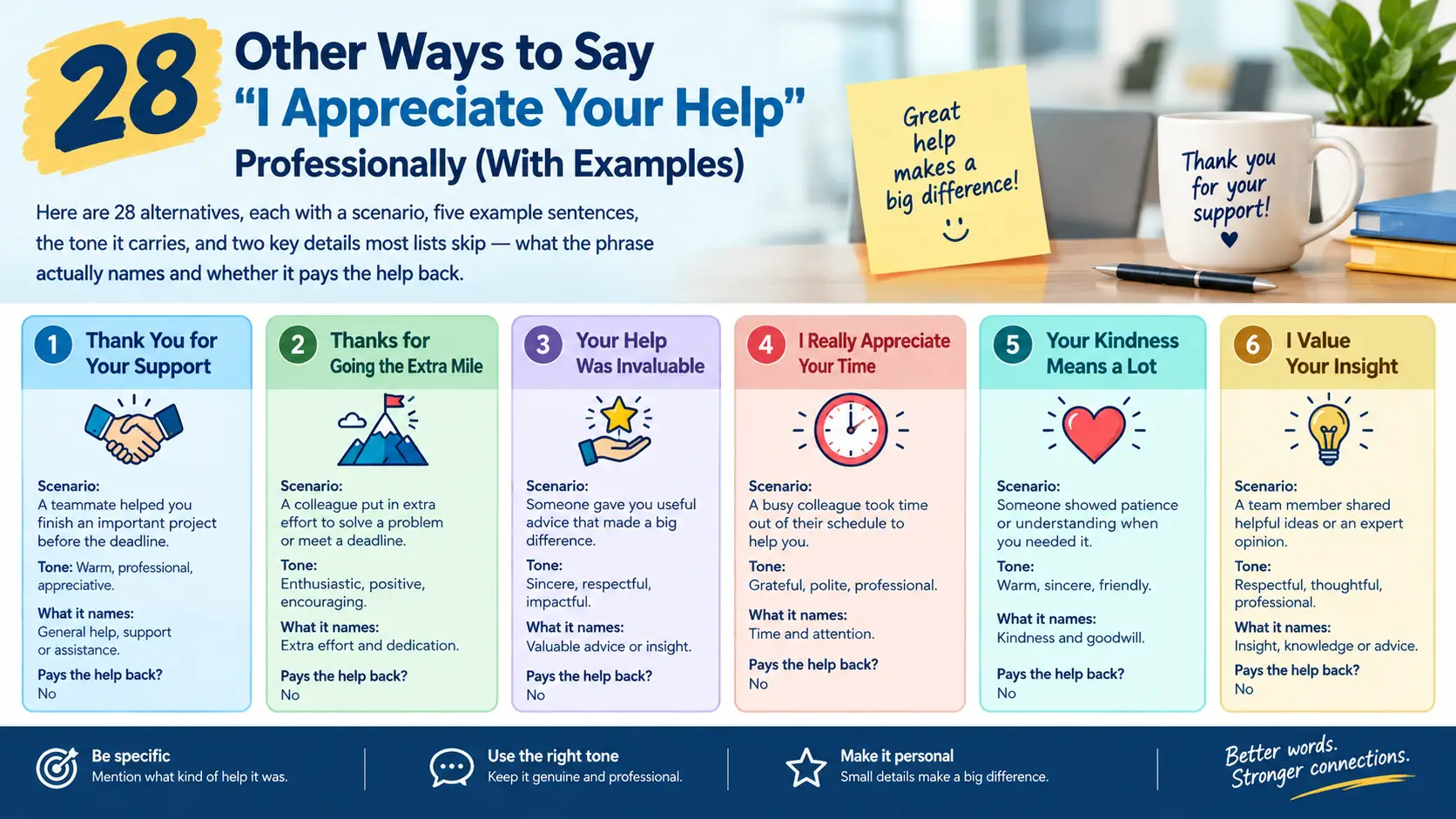
Looking for Other Ways to Say I Appreciate Your Help Professionally? Here are 28 alternatives, each with a scenario, five example sentences that contain the phrase, the tone it carries, and the two columns no other list on this subject includes — what the phrase actually names, and whether it pays the help back.
Those two columns exist because most appreciation vocabulary does neither. A reader who receives I appreciate your help learns that you have a feeling, and nothing about which help, what it produced, or whether anything comes back — and in a workplace those three things are the whole message.
The verb itself is the reason this phrase is slippery, and the dictionary makes it plain. Appreciate carries four distinct senses: to be grateful or thankful for; to view as valuable; to be fully conscious of, to understand, to be aware of, to detect; and, intransitively, to increase in value, with depreciate as its antonym. So one word does the work of thank, value, understand and rise in price, which is why the same four syllables can sound warm, evaluative, dismissive or financial depending on the sentence around them.
The third sense is the one that trips people up at work, and it is worth separating now. I appreciate your help uses the gratitude sense; I appreciate that the deadline is tight uses the understanding sense — and because the second construction is the standard English concession marker, a reader who sees I appreciate… at the start of a sentence braces for a but. That is the whole reason I appreciate your help, however… reads as a brush-off, and entry 28 is about telling the two apart deliberately.
There is a grammatical note that improves half the sentences below. Appreciate is a catenative verb that takes the gerund, which means I appreciate your helping me with the audit is the strictly correct form where most people write I appreciate your help with the audit. Both are understood everywhere and the noun version is now standard, but the gerund is useful when you want the emphasis on the act rather than the thing: I appreciate you staying late says more than I appreciate your help ever does.
And the word’s history explains its faintly transactional feel. Appreciate arrived in the 1640s from Medieval Latin appreciātus, valued or appraised, from ad plus pretium, price — the same root that gives appraise and precious, with the archaic spelling appretiate still on record. To appreciate something is literally to put a price on it, which is exactly why the financial sense exists alongside the grateful one and why appreciated can read as a valuation rather than a feeling.
Japanese encodes the same idea from the opposite direction, and the etymology is worth knowing before the language section below. ありがとう comes from ありがたく, the adverbial form of the Old Japanese and Classical Japanese adjective ありがたし — modern ありがたい, grateful, thankful, welcome — built from 有り, the stem of aru, to exist, plus 難し, hard, difficult, with katashi becoming gatashi through 連濁. So the Japanese thank-you means difficult to exist, hard to be — in other words, this is rare.
The dates are precise and they retire one popular myth. Arigatashi is first attested in the oldest literature of the 8th century, meaning difficult to exist, shifting to rare, special, and reaching welcome, thankful, nice to have by some time in the 15th century, with the sense still live in sentences such as kono tenki wa arigatai ne — this weather is welcome, literally hard to come by. The resemblance to Portuguese obrigado is purely coincidental: the Portuguese first arrived in Japan in 1543, well over a century after citations expressing gratitude are already found. The -u ending survives from a sound change in the Muromachi period that persists in a handful of set expressions — ありがとう, おはよう and おめでとう among them.
28 Other Ways to Say “I Appreciate Your Help” Professionally
Every entry has a scenario, five example sentences containing the phrase, and an attribute line ending in what the phrase names and whether it pays the help back.
This is the list in full, and it also answers other ways to say i appreciate your help, ways to say i appreciate your help, how to say i appreciate your help, how to say i appreciate your help professionally, what is another way to say i appreciate your help, what’s another way to say i appreciate your help, other words for i appreciate your help, i appreciate other ways to say, other ways to say i appreciate you, other ways to say i appreciate your assistance, other ways to say thank you for your help and another way to say thank you for your help — with dedicated sections below for time, effort, kindness, insight, support, email and Japanese.
1. Thank You for Your Support
The broadest of the standard options, and the one that most needs a noun after it.
Scenario: A teammate helped you finish an important project before the deadline.
Examples:
- Thank you for your support on the Henderson submission — it went in four days early.
- Thank you for your support through a fortnight of scope changes.
- Thank you for your support; the two evenings you gave it made the difference.
- Thank you for your support, and the overtime has been approved.
- Thank you for your support — I have told Elena it was your catch.
Why it works: It covers every kind of help in one phrase, which is its use and its weakness: support can mean labour, advice, cover, advocacy or encouragement. Naming which one turns a formula into a message, and the last two examples add what almost no thank-you does — something material, and credit passed upward. This also answers other ways to say thank you for your support and another way to say thank you for your support, with the full support section further down.
Tone: warm, professional | Formality: neutral to formal | Best for: teamwork, projects, email | Avoid in: highly formal legal documents | Names: nothing, unless you add the project | Pays it back: no, unless you attach something
2. I Truly Appreciate Your Assistance
The formal workhorse: the original phrase with a stronger intensifier and a cooler noun.
Scenario: A colleague solved a difficult work problem for you.
Examples:
- I truly appreciate your assistance with the reconciliation; it balanced to the penny.
- I truly appreciate your assistance in tracing the duplicate records back to the import.
- I truly appreciate your assistance — that problem had beaten me for two days.
- I truly appreciate your assistance on something well outside your remit.
- I truly appreciate your assistance, and the fix is now documented for everybody.
Why it works: Assistance is the register word of business English, formal enough for a client and neutral enough for a stranger. Truly is the safest intensifier in professional writing: greatly has gone stale through overuse, really is informal, and deeply is too strong for a routine thank-you. The fifth example adds the professional upgrade — documenting the fix means the help does not have to be given twice. This is the direct answer to another way to say thank you for your assistance.
Tone: sincere, respectful | Formality: formal | Best for: email, clients, cross-team requests | Avoid in: casual chats with friends | Names: the task, with the clause attached | Pays it back: no
3. Your Help Means a Lot
The warmest standard option, because it reports an effect on you rather than a judgement of them.
Scenario: A coworker stayed late to help you complete an urgent assignment.
Examples:
- Your help means a lot — I would not have got through that fortnight otherwise.
- Your help with the night shift means a lot, and I have said so to the manager.
- Your help means a lot; you stayed until nine when you did not have to.
- Your help means a lot, and I will take the next round of weekend cover.
- Your help during a rough month means a lot more than this email gets across.
Why it works: It describes an effect on a person rather than on a project, which is a larger and more believable claim than appreciation. It is also the entry that survives being said aloud, where I truly appreciate your assistance sounds like a letter being read. The fourth example is the one that matters between peers: an offer to return the favour converts a debt into a working relationship. For the lightest reply when they wave it off, see It’s my pleasure to help you.
Tone: warm, appreciative | Formality: informal to neutral | Best for: coworkers, peers, real favours | Avoid in: formal contracts, client correspondence | Names: the effect on you | Pays it back: yes, in the fourth example
4. I’m Grateful for Your Guidance
Upward thanks in the right register, and the word guidance flatters without flattering.
Scenario: Your manager provided valuable advice on a difficult project.
Examples:
- I’m grateful for your guidance on the pricing; the client accepted the middle option.
- I’m grateful for your guidance, and I have taken both of the introductions you offered.
- I’m grateful for your guidance on how to handle the committee — it worked exactly as you said.
- I’m grateful for your guidance throughout the promotion process, including the honest parts.
- I’m grateful for your guidance, and I will report back on how the conversation goes.
Why it works: Grateful is warmer than appreciative and still formal, which is a narrow and useful band for writing upward. And guidance names something senior people actually give: not labour, but judgement. The second and fifth examples do what almost nobody does, which is report back — advisers remember the people who tell them what happened, and the number who do is small.
Tone: respectful, sincere | Formality: formal | Best for: managers, mentors, advisers | Avoid in: very casual conversations | Names: the advice | Pays it back: partly — reporting back is the currency
5. Thank You for Your Valuable Input
For ideas rather than labour, and the only entry here that doubles as a way of closing somebody down.
Scenario: A teammate shared ideas that improved your presentation.
Examples:
- Thank you for your valuable input on the pricing tiers; the middle option came from you.
- Thank you for your valuable input in the retro — the deployment checklist exists because of it.
- Thank you for your valuable input, and the actions arising from it are in the notes below.
- Thank you for your valuable input on the accessibility review; it changed three decisions.
- Thank you for your valuable input, which challenged the assumption everybody else accepted.
Why it works: Thanking input encourages more of it, and the people with the best input are often the quietest in the room. The caution is real: thank you for your valuable input with nothing after it is a recognised way of ending a discussion, so the word valuable has to be earned by the next clause. Say what the input changed, as four of the five examples do, and the compliment becomes evidence. The wording for inviting it in the first place is in Please let me know your thoughts.
Tone: professional, appreciative | Formality: formal | Best for: meetings, reviews, consultations | Avoid in: informal texts, and as a way of closing a discussion | Names: the idea, with the change attached | Pays it back: no
6. I Sincerely Appreciate Your Time
Thanks for the one thing nobody gets back, which makes it the most serious entry in the set.
Scenario: Someone spent extra time helping you understand a process.
Examples:
- I sincerely appreciate your time this morning — forty minutes saved me a fortnight of guessing.
- I sincerely appreciate your time, and I have written up the steps so nobody asks you twice.
- I sincerely appreciate your time on a day when your diary was already full.
- I sincerely appreciate your time; I will keep the next one to fifteen minutes.
- I sincerely appreciate your time and the patience that went with it.
Why it works: Time is finite and unrecoverable, so naming it is more precise than naming help. The second and fourth examples contain the two moves that make this phrase land: writing the answer down so the same question never returns, and promising a smaller ask next time. This also answers another way to say i appreciate your time and other ways to say thank you for your time, with the full section on time further down.
Tone: respectful, formal | Formality: formal | Best for: clients, seniors, interviewers | Avoid in: casual workplace jokes | Names: the time | Pays it back: yes, with the second example
7. Thank You for Your Expertise
It thanks a capability rather than an action, which is how specialists prefer to be thanked.
Scenario: A specialist helped solve a technical issue.
Examples:
- Thank you for your expertise — nobody here would have found the indexing fault.
- Thank you for your expertise on the clause; the wording is now exactly right.
- Thank you for your expertise, and I have borrowed your method for the next one.
- Thank you for your expertise on the structural question, which was outside all of our training.
- Thank you for your expertise; the report is stronger for the single paragraph you rewrote.
Why it works: Expertise took years, and acknowledging it recognises the years rather than the twenty minutes. The third example is the highest compliment available in professional life, which is telling somebody you have adopted their method. Keep it for genuine specialists: used for a colleague who answered an easy question it inflates, and inflated thanks is discounted.
Tone: professional, respectful | Formality: formal | Best for: specialists, consultants, technical help | Avoid in: family conversations, routine favours | Names: the knowledge | Pays it back: partly — adoption is a form of credit
8. I Appreciate Your Dedication
Thanks for a pattern rather than an act, which makes it recognition rather than gratitude.
Scenario: A teammate consistently worked hard on a long project.
Examples:
- I appreciate your dedication across eighteen months and two scope changes.
- I appreciate your dedication to getting the documentation right when nobody was asking for it.
- I appreciate your dedication, and the leadership team has noticed it too.
- I appreciate your dedication through the quiet months, which is the part nobody sees.
- I appreciate your dedication, and time off is being arranged for next week.
Why it works: Thanking a pattern says you have been watching for longer than a week, which flatters more than a single compliment. It also carries a risk worth naming: said to somebody who has just worked three weekends, I appreciate your dedication can read as a request for a fourth. Pair recognition with relief, as the fifth example does — time back, a lighter sprint, a day off. The ongoing recognition register sits in Thank you for your cooperation.
Tone: encouraging, professional | Formality: neutral to formal | Best for: long projects, appraisals, recognition | Avoid in: informal social media chats | Names: a pattern of effort | Pays it back: yes, with relief attached
9. Your Assistance Was Invaluable
The strongest formal claim in the standard list, and one word in it is worth checking.
Scenario: Someone’s help prevented a major project problem.
Examples:
- Your assistance was invaluable — the error would have reached the client on Monday.
- Your assistance was invaluable during the outage; we were back inside the service level.
- Your assistance was invaluable, and the recovery plan is now written down because of it.
- Your assistance was invaluable on a day when three things failed at once.
- Your assistance was invaluable, and the board note says so by name.
Why it works: Invaluable means beyond price, so it belongs to help that genuinely averted something. The word is a useful illustration of the family this phrase belongs to: invaluable, appreciate, appraise and precious all come from the Latin pretium, price — which is why thanks in English so often sounds like a valuation. Used for ordinary help it is the clearest case of inflation on the page, and the fifth example shows the version with consequences: a name in a board note.
Tone: formal, appreciative | Formality: very formal | Best for: averted problems, project completion, references | Avoid in: casual conversations, routine tasks | Names: the outcome | Pays it back: yes, with the fifth example
10. Thank You for Going the Extra Mile
An idiom for effort beyond the job, and it needs the mile named.
Scenario: A colleague exceeded expectations to help you.
Examples:
- Thank you for going the extra mile — you rang the supplier yourself rather than passing it back.
- Thank you for going the extra mile on Thursday evening; the submission went in with an hour to spare.
- Thank you for going the extra mile and rewriting the section nobody had asked you to look at.
- Thank you for going the extra mile with a customer who was not being reasonable.
- Thank you for going the extra mile, and the overtime has been logged and approved.
Why it works: It acknowledges that somebody did more than the role required, which is the thing people most want noticed and least often hear. The idiom alone is a cliché, and the mile is what rescues it: ringing the supplier, the Thursday evening, the unrequested rewrite. The fifth example adds the only thing that matters after unpaid effort, which is a material acknowledgement rather than a warmer adjective.
Tone: warm, appreciative | Formality: neutral | Best for: recognition, unasked-for effort | Avoid in: legal writing, formal reports | Names: the extra effort, once specified | Pays it back: yes, with the fifth example
11. I Appreciate Your Commitment
Close to entry 8, and the difference is persistence against adversity rather than steady effort.
Scenario: A team member remained dedicated despite challenges.
Examples:
- I appreciate your commitment through a quarter in which almost nothing went right.
- I appreciate your commitment to the apprentices; three of them now run their own accounts.
- I appreciate your commitment, and the rota is being rewritten so it is not needed again.
- I appreciate your commitment to the standard rather than the deadline.
- I appreciate your commitment, and I have put it in writing to your manager.
Why it works: Commitment implies a choice to stay when leaving was available, which is a stronger compliment than diligence. The third example is the version a good manager sends: thanks plus a structural change, so the commitment is not demanded indefinitely. Written recognition, as in the fifth example, is the form that reaches an appraisal — spoken thanks is usually gone by the weekend.
Tone: professional, encouraging | Formality: formal | Best for: appraisals, long programmes, difficult quarters | Avoid in: short tasks, where it overstates | Names: sustained choice | Pays it back: yes, with a change or a record
12. Thank You for Your Encouragement
Thanks for words rather than work, which is the one thing people rarely bother to acknowledge.
Scenario: A colleague motivated you during a difficult project.
Examples:
- Thank you for your encouragement — the message on the Tuesday was the one that landed.
- Thank you for your encouragement during a project I nearly walked away from.
- Thank you for your encouragement; you were the only person who said it would work.
- Thank you for your encouragement, and you were right about the second version.
- Thank you for your encouragement, which cost you nothing and changed the week.
Why it works: Encouragement is forward-looking where thanks is backward-looking, so thanking it closes a loop the giver never expected to be closed. The third and fifth examples are the ones people remember receiving: being told that your words were the ones that worked is rarer than being thanked for labour. Say which message and when, because a specific memory proves it mattered.
Tone: warm, supportive | Formality: neutral | Best for: mentors, teammates, managers | Avoid in: formal documents | Names: the words and the moment | Pays it back: partly — reporting the effect is the return
13. Your Support Made a Difference
Impact rather than feeling, and the strongest of the standard options in a written thank-you.
Scenario: A manager supported your professional growth.
Examples:
- Your support made a difference — the role I am in now came out of that conversation.
- Your support made a difference to a decision that could have gone either way.
- Your support made a difference; the funding came through because you argued for it in the room.
- Your support made a difference to the whole team, not only to me.
- Your support made a difference, and I have said so to the people who make the decisions.
Why it works: It names an outcome, and an outcome is the only kind of thanks that cannot be dismissed as politeness. The third example captures the thing most worth thanking a senior person for, which is advocacy in a room you were not in — and telling them you know about it is the whole point. Note that the competitor’s own list loses this entry’s heading entirely, which is a shame, because it is the best phrase they offer.
Tone: sincere, appreciative | Formality: neutral to formal | Best for: thank-you emails, recognition messages, advocacy | Avoid in: trivial favours | Names: the outcome | Pays it back: yes, by reporting it onward
14. Many Thanks for Your Assistance
British, brisk and slightly dated, which is exactly why it works in a two-line email.
Scenario: A client quickly responded to your request.
Examples:
- Many thanks for your assistance — the figures arrived in time for the board pack.
- Many thanks for your assistance with the access request; the team is unblocked.
- Many thanks for your assistance in chasing the signature through their legal team.
- Many thanks for your assistance, and nothing further is needed from your side.
- Many thanks for your assistance on the site arrangements, which were faultless.
Why it works: It is short enough to close an email without ceremony, and the plural thanks does the work that very much would otherwise do. It carries a British accent: common in London offices and much rarer in American business email, where thanks so much fills the slot. The one thing to avoid is stacking it with a new request — many thanks for your assistance, could you also… turns the thanks into a preface, and readers feel the hinge. Row four is the professional upgrade: a status, not a sentiment.
Tone: polite, professional | Formality: formal | Best for: email, quick exchanges, clients | Avoid in: highly casual settings | Names: the task | Pays it back: no
15. I Value Your Contribution
Value rather than appreciate, which is a judgement rather than a feeling — and that is the point.
Scenario: A teammate played an important role in a successful project.
Examples:
- I value your contribution — the pricing model was yours from the first draft.
- I value your contribution to the working group, and the papers now reflect your point.
- I value your contribution; you ask the question nobody else is willing to ask.
- I value your contribution to a workstream that would not exist without you.
- I value your contribution, and the slide credits each workstream by name.
Why it works: Value implies assessment, which flatters a senior or expert colleague more than warmth does. It is also one of the few entries that works upward without sounding presumptuous, because reporting that you find somebody’s input valuable is a statement about you rather than a grade for them. The third example is the specific compliment most worth paying: naming somebody as the person who asks the hard question.
Tone: respectful, appreciative | Formality: formal | Best for: committees, teams, cross-functional work | Avoid in: casual chats | Names: the specific contribution | Pays it back: yes, with public credit
16. Thank You for Your Cooperation
The institutional phrase, correct in a notice and faintly cool one to one.
Scenario: A coworker worked closely with you to complete an important assignment.
Examples:
- Thank you for your cooperation throughout the audit; the fieldwork closed four days early.
- Thank you for your cooperation with the new approval step while we fix the cause.
- Thank you for your cooperation on the joint standup, which is staying in place.
- Thank you for your cooperation during the migration weekend.
- Thank you for your cooperation — and the duplicate request is being removed for next year.
Why it works: It is the standard phrasing for compliance and joint process, and in a notice to many people its impersonality is appropriate rather than cold. Between two colleagues it understates: cooperation describes going along with something, where a teammate who worked beside you collaborated. Use collaboration for joint work and keep cooperation for process, and the fifth example shows the repair that makes the institutional version bearable — removing the burden you are thanking them for absorbing. The full set is in Thank you for your cooperation.
Tone: professional, respectful | Formality: formal | Best for: process, audits, notices | Avoid in: warm one-to-one thanks | Names: compliance | Pays it back: yes, when you remove the burden
17. I’m Thankful for Your Advice
Warm, slightly old-fashioned, and the right phrase when the advice was personal.
Scenario: A mentor offered valuable career guidance.
Examples:
- I’m thankful for your advice — I applied for the role and it starts in January.
- I’m thankful for your advice about not taking the first offer.
- I’m thankful for your advice, especially the part I did not want to hear.
- I’m thankful for your advice on the conversation with my manager; it went exactly as you predicted.
- I’m thankful for your advice, and I have passed it on to somebody in the same position.
Why it works: Thankful is warmer and less transactional than appreciative, which suits advice given out of goodwill rather than duty. Note the usage drift: in modern English thankful leans towards circumstances — thankful it was not worse — while grateful kept the interpersonal sense, so I’m grateful for your advice is the slightly more natural form. The third and fifth examples are the ones advisers remember: acknowledging the unwelcome part, and passing the advice on.
Tone: warm, appreciative | Formality: neutral | Best for: mentors, personal guidance | Avoid in: formal client correspondence | Names: the advice | Pays it back: yes, by passing it on
18. I Appreciate Your Prompt Response
Thanks for speed specifically, which is the most under-recognised favour in professional life.
Scenario: A client quickly answered an urgent request.
Examples:
- I appreciate your prompt response — the quote went out the same afternoon.
- I appreciate your prompt response on the contract query; the signing is back on schedule.
- I appreciate your prompt response, especially given how little notice we gave you.
- I appreciate your prompt response; it let us close the ticket inside the service level.
- I appreciate your prompt response to the security questionnaire, which unblocked procurement.
Why it works: Speed is measurable, so this is one of the few entries whose claim a reader verifies. It also has a persuasive side effect: thanking somebody for a fast reply tends to produce another one, which is the practical case for noticing it. This answers other ways to say thank you for your cooperation in its process sense too, as well as another way to say i appreciate your prompt response, another way to say i appreciate your quick response, other ways to say thank you for your prompt response and other ways to say thank you for your quick response — and the full set of alternatives sits in Thank you for your quick response.
Tone: professional, polite | Formality: formal | Best for: email replies, urgent requests, clients | Avoid in: social conversation | Names: the speed | Pays it back: no
19. Thank You for Your Patience
Thanks for waiting, and the most commonly mistimed phrase in customer service.
Scenario: Someone waited while you resolved an unexpected issue.
Examples:
- Thank you for your patience — the index is rebuilt and search is back to normal speed.
- Thank you for your patience through three rescheduled calls; the report is attached.
- Thank you for your patience on the refund, which cleared this morning.
- Thank you for your patience during the maintenance window, which finished early.
- Thank you for your patience — the root cause was ours, and here is what changed.
Why it works: It names a specific thing the other person supplied, which is time, and it concedes that they had to spend it. The failure mode is timing: sent while somebody is still waiting it reads as a request for more patience, which is why it is the sentence people quote back sarcastically from queue messages. Send it when the wait is over and pair it with the resolution, as all five examples do. This answers other ways to say thank you for your patience and other ways to say i appreciate your patience, and the wording for the update itself is in Thank you for the update.
Tone: respectful, considerate | Formality: formal | Best for: delays, service recovery, rescheduling | Avoid in: mid-wait messages | Names: the waiting | Pays it back: yes, with the resolution attached
20. I’m Grateful for Your Continued Support
The loyalty phrase, and it needs a number or a year to mean anything.
Scenario: A long-term client consistently supports your business.
Examples:
- I’m grateful for your continued support — this is the fourth year of the partnership.
- I’m grateful for your continued support through two pricing changes and a platform migration.
- I’m grateful for your continued support; your renewal arrived before we sent the reminder.
- I’m grateful for your continued support, and the account team is unchanged for next year.
- I’m grateful for your continued support, which has shaped the roadmap more than any other account.
Why it works: It recognises duration, which is the one thing a new customer cannot supply and a long-standing one notices being ignored. Unsupported it is the weakest phrase here, because continued support is what every automated renewal email says. Attach the span, the number or the thing that changed because of them, as four of the five examples do. This also covers other ways to say thank you for your continued support, other ways to say we appreciate your business, other ways to say thank you for your business, other ways to say thank you for your patronage and other ways to say thank you for your purchase — all of which improve the same way, with a count rather than an adjective.
Tone: warm, professional | Formality: formal | Best for: renewals, long clients, donors | Avoid in: one-off transactions | Names: duration, once you add it | Pays it back: yes, with continuity or a concession
21. Thank You for Helping Make This Possible
Event language, and the most generous construction available: it hands over the credit.
Scenario: Several teammates contributed to a successful event.
Examples:
- Thank you for helping make this possible — two hundred and forty people came through the doors.
- Thank you for helping make the conference possible; the volunteer rota never had a gap in it.
- Thank you for helping make this possible, and the fund closed at £31,000.
- Thank you for helping make the open day possible, from the signage to the coffee.
- Thank you for helping make this possible; the photographs are in the shared album.
Why it works: It gives the achievement away, which is the most reliable way to be thanked yourself next time. Numbers make it real — an attendance figure, a total raised, a count of volunteers — and without them this is a pronoun that cannot be grateful for anything in particular. It is also the right phrase for a group, where the warmer one-to-one options would single somebody out.
Tone: appreciative, inspiring | Formality: neutral | Best for: events, campaigns, launches, groups | Avoid in: minor favours | Names: the outcome, with a number | Pays it back: yes — it transfers the credit
22. I Truly Value Your Efforts
Effort rather than outcome, which makes it honest when the result went badly.
Scenario: A coworker consistently puts extra effort into every assignment.
Examples:
- I truly value your efforts — three weekends on the tender, whatever the decision is.
- I truly value your efforts on the recovery; six people would have lost work otherwise.
- I truly value your efforts, and the hours are logged and approved.
- I truly value your efforts over a quarter in which almost nothing landed.
- I truly value your efforts, and the on-call rota is being rewritten because of them.
Why it works: Effort is the part anybody controls, so praising it is fair where praising results is luck-dependent. The caution is familiar: effort praise after a visible failure reads as consolation — at least you tried. Attach either a consequence or a change, as the second, third and fifth examples do, and it becomes recognition rather than sympathy. This answers another way to say i appreciate your efforts.
Tone: sincere, respectful | Formality: formal | Best for: near-misses, long effort, appraisals | Avoid in: clear wins, where it understates | Names: the effort | Pays it back: yes, with hours or a change
23. Your Professionalism Is Appreciated
Thanks for conduct under pressure, and the phrase has a faint edge worth knowing.
Scenario: A business partner handled a difficult situation professionally.
Examples:
- Your professionalism is appreciated — the complaint was handled better from your side than ours.
- Your professionalism is appreciated, particularly with the outgoing supplier in the room.
- Your professionalism is appreciated; the correction has been issued and the account notes updated.
- Your professionalism is appreciated during a negotiation that could have soured.
- Your professionalism is appreciated, and I have said so to your director.
Why it works: It names conduct rather than output, which is the rarest thing to be thanked for and the most remembered. The edge is implicit: thanking somebody for professionalism implies that unprofessional behaviour was available, which is a compliment in a dispute and slightly odd after an easy meeting. Keep it for the hard occasions, where it is both accurate and generous. For the formal sign-off that often follows, see Thank you for your approval.
Tone: formal, respectful | Formality: very formal | Best for: disputes, complaints, handovers | Avoid in: casual conversation, routine work | Names: conduct | Pays it back: yes, with the fifth example
24. Thank You for Your Thoughtful Assistance
It praises the care taken rather than the help given, which is a finer distinction than it looks.
Scenario: Someone carefully helped you solve a complicated problem.
Examples:
- Thank you for your thoughtful assistance — you answered the question I should have asked.
- Thank you for your thoughtful assistance; the worked example was better than the specification.
- Thank you for your thoughtful assistance, and for not making me feel foolish about it.
- Thank you for your thoughtful assistance on something you could have handed back.
- Thank you for your thoughtful assistance, and the notes you wrote are now in the handbook.
Why it works: Thoughtful says somebody considered what you actually needed rather than what you asked for, which is the difference between help and good help. The first and third examples are the ones worth copying: being answered on the real question, and being helped without being made to feel stupid. The fifth shows the compounding version — help that becomes documentation helps everybody after you. The register for acknowledging information received is in Thank you for the information.
Tone: professional, thoughtful | Formality: formal | Best for: complex problems, teaching moments | Avoid in: quick favours, where it is heavy | Names: the care taken | Pays it back: partly — documenting it is the return
25. I Couldn’t Have Done It Without Your Support
The warmest and most quoted option, and the one that concedes the most.
Scenario: A colleague played a key role in your success.
Examples:
- I couldn’t have done it without your support — and I have said exactly that to the panel.
- I couldn’t have done it without your support; the model was half yours.
- I couldn’t have done it without your support, and I would like you in the room when it is presented.
- I couldn’t have done it without your support on a deadline neither of us chose.
- I couldn’t have done it without your support, and the write-up credits you by name.
Why it works: It cedes part of the achievement, which is a real cost and therefore a real compliment. Used loosely it becomes a politeness formula — said about help that was marginal, it reads as modesty theatre. Used accurately it is the strongest thanks in the list, and the first, third and fifth examples show the versions with consequences attached: a word to the panel, a seat in the room, a name in the write-up. This answers another way to say i really appreciate your help and how do you say i really appreciate your help, with more in the section below.
Tone: heartfelt, appreciative | Formality: neutral to formal | Best for: genuine joint achievements | Avoid in: marginal help, where it is false modesty | Names: the dependence | Pays it back: yes, with public credit
3 More Alternatives You Will Not Find on Other Lists
All twenty-five above report a feeling about help that has already happened. These three name what the help cost you in saved time or money, report that you no longer need to ask, and separate the two senses of appreciate that cause most of the confusion in professional email.
26. Your Help Saved Me [the Specific Cost]
A template rather than a phrase, and the only construction here that a reader can verify.
Scenario: Any help whose effect you can measure — hours, money, a missed deadline, an averted error.
Examples:
- Your help saved me two days of chasing — I would still be in the archive without it.
- Your five minutes saved me an afternoon, which is the best exchange rate I will get this week.
- Your help saved us a £6,000 overpayment; the duplicate line was invisible from my side.
- Your help saved the Monday filing. Nothing else would have.
- Your help saved me from sending the wrong version to the client, which is a different kind of debt.
Why it works: It converts gratitude into arithmetic, and arithmetic is believed where adjectives are discounted. It also passes the only test that matters for a thank-you: the person could not have received it without knowing it was about them, because the figure is a fact only the two of you share. And it makes the help visible to anybody the message is forwarded to — a line saying your help saved us a £6,000 overpayment is quotable in an appraisal, where I truly appreciate your assistance cannot. Where no number exists, name the averted consequence instead, as the fourth and fifth examples do. The formal request version of the same discipline is in It would be greatly appreciated.
Tone: specific, evidential, warm | Formality: any | Best for: every workplace thank-you where an effect is known | Avoid in: cases where you are guessing at the figure | Names: the saving, by construction | Pays it back: yes — it is quotable evidence
27. I Haven’t Had to Ask Since — You Taught Me That
The thanks that reports a transfer of capability, which is the rarest kind to receive.
Scenario: Somebody who showed you how rather than doing it for you — weeks or months after the fact.
Examples:
- I haven’t had to ask since — you taught me that, and I have taught two other people.
- Six months on, I still use the method you showed me in March.
- I haven’t had to raise a ticket for this since you walked me through it.
- You showed me once and it stuck. That is the most useful twenty minutes anybody gave me this year.
- I haven’t had to ask since, which I know was the point of how you explained it.
Why it works: Most thanks arrives within a day and reports a feeling; this arrives months later and reports an outcome in you. Nobody ever hears it, which is precisely why it lands — the person who taught you has no way of knowing whether it worked unless you tell them. It also credits the way they helped: showing rather than doing, which costs more at the time and is almost never acknowledged. The first example adds the compounding version: the knowledge passed on to two more people, which is the return on their twenty minutes.
Tone: specific, generous, unexpected | Formality: any | Best for: teachers, trainers, patient colleagues, mentors | Avoid in: cases where you have in fact asked again | Names: the capability transferred | Pays it back: yes, by passing it on
28. “I Appreciate That” Is Not Thanks — Telling the Two Senses Apart
The same verb means I am grateful and I understand, and in an email the second reading usually wins.
Scenario: Any message where you are both thanking somebody and disagreeing with them, or conceding a point before making your own.
Examples:
- I appreciate the deadline is tight — and here is what we can do by Thursday. (understanding, not thanks)
- Thank you for the figures. Separately: I appreciate that the method is contested, and I still prefer it. (both senses, kept apart)
- I am grateful for your help, and I disagree about the second recommendation. (gratitude, stated plainly)
- I take the point about timing. Thank you for the analysis, which stands on its own. (concede, then thank)
- I appreciate your help — full stop, no however coming. (the version that reassures)
Why it works: It stops a thank-you from being read as a preface to a rebuttal. The dictionary carries both senses: appreciate means to be grateful or thankful for, and also to be fully conscious of, to understand, to be aware of — and because I appreciate that… is the standard English concession marker, readers brace for the but. Three rules follow. Use grateful when you mean thanks and reserve appreciate for the concession; put the two in separate sentences; and if a thank-you has no caveat attached, say so, because the reader cannot tell from the verb alone. The fifth example is worth keeping for exactly that — a sentence that promises no however is a small kindness in a tense thread. The wording for flagging the disagreement itself sits in Thank you for letting me know.
Tone: precise, candid, professional | Formality: any | Best for: negotiations, disagreements, mixed messages | Avoid in: straightforward thanks, where it overthinks it | Names: which sense you mean | Pays it back: not applicable — it prevents a misread
Quick Comparison Table
All 28 alternatives, with what each phrase names and whether it pays the help back. The two right-hand columns are the reason some thank-you emails get kept and most get deleted.
| Phrase | Tone | Best for | Avoid in | What it names | Pays it back |
|---|---|---|---|---|---|
| 1. Thank You for Your Support | Warm | Teamwork, projects | Legal documents | Nothing, unless you add the project | No, unless attached |
| 2. I Truly Appreciate Your Assistance | Sincere | Email, clients | Casual chats | The task, with a clause | No |
| 3. Your Help Means a Lot | Friendly | Coworkers, real favours | Formal contracts | The effect on you | Yes, with an offer |
| 4. I’m Grateful for Your Guidance | Respectful | Managers, mentors | Very casual talk | The advice | Partly — report back |
| 5. Thank You for Your Valuable Input | Professional | Meetings, reviews | Closing a discussion | The idea, with the change | No |
| 6. I Sincerely Appreciate Your Time | Polite | Clients, seniors | Casual jokes | The time | Yes, if you write it down |
| 7. Thank You for Your Expertise | Formal | Specialists, consultants | Family, routine favours | The knowledge | Partly — adoption |
| 8. I Appreciate Your Dedication | Appreciative | Long projects, appraisals | Social media chats | A pattern of effort | Yes, with relief |
| 9. Your Assistance Was Invaluable | Very formal | Averted problems | Routine tasks | The outcome | Yes, with a record |
| 10. Thank You for Going the Extra Mile | Warm | Unasked-for effort | Legal writing | The extra effort, once named | Yes, materially |
| 11. I Appreciate Your Commitment | Professional | Difficult quarters | Short tasks | Sustained choice | Yes, with a change |
| 12. Thank You for Your Encouragement | Supportive | Mentors, teammates | Formal documents | The words and the moment | Partly |
| 13. Your Support Made a Difference | Sincere | Advocacy, recognition | Trivial favours | The outcome | Yes, reported onward |
| 14. Many Thanks for Your Assistance | Polite, British | Short email | Very casual settings | The task | No |
| 15. I Value Your Contribution | Respectful | Committees, teams | Casual chats | The contribution | Yes, public credit |
| 16. Thank You for Your Cooperation | Institutional | Process, audits, notices | Warm one-to-one thanks | Compliance | Yes, if you remove the burden |
| 17. I’m Thankful for Your Advice | Warm | Mentors, personal guidance | Client correspondence | The advice | Yes, by passing it on |
| 18. I Appreciate Your Prompt Response | Professional | Email replies, urgency | Social conversation | The speed | No |
| 19. Thank You for Your Patience | Considerate | Delays, service recovery | Mid-wait messages | The waiting | Yes, with the resolution |
| 20. I’m Grateful for Your Continued Support | Warm | Renewals, long clients | One-off transactions | Duration, once added | Yes, with continuity |
| 21. Thank You for Helping Make This Possible | Inspiring | Events, groups | Minor favours | The outcome, with a number | Yes — transfers credit |
| 22. I Truly Value Your Efforts | Sincere | Near-misses, appraisals | Clear wins | The effort | Yes, with hours or change |
| 23. Your Professionalism Is Appreciated | Very formal | Disputes, handovers | Routine work | Conduct | Yes, told upward |
| 24. Thank You for Your Thoughtful Assistance | Thoughtful | Complex problems | Quick favours | The care taken | Partly — documenting it |
| 25. I Couldn’t Have Done It Without Your Support | Heartfelt | Joint achievements | Marginal help | The dependence | Yes, public credit |
| 26. Your help saved me [the specific cost] | Evidential | Any measurable help | Guessed figures | The saving, by construction | Yes — quotable evidence |
| 27. I haven’t had to ask since — you taught me that | Generous | Teachers, patient colleagues | Where you did ask again | The capability transferred | Yes, by passing it on |
| 28. “I appreciate that” is not thanks | Precise | Disagreements, mixed messages | Straightforward thanks | Which sense you mean | Prevents a misread |
Three patterns, and the first is the one the other lists never report.
First, six of the twenty-five standard alternatives name nothing at all without help from a neighbouring clause. Thank you for your support, many thanks for your assistance and their relatives are complete sentences that tell the reader only that you have a feeling — and nine of the twenty-five name something genuinely specific: the time, the speed, the outcome, the conduct, the advice. The fix is one clause, and it is the cheapest improvement available on this page.
Second, thirteen of the twenty-five can pay the help back, and almost nobody uses them that way. Paying it back means something concrete in the same message: approved overtime, written recognition, public credit, documentation so the question never returns, a rota change, or an offer to take the next shift — and that is the difference between thanks and a transaction completed. Entry 13 is the sharpest of the standard set, because reporting somebody’s advocacy onward is both thanks and currency.
Third, two entries fail on timing rather than wording. Thank you for your patience sent mid-wait reads as a request for more of it, and I appreciate your dedication sent to somebody who has just worked three weekends reads as a request for a fourth. Both are repaired the same way: send them when the thing is over, and attach the relief.
Why Varying Your Gratitude Matters
Because the phrase has to carry three pieces of information the standard version leaves out: which help, what it produced and whether anything comes back.
The Limits of a Repeated Phrase
Eight ways this phrase wears out, and six of them are repaired by one clause.
| The pattern | What happens | The fix |
|---|---|---|
| Every email ends the same way | It becomes part of your signature block | Vary it, or attach the effect |
| Sent with no detail | The reader learns only that you have a feeling | Name the task, the time or the saving |
| Sent with a new request attached | The thanks reads as a run-up | Two sentences, or two messages |
| Sent for help that cost somebody an evening | Words against a real cost | Add overtime, credit or a rota change |
| Sent as I appreciate that… | The reader hears I understand, but | Use grateful when you mean thanks |
| Sent mid-wait or mid-crunch | It asks for more of the same | Wait until it is over |
| Sent to a whole team with no names | Each reader assumes it is about somebody else | General line plus two named credits |
| Sent months late with no reason | It reads as an afterthought | Say why now: six months on, I still use it |
The repetition problem is the mild one and the specificity problem is the real one. A reader who sees the same closing on every email simply stops reading it, which costs an opportunity rather than any goodwill; a reader who cannot tell what you are thanking them for has been sent a formula. Row four is the one with consequences: appreciation words set against an evening of somebody’s unpaid time are read as a substitute for payment, which is how goodwill gets spent.
Row five is the structural trap, and it comes from the verb itself. Appreciate means both to be grateful for and to be fully conscious of, to understand, to be aware of — so I appreciate that… is heard as a concession with a but behind it. When you mean thanks, grateful is the unambiguous word, and entry 28 covers the distinction in full.
Matching Tone to Context
Six questions, in this order, and the phrase chooses itself.
| The question | The options | What it decides |
|---|---|---|
| Who helped | Peer, senior, junior, client, supplier, stranger | Decides the register and the noun |
| What they gave | Labour, time, expertise, advocacy, patience, encouragement | Six different gifts, six different phrases |
| What it cost them | Minutes, an evening, political capital, their own deadline | Decides whether words are enough |
| What it produced | Hours saved, money saved, an averted error, a decision | The strongest thing you can name |
| Channel | Chat, email, letter, in person, appraisal | Chat takes four words; an appraisal takes a sentence |
| Can you pay it back | Credit, documentation, cover, approval, a return favour | If yes, do that instead of adding an adverb |
The second question does most of the work, because help is six things wearing one word. Labour, time, expertise, advocacy, patience and encouragement are different gifts, and thanking the wrong one is the commonest misfire — a specialist thanked for their support rather than their expertise hears that you did not notice what you were given. Name the gift and the sentence writes itself.
The last question is the one that separates a courteous message from a complete one. If you can approve the overtime, write to their manager, credit them publicly, document the answer or take the next shift, do that — and let the thanks be short. An adverb costs nothing and is worth nothing; a line in an appraisal costs a minute and is worth a great deal.
What Does “I Appreciate Your Help Professionally” Mean?
It means you are expressing sincere gratitude for somebody’s support, guidance, effort or assistance in a work-related setting: it shows respect, professionalism and acknowledgment of another person’s contribution.
The verb is doing more work than the sentence admits, which is the useful thing to know about it. Appreciate carries four senses: to be grateful or thankful for; to view as valuable; to be fully conscious of, understand or detect; and, intransitively, to increase in value — with depreciate as the antonym of the last. In I appreciate your help the first sense is active, in I appreciate that the deadline is tight the third is, and the financial sense sits behind both, since the word reached English in the 1640s from Medieval Latin appreciātus, valued or appraised, from ad plus pretium, price.
There is also a grammatical point that improves the sentences below. Appreciate is a catenative verb that takes the gerund, so the strictly correct form is I appreciate your helping me, where modern usage prefers the noun: I appreciate your help. Both are standard, and the gerund is the better choice when the act matters more than the thing — I appreciate you staying late says something I appreciate your help does not.
When to Use “I Appreciate Your Help Professionally”
Use it to thank a coworker for assisting with a project, to show appreciation to your manager for guidance, to recognise a client’s support, to acknowledge teamwork after completing a task, and to express gratitude in emails, meetings or messages.
Two refinements decide whether it lands. First, timing: thanks arriving the same day is worth several times the same words a week later, because the act is still in both memories — with one exception, which is thanks for a transfer of capability, where months later is better. Second, proportion: match the weight of the phrase to the weight of the help, since your assistance was invaluable about a forwarded email inflates, and thanks about a rescued deadline understates.
And one setting calls for a different construction entirely. When the thanks sits in the same message as a disagreement, split them: thank in one sentence and concede in another, because the reader cannot tell which sense of appreciate you mean from the verb alone. When the thanks sits in the same message as a new request, split those too — gratitude attached to an ask is read as a preface. The wording for the request half is in It would be greatly appreciated.
Pros and Cons of “I Appreciate Your Help Professionally”
Pros: it is professional and respectful, easy to understand, suitable for almost every workplace, and shows gratitude without sounding too casual. Cons: it sounds repetitive, feels generic if overused, lacks personality, and does not always fit informal teams.
Pros
The advantages are real, and two of them are structural rather than stylistic.
It is safe in every direction: upward, downward and outward, to a stranger or a chief executive, with no risk of over-familiarity — which is more than the warmer options manage. It is also understood instantly by readers for whom English is a second or third language, since a plain Latinate formula travels further across a multinational than an idiom does. And it scales: the same phrase works on the hundredth email of the week, which is a genuine operational property rather than a literary one.
Cons
The listed drawbacks are about freshness, and the two that matter are about content.
The first is that the phrase names nothing: it reports a feeling and leaves the reader to work out which help, what it produced and whether anything follows. The second is the ambiguity in the verb itself, which means a thank-you built on appreciate is read as a concession rather than gratitude — especially at the start of a sentence, and especially in a thread where you have been disagreeing. Both are fixed in one line: name the thing, state the effect, and use grateful where you mean thanks.
Why Do We Need to Use “I Appreciate Your Help Professionally”?
Because acknowledging help properly strengthens working relationships, makes the next request easier to grant, and records a contribution that would otherwise go unnoticed.
And because the alternatives are not synonyms, which is the practical reason for having twenty-eight of them. Your time thanks something finite, your expertise thanks years of training, your patience thanks forbearance, your prompt response thanks speed, your professionalism thanks conduct, your support made a difference thanks an outcome, and your help saved me two days thanks with a number — seven different acts that one phrase flattens into a mood. Choosing the right one is the difference between being polite and being understood. For the version that acknowledges somebody has told you something, see Thank you for letting me know.
Professional Alternatives for the Workplace
At work the upgrade is never a warmer adverb: it is the task, the saving, the record or the return.
How to Say “I Appreciate Your Help” Professionally
| Phrase | What it adds | Best for |
|---|---|---|
| I’m grateful for your help with the audit | Names the task, uses the unambiguous verb | Any professional register |
| Thank you for your help on this — it saved two days | Thanks plus the saving | Internal email |
| I truly appreciate your assistance with the reconciliation | Formal, specific | Clients, cross-team |
| Your help on the submission made the difference | Outcome rather than feeling | Recognition messages |
| Thank you — and nothing further is needed from you | Thanks plus a status | Client service |
| I’m grateful for your time this morning | Thanks for the finite thing | Seniors, interviewers |
| Thank you for the expertise; I have borrowed the method | Thanks plus adoption | Specialists |
| Noted with thanks, and the fix is documented | Brisk and complete | Operations, support |
| Thank you. I have put it in writing to your manager | Thanks plus a record | Reports, contractors |
| I’m grateful, and the overtime is approved | Thanks plus money | Unpaid extra effort |
For how to say i appreciate your help professionally and professional way to say i appreciate your help, the first row is the simplest improvement available. Swap appreciate for grateful and add the task: I’m grateful for your help with the audit is unambiguous, specific and no longer than the original. The bottom three rows are the versions with consequences — documentation, a written note to a manager, approved overtime — and those are the ones remembered a year later.
A Better Way to Say “I Appreciate Your Help”
| Instead of | Write | What changed |
|---|---|---|
| I appreciate your help | Your help saved me two days of chasing | A saving, quantified |
| I appreciate your help | I’m grateful you rang the supplier yourself | The act, named |
| I appreciate your help | Thank you — I have told Elena it was your catch | Credit transferred |
| I appreciate your help | Thank you, and the steps are now in the shared document | Documented, so it is not needed twice |
| I appreciate your help | I haven’t had to ask since — you taught me that | Capability transferred |
| I appreciate your help | Thank you, and I will take your Thursday clinic | Reciprocity, concretely |
For better way to say i appreciate your help, every row on the right replaces a feeling with a fact. A saving, a named act, credit passed on, documentation, a capability transferred, or a favour returned — those six are the complete set of upgrades this phrase has. There is no adjective that improves it, which is why swapping appreciate for truly appreciate changes nothing at all.
Thank-You Alternatives for Assistance
| The context | What to write | The move |
|---|---|---|
| another way to say thank you for your assistance | I’m grateful for your assistance with [the task] | Agent plus object |
| Formal letter | I should be grateful for your assistance in this matter | Traditional register |
| another way to say thank you for your assistance with this matter | Thank you for your assistance in resolving the matter | Names the resolution |
| Short email | Many thanks for your assistance — all received | Thanks plus a status |
| Client-facing | Thank you for your assistance; nothing further is outstanding | Closes the loop |
| After a problem | Your assistance was invaluable — the error never reached the client | Averted consequence |
| To a specialist | Thank you for the assistance on the technical annexe | Names the artefact |
| On the record | Your assistance is noted in the project log by name | Written credit |
Assistance is the formal register word, and it carries a slight coolness that is useful outward and limiting downward. Thanking a junior colleague for their assistance can read as distant where help reads as human, so keep the formal noun for clients, strangers and letters. Row two is the traditional British construction — I should be grateful for your assistance in this matter — which is correct in correspondence and comic in chat.
Thank-You Alternatives for Help on a Task
| The situation | What to write | The move |
|---|---|---|
| another way to say thank you for your help | I’m grateful for your help with the pricing section | Task named |
| another way to say thank you for your help with this | Thank you for your help with this — the client signed on your version | Outcome attached |
| Quick internal note | Thanks for the help on p3 — sorted | Four words plus a status |
| Thanks for a rescue | You saved the Monday filing. Nothing else would have. | Consequence, stated plainly |
| Thanks for a small favour | Thanks — that was two minutes for you and an afternoon for me | Exchange rate named |
| Thanks in a group channel | Thanks all — and Ravi rebuilt the index twice | General plus named credit |
| Thanks to somebody junior | Thank you for taking that on. I have said so to your manager. | Thanks plus a record |
| Thanks to somebody senior | I’m grateful for the ten minutes; it saved a fortnight of guessing | Time plus saving |
For another way to say thank you for your help with this, the fix is to replace this with the thing. This is a pronoun, and a pronoun cannot be thanked for anything in particular — the pricing section, page three, the Monday filing. Row five is the most quoted version in offices: naming the exchange rate, two minutes against an afternoon, makes the scale of the favour explicit without exaggerating it. The acknowledgement for information rather than labour sits in Thank you for the information.
Emphasizing Genuine Gratitude
For real emphasis, swap the intensifier for a fact: a number, a debt acknowledged, or a word of credit to somebody who matters.
How Do You Say “I Really Appreciate Your Help”?
| Instead of | Write | Why it is stronger |
|---|---|---|
| I really appreciate your help | I can’t tell you how much that helped | Reports an inability to measure it |
| I really appreciate your help | You saved me two days. Genuinely. | A number plus one word |
| I really appreciate your help | I owe you one, and I mean it | Debt acknowledged |
| I really appreciate your help | That was above anything I could have asked for | Names the excess |
| I really appreciate your help | I couldn’t have done it without you — and I said so to the panel | Dependence plus public credit |
| I really appreciate your help | Thank you. That one is going in my memory as a favour owed. | Warm and specific |
For how do you say i really appreciate your help and other ways to say i really appreciate your help, the honest answer is that really is the weakest word in the sentence. Intensifiers signal effort in the speaker rather than scale in the favour, so readers discount them automatically — which is why you saved me two days carries more than I really, really appreciate it. Row five is the strongest form available, because public credit costs you something and an adverb does not.
Another Way to Say “I Really Appreciate Your Help”
Eight intensifiers, with what each one signals.
| The word | What it signals | Best for |
|---|---|---|
| really | Informal, warm | Colleagues, friends |
| truly | The safest formal intensifier | Client email |
| sincerely | Formal and deliberate | Letters, seniors |
| genuinely | Reads as honest rather than polite | Peers; good after a real favour |
| deeply | Strong; needs an occasion | Significant personal help |
| hugely | British, informal | Chat with close colleagues |
| so | American-leaning, warm | Informal messages |
| enormously | Formal and emphatic | Written thanks for major help |
If an intensifier is wanted, truly and genuinely are the two that still work. Truly is the safest in formal writing and genuinely reads as honest rather than polite, which is useful precisely because the polite version is assumed. Two are regionally marked: hugely is British and informal, and so appreciated leans American. And deeply needs an occasion — on a forwarded attachment it is comic.
Appreciating Specific Contributions
Six gifts, six vocabularies: time, effort, speed, character, insight and collaboration all want different words.
Appreciating Time
| If you searched | Use | The move |
|---|---|---|
| another way to say i appreciate your time | Thank you for the half hour — it saved me a fortnight | Time plus saving |
| other ways to say thank you for your time | I’m grateful for the time you gave this | Plain and warm |
| another way to say i appreciate your time and consideration | Thank you for reading it and for thinking it over | Splits the two acts |
| other ways to say thank you for your time and consideration | I’m grateful for your time and for the decision either way | Application register |
| After an interview | Thank you for the forty minutes; the question about scale was the useful one | Specific detail |
| After a meeting that overran | Thank you — and I will keep the next one to fifteen minutes | Promises a smaller ask |
| To somebody whose diary is full | I’m grateful you found the slot at all | Acknowledges the scarcity |
| Written down afterwards | Thank you for the time; the steps you gave me are now in the handbook | Makes the time reusable |
Time is the only gift nobody gets back, which is why thanking it specifically lands so well. The two strongest moves are naming the exchange — half an hour against a fortnight — and promising a smaller ask next time. Row three is worth separating out: time and consideration is two acts, the reading and the thinking, and splitting them in the thanks shows you noticed both. The confirmation that closes the loop is in Thank you for the confirmation.
Appreciating Effort and Quick Responses
| If you searched | Use | The move |
|---|---|---|
| another way to say i appreciate your efforts | I truly value the work you put into this | Effort, formally |
| Mid-project | I can see how much has gone into this, and it shows | Present tense |
| another way to say i appreciate your prompt response | Thank you for coming back so quickly — the quote went out the same day | Speed plus consequence |
| another way to say i appreciate your quick response | That was a fast turnaround and it unblocked three people | Scale of the unblocking |
| other ways to say i appreciate your response | Thank you for the response; that answers it | Closes the loop |
| other ways to say thank you for your response | Thank you for replying; that answers it | Confirms the loop is closed |
| other ways to say thank you for your reply | Thanks for the reply — noted and actioned | Brisk |
| other ways to say thank you for your email | Thank you for the email; I have the attachment | Acknowledges receipt |
| other ways to say thank you for your review | Thank you for reviewing it — both comments are in | Names what you did with it |
Speed is measurable, so thanks for it should carry the measurement. The quote went out the same day and it unblocked three people both tell the other person what their speed bought, which is more motivating than any adjective and tends to produce the same speed next time. Rows five to eight cover the quieter acknowledgements — a reply, an email, a review — where the useful addition is what you did with what they sent.
Appreciating Character and Care
| If you searched | Use | The move |
|---|---|---|
| another way to say i appreciate your kindness | That was a kind thing to do, and I noticed | Act, not trait |
| other ways to say thank you for your kindness | Thank you for the kindness; it was not part of the job | Names the discretion |
| another way to say i appreciate your kind words | Your message came at the right moment, and it helped | Effect, not adjective |
| what is another way to say thank you for your kind words | Thank you — that was generous of you to say | Credits the generosity |
| another way to say i appreciate your honesty | Thank you for telling me straight; it was more useful than agreement | Names the cost of honesty |
| another way to say i appreciate your concern | Thank you for checking — I am all right, and it mattered that you asked | Answers the worry |
| other ways to say thank you for your concern | Thank you for asking after me | Plain and warm |
| other ways to say thank you for your generosity | Thank you — that was more than anybody expected | Names the excess |
| another way to say i appreciate your patience | Thank you for waiting; here is where it stands | Pairs with a status |
| other ways to say thank you for your understanding | Thank you for taking it so well; the cause is fixed | Admits the imposition |
With character, thank the act rather than the trait: that was a kind thing to do beats you are so kind. Naming the act keeps the thanks verifiable and avoids grading somebody’s personality, which not everybody welcomes. Row five is the one worth practising: thanking somebody for honesty acknowledges that telling you the truth cost them something, and it is the surest way to keep hearing it.
Appreciating Insight and Collaboration
| If you searched | Use | The move |
|---|---|---|
| another way to say i appreciate your perspective | That is a view I had not considered, and it changes things | Reports the change |
| another way to say i value your opinion | I would rather have your read on this than anybody’s | Specific preference |
| another way to say i appreciate your partnership | Five projects in, and the way you brief us is still the clearest | Count plus specific praise |
| another way to say i appreciate the opportunity | I would welcome the chance to take it further | Active rather than reactive |
| another way to say i appreciate the recognition | Thank you — and the credit belongs to the whole workstream | Shares it back |
| other ways to say i appreciate your consideration | Thank you for considering it; a no is useful too | Makes refusal easy |
| another way to say i appreciate your consideration | I’m grateful you looked at it properly | Names the reading |
| other ways to say thank you for your consideration | Thank you for considering the application | Formal, and the commonest form |
| other ways to say thanks for your consideration | Thank you for the consideration, whichever way it goes | Application register |
| other ways to say thank you for your kind consideration | Thank you for considering this so carefully | Formal, warm |
| other ways to say thank you for your service | Thank you for the years, and for the handover | Names the span |
For insight, the strongest thanks reports what changed. That is a view I had not considered, and it changes things proves the perspective was used rather than merely heard — which is what anybody offering an opinion actually wants to know. Row six is the courtesy most applications forget: telling somebody a no is useful too makes the consideration genuine rather than performed.
Appreciating Support (Individual and Team)
The difference between I and we is not grammatical politeness: it decides whether the thanks is personal or institutional, and readers can tell.
How to Say “I Appreciate Your Support”
| The situation | What to write | The move |
|---|---|---|
| how to say i appreciate your support | I’m grateful for your support on [the specific thing] | Name the support |
| To a manager | Thank you for backing the request in front of the committee | Names the room |
| To a mentor | Your support changed what I thought I was allowed to apply for | Reports the effect |
| To a peer | You had my back on that call. Noted, and returned whenever you need it. | Reciprocity |
| During illness or hardship | Your support this year has meant more than I have said | Admits the understatement |
| After advocacy | I know you argued for it when I was not in the room. Thank you. | Names the invisible act |
| In writing, formally | I am grateful for your continued support of the programme | Correspondence register |
| Keeping it short | Grateful for the support — genuinely | Four words plus one |
For how to say i appreciate your support and other ways to say i appreciate your support, the first move is always to say which support. The word covers labour, cover, advice, advocacy, resources and encouragement, and each of those is a different gift: thanking a colleague for support when they gave you two evenings of work understates it considerably. Row six is the most valuable thanks on this page — telling somebody you know they argued for you in a room you were not in acknowledges a risk they took, and most people never hear it.
How Do You Say “We Appreciate Your Support”?
| If you searched | Use | The move |
|---|---|---|
| how do you say we appreciate your support | We are grateful for your support of the campaign | Plural, formal |
| another way to say we appreciate your support | Your support made this possible — the fund closed at £31,000 | Outcome with a number |
| To donors | Thank you — your gift paid for the whole of the autumn programme | Names what it bought |
| To customers | We are grateful for five years of your business | Duration |
| other ways to say we appreciate your business | Thank you for twelve projects and counting | A count, not an adjective |
| other ways to say thank you for your business | Thank you for choosing us again this year | Names the choice |
| other ways to say thank you for your patronage | Thank you for your custom, and the account team is unchanged | Continuity |
| other ways to say thank you for your purchase | Thank you for your order — dispatch is Tuesday and the tracking follows | Thanks plus logistics |
| To volunteers | Thank you — eleven of you covered the whole weekend | Count plus coverage |
| To a whole team | Thanks all, and Ravi and Elena took the night shifts | General plus named credit |
The plural is the voice of an organisation, which makes it right for donors, customers and public thanks and wrong for a personal favour. We appreciate your support from one colleague to another sounds like a form letter, because the reader knows there is no committee behind it. Where the plural is correct, the repair is a number: a total raised, a count of projects, years of custom, volunteers who covered a weekend.
The last row carries the rule for any group thank-you. A message beginning thanks everyone for all your hard work is read by each person as being about somebody else, so the shape that works is one line of general thanks followed by two or three named credits. Naming two acts also proves you knew who did what, which is the part people remember. The formal approval that often accompanies it is in Thank you for your approval.
Two dialogues, showing what changes when the thanks carries a fact.
Daniel: Hi Priya — just wanted to say I really appreciate your help this week. Thanks so much!
Priya: No problem at all.
Daniel: Honestly, I appreciate it. You were a great help.
Priya: Any time.
Two warm messages, nothing named, and Priya has no idea which of the four things she did this week mattered — so there is nothing for her to repeat and nothing she can quote.
Daniel: Priya — your help on the pricing annexe saved me two days of chasing, and you caught the tier two rate, which was wrong.
Priya: I nearly left that one. The sampling looked fine until the third pass.
Daniel: Then that is the sentence going in the project log and to Elena: you found a tier error on the third pass when the first two looked clean. I have also written the check into the template so nobody has to find it again.
Priya: That is genuinely useful — and thank you for putting it in writing rather than just saying it.
Daniel: One more thing: I haven’t had to ask about the sampling method since you walked me through it in March. That has saved me asking four or five times.
Priya: Nobody has ever told me that. Thank you.
Daniel names the task, the saving, the specific catch, puts it in writing, documents the fix and reports a capability transferred six months earlier. He uses the word appreciate nowhere at all — and Priya ends the exchange thanking him, which is what happens when gratitude carries evidence. For the reply when the thanks comes back to you, see It’s my pleasure to help you.
Channel-Specific Guidance
The wording changes less than the content does: email wants a status, and Japanese wants a different verb entirely.
How to Say “I Appreciate Your Help” in Email
| Where it goes | What to write | Why |
|---|---|---|
| Subject line | Thank you — pricing annexe (no action needed) | Thanks plus the status |
| Opener, thanks only | Thank you for the figures you sent on Friday evening. | Starts with the act, not with I |
| Opener, before an ask | Thank you for last week’s turnaround. Separately, one small ask. | Separates the two jobs |
| Body, with the saving | That saved two days of chasing and caught a tier error. | The quotable sentence |
| Body, with a record | I have copied Elena, with thanks. | Credit transferred |
| Closing, no caveat coming | Thank you — genuinely, with no however attached. | Reassures in a tense thread |
| Closing, formal | I am grateful for your assistance in this matter. | Correspondence register |
| Closing, with a status | Nothing further is needed from you on this. | Answers the open question |
| Reply to a thank-you | Happy to help — and thank you for the clear brief. | Returns it |
| Out-of-office handover | Clara has the history and my thanks for covering. | Names the person |
For how to say i appreciate your help in email, the two highest-value slots are the ones people leave empty. The subject line can carry the thanks and the status at once — thank you, no action needed — which lets somebody read the message without scanning it for work; and the body can carry the saving, which is the sentence they can quote in an appraisal. Row three is the discipline most emails break: thanks folded into a request becomes a preface, so give each its own sentence or its own message.
Row six is worth keeping for a difficult thread. Because appreciate also means understand, a thank-you in a tense exchange is read as the beginning of a concession — so saying outright that no however is coming removes a real anxiety. And row ten is the one that holds a handover together: naming who has the history is worth more than any assurance of availability.
How to Say “I Appreciate Your Help” in Japanese
助かりました for help received, and 感謝しています when you want to state the gratitude itself.
| If you searched | Say | Note |
|---|---|---|
| how to say i appreciate your help in japanese | 助かりました | Tasukarimashita — literally I was helped out of trouble |
| Most formal | 感謝しています | Kansha shiteimasu, I feel gratitude |
| Standard polite thanks | ありがとうございます | Arigatō gozaimasu, the everyday formal form |
| After an extended favour | お世話になりました | Osewa ni narimashita, I have been in your care |
| Casual, to a colleague | 助かった | Tasukatta, past tense, informal |
| Casual thanks | ありがとう | Arigatō, friends and juniors only |
| In writing, business email | ご協力ありがとうございます | Go-kyōryoku arigatō gozaimasu, for cooperation |
| Apologetic thanks | お手数をおかけしました | Otesū o okake shimashita, I caused you trouble |
The first row is the one worth learning, and the grammar is the interesting part. 助かりました comes from 助かる, tasukaru, an intransitive verb meaning to escape from danger or trouble, derived as the spontaneous counterpart to tasukeru, to help — so the Japanese thanks does not say I appreciate your help but something closer to I was saved. The subject is the speaker’s rescue rather than the helper’s virtue, which is a different theory of gratitude from the English one.
The everyday word has a history that makes the same point. ありがとう descends from ありがたく, the adverbial form of ありがたし — modern ありがたい — built from 有り, the stem of aru, to exist, plus 難し, difficult, with rendaku voicing the second element. It is first attested in the 8th century meaning difficult to exist, shifted to rare, special, and reached welcome, thankful by some time in the 15th century — and the older sense survives in sentences such as kono tenki wa arigatai ne, this weather is welcome, literally hard to come by.
One myth deserves retiring here, because it circulates widely. The resemblance between ありがとう and Portuguese obrigado is purely coincidental: the Portuguese first reached Japan in 1543, well over a century after citations of the Japanese word expressing gratitude already appear. The -u ending is a survival of a Muromachi-period sound change that persists in a few set expressions, おはよう and おめでとう among them.
Register matters more in Japanese than the vocabulary does. ありがとうございます is the standard polite form for colleagues and clients, the bare ありがとう is for friends and juniors only, and お世話になりました — I have been in your care — is the phrase for the end of an extended working relationship. And for thanks that acknowledges the trouble you caused, Japanese has a dedicated construction, which English lacks entirely.
Quick-Reference Phrase Bank
Ten tiers and ten mistakes — and in every row the improvement is content rather than vocabulary.
Formal, Neutral, and Casual Tiers
| Tier | Phrases | Where it belongs |
|---|---|---|
| Formal | I am grateful for your assistance in this matter · your assistance was invaluable · I sincerely appreciate your time | Letters, clients, regulated work |
| Formal, with a record | Your contribution is noted in the project log by name | Appraisals, references |
| Neutral professional | I’m grateful for your help with [the task] · thank you for the expertise | Most workplace email |
| Neutral, with the saving | That saved two days of chasing | The quotable version |
| Warm | Your help means a lot · I couldn’t have done it without you | Colleagues you know well |
| Casual | Thanks — that was two minutes for you and an afternoon for me | Peers, chat |
| Chat shorthand | thanks, sorted · that saved me, cheers | Internal chat |
| Group | Thanks all — and Ravi rebuilt the index twice | Channels, all-staff |
| Upward | I’m grateful for the ten minutes; it saved a fortnight | Seniors, busy people |
| Downward | Thank you. I have put it in writing to your manager. | Reports, juniors, contractors |
Read the tiers downward and the register shifts with the channel rather than with the depth of feeling. A letter wants I am grateful for your assistance in this matter; a chat window wants thanks, sorted; and both can carry the same amount of gratitude — which is why matching the channel matters more than choosing a warmer word. Rows two and four are the two that outlive the message: a name in a log, and a saving somebody can quote.
The last two rows are the directional ones. Upward, cap the thanks and name the saving, because senior people are thanked constantly and told the effect almost never; downward, put it in writing, because a manager’s spoken compliment and a manager’s written one have entirely different half-lives.
Common Mistakes to Avoid
| The mistake | Why it fails | Instead |
|---|---|---|
| I appreciate that… when you mean thanks | The reader hears I understand, but | I’m grateful for… |
| Thanks with a request attached | It becomes a preface, not a thank-you | Two sentences, or two messages |
| Over-thanking a small favour | Invaluable about a forwarded email inflates | Thanks — that saved me a search |
| Under-thanking real effort | Words against an unpaid evening | Add overtime, credit or a change |
| Thanking the wrong gift | Calling expertise support | Name the gift: time, expertise, advocacy |
| Thanking nobody in particular | Thanks everyone for all your hard work | Two named credits |
| Thanking mid-wait | Thank you for your patience while they still wait | Send it when it is over |
| Stacking intensifiers | I really, truly, hugely appreciate it | One fact beats three adverbs |
| Writing it and not sending it upward | Private thanks does not reach an appraisal | Copy the manager, with thanks |
| Thanking only in person | Spoken thanks is gone by the weekend | Put the sentence in writing |
Row one is the mistake unique to this phrase, and it comes out of the dictionary rather than out of etiquette. Because appreciate means both be grateful for and be fully conscious of, understand, be aware of, a sentence opening with I appreciate primes the reader for a concession — so when thanks is all you mean, grateful removes the ambiguity in one word. For what can i say instead of appreciate, that is the short answer: grateful, thankful, glad of, indebted, or simply thank you for.
Rows nine and ten are the ones that cost somebody else money. Thanks that stays in your head, or in a corridor, never reaches an appraisal, a reference or a renewal — and the people who most need the record are usually the most junior. Copying a manager takes thirty seconds and is the most valuable thing on this page.
Final Thoughts
The phrase is correct, safe and almost content-free, and everything that improves it is information rather than vocabulary.
Three things are worth carrying away. First, the verb carries four senses — to be grateful for, to view as valuable, to be fully conscious of or understand, and to increase in value — so grateful is the unambiguous word when thanks is what you mean. Second, name the gift: labour, time, expertise, advocacy, patience and encouragement are six different things, and thanking the wrong one tells somebody you did not notice what they gave. Third, say what the help produced, and where you can, pay it back in the same message — a saving, a record, public credit, documentation or a returned favour.
And the oldest words in this family agree with each other across two languages. English appreciate comes from pretium, price, so to appreciate something is to put a value on it; Japanese ありがとう comes from ありがたし, difficult to exist, by way of rare and special. Both encode the same idea: thanks is a statement about how rare or valuable the thing was, and a thank-you that names neither the rarity nor the value is only half a sentence.
Conclusion
Use I’m grateful for your help with [the task] as the everyday professional default, I sincerely appreciate your time for anybody senior, your support made a difference after advocacy, your help saved me [the cost] whenever an effect is measurable, and I haven’t had to ask since — you taught me that months later for whoever showed you how.
The original is a good sentence doing half a job. Name which help, say what it produced, and attach whatever you can give back — the credit, the record, the documentation or the next shift — and keep the gratitude itself short, because the specifics are what the reader keeps. And when you mean I understand rather than thank you, say that instead. For the warm reply when the thanks arrives in your direction, see It’s my pleasure to help you, and for the praise register that sits alongside it, Good girl.
FAQs: Frequently Asked Questions
1. What does “I Appreciate Your Help” mean?
It expresses sincere gratitude for somebody’s support, guidance, effort or assistance, and in a work setting it signals respect and acknowledgment of their contribution. The verb is doing more than that, though: appreciate means to be grateful for, to view as valuable, to be fully conscious of or understand, and to increase in value — which is why the same word can read as thanks, as a valuation or as a concession.
2. When should I use “I Appreciate Your Help”?
When thanking a coworker for assisting with a project, a manager for guidance, a client for support, or a team after a task — in emails, meetings and messages. Two conditions make it land: send it the same day, and match the weight of the phrase to the weight of the help. And keep it out of the same sentence as a new request, where it reads as a preface rather than as thanks.
3. Is “I Appreciate Your Help” professional?
Yes — it is professional, respectful and safe in every direction, upward, downward and outward. Its weakness is that it names nothing: the reader learns that you have a feeling and not which help, what it produced or whether anything follows. One clause fixes it: I’m grateful for your help with the audit — it saved two days of chasing.
4. What are some alternatives to “I Appreciate Your Help”?
I’m grateful for your help with [the task], thank you for your assistance, your support made a difference, I sincerely appreciate your time, thank you for the expertise, and your help saved me [the cost]. Choose by what the person actually gave — labour, time, expertise, advocacy, patience or encouragement. All 28 are above with tone, what each names, and whether it pays the help back.
5. Why is expressing appreciation important?
Because it strengthens working relationships, makes the next request easier to grant, and records a contribution that would otherwise go unnoticed. The last of those is the one most people neglect: thanks that stays in a corridor never reaches an appraisal, a reference or a renewal, and the people who most need the record are usually the most junior. Copying a manager takes thirty seconds.
6. What can I say instead of “appreciate”?
Grateful, thankful, glad of, indebted, value, or simply thank you for. Grateful is the best single swap, because appreciate also means understand — and a sentence beginning I appreciate… primes a reader for a but. Value is the right word when you mean judgement rather than feeling, which is why it works upward: I value your read on this.
7. Why does “I appreciate that” sound like a brush-off?
Because it is using a different sense of the verb. Appreciate means both to be grateful or thankful for and to be fully conscious of, to understand, to be aware of, to detect — and I appreciate that… is the standard English concession marker, so readers brace for the objection. Keep the two in separate sentences: thank in one, concede in the other, and if no caveat is coming, say so.
8. Is it “I appreciate your help” or “I appreciate you helping”?
Both are standard, and the gerund is the stricter form. Appreciate is a catenative verb that takes the gerund, so I appreciate your helping me with the audit is the textbook construction while I appreciate your help is now the common one. Use the gerund when the act matters more than the thing: I appreciate you staying late says more than I appreciate your help does.
9. Where does the word “appreciate” come from?
From a word about price. It arrived in the 1640s from Medieval Latin appreciātus, valued or appraised, from ad plus pretium, price — the same root as appraise and precious, with the archaic spelling appretiate still on record. That is why the financial sense sits in the same word: a house appreciates, and so does the antonym depreciate.
10. What is a better way to say “I appreciate your help”?
Your help saved me two days of chasing. Every strong version of this message replaces a feeling with a fact — a saving, a named act, credit passed on, documentation, a capability transferred, or a favour returned. There is no adjective that improves the original, which is why truly appreciate and really appreciate change nothing at all.
11. How do you say “I really appreciate your help”?
Replace the intensifier with a number or a debt: you saved me two days. Genuinely. or I owe you one, and I mean it. Intensifiers signal effort in the speaker rather than scale in the favour, so readers discount them. If one is wanted, truly is the safest formal choice and genuinely reads as honest; hugely is British and informal, and deeply needs a real occasion.
12. What is another way to say “thank you for your help”?
I’m grateful for your help with the pricing section, or with the outcome attached: thank you for your help with this — the client signed on your version. For another way to say thank you for your help with this, replace this with the thing, because a pronoun cannot be thanked for anything in particular.
13. What is another way to say “thank you for your assistance”?
I’m grateful for your assistance with [the task], and in a letter, I should be grateful for your assistance in this matter. Assistance is the formal register word, cooler than help, which makes it right for clients and strangers and slightly distant for a junior colleague. For with this matter, name the resolution: thank you for your assistance in resolving the matter.
14. What is another way to say “I appreciate your time”?
Thank you for the half hour — it saved me a fortnight. Time is the one gift nobody gets back, so name the exchange, and where the thanks follows a meeting that overran, promise a smaller ask next time. For time and consideration, split the two acts: thank you for reading it and for thinking it over.
15. What is another way to say “I appreciate your prompt response”?
Thank you for coming back so quickly — the quote went out the same afternoon. Speed is measurable, so the thanks should carry the measurement: the same-day quote, the unblocked team, the ticket closed inside the service level. Thanking somebody for a fast reply also tends to produce another one, which is the practical case for noticing it.
16. What is another way to say “I appreciate your kindness”?
That was a kind thing to do, and I noticed. Thank the act rather than the trait, which keeps the thanks verifiable and avoids grading somebody’s character. For kind words, report the effect: your message came at the right moment, and it helped.
17. What is another way to say “I appreciate your honesty”?
Thank you for telling me straight; it was more useful than agreement. Honesty costs the person who offers it, so naming that cost is what makes the thanks land — and it is the surest way to keep hearing the truth from somebody. Say what you did with it: I have changed two of the three points.
18. What is another way to say “I appreciate your consideration”?
Thank you for considering it; a no is useful too. Making refusal acceptable is what turns consideration from a formality into a real one, and it also gets you a faster answer. In formal applications, thank you for the consideration, whichever way it goes is the correct register, and your kind consideration is the warmer variant.
19. What is another way to say “I value your opinion”?
I would rather have your read on this than anybody’s. Value implies judgement rather than feeling, which flatters an expert more than warmth does — and naming a preference is more convincing than naming a quality. For a perspective that changed your mind, say so: that is a view I had not considered, and it changes things.
20. How do you say “we appreciate your support”?
We are grateful for your support of the campaign, and better, with a number: your support made this possible — the fund closed at £31,000. The plural is the voice of an organisation, so it suits donors, customers and public thanks and sounds like a form letter between two colleagues. For business specifically, use a count: thank you for twelve projects and counting.
21. What is another way to say “thank you for your continued support”?
I’m grateful for your continued support — this is the fourth year of the partnership. Unsupported, the phrase is what every automated renewal email says, so attach the span, the number, or the thing that changed because of them. The same repair works for your business, your patronage and your purchase: a count, a choice, or the logistics.
22. What should I say when somebody’s help cost them an evening?
Add something material: approved overtime, time back, a rota change, or written recognition. Appreciation words set against unpaid effort are read as a substitute for payment, which is how goodwill is spent rather than built. I appreciate your dedication sent to somebody who has just worked three weekends reads as a request for a fourth — so pair recognition with relief.
23. How do I thank somebody months after they helped?
Report what has happened since: I haven’t had to ask since — you taught me that. Nobody ever hears this, because the person who taught you has no way of knowing whether it worked. It credits the harder form of help — showing rather than doing — and the compounding version is better still: and I have taught two other people.
24. How do I thank a whole team without it sounding generic?
One line of general thanks, then two or three named credits. A message beginning thanks everyone for all your hard work is read by each person as being about somebody else, which is the opposite of the intention. Naming two specific acts also proves you knew who did what, which is the part people remember.
25. How do I say it in an email?
Put the thanks and the status in the subject line, the act in the first sentence, and the saving in the body. Thank you — pricing annexe (no action needed). Thank you for the figures you sent on Friday evening. That saved two days of chasing. Keep any new request in its own sentence or its own message, and copy the person’s manager where credit is due.
26. How do you say “I appreciate your help” in Japanese?
助かりました — tasukarimashita — for help received, or 感謝しています, kansha shiteimasu, to state the gratitude itself. 助かる is an intransitive verb meaning to escape from danger or trouble, derived as the spontaneous counterpart to tasukeru, to help — so the Japanese says something closer to I was saved than I appreciate your help. For an extended working relationship, お世話になりました.
27. Where does the Japanese word for thank you come from?
From difficult to exist. ありがとう comes from ありがたく, the adverbial form of ありがたし — modern ありがたい — from 有り, the stem of aru, to exist, plus 難し, hard, difficult, with 連濁 voicing the second element. First attested in the 8th century, it shifted from difficult to exist to rare, special and reached welcome, thankful by some time in the 15th century.
28. Is the Japanese “arigatō” related to Portuguese “obrigado”?
No — the similarity is purely coincidental. The Portuguese first arrived in Japan in 1543, well over a century after citations of the Japanese word expressing gratitude are already found, so the loan could not have gone that way. The -u ending is a survival of a Muromachi-period sound change that persists in a handful of set expressions, おはよう and おめでとう among them.
29. What is the single best way to thank somebody for their help?
Name the act, state what it saved, and put it somewhere that outlives the message. Your help on the pricing annexe saved me two days, and you caught the tier two rate. I have copied Elena, with thanks. That sentence contains gratitude, evidence and a transfer of credit, and it is the version a reader can quote in an appraisal a year later.