LYK Meaning in Text: What Does LYK Mean in Chat, Slang and Afrikaans?
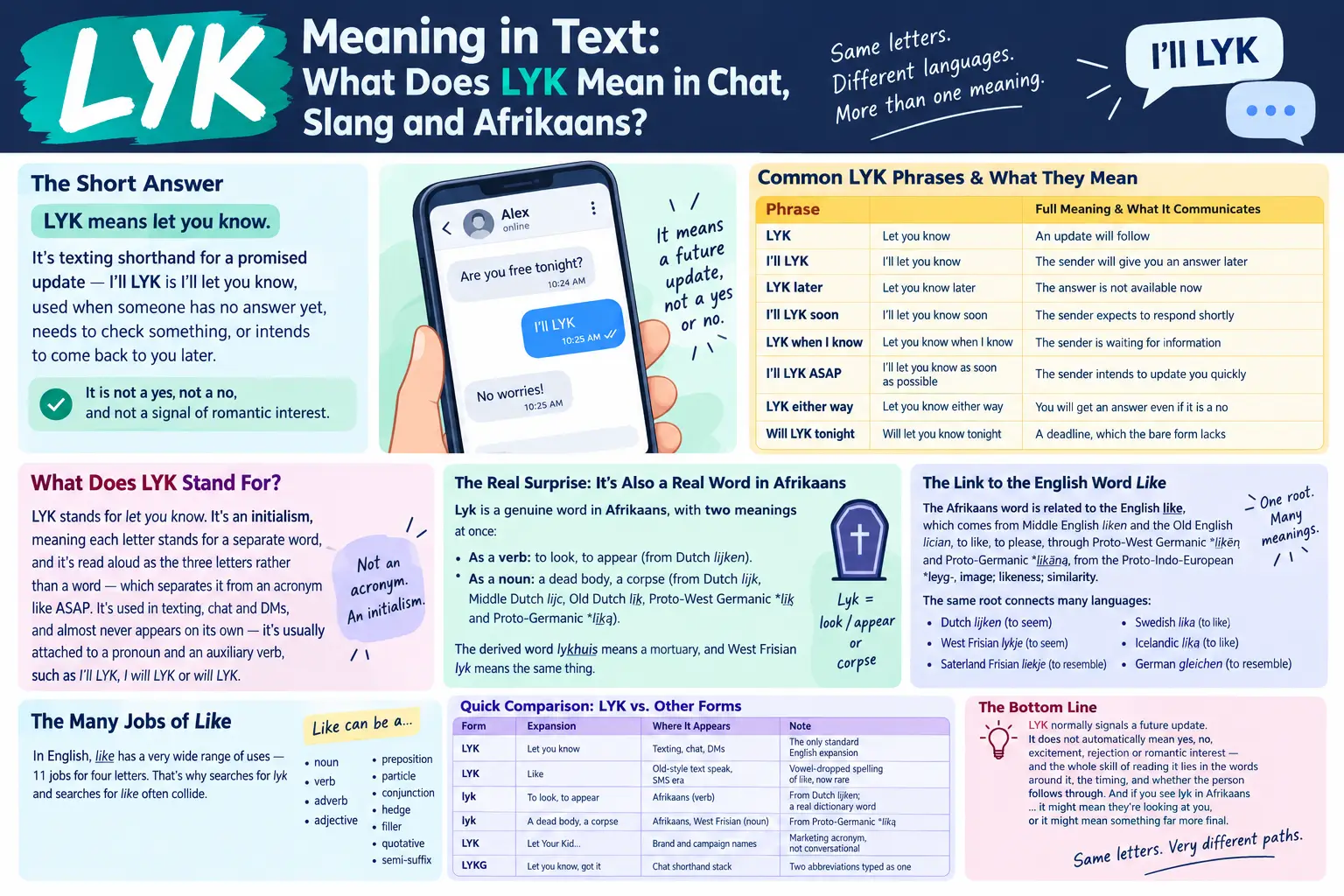
LYK Meaning in Text: LYK means let you know. It is texting shorthand for a promised update — I’ll LYK is I’ll let you know, used when somebody has no answer yet, needs to check something, or intends to come back to you later. It is not a yes, not a no, and not a signal of romantic interest.
The dictionary entry is as short as the abbreviation. lyk is recorded as Internet slang and text-messaging usage, an initialism of let you know — which is the whole of the English meaning, and the reason most of this page is about reading the context rather than decoding the letters.
There is a second, stranger fact about those three letters, and it is the one nobody mentions. Lyk is also a real word in Afrikaans, where it means two things at once: as a verb, from the Dutch lijken, it means to look, to appear; as a noun, it means a dead body, a corpse — from Dutch lijk, Middle Dutch lijc, Old Dutch līk, Proto-West Germanic *līk and Proto-Germanic *līką. The derived word lykhuis is a mortuary, and West Frisian lyk, from Old Frisian līk, means the same thing.
And the two senses are related to the English word like, which is the genuinely elegant part. English like comes as a verb from Middle English liken and the Old English līcian, to like, to please, through Proto-West Germanic *līkēn and Proto-Germanic *līkāną, from the Proto-Indo-European *leyg-, image; likeness; similarity — the same root as the Afrikaans word. The cognates make the family obvious: Dutch lijken to seem, West Frisian lykje to seem, appear, look, Saterland Frisian liekje to resemble, German gleichen to resemble, Swedish lika and Icelandic líka to like. So a texter who types lyk for let you know has accidentally written a word that means looks like in another language — and both trace back to one Indo-European root about likeness.
That root is also why the word like itself is so overloaded, which is the other half of this page. In English, like has a very wide range of uses, both conventional and non-standard: it works as a noun, a verb, an adverb, an adjective, a preposition, a particle, a conjunction, a hedge, a filler, a quotative and a semi-suffix — eleven jobs for four letters. Which is why searches for lyk and searches for like collide constantly, and why the sections below cover both: the abbreviation, and the whole family of like phrases people look up alongside it.
Quick Answer: What Does LYK Mean in Text?
LYK Meaning in Text: What Does LYK Mean in Chat? Both questions have the same three-word answer, and what follows is LYK Meaning: The Complete Guide to “Like” Slang, Phrases, and Abbreviations — the texting sense first, then every other sense those letters collide with.
LYK means let you know. It is a common piece of texting shorthand used in informal digital conversations, and someone writes I’ll LYK to mean I’ll let you know — when they do not have an answer yet, need to check something, or want to update you later.
| Text | Full meaning | What it communicates |
|---|---|---|
| LYK | Let you know | An update will follow |
| I’ll LYK | I’ll let you know | The sender will give you an answer later |
| LYK later | Let you know later | The answer is not available now |
| I’ll LYK soon | I’ll let you know soon | The sender expects to respond shortly |
| LYK when I know | Let you know when I know | The sender is waiting for information |
| I’ll LYK ASAP | I’ll let you know as soon as possible | The sender intends to update you quickly |
| LYK either way | Let you know either way | You will get an answer even if it is a no |
| Will LYK tonight | Will let you know tonight | A deadline, which the bare form lacks |
The key point is simple: LYK normally signals a future update. It does not automatically mean yes, no, excitement, rejection or romantic interest — and the whole skill of reading it lies in the words around it, the timing, and whether the person follows through. Row eight is the version worth asking for: will LYK tonight has a deadline in it, and the bare form does not.
What Does LYK Stand For?
LYK stands for let you know. It is an initialism, meaning each letter stands for a separate word, and it is read aloud as the three letters rather than as a word — which separates it from an acronym such as ASAP. Dictionaries label it as Internet slang and text messaging usage, which is exactly where it lives. The expansion almost never appears on its own: it arrives attached to a pronoun and an auxiliary verb, as I’ll LYK, I will LYK or will LYK, because the phrase it replaces is a verb phrase and needs a subject.
| Form | Expansion | Where it appears | Note |
|---|---|---|---|
| LYK | Let you know | Texting, chat, DMs | The only standard English expansion |
| LYK | Like | Old-style text speak, SMS era | Vowel-dropped spelling of like, now rare |
| lyk | To look, to appear | Afrikaans (verb) | From Dutch lijken; a real dictionary word |
| lyk | A dead body, a corpse | Afrikaans, West Frisian (noun) | From Proto-Germanic *līką |
| LYK | Let Your Kid… | Brand and campaign names | Marketing acronym, not conversational |
| LYKG | Let you know, got it | Chat shorthand stack | Two abbreviations typed as one |
Rows one and two are the two texting answers, and the first has effectively won. In the SMS era, when every character was counted and messages were capped at 160, writers dropped vowels on purpose and lyk was a spelling of like — alongside luv, wat, bcoz and plz. Unlimited messaging and predictive keyboards ended the practice, and the vowel-dropped lyk now reads as dated or deliberately playful, while the initialism for let you know kept growing. The same shift explains LUV meaning in text, which survived as affection rather than as compression.
Rows three and four are the ones that surprise people, and they are not slang at all. In Afrikaans, lyk is an ordinary word with two senses: the verb to look, to appear, and the noun a dead body — so hy lyk moeg is he looks tired, while the noun supplies lykhuis, a mortuary. The verb is conjugated normally, with the participle lykende and the past participle gelyk, and the noun has the synonyms kadawer and liggaam.
LYK as “Like” in Text Speak
When LYK means like, it is a spelling choice rather than an abbreviation of a phrase. The writer has removed the i and the e and kept the sound, exactly as nyt stands for night and ryt for right — a convention that belonged to pay-per-message keypads and to early chat rooms. Two signals tell you which meaning is on the screen. If the word sits where a verb of promising belongs — after I’ll, will or gonna — it is let you know; if it sits where a comparison or a preference belongs, it is like. I’ll lyk is an update; i lyk that song and he looks lyk his dad are the older spelling.
What Is the Difference Between LYK and LMK?
LYK and LMK are mirror images, and confusing them is the most common mistake made with either: LYK is a promise from the sender, LMK is a request to the receiver.
LYK vs. LMK: What’s the Difference? A Side-by-Side Comparison
| LYK | LMK | |
|---|---|---|
| Meaning | Let you know | Let me know |
| Who acts | The sender | The receiver |
| Direction | Outgoing: a promise to update | Incoming: a request for information |
| Typical sentence | I’ll LYK tonight | LMK when you’re free |
| What it asks of you | Nothing — wait | A reply |
| Tone | Pending, non-committal | Open, inviting |
| Common error | Reading it as a request | Reading it as a promise |
| Reply needed | Sounds good at most | Yes, an actual answer |
The whole distinction lives in the middle letter: Y is you, M is me. In LYK the sender is the one who will act — I’ll let you know — so there is nothing for you to do but wait; in LMK the receiver is the one who must act, so a reply is genuinely owed. That is why the error is costly in both directions: reading LYK as a request produces an unnecessary answer, and reading LMK as a promise leaves somebody waiting for a message that never arrives because you thought they were sending it. The last two rows are the practical test — ask yourself who has the information, and the abbreviation decodes itself.
Example Using Both
| Message | What happens | Why it works |
|---|---|---|
| LMK if Friday works and I’ll LYK about Saturday | One asks, one promises | Both abbreviations, correctly used |
| I’ll LYK — LMK if that’s too late | Update coming, objection invited | The polite double |
| LYK means I’m checking; LMK means I’m asking | The one-line rule | Worth memorising |
Daniyal: Are we still doing Saturday? LMK by Thursday because I need to book the table.
Hira: Waiting on my shift rota — I’ll LYK Wednesday night, either way.
Daniyal: Perfect. Nothing needed from me then.
That exchange is the model, because every part of it is explicit. Daniyal asks with LMK and attaches a deadline and a reason; Hira answers with LYK and attaches a time and the words either way — which turns a vague pending into a scheduled one. Daniyal’s last line names the state of play out loud, which is what stops two people both waiting for the other.
LYK vs. Similar Texting Abbreviations
LYK vs. similar abbreviations is really one question asked twelve ways: who holds the next move? LYK sits in a family of short forms that manage the flow of a conversation rather than its content, and each one hands the next move to a different person.
| Abbreviation | Expansion | What it does | Example |
|---|---|---|---|
| LYK | Let you know | A future update is promised | I’ll LYK after work |
| LMK | Let me know | The sender wants an answer | LMK what you decide |
| IDK | I don’t know | No answer exists right now | IDK, ask Priya |
| FYI | For your information | Information shared, no reply needed | FYI, the room changed |
| TTYL | Talk to you later | The conversation is ending | Dinner’s ready, TTYL |
| BTW | By the way | A side point is being added | BTW, bring cash |
| BRB | Be right back | A short pause, same conversation | BRB, two minutes |
| ASAP | As soon as possible | Urgency, no fixed time | Need it ASAP |
| NVM | Never mind | The question is withdrawn | NVM, found it |
| TBD | To be determined | The formal cousin of LYK | Venue TBD |
| WIP | Work in progress | A task is unfinished | Deck is a WIP |
| EOD | End of day | A deadline LYK lacks | You’ll have it by EOD |
LYK vs. IDK
LYK and IDK both admit that an answer is missing, and they differ on whether one is coming. IDK closes the question — the sender has no answer and is not promising to find one; LYK keeps it open, because the sender undertakes to come back. IDK, I’ll LYK is therefore a complete and useful message: no answer now, an answer later. IDK alone, in reply to a plan, is the one that strands people, which is why the follow-up can you find out and LYK? is worth typing.
LYK vs. FYI
FYI delivers information; LYK promises it. FYI is backward-looking and complete — the news is in the message, and no reply is expected; LYK is forward-looking and incomplete, since the news has not arrived yet. They pair naturally across a conversation: I’ll LYK when the time is confirmed, followed the next day by FYI, it’s moved to four. The full range of that second form is in FYI meaning in text.
LYK vs. TTYL
TTYL ends the conversation; LYK ends the topic. TTYL is a sign-off with no content attached, and it carries no obligation at all; LYK is a content promise that leaves the conversation open. The two appear together at the close of a chat — I’ll LYK about the weekend, TTYL — where the first half owes you a message and the second half simply says goodbye. The short-pause version of the same move is BRB meaning in text, and the leaving-now version is GTG meaning in text.
LYK vs. BTW
BTW adds something; LYK defers something. BTW introduces a side point the sender already has in hand, and it belongs mid-conversation; LYK closes a thread that is still unresolved. A single message often runs both: BTW the parking is free after six — I’ll LYK about the tickets, where one clause gives you information and the other owes you some.
How to Use LYK Naturally
The difference between a LYK that reads as considerate and one that reads as a brush-off is whether anything is attached to it.
| Write | What it adds | Why |
|---|---|---|
| I’ll LYK by six | Adds a time | The single best upgrade to LYK |
| I’ll LYK once I’ve spoken to Dad | Names the dependency | Explains the delay |
| I’ll LYK either way | Promises a no as well as a yes | Removes the waiting |
| Can’t say yet — LYK tomorrow | Admits the gap first | Honest and complete |
| LYK, alone | Nothing added | Technically fine, often read as cold |
| I’ll let you know | Written in full | Correct for work, clients, anyone senior |
Row one is the fix for almost every complaint about LYK: give it a time. I’ll LYK is an open-ended promise, and I’ll LYK by six is an appointment — the second lets the other person plan, and it also commits you, which is the point. Row three is the next most valuable, because either way promises a no as well as a yes and removes the most tiring part of waiting: not knowing whether silence is the answer. Row six is the register rule — write the phrase out in full for clients, managers, teachers and anybody you have not texted before, since the abbreviation signals informality more loudly than it signals brevity.
What Does LYK Mean in Chat?
In chat, LYK means let you know, and it functions as a placeholder that keeps a thread alive without answering it. The sender is telling you three things at once: there is no answer yet, the question has not been forgotten, and the next message in this thread will come from them — which is why the correct reply is usually a short acknowledgement rather than a follow-up question. Chat is also where LYK does its most useful work, because live conversations stall when somebody has to go and check something, and three letters keep the stall from looking like silence.
Examples of LYK in Text Messages
| Message | Where it appears | What it means |
|---|---|---|
| I’ll LYK | Group chats, DMs | An answer is coming, no time given |
| LYK in a sec | Live chat | Minutes, not days |
| LYK when I’m home | Friends | Tied to an event rather than a clock |
| LYK after I check with the others | Group plans | Waiting on somebody else |
| Will LYK once it’s confirmed | Work chat | Waiting on a decision |
| LYK if anything changes | Any plan | Promises that silence means no change |
| k, LYK | Casual, close friends | Minimal; fine between people who text constantly |
| LYK!! | Excited plans | Punctuation carries the enthusiasm, not the letters |
Row six is the most under-rated entry in the whole table. LYK if anything changes converts silence into information: it tells you that no message means the plan stands, which is the opposite of the bare LYK, where silence means nothing at all. Rows two and three show the two ways people attach a time — to a clock (in a sec) or to an event (when I’m home) — and the event version is the more honest of the two, because it names what has to happen first. Row seven looks rude and usually is not: between people who exchange dozens of messages a day, k, LYK is efficient rather than cold, and the same brevity between near-strangers reads very differently. The laughter-shorthand version of that same intimacy gap shows up in LMFAO meaning in text.
What Does LYK Mean on Social Media?
On social media, LYK carries the same expansion — let you know — but it is far more often mixed up with LMK, because posts and comments are addressed to crowds rather than to one person.
| Where | Typical use | What it means |
|---|---|---|
| Comment reply | LYK when the next drop is live | A promise to the commenter |
| Story reply | Interested — LYK the details | Often a request in disguise; read it as LMK |
| Group DM | I’ll LYK about Saturday | Exactly the texting sense |
| Caption | More soon, LYK | Addressed to everybody, so it commits to nobody |
| Seller DM | LYK if it’s still available | A request, despite the Y |
| Creator post | LYK in the comments | Mixed up with LMK; context decides |
Does LYK Have a Special Social Media Meaning?
No. LYK has no separate platform meaning, and anybody who tells you Instagram or TikTok has its own definition is inventing one. What changes across platforms is not the expansion but the direction: in a one-to-one DM it reliably means the sender will update you, and in a public comment it is frequently typed where LMK belongs, so LYK if it’s still available is a buyer asking a question rather than promising anything. Two rules decode it every time. Ask who holds the information, and ask whether the message is addressed to one person or to everybody — a public LYK commits nobody, because no particular person has undertaken to act. The in-group shorthand that genuinely does shift meaning by platform is covered in IYKYK meaning in text.
What Does LYK Mean on Snapchat?
On Snapchat, LYK means let you know, and it arrives most often inside plans being arranged in chat rather than on a snap itself.
| How it appears | Context | What it means |
|---|---|---|
| LYK on a snap | Plans being made in chat | The ordinary promise, lowest effort |
| I’ll LYK tn | tn = tonight | A time, which makes it reliable |
| LYK plus a streak snap | A streak being kept alive | Often just streak maintenance, not a plan |
| LYK if ur out | Group plans | A request; the sender wants your answer |
| lyk in lower case | Everyday Snapchat typing | Case carries no meaning on Snapchat |
| LYK after a long gap | Dormant chat reopened | Reads as polite closure, not a plan |
Common Snapchat Examples of LYK
Snapchat adds one factor no other platform has: the streak. A chat sent purely to keep a streak alive carries almost no conversational content, so a LYK inside streak traffic is frequently a filler keystroke rather than a commitment — which is the single most useful thing to know when you are waiting on an answer there. Timing tells you which you have: a LYK that arrives in the middle of a real back-and-forth about Saturday is a promise, and one that arrives alone at 11pm alongside a ceiling snap is maintenance. Snapchat typing conventions also strip the capitals, so lyk, Lyk and LYK mean exactly the same thing, and nobody is being emphatic by holding shift.
What Does LYK Mean on WhatsApp?
On WhatsApp, LYK means let you know, and the platform’s heavy use of family and work groups makes the full phrase the safer choice more often than elsewhere.
| Setting | Typical message | Why it reads that way |
|---|---|---|
| Family group | Will LYK after I speak to Amma | Names the dependency, which families expect |
| Work group | I’ll LYK once the client replies | Spell it out in full for managers |
| Neighbourhood group | LYK if the plumber turns up | A promise to report back |
| One-to-one | LYK in 10 | Minutes; the commonest WhatsApp use |
| Broadcast or status | LYK soon | No single recipient, so no real commitment |
WhatsApp is the one platform where typing LYK genuinely costs you something. Its groups mix generations and colleagues in a way Snapchat and Instagram DMs do not, so a message that reads as efficient to a friend reads as unexplained to a parent and as curt to a manager — and the fix costs four extra words. Row two is the rule: write I’ll let you know in full in any group that includes people senior to you, and keep the abbreviation for one-to-one chats and friends. Read receipts add a second complication: on WhatsApp the sender often sees that you read the message, so a LYK followed by three days of blue ticks and no update is visible in a way it is not on other platforms.
LYK Meaning on Instagram and TikTok
On Instagram and TikTok, LYK still means let you know, and the only thing worth checking is which way it points.
| Where | Typical message | What it means |
|---|---|---|
| Instagram DM | I’ll LYK about the collab | The standard promise; one named recipient |
| Instagram comment | LYK when restocked | A request aimed at the account owner |
| Instagram story reply | LYK the song name | Means LMK; the sender wants the answer |
| TikTok comment | LYK if you do a part 2 | A request to the creator |
| TikTok reply from a creator | Filming tomorrow, LYK | A genuine promise to the commenter |
| TikTok caption | LYK in the comments | Crowd-addressed, so read it as LMK |
Comment sections invert the abbreviation almost as a rule. A comment is written by somebody who wants information, so the LYK typed under a post is nearly always a request — the commenter means let me know, and the Y is a slip or a habit. The reverse is true in replies from the account itself, where a creator answering filming tomorrow, LYK is making a real promise to a real person. Story replies are the trickiest, because they arrive as DMs but behave like comments, so LYK the song name is a question wearing the wrong letters.
What Does LYK Mean in Dating and on Dating Apps?
In dating, LYK means exactly what it means everywhere else — let you know — and the only question worth asking is what is attached to it. A LYK with a time and a named obstacle is scheduling; a LYK with nothing attached, repeated, is a soft decline. The abbreviation itself carries no romantic charge at all, which is the fact most guides get wrong: it is not flirtation, not rejection, and not a hidden message. What carries meaning is the pattern around it — whether a date is offered, whether the update actually arrives, and whether the warmth of earlier messages is still there.
LYK Examples in Dating Conversations
| Message | Situation | How to read it |
|---|---|---|
| I’ll LYK about Friday | Plans not yet fixed | Neutral; the schedule is the subject |
| Busy week — I’ll LYK | No time named | Weak unless a time follows |
| I’ll LYK once my shifts are up | A real dependency | Strong; the obstacle is named |
| LYK, promise | Reassurance added | The sender knows the delay is awkward |
| I’ll LYK, then silence for days | No follow-through | The behaviour answers, not the words |
| I’ll LYK, but I’d rather see you Sunday | An alternative offered | The clearest good sign in the set |
Genuine Scheduling Uncertainty
The clearest version of LYK names an obstacle with a date on it. I’ll LYK once my rota is out on Wednesday contains a reason, a timetable and an implied promise, and there is nothing to decode: somebody who does not yet know their own working hours is telling you so. Shift workers, students with timetables, parents sharing childcare and anybody on call produce this message constantly, and reading it as evasion is the commonest unforced error in early dating.
Waiting for Information
The second honest version is the one where a third person holds the answer. Need to check whether my sister needs the car — LYK tonight is a deferral the sender does not control, and the detail is the proof: people inventing excuses rarely supply a specific person and a specific object. The tell is the dependency, so if a message names who is being consulted and when, treat it as true.
Following Up After a Date
A LYK that arrives wrapped in warmth is a positive message, and the warmth is the part that matters. Had a really good time. I’ll LYK about next week. contains an evaluation of the date and a commitment to continue — the deferral is about logistics, and the sentiment is already settled. Compare it with the bare LYK about next week, which contains no evaluation at all; the difference between the two is the whole signal.
A Vague Response
The one version worth worrying about is the bare, repeated LYK. Three letters with no time, no reason, no alternative and no warmth, offered a second and third time, is a soft decline — not because the abbreviation means no, but because somebody interested supplies something to hold on to. The rule is to count, not to interpret: once is a busy week, twice is a pattern, and a pattern is an answer.
Does LYK Mean Someone Likes You?
No. LYK does not mean somebody likes you, and it does not mean they do not. The confusion comes almost entirely from the letters themselves — lyk looks like like, and the older text-speak spelling of like was in fact lyk, so a search for the abbreviation and a search for the feeling land in the same place. In current usage the three letters are a scheduling device, not a declaration. What answers the question is everything else in the thread: who initiates, whether plans get made, whether the promised update arrives, and whether the messages are warmer than they are efficient. Affection in text has its own shorthand, and LUV meaning in text covers the words people actually use when they mean it.
What Does LYK Mean From a Guy or Girl?
LYK means the same thing from a guy and from a girl: let you know. There is no gendered sense of the abbreviation, no hidden male version and no hidden female version — and guides that claim otherwise are reading personality differences into a three-letter initialism. Communication habits do vary between individuals, and some people attach times and reasons by default while others send the bare form, which is why the same three letters feel reliable from one friend and evasive from another. That variation tracks the person, not their gender.
Don’t Judge Interest From LYK Alone
One abbreviation is not enough data to draw a conclusion from, and treating it as though it were is how people talk themselves into both false hope and false alarm. A single LYK tells you only that an answer is pending; what tells you about interest is the pattern across a week — initiation, follow-through, specificity and warmth. The practical version of that rule is to wait for the next two messages before deciding anything, because the update that arrives, or fails to arrive, settles the question that the abbreviation cannot.
Is LYK a Good Sign or a Bad Sign?
LYK is neutral on its own, and what sits next to it decides.
| What you received | Reading | Why |
|---|---|---|
| LYK with a time and a reason | Good sign | The sender is managing your expectations |
| LYK plus an alternative date | Good sign | They are trying to make it happen |
| LYK plus warmth about the last meeting | Good sign | The feeling is in the message, not the letters |
| LYK alone, once | Neutral | People are busy; one deferral means little |
| LYK alone, every time you ask | Bad sign | A pattern, and patterns are the data |
| LYK with no follow-through | Bad sign | Behaviour over wording, always |
| LYK after enthusiastic earlier messages | Watch it | A change in temperature matters more than the word |
| LYK plus initiating the next contact themselves | Good sign | They came back without being chased |
Read down that table and a single principle emerges: specificity is the signal, and the abbreviation is not. A time, a reason, an alternative date or a line of warmth all mean the sender is managing your expectations, which is what interested and considerate people do; nothing attached, repeatedly, means the opposite — and in neither case do the three letters themselves carry the meaning. Row six is the one to trust above all the others, because follow-through outranks wording every time: a promised update that arrives on Wednesday settles more than any phrasing, and one that never arrives settles it too.
Case Study: Reading LYK in Context
Marcus: Still up for Thursday? I can do anything after six.
Elena: I want to, but my rota lands Tuesday morning. I’ll LYK the second I see it — and if Thursday’s out, Sunday lunch?
Marcus: Sunday works either way. No rush.
Elena, Tuesday 9:14am: Thursday is on. Six thirty?
Marcus: Still up for Thursday? I can do anything after six.
Jordan: LYK
Marcus, two days later: Any news on Thursday?
Jordan: LYK
Those two exchanges contain the identical abbreviation and opposite messages. Elena names the obstacle, dates it, offers an alternative and then actually follows through on the morning she said she would; Jordan supplies three letters, twice, with nothing attached and no update in between. Neither reply is decoded from the word LYK — the first is read from the specificity and the follow-through, the second from the repetition and the silence. And Marcus does the right thing in both: he acknowledges without pressing, which keeps the first conversation easy and makes the second one’s answer unmistakable.
How to Respond When Someone Says LYK
LYK asks nothing of you, so the correct response is an acknowledgement rather than a question — and the only time to add anything is when you have a deadline of your own. Three replies cover almost every case: a short acceptance, an acceptance with your own cut-off attached, and a request for a time. What rarely helps is chasing immediately, because the message has already told you that the answer does not exist yet.
Casual Responses to LYK
| Reply | Best for | Why it works |
|---|---|---|
| Sounds good | Anybody | The complete answer; nothing else is needed |
| No rush | Friends | Removes the pressure, keeps the thread warm |
| Cool, I’ll keep it free | Plans | Tells them the slot is still open |
| 👍 | Close friends, live chat | A reaction is a reply; no message required |
| All good — shout when you know | Casual | Hands the next move back cleanly |
| Thanks for letting me know you don’t know | Friends, affectionate | Funny, and it genuinely credits the update |
Row one is the whole answer in two words, and most people over-write it. Sounds good closes the loop, confirms you read the message and hands the next move back to them, which is everything the situation requires. Row four matters more than it looks: on platforms with reactions, a thumbs-up is a genuine reply, and it spares both of you a message that says nothing. Row three adds the one piece of information you hold — telling somebody the slot is still free is useful to them, and it quietly signals that it will not stay free forever.
If You Need an Answer Soon
| Reply | When to use it | Why it works |
|---|---|---|
| Of course — any idea when? I need to book by Thursday | A deadline of your own | Gives them your constraint, not an accusation |
| No problem. If I haven’t heard by Friday I’ll assume it’s a no and book the other thing | A hard cut-off | Removes the need to chase at all |
| Sure — can you LYK by six either way? | Turning it into a time | Asks for the one thing the bare form lacks |
| Totally fine. What are you waiting on? | When the delay is unexplained | Finds out whether a real obstacle exists |
| Understood. I’ll follow up Wednesday if that’s easier | When they are overloaded | You take on the chasing, which is often kinder |
The technique here is to state your constraint instead of questioning theirs. I need to book by Thursday is a fact about your week, and it gives the other person a reason to hurry without accusing them of stalling — where when will you know? puts them on the spot and invites a defensive answer. Row two is the strongest version in the table, because an announced cut-off removes the chasing entirely: you have told them what silence will mean, so neither of you has to send another message. Row five is the generous option — volunteering to follow up yourself is often the kindest reply to somebody who is plainly overloaded.
If You’re Dating
| Reply | Situation | Why it works |
|---|---|---|
| Sounds good — and if Thursday falls through, I’m free Sunday | Early dating | Keeps momentum without pressing |
| No rush at all. Enjoy the week. | After a warm message | Matches their warmth, asks for nothing |
| Cool. I’ll make other plans and we’ll find another night. | After a second bare LYK | Dignified, and it stops the waiting |
| Hope the rota is kind to you | When they named a real obstacle | Shows you read the message |
| Nothing at all | After a third bare LYK | Silence is a complete and appropriate answer |
In dating the aim is to stay warm without starting a negotiation, and the tool for that is the alternative. Offering Sunday in the same breath as accepting Thursday’s uncertainty keeps the plan alive and costs you nothing in composure, while asking when they will know turns a light exchange into an interrogation. Row three is the one worth memorising: after a second bare LYK, saying you will make other plans is neither sulking nor an ultimatum — it is simply accurate, and it hands them a clear opportunity to choose you. And row five is a real option, not a failure: after three empty deferrals, no reply at all is a complete answer, and sending it costs you nothing you want to keep.
How to Tell What Someone Really Means by LYK
Eight signals decode a LYK, and none of them is the abbreviation itself.
| Signal | Question to ask | What it tells you |
|---|---|---|
| Timing | Did it arrive instantly or after a long gap? | An immediate LYK is logistics; a delayed one is often reluctance |
| The reason | Is an obstacle named? | A named dependency is almost always genuine |
| Follow-through | Did the update actually come? | The single most reliable indicator |
| The conversation | Is the warmth the same as before? | A temperature drop matters more than the word |
| Specificity | Is there a time attached? | A time is a commitment; soon is not |
| Repetition | Is this the first LYK or the third? | Once is busy; three times is an answer |
| Who initiates | Did they come back without being chased? | Returning unprompted outranks every phrasing |
| The alternative | Was another option offered? | Offering a plan B is active interest |
Look at the Timing
How quickly the LYK arrived tells you more than how it is worded. A reply that lands within minutes of your question is logistics — the sender read the message, realised they could not answer it, and said so straight away. One that lands two days later, after a question that needed a yes or a no, is a different kind of message: the delay is the content, and the three letters are the wrapping. The exception is the person who simply does not look at their phone, which is why timing is read against that individual’s normal speed rather than against an absolute standard.
Look at the Reason
A named dependency is the strongest evidence of sincerity in a deferral. Waiting on my rota, waiting on the client, need to ask my sister about the car all identify somebody or something that holds the answer, and that specificity is hard to fake comfortably. The bare LYK supplies no reason, which does not make it dishonest — people are busy and type fast — but it does make it uninformative, and uninformative messages are the ones worth asking a follow-up question about.
Look at Their Follow-Through
Follow-through is the only signal that settles the question outright. Somebody who says they will let you know on Wednesday and messages on Wednesday has told you everything about how they treat commitments; somebody who says it and goes quiet has told you the same thing in the other direction. This is why waiting is usually better than chasing: the information you want arrives on its own, and it arrives in a form that needs no interpretation.
Look at the Overall Conversation
Read the LYK against the temperature of everything around it. A short deferral inside a thread full of jokes, questions and plans means almost nothing; the same three letters at the end of a conversation that has been cooling for a week mean a great deal — and the change is the signal, not the abbreviation. Length is the easiest thing to measure: when messages that used to run three lines start running three letters, the shift in effort is the message. And the reverse is reassuring, because a bare LYK from somebody who writes tersely to everybody is simply how they type. Reading tone from abbreviations is the same skill as reading HYD meaning in text as either a real question or a filler.
LYK Examples in Real-Life Texting Situations
The same three letters behave differently in eight everyday settings, and the only variable is how much you need to attach to them.
| Situation | Example | Why it reads that way |
|---|---|---|
| Making plans | I’ll LYK once I’ve checked with Sam | Somebody else in the group holds the answer |
| Work or school | Will LYK when the deadline is confirmed | Write it in full to a manager or a teacher |
| Friends | LYK if I can get the night off | A real obstacle, named briefly |
| Family | Will LYK after I speak to Nani | Families expect the dependency spelled out |
| Dating | I’ll LYK about Friday — or Sunday if that is easier | A deferral plus an alternative |
| Online conversations | LYK if the stream goes up tonight | A promise to a crowd, so it binds nobody |
| Shopping or buying something | LYK if the size comes back in | Usually a request to the seller, despite the Y |
| Travel | LYK my landing time once I check in | Information that genuinely does not exist yet |
Making Plans
Plans are where LYK was invented, and where it is least likely to be misread. Group arrangements stall on one unavailable person, so the message that keeps the thread moving is the one that admits the stall and names it — I’ll LYK once I’ve checked with Sam tells four people why nothing has been decided. The upgrade is always a time: add tonight and the others can book without chasing you.
Work or School
At work and at school, the abbreviation is riskier than the phrase is useful. A manager, a teacher or a client reads LYK as informal first and efficient second, and in writing that gets forwarded, quoted and filed, the four extra words are free. The exception is internal chat on a team that already types that way, where matching the house register is the more fluent choice. What a professional message genuinely needs is the date: I will confirm by Thursday does the job that LYK leaves half done.
Friends
Between friends, LYK needs nothing attached and nobody minds. A shared history of constant messaging supplies the context that the abbreviation leaves out, so LYK if I can get the night off is a complete communication between people who know each other’s shifts. The one place it still misfires is a long gap — a bare LYK after a fortnight of silence reads colder than the sender intends. The same brevity rule governs LMS meaning in text, which only works inside an audience that already knows you.
Family
Family messages want the reason more than the abbreviation. Relatives read a deferral as a question about the family rather than about the calendar, so will LYK after I speak to Nani lands warmly where a bare LYK invites a phone call. Age is the practical factor: a parent or grandparent who does not use abbreviations will read three capital letters as a typing error, and the full phrase prevents a confused reply.
Dating
In dating, attach an alternative rather than just a time. I’ll LYK about Friday — or Sunday if that is easier turns a deferral into a plan with two doors, and it reads as effort rather than as hedging. The bare form is the one that causes the overthinking, which is why the version with an option attached saves both people a day of guessing.
Friends in Online Conversations
In public and semi-public channels, LYK is a broadcast and not a commitment. A promise addressed to a server, a comment section or a community chat has no particular recipient, so nobody is owed the update — which is exactly why creators and streamers use it so freely. If you actually need the answer, move it to a DM, where the same three letters bind one named person.
Shopping or Buying Something
In marketplace messages, LYK is usually a request wearing the wrong letters. LYK if it’s still available is written by the buyer, who holds no information at all, so the sender means let me know. From the seller’s side it works correctly — LYK when the size is back in is a genuine promise to restock-watch, and it is the one marketplace use that means what it says.
Travel
Travel produces the most honest LYKs in English, because the information really does not exist yet. Landing times, transfer times, delays and which train actually turns up are all unknown until they happen, so LYK my landing time once I check in is a factual statement about the future. Add the time zone, which is the one detail travellers forget and the person collecting you needs most.
Is LYK Formal or Informal?
LYK is informal, and it belongs to conversational digital writing only. It is an initialism built for speed, and speed is the wrong priority in any message that will be forwarded, filed, quoted or read by somebody senior to you — which is the whole of the register rule.
LYK Works Well In:
| Where | Why |
|---|---|
| Texts to friends and family | The register matches entirely |
| Group chats about plans | Everybody is reading quickly |
| DMs on Snapchat, Instagram and TikTok | Abbreviations are the house style |
| Internal chat with colleagues you know well | Only where the team already types that way |
| Gaming and community chats | Speed is the point |
| Replies where you are genuinely checking something | The abbreviation is doing real work |
Avoid LYK In:
| Where | Why |
|---|---|
| Emails to clients or customers | It reads as careless in a document |
| Messages to a manager, teacher or lecturer | The informality is louder than the brevity |
| Job applications and interview follow-ups | Every abbreviation costs you credibility here |
| Anything contractual, medical or official | Precision matters more than speed |
| First contact with anybody | You do not yet know their register |
| Messages to older relatives | Many will not recognise the letters at all |
| Writing across a language barrier | Initialisms do not translate |
Row seven is the one most people never think about: initialisms do not cross languages. Excellent English is no guarantee of exposure to LYK, LMK or TBD, because these forms are learned from chat rather than from study — and an unfamiliar abbreviation in an otherwise clear message produces exactly the confusion the shorthand was meant to avoid. Write the phrase out whenever the reader learned English somewhere other than a group chat.
Formal Alternatives to LYK
| Write instead | Best for | Note |
|---|---|---|
| I will let you know | Any professional message | The direct, complete swap |
| I will confirm by Thursday | Clients, managers | Adds the deadline LYK lacks |
| I will revert once I have an answer | Business English, South Asia and the UK | Common in corporate correspondence |
| I will follow up shortly | Customer service | Soft, professional, non-committal |
| I will update you as soon as I hear | Teams, suppliers | Names the dependency |
| To be confirmed / TBD | Agendas, documents, invitations | The written-document version |
| I shall advise in due course | Formal and legal writing | Very formal; rarely needed |
| Pending confirmation | Status lines, tickets, spreadsheets | A label rather than a sentence |
Row two is the only alternative that fixes LYK’s actual weakness. Every other swap changes the register while keeping the vagueness, and I will confirm by Thursday adds the date — which is what the recipient wanted in the first place. Row three is worth knowing if you work with British or South Asian colleagues, where I will revert is ordinary business English for I will get back to you, and startles everybody else. Rows six and eight are labels rather than sentences, which makes them the right choice in an agenda, a ticket or a spreadsheet cell, where no verb fits.
Common Mistakes People Make With LYK
Eight mistakes account for nearly every misread LYK, and the first two — confusing it with LMK, and reading it as interest — cause the rest.
| The mistake | Why it misfires | Do this instead |
|---|---|---|
| Confusing LYK with LMK | LYK when you’re free asks nothing of anybody | Check the middle letter: Y is you, M is me |
| Assuming LYK means someone is interested | The letters resemble like, which they are not | Read the pattern, not the abbreviation |
| Treating LYK as a definite promise | No time, no obligation | Ask for a time: LYK by six? |
| Using LYK in formal writing | It reads as careless to clients and managers | Write I will let you know in full |
| Overanalyzing a short message | Three letters do not carry a hidden meaning | Wait for the next two messages |
| Sending a bare LYK repeatedly | It reads as avoidance even when it is not | Attach a time or a reason |
| Using it to a stranger or a first contact | You do not know their register yet | Full sentences until they abbreviate first |
| Expecting a reply to your own LYK | It asks nothing, so silence is correct | Do not read the lack of answer as rudeness |
Confusing LYK With LMK
This is the error that produces real-world consequences, because both people end up waiting. Typing LYK when you’re free asks nothing of anybody: the sender has promised to report on the receiver’s diary, which is impossible. The one-second check is the middle letter — Y is you, so the sender acts; M is me, so the receiver acts.
Assuming LYK Means Someone Is Interested
The letters resemble like, and that resemblance is the entire source of the belief. LYK contains no sentiment of any kind, and a scheduling abbreviation cannot tell you how somebody feels — interest is visible in initiation, specificity, follow-through and warmth, all of which sit outside the three letters.
Treating LYK as a Definite Promise
LYK commits the sender to a message, not to a time, and that gap is where most frustration lives. A promise with no deadline cannot be broken, which is precisely what makes it unreliable as a planning tool. The fix is one question: can you LYK by six, either way? — and the words either way are the half that matters, because they promise a no as well as a yes.
Using LYK in Formal Writing
An abbreviation that saves fourteen characters is never worth the impression it creates in a document. Emails are forwarded, quoted and kept, so a client-facing LYK is read by people who never saw the conversation it came from — and to them it reads as carelessness rather than as fluency. In anything contractual, medical or official, the cost is higher still, because ambiguity in those documents is a practical problem rather than a stylistic one.
Overanalyzing a Short Message
Three letters cannot hold the amount of meaning people extract from them. Most bare LYKs are typed by somebody walking, working or holding a child, and the brevity reflects their hands rather than their feelings. The discipline is to wait for the next two messages, which contain the information the abbreviation never did.
Does LYK Have Other Meanings?
Yes — LYK carries one dominant English meaning and several genuine others, including two real dictionary senses in another language.
| Type | Meaning | Where | Note |
|---|---|---|---|
| Texting initialism | Let you know | English, worldwide | The dominant meaning |
| Text-speak spelling | Like | SMS era, early chat | Vowels dropped to save characters |
| Afrikaans verb | To look, to appear | South Africa, Namibia | Hy lyk moeg = he looks tired |
| Afrikaans noun | A dead body, a corpse | South Africa, Namibia | Gives lykhuis, a mortuary |
| West Frisian noun | Dead body, cadaver | Friesland, Netherlands | From Old Frisian līk |
| Stacked shorthand | Let you know, got it | Chat | Typed as LYKG |
| Doubled form | Like, like or emphasis | Casual chat | lyk lyk; stress or a typing stutter |
| Brand acronyms | Campaign-specific | Marketing | No conversational meaning |
Rows three to five are the ones that make this word unusual among texting abbreviations. Most initialisms are invented inside chat and mean nothing outside it; lyk collides with an ordinary word in Afrikaans and West Frisian, which is why a search for it returns funeral vocabulary alongside texting guides. Row seven explains the odd doubled form people notice in chat logs: lyk lyk is either emphasis, in the way repetition stresses a word in speech, or a keyboard stutter, and nothing more systematic than that.
LYK Meaning in Afrikaans
In Afrikaans, lyk is not slang at all. It is an everyday verb meaning to look or to appear, and a noun meaning a dead body.
| Afrikaans | English | Grammar |
|---|---|---|
| Hy lyk moeg | He looks tired | Verb: appearance |
| Dit lyk goed | It looks good | Verb: judgement |
| Jy lyk soos jou ma | You look like your mother | Verb plus lyk soos = look like |
| Dit lyk of dit gaan reën | It looks like it is going to rain | Verb: inference |
| Die lyk | The corpse | Noun: the other sense entirely |
| Lykhuis | Mortuary | Noun compound |
| Lykende | Appearing, seeming | Present participle |
| Gelyk | Appeared / equal | Past participle; also equal |
The verb is the one South Africans use every day, and it behaves like any other. It comes from the Dutch lijken, to seem, and it takes the present participle lykende and the past participle gelyk — so dit lyk goed is it looks good, and lyk soos is the ordinary way to say look like. The noun has a completely separate line of descent: Dutch lijk, Middle Dutch lijc, Old Dutch līk, Proto-West Germanic *līk and Proto-Germanic *līką, with the synonyms kadawer and liggaam. West Frisian kept only the second sense, where lyk, from Old Frisian līk, means dead body — while West Frisian lykje keeps the first, to seem, appear, look.
LYK Meaning in English
In English the answer is single and short: LYK means let you know. There is no second English sense in current use, and the older lyk spelling of like is now read as a period detail rather than as a live convention — which is why the dictionary record for lyk carries exactly one English definition. The practical consequence is that English readers decode it by position: after I’ll or will, it is the initialism; anywhere a comparison or a preference belongs, it is the archaic spelling.
LYK Meaning in Urban Dictionary Terms
Crowd-written slang dictionaries list both senses, and they list them in the order the internet learned them. The older entries define lyk as the SMS spelling of like, because that is what the word did in the keypad era; the newer ones define it as let you know — and the two coexist in the same entry lists, which is the source of most of the confusion online. Crowd-sourced definitions are also unedited, so joke senses sit beside real ones; the test is whether a meaning works in a sentence you have actually received. The same layering of old and new definitions affects 67 meaning in slang, where the newest sense bears no relation to the oldest.
LYK Meaning in Gen Z Slang
Gen Z uses LYK for let you know, and the generational difference is in the typing rather than in the meaning.
| Form | Meaning | Note |
|---|---|---|
| LYK | Let you know | Still the default, all ages |
| lyk | Let you know | Lower case is the Gen Z default |
| lyk for like | Like | Reads as millennial or ironic now |
| lykg | Let you know, got it | Stacked shorthand, chat only |
| lyk lyk | Emphasis, or a stutter | Rare; context decides |
| ill lyk | I will let you know | Apostrophe dropped, which is normal |
The marker of generation here is capitalisation, not vocabulary. Lower-case lyk, ill lyk and dropped apostrophes are the current default, where capitals read as emphasis or as an older hand — and the vowel-dropped spelling of like now reads as a millennial habit or as deliberate irony. Row four is the only genuinely new form: lykg, stacking let you know and got it, exists in fast chat and nowhere else. The wider Gen Z vocabulary that LYK sits inside is covered in GYATT meaning and LFG meaning.
LYK and “Like” Meaning in Other Languages
Searches for lyk meaning in Hindi, lyk meaning in Tamil and the rest are almost always asking about like, and the answer has a twist: most languages split the English word in two, because I like it and it looks like rain are unrelated ideas everywhere except English.
| Language | “Like” (to enjoy) | “Like” (similar to) | Note |
|---|---|---|---|
| Hindi | पसंद / पसंद करना | जैसा / की तरह | मुझे पसंद है = I like it |
| Urdu | پسند | کی طرح | Shares پسند with Hindi |
| Bengali | পছন্দ | মতো | মতো is the comparison word |
| Tamil | பிடிக்கும் | போல | பிடிக்கும் is literally it pleases |
| Telugu | ఇష్టం | వలె | ఇష్టం = liking, fondness |
| Kannada | ಇಷ್ಟ | hāge | Same Sanskrit root as Telugu |
| Malayalam | ഇഷ്ടം | pole | Cognate with the Tamil comparison word |
| Marathi | आवडते | की तरह | आवडते = it is pleasing |
| Gujarati | ગમે | jevu | ગમે = it pleases |
| Punjabi | ਪਸੰਦ | vang | Shares the Persian-derived ਪਸੰਦ |
| Odia | ପସନ୍ଦ | pari | Persian loanword again |
| Nepali | मन पर्ने | jasto | Literally falling to the mind |
| Khasi | sngewbha | kum | Austroasiatic, not Indo-European |
| German | mögen / gefallen | wie | Two verbs, split by object type |
| Japanese | 好き | のように | 好き is an adjective, not a verb |
| Korean | 좋아해 | 같이 | 좋아해 = I like it |
| Tagalog | gusto | parang | gusto from Spanish gusto |
| Afrikaans | hou van | lyk soos | Where lyk itself means look |
Read that table across and English looks like the odd one out. Every language listed uses two different words for the two senses, where English uses one — and several of them do not use a verb for preference at all. The South Asian languages share a loanword: Hindi, Urdu, Punjabi and Odia all use a form of पसंद, which entered from Persian, while Tamil, Telugu, Kannada and Malayalam use words meaning pleasing or fondness. That is the grammatical point worth taking away: in Hindi, Tamil and Japanese, liking something is expressed as the thing being pleasant to you, not as an action you perform on it.
LYK Meaning in Hindi
In Hindi, like as a preference is पसंद (pasand), and like as a comparison is जैसा (jaisa) or की तरह (ki tarah). The preference construction reverses the English one: मुझे पसंद है translates word for word as to me it is liked, so the thing enjoyed is the subject and the person is marked as the one experiencing it. The verb form पसंद करना exists too, and it carries a more deliberate sense — closer to to approve of or to choose than to an everyday preference. For the comparison sense, जैसा agrees with what it describes, which is why Hindi speakers learning English find the single invariable like easy, and English speakers learning Hindi do not.
LYK Meaning in Tamil
In Tamil, like as a preference is பிடிக்கும் (pidikkum), and like as a comparison is போல (pola). The first is built on a verb whose literal sense is to catch or to seize, so the idiom describes a thing taking hold of you rather than you choosing it — and, as in Hindi, the grammar puts the thing enjoyed in the subject position. போல does the simile work, and it has cognates across the Dravidian family, including the Malayalam pole.
LYK Meaning in Urdu, Bengali and the Rest of South Asia
Urdu, Bengali, Marathi, Gujarati, Punjabi, Odia and Nepali all split the word the same way, and several share the same borrowed root. پسند in Urdu, ਪਸੰਦ in Punjabi and ପସନ୍ଦ in Odia are the same Persian-derived word as the Hindi पसंद, which is a trace of centuries of Persian as a court and literary language across northern South Asia. Bengali uses পছন্দ alongside its own forms, with মতো for comparison; Marathi prefers आवडते, Gujarati ગમે and Nepali मन पर्ने — and all three are built on the idea of something pleasing the mind. Khasi, spoken in Meghalaya, is the outlier, because it belongs to the Austroasiatic family rather than the Indo-European or Dravidian ones, and shares none of this vocabulary.
LYK Meaning in German, Japanese, Korean and Tagalog
Outside South Asia the same split appears, with different machinery. German divides preference between mögen, used of things and people, and gefallen, which works like the Hindi construction — es gefällt mir is it pleases me — while wie handles comparison. Japanese 好き is not a verb at all but an adjective, so I like sushi is built as sushi is likeable to me, and のように carries the simile sense. Korean 좋아해 is a true verb, with 같이 for like this. Tagalog borrowed its word outright: gusto comes from the Spanish gusto, and parang does the comparing.
One practical warning covers all of them.
| English phrase | Which sense | Word to use |
|---|---|---|
| I like it | Preference | Hindi मुझे पसंद है |
| It looks like rain | Appearance | Afrikaans dit lyk of dit gaan reën |
| He runs like a cheetah | Simile | Hindi की तरह |
| Do it like this | Manner | Korean 같이 |
| I’d like a coffee | Polite request | Not the preference verb in most languages |
| Like my post | The social-media verb | Usually borrowed as English |
Row five is the trap for English learners and for translation tools alike. I’d like a coffee contains no preference at all — it is a polite request, and translating it with the preference verb produces a sentence about enjoying coffee in general. Row six is the opposite problem: the social-media sense of like is so new that most languages simply borrowed the English word, so Hindi, Tamil and Tagalog speakers all say like when they mean the button.
Why “Like” Has So Many Meanings
Because one four-letter word does eleven separate grammatical jobs in English, which is almost unmatched among common words. The word like has a very wide range of uses, both conventional and non-standard: it works as a noun, a verb, an adverb, an adjective, a preposition, a particle, a conjunction, a hedge, a filler, a quotative and a semi-suffix — and that is why a search for three letters that resemble it returns such a scattered set of answers.
| Role | What it means | Example | Note |
|---|---|---|---|
| Verb | To find agreeable | I like this song | Old English līcian |
| Noun | A preference, or a social-media endorsement | Her likes and dislikes; a thousand likes | The newest sense of all |
| Preposition | Similar to | He runs like a cheetah | The simile sense |
| Adjective | Of the same kind | like charges, like minds | Formal and technical English |
| Adverb | Nearly, in the manner of | more or less | Often dialectal |
| Conjunction | As, as if | It looks like it will rain | The disputed one |
| Particle | Marks focus or hedging | It was, like, enormous | Discourse grammar |
| Hedge | Approximation | like twenty people | Means almost or more or less |
| Filler | Fills a pause | I was, like, waiting | Older than most people assume |
| Quotative | Introduces speech or thought | She was like, no way | Attested since at least the 1980s |
| Semi-suffix | Resembling | child-like, dream-like | Productive: you can coin new ones |
Literal vs. Slang Uses of “Like”
The split runs between the senses a dictionary settled centuries ago and the ones spoken English invented recently. The verb and the preposition are the old core — enjoyment and similarity — and both trace to the Proto-Indo-European *leyg-, image; likeness; similarity, which is the root that also produced the Afrikaans word for to look. The particle, hedge, filler and quotative are the modern layer, and they are grammatical machinery rather than meaning: they manage emphasis, approximation, pauses and reported speech. The noun sense is newer still, because counting likes as objects required a button to exist first.
Filler Word and Discourse Marker Uses
One role has been argued about for seventy years: like as a conjunction. Using it in place of as or as if — it looks like it will rain — was long condemned by prescriptivists, and the dispute became a public one through the 1954 Winston cigarettes campaign and its slogan Winston tastes good—like a cigarette should. The reaction was loud enough that the company answered it in an advertisement, in which a woman insisting on as is shouted down with the line What do you want—good grammar or good taste? — a rare case of a grammatical argument becoming a marketing asset. The construction is now standard in speech and common in writing.
The quotative is the role that confuses readers most, and it is the most elegant one. She was like, no way is quotation through simile: it reports the sense of what somebody said rather than their exact words, which is why it pairs with be and also with say and think. It has been in use since at least the 1980s, and it fills a genuine gap, since English had no compact way to report an attitude as distinct from a sentence.
Regional and Generational Variation
The famous uses are older and more widespread than their reputation suggests.
| When | What happened | Detail |
|---|---|---|
| Old English līcian | To like, to please | The verb, from Proto-Germanic *līkāną |
| Middle English liken | To please | The subject and object later swapped |
| 19th century | Filler and focus marker | Already regional in Scotland and Wales |
| 1886 | Filler in print | Robert Louis Stevenson’s novel Kidnapped |
| 1954 | Conjunction in advertising | The Winston cigarettes slogan |
| 1980s | Quotative and discourse particle | Spread among young speakers |
| 1982 | Pop-culture fixation | Frank Zappa’s song Valley Girl |
| 1983 | The film | Valley Girl released the following year |
| 2009 onward | The noun sense explodes | Social-media likes become countable units |
Two entries in that table overturn the usual story. The discourse-particle like is routinely blamed on North American teenagers, and it is indeed common among them — but the filler has a long history in Scots English, and it appears in print in Robert Louis Stevenson’s 1886 novel Kidnapped. It is also an old regional practice in Welsh English and in Scotland, used in much the same way at least as early as the nineteenth century, which makes the modern form a revival rather than an invention.
The modern spread did two different jobs at once, and the distinction is worth knowing. Since the late twentieth century the colloquial particle has been used across all dialects to signal either a hedge, marking uncertainty or approximation, or a marker of focus, flagging that what follows is new information — so like twenty people is an estimate, and it was, like, the best night is emphasis. The hedge sense is adverbial and synonymous with almost or more or less, which is precisely the work about and roughly do in formal writing. It rarely appears in writing and has been stigmatised in formal speech for decades, and the stigma attached itself to a stereotype: the Valley girl, fixed in popular culture by Frank Zappa’s 1982 song Valley Girl and the film of the same name released the following year, and associated with the California variety known as Valspeak. The irony is complete — a usage recorded in Victorian Scotland was reassigned to Californian teenagers and then criticised as a new corruption.
“Like” in Workplace and Professional Contexts
At work, like almost never means enjoyment. It means of the same kind, and that single adjective sense generates a whole vocabulary of comparison.
| Term | Meaning | Where it is used | Example |
|---|---|---|---|
| like-for-like | Compared on identical terms | Retail, finance, reporting | like-for-like sales rose 4% |
| alike | In the same way; similar | General and legal English | treated alike; the two roles are alike |
| job alike | Peers doing the same role | Education and HR | job-alike groups meet on Fridays |
| likewise | In the same manner; also | Correspondence | Likewise, the deadline moves |
| in like manner | In the same way | Formal writing | Archaic but still used in law |
| the like | Similar things | Lists | letters, forms and the like |
| likeness | A resemblance or an image | Portraits, contracts, rights | the right to use your likeness |
| unlike | Different from | Comparisons | unlike last quarter |
| like terms | Terms with identical variables | Algebra | collect like terms |
| like kind | Of the same class | Tax and property law | a like-kind exchange |
The professional senses all descend from the adjective, which is the role most people never consciously use. Like charges, like minds, like terms and like kind are all saying of the same class, and that is why the business vocabulary built on like is about matching rather than about preferring. Row ten is worth knowing if you own property, since a like-kind exchange is a specific tax concept rather than a loose description. Row seven matters in any contract: granting the use of your likeness grants the use of your image, which is a far broader permission than it sounds.
Job Alike Meaning
Job alike means a group of people who hold the same role, and it is used as a noun phrase in education and human resources. A job-alike group is a set of colleagues who do substantially the same work — all the Year 4 teachers in a district, all the shift supervisors in a region — brought together so that training, moderation or problem-solving happens between genuine peers. The point of the grouping is comparability: people in identical roles can share materials and standards in a way that a mixed group cannot, which is the same logic that produces like-for-like reporting. The term is near-invisible outside those two sectors, so expect blank looks if you use it elsewhere.
Like-for-Like Meaning and Like-for-Like Comparisons at Work
Like-for-like means compared on identical terms, with the variables that would distort the comparison removed.
| Field | What is held constant | Why it matters |
|---|---|---|
| Retail sales | Same stores, same weeks, new figures | Strips out new store openings |
| Property | Same square footage, same area | Makes two valuations comparable |
| Insurance | Replacement of equal specification | like-for-like replacement, not an upgrade |
| Hiring | Same role, same seniority, same market | Used in pay benchmarking |
| Energy bills | Same tariff type, same usage | The only honest way to compare suppliers |
| Sport | Same fixtures, same competition stage | Prevents flattering comparisons |
The phrase exists because raw totals mislead, and retail is the clearest case. A chain that opened forty shops will report higher sales whatever happened to its business, so like-for-like sales counts only the shops that were trading in both periods — which is the number that tells you whether the company is actually growing. Row three is the one that affects ordinary people most: an insurance policy promising like-for-like replacement promises an item of equal specification, not a newer or better one, and that distinction is where most claim disputes begin. Written with hyphens as a modifier, unhyphenated after a verb — like-for-like growth, but compared like for like.
Like By Meaning and Other Easily Confused Forms
Like by is not an idiom, and almost every search for it is two separate words meeting by accident. It appears where like ends one clause and by begins the next — paid in instalments, like by direct debit — or in the passive, where something is liked by somebody. The social-media sense is the commonest source: liked by 2,400 people is a label, not a phrase, and the by belongs to the passive verb. Two genuine idioms sit nearby and are worth keeping straight: side by side for comparison, and by and large for generalisation, neither of which involves like at all.
“Like” in Numbers, Ages, and Quantities
When like sits in front of a number it is doing one of two jobs: estimating, or quoting a cultural reference.
| Phrase | Example | Meaning | Origin or note |
|---|---|---|---|
| like 1999 | Party like it’s 1999 | Celebrate with no thought for tomorrow | From the Prince song 1999 |
| like 2K | It cost like 2K | Approximately two thousand | Hedge sense: like = about |
| like 36 | There were like 36 people | Roughly thirty-six | The hedge again, with a precise-sounding number |
| like 67 | I got like 67 of them | Roughly sixty-seven | Collides with the 67 slang meme |
| like 90 | like 90 percent of the time | Nearly always | An estimate used as emphasis |
| like 360 | He turned it like 360 | A full rotation | Borrowed from skating and gaming |
| like billio | It rained like billio | Vigorously, intensely | British idiom, also spelled like billy-o |
| like4like | like4like in a caption | Reciprocal liking | A social-media bargain, not an idiom |
| like zone | stuck in the like zone | Liked but not desired | A sibling of the friend zone |
| a thousand likes | it hit a thousand likes | The countable noun | The newest sense of the word |
“Like” as an Approximation
Before a number, like is a hedge, and it means about, almost or more or less.
| Spoken | What it signals | Formal equivalent |
|---|---|---|
| like 20 minutes | An estimate | about 20 minutes |
| like 2K | A rounded amount | approximately two thousand |
| like 90% | Emphasis dressed as data | nearly all |
| like a million times | Deliberate exaggeration | repeatedly |
| like 36 people | A precise number made vague | roughly three dozen |
| like half | A rough proportion | around half |
The grammar here is adverbial, and the effect is deliberately contradictory. Attaching like to a specific figure cancels the specificity — like 36 people says both thirty-six and do not hold me to it, which is exactly why speakers reach for it. In writing it has one legitimate use and no others: reporting speech. Everywhere else the formal equivalents in the right-hand column are shorter and clearer, and roughly, around and nearly all cost nothing in tone.
Like 1999 and Like 2K Meaning: Party Like It’s 1999
Party like it’s 1999 means celebrate without restraint, and the phrase comes from Prince’s 1982 song 1999. The song imagines dancing through the final night before a feared end, so the idiom carries that specific shade: joy with the brakes off, because tomorrow is somebody else’s problem — which is why it never means a quiet celebration. The date did its own work, since the phrase peaked in use as the actual year approached and the millennium gave it a second life. The construction is productive: party like it’s any year now works as a template, and the like in it is the conjunction sense, standing in for as if.
Like 36, Like 67, and Like 90 Meaning
K stands for a thousand, so like 2K is around two thousand — of money, of followers, or of anything countable. The abbreviation comes from the metric prefix kilo, which is why 2K works for pounds, dollars, views and steps alike, and like in front of it signals that the figure is rounded. Like 67 is the one that trips people up, because the bare number has acquired a slang life of its own online, and a sentence containing like 67 is read by some people as an estimate and by others as a reference. Position settles it: in front of a noun it is counting, and standing alone it is the meme. The second reading is unpacked in 67 meaning in slang.
Like 360 Meaning and Rotation Slang
Like 360 describes a full turn, and the number comes from the 360 degrees of a circle. Skateboarding, snowboarding, BMX and gaming all name tricks by the degrees rotated — a 180 is a half turn, a 360 a full one, a 540 one and a half — and the usage spread into ordinary speech from there. The business sense borrowed the same figure: 360-degree feedback means feedback gathered from every direction around a person. The common error is treating a 360 as a reversal, when a full rotation returns you to where you started; the reversal is a 180.
Like Billio Meaning
Like billio — also written like billy-o or like billy-oh — is a British intensifier meaning vigorously, furiously or to an extreme degree. It attaches to verbs rather than to adjectives, so things rain like billio, run like billio and sting like billio, and the phrase is doing the same work as like mad or like crazy. The origin is unsettled, with competing stories attached to names and to a euphemism for the devil, and none of them documented well enough to repeat as fact. The register is dated and affectionate, and it belongs to British English, which makes it a British grandparent’s word: instantly understood in the UK and Ireland, and opaque almost everywhere else.
Like4Like Meaning and Like Zone Meaning
Like4like is a reciprocal arrangement, not an idiom: it offers a like in exchange for a like. It belongs to hashtag culture, alongside follow4follow, and it names a transaction rather than a feeling — which is why platforms treat it as engagement farming and suppress it. Like zone is the emotional cousin of the friend zone, and it describes being liked warmly and consistently without that liking turning into attraction. Both phrases depend on the newest senses of the word: the countable noun and the social-media verb, neither of which existed before the button did.
“Like” in Comparisons and Grammar
The comparison senses are where like is most often used wrongly in writing, and the whole rule is about what follows the word.
| Form | Meaning | Example | Rule |
|---|---|---|---|
| like | Similar to | She writes like her father | Preposition plus a noun |
| as | In the manner that | She writes as her father did | Takes a clause, not a noun |
| as if / as though | Resembling a hypothetical | It looks as if it will rain | Formal register |
| like as | In the same way that | Like as a father pitieth his children | Archaic, biblical |
| such as | For example | fruits such as mangoes | Introduces examples, never comparisons |
| alike | In the same way | They dress alike | Follows the verb; never precedes a noun |
| likewise | Also, similarly | Likewise, fees rise in April | Sentence adverb |
| similar to | Comparable with | similar to last year | Safe in formal writing |
Like As Meaning in Bengali, Hindi, and Urdu
Like as means in the same way that, and it is archaic English preserved almost entirely in scripture and in hymns. Its best-known appearance is the Psalm line Like as a father pitieth his children, where the doubled form introduces an extended comparison rather than a single likeness. Modern English split the pair: like took the nouns and as took the clauses, which is why the combination now reads as deliberately old-fashioned. Searches for it also come from another direction entirely — speakers of Hindi, Urdu and Bengali looking for the equivalent of English like as a comparison word, which is की तरह in Hindi, کی طرح in Urdu and মতো in Bengali.
Like Be Meaning in Hindi: “Would Like to Be” and the Polite Forms
Would like is not the preference verb at all: it is a politeness construction, and it means want.
| Sentence | What it does | Note |
|---|---|---|
| I would like to be a teacher | Ambition | Not a statement of preference |
| I would like a coffee | A polite request | Translates badly into most languages |
| I’d like you to be there | A soft instruction | Politeness covering a request |
| I like being outdoors | A genuine preference | Like plus a gerund |
| I like to walk to work | A habit | Like plus an infinitive: habitual |
| Would you like to be added? | An offer | The question form of the request |
Rows four and five contain the distinction that costs English learners the most marks. I like being outdoors states an enjoyment, while I like to walk to work states a habit — the gerund reports a feeling and the infinitive reports a practice, and the two are not interchangeable even though both are correct. Row two is the cross-language trap: I would like a coffee is an order placed politely, and translating it with the preference verb produces a sentence about enjoying coffee in general, which is why ordering abroad from a phrasebook goes wrong so often.
Like Better and Like Best Meaning
| Say | When | Note |
|---|---|---|
| I like it | Plain preference | Baseline |
| I like it better | Preferring one of two | Standard and idiomatic |
| I like it best | Preferring one of three or more | Best needs a field, not a pair |
| I prefer it | The formal equivalent | Writing, work, complaints |
| I’d rather have it | Preference plus choice | Spoken English |
| I like it more than that | Explicit comparison | When the alternative is named |
| I like it the most | Superlative, informal | Best is tidier |
The rule is the ordinary comparative-superlative split, applied to a verb rather than to an adjective. Better compares two things and best ranks three or more — so I like the blue one better implies exactly one alternative, and I like the blue one best implies a field of them. Both are fully standard English, despite a persistent belief that like better is sloppy; the formal swap is prefer, which takes to rather than than: I prefer this to that.
Like Before and Like Always Meaning
| Phrase | Meaning | Example | Note |
|---|---|---|---|
| like before | As it was previously | It works like before | Compares with a past state |
| as before | In the previous manner | Proceed as before | The formal version |
| like always | As usual | Late, like always | Often carries mild complaint |
| as always | As is customary | As always, thank you | Warm and formal at once |
| like never before | To an unprecedented degree | selling like never before | Emphatic, not comparative |
| like old times | As it used to be | It was like old times | Nostalgic approval |
These two phrases carry tone that their formal equivalents do not. Like always usually arrives with a complaint attached — late, like always — where as always is neutral or warm, and as always, thank you is a compliment. The difference is register doing emotional work: the informal version implies a pattern the speaker is tired of, and the formal version implies a pattern the speaker relies on. In writing, use as before and as always, and keep the like versions for speech and dialogue.
“Like” in Idioms and Expressions
The preposition sense produces the richest idiom family in English, because any vivid comparison is built from like plus a noun.
| Idiom | Meaning | Example | What it measures |
|---|---|---|---|
| like clockwork | Reliably, on schedule | The 7:42 arrives like clockwork | Regularity |
| like a charm | Perfectly, first time | The new battery worked like a charm | Effortless success |
| like butter | Smoothly, with no resistance | The gearbox shifts like butter | Smoothness |
| like catnip | Irresistibly attractive to a group | Free samples are like catnip to students | Irresistibility, mildly mocking |
| like crack | Addictive | That series is like crack | Addictiveness; coarse register |
| like anything | Intensely, very much | It hurt like anything | British intensifier |
| like glue | Inseparably | They stuck together like glue | Attachment |
| like gangbusters | With great force and success | Sales went like gangbusters | American; from radio drama |
| like the dickens | Very hard, very fast | Ran like the dickens | A euphemism, not a Dickens reference |
| in like Flynn | Easily and immediately successful | One interview and he was in like Flynn | American, mid-century |
| like a boss | Confidently, with authority | Handled it like a boss | Internet-era, 2010s |
| like crazy | To an extreme degree | It grew like crazy | The all-purpose intensifier |
| like pulling teeth | Painfully difficult | Getting an answer was like pulling teeth | Reluctance |
| like watching paint dry | Extremely dull | The meeting was like watching paint dry | Boredom |
| like a duck to water | Naturally, without effort | She took to it like a duck to water | Aptitude |
Like Clockwork Meaning
Like clockwork means with perfect regularity, and the image is mechanical rather than complimentary. A clock’s hands move because a train of gears forces them to, so the idiom describes something that happens on time because the system makes it happen — not because anybody is trying. That is why it fits trains, invoices, a colleague’s 9:02 complaint and a baby’s 4am waking equally well, and why it is said with admiration as often as with weariness. The phrase also made a second life as a title, in Queens of the Stone Age’s 2013 album …Like Clockwork, where the ellipsis does the work the idiom does on its own.
Like Clockwork Meaning in Queens of the Stone Age
Queens of the Stone Age released …Like Clockwork in 2013, and the title takes the idiom and removes its subject. The ellipsis leaves the sentence unfinished, so the phrase stops describing something reliable and starts describing the expectation of it — which is why the title reads as weary rather than admiring. That inversion is available to the idiom in ordinary speech too: he was late, like clockwork uses regularity as a complaint, and the album title is the same move made in three dots.
Like Charm Meaning and Like Butter Meaning
Like a charm means perfectly and at the first attempt, and the charm in it is a magic spell rather than a pleasant quality. The idiom claims a result too clean to be explained by ordinary effort, which is why it attaches to fixes, remedies and workarounds. Like butter measures smoothness instead of success — a gearbox, a brushstroke or a negotiation that meets no resistance — and the related like a hot knife through butter adds effortless penetration. Keep the two apart: a thing that worked like a charm succeeded, and a thing that went like butter was merely easy.
Like Catnip Meaning and Like Crack Meaning
Like catnip means irresistible to a particular group, and the comparison carries a wink. Catnip affects cats and nothing else, so the idiom always implies a specific susceptible audience — like catnip to economists, like catnip to the press — and it gently mocks that audience for being predictable. Like crack measures addictiveness rather than attraction, and the register is far coarser: it compares a television series or a snack to a controlled drug, which is why it belongs to casual speech and not to writing for work.
Like Anything Meaning, Like Crazy and the Intensifiers
English has a whole shelf of like intensifiers, and they differ by nation and by date. Like crazy and like mad are the neutral all-purpose pair; like anything and like billio are British; like gangbusters is American and came from the pace of a 1930s radio crime serial; like the dickens is a euphemism for the devil and has nothing to do with the novelist. In like Flynn belongs to mid-century American English and means immediately and easily successful. All of them attach to verbs, which is the practical test: you run, sell, grow or hurt like crazy, and nothing is ever like crazy good in standard usage.
“Like” in Pop Culture and Fandom
Eight titles carry the word, and they use three different senses of it: the button, the intensifier and the simile.
| Title | Artist and year | Why it is on this list |
|---|---|---|
| …Like Clockwork | Queens of the Stone Age, 2013 | An album title built on the idiom |
| Like | BTS, 2013 | An early single, from O!RUL8,2? |
| Like Crazy | Jimin, 2023 | Lead single from the solo album Face |
| Like a G6 | Far East Movement, 2010 | Compares a lifestyle to a private jet |
| Like a Prayer | Madonna, 1989 | The simile is the whole title |
| Like Glue | Sean Paul, 2003 | The idiom used as a hook |
| 1999 | Prince, 1982 | Source of party like it’s 1999 |
| Valley Girl | Frank Zappa, 1982 | Fixed the filler like in popular culture |
Like Animals Meaning in BTS
Among BTS listeners, like animals is read as untamed, instinctive energy rather than as a comparison to any particular creature. The construction is the plain English simile — like plus a plural noun, meaning in the manner of — and the fandom reading adds the context of youth, appetite and release that runs through the group’s early work. Two things are worth separating: the grammar, which is settled, and the interpretation, which belongs to listeners rather than to a dictionary. English has a whole shelf of these animal similes, from like vultures for predatory waiting to like a duck to water for natural aptitude, and all of them work the same way.
Like BTS Meaning Song
BTS released a track called Like in 2013, on the album O!RUL8,2?, early in the group’s career. The title uses the newest sense of the word rather than the oldest — the social-media verb, which is why the song is about the gap between what a screen shows and what somebody feels. Jimin returned to the word a decade later with the 2023 solo single Like Crazy, which borrows the English intensifier whole. The pair makes a neat illustration of the point: one title uses like as a button, the other uses it as a measure of degree, and nothing but context separates them.
Like a Meaning in Song Titles
Like a is the most productive opening in popular music, because a simile delivers an entire emotional claim in three words. Like a Prayer, Like a G6, Like a Rolling Stone and Like a Virgin all name a feeling by naming something else and leaving the listener to close the gap — which is exactly the preposition sense doing its oldest job. The construction also scales: swap the noun and the title still works, which is why songwriters reach for it and why parody titles are so easy to make. The grammar underneath is unglamorous: like plus an indefinite article plus a noun, the same structure as he runs like a cheetah.
Song titles reach for like because a simile does in three words what a verse would need a stanza for. Like a Prayer, Like a G6 and Like Glue all name a feeling by naming something else entirely, and the listener does the work. K-pop added two of the most-searched entries: BTS released Like in 2013, early in their career, and Jimin’s 2023 solo single Like Crazy took its title straight from the English intensifier. And the most consequential entry is the last one, because Frank Zappa’s 1982 Valley Girl turned a Californian speech habit into a national stereotype, and attached decades of stigma to a usage that Scottish writers had been printing since the nineteenth century.
“Like” in Science, Color, and Everyday Description
The adjective sense — of the same kind — is the one that survives in technical English, where precision matters more than style.
| Term | Meaning | Example | Field |
|---|---|---|---|
| like charges | Charges of the same sign | Like charges repel; unlike charges attract | Physics |
| like poles | Magnetic poles of the same kind | Two north poles push apart | Physics |
| like terms | Terms with identical variables | 3x and 5x combine | Algebra |
| like colors | Colours of the same group | Wash like colors together | Laundry and design |
| like-kind | Property of the same class | Used in tax law | Finance |
| like-minded | Sharing an outlook | a like-minded group | General |
| like dissolves like | Solvents dissolve similar solutes | Polar dissolves polar | Chemistry |
Like Charges Meaning
Like charges means electric charges of the same sign, and the rule attached to the phrase is one of the first things taught in electrostatics: like charges repel, and unlike charges attract. Two protons push each other apart, two electrons push each other apart, and a proton and an electron pull together — with the force described by Coulomb’s law, which makes it proportional to the product of the charges and inversely proportional to the square of the distance between them. The same adjective runs through the rest of physics: like poles of two magnets repel for the same structural reason, and the phrasing is deliberate, because same charges would suggest one charge rather than two of a kind.
Like Colors Meaning
Like colors means colours belonging to the same group, and the phrase lives on laundry labels and in design briefs. On a care label it is an instruction to sort: wash like colors together, so that dye released by one garment lands on fabric already that colour — which is why whites, darks and brights go in separate loads. In design the same phrase means something different, grouping hues that sit near each other on the colour wheel, where the technical term is analogous colours. The spelling tells you which field you are in: like colors on a label is American English, and British labels say wash with similar colours.
Like AG Meaning and Other Misread Forms
Searches for like ag are nearly always one of three things, and none of them is a phrase in its own right. The commonest is like a G — hip-hop shorthand for like a gangster, meaning with unbothered confidence, and the parent of both like a G6 and like a boss. The second is the chemical symbol, where Ag is silver, from the Latin argentum, so like Ag appears in writing about metals and alloys. The third is a brand name, since AG is a denim label and like AG turns up in shopping comparisons. Context separates them instantly, and the slang reading is correct whenever the sentence is about how somebody carried themselves.
Every “Like” and LYK Phrase, A to Z
The phrases below are the ones people actually search for, with the sense each one carries. Three patterns run through the whole list: the abbreviation always means let you know, the preference sense and the comparison sense are separate words in every other language, and most of the two-word combinations are a grammatical accident rather than an idiom.
A: “Like” Meaning and Synonyms, Like Always, Like Anything, Like AG
| Search phrase | Meaning | Note |
|---|---|---|
| like meaning and synonyms | To find agreeable; enjoy, favour, be fond of, care for, be keen on | Verb sense |
| like meaning slang | Let you know when written lyk; a filler or hedge in speech | Two different slangs |
| like meaning synonyms | similar to, akin to, resembling, comparable with | Preposition sense |
| like always meaning | As usual — often with mild complaint attached | Late, like always |
| like anything meaning | Intensely, very much | British intensifier |
| like a meaning | Introduces a simile: similar to a | like a cheetah |
| like ag meaning | Like a G: with unbothered confidence | Also Ag, the symbol for silver |
| like animals meaning bts | Fan shorthand for untamed, instinctive energy in lyrics | A fandom reading, not a dictionary sense |
| like as meaning in hindi | की तरह (ki tarah) or जैसा (jaisa) | Comparison |
| like as meaning in urdu | کی طرح (ki tarah) | Comparison |
| like as meaning in bengali | মতো (moto) | Comparison |
| like meaning and synonyms in english | Enjoy; resemble; of the same kind | Three core senses |
B: Like Bangla, Like Better, Like Before, Like Butter, Like Billio
| Search phrase | Meaning | Note |
|---|---|---|
| like meaning bangla | পছন্দ for preference, মতো for comparison | Bengali splits the word |
| like meaning bts | Fans use it of the 2013 single Like | A title, not a meaning |
| like bts meaning song | Like, released by BTS in 2013 | From O!RUL8,2? |
| like best meaning | Preferred above three or more options | Superlative |
| like better meaning | Preferred out of two options | Comparative |
| like before meaning | As it was previously | It works like before |
| like butter meaning | Smoothly, with no resistance | Smoothness, not success |
| like be meaning in hindi | Would like to be: पसंद plus banna, to become | A politeness form, not preference |
| like billio meaning | Vigorously, intensely | Also like billy-o |
| like by meaning | Two words meeting: a clause boundary, or the passive liked by | Not an idiom |
C: LYK in Chat, Like Clockwork, Like Crazy, Like Charges, Like Charm
| Search phrase | Meaning | Note |
|---|---|---|
| lyk meaning chat | Let you know | Same in every chat app |
| lyk meaning in chat from a girl | Let you know — no gendered sense exists | Read the pattern instead |
| like clockwork meaning | With perfect regularity | Mechanical image |
| like clockwork meaning queens of the stone age | The band’s 2013 album …Like Clockwork | Title taken from the idiom |
| like crazy meaning | To an extreme degree | All-purpose intensifier |
| like crazy meaning jimin | Jimin’s 2023 single Like Crazy | Lead track from Face |
| like colors meaning | Colours of the same group | Wash or pair together |
| like catnip meaning | Irresistible to one specific group | Gently mocking |
| like crack meaning | Addictive | Coarse register |
| like charges meaning | Electric charges of the same sign | Like charges repel |
| like charm meaning | Perfectly, at the first attempt | Charm = a spell |
D: Like Do, Like Dickens, and the LYK Definition Searches
| Search phrase | Meaning | Note |
|---|---|---|
| like d meaning | Keyboard truncation of like plus a word beginning with d | Not a phrase |
| like do meaning | A dialect tag: as I do | He talks like I do |
| like do meaning in hindi | पसंद करना (pasand karna), to like as an action | Verb form |
| like dickens meaning | Very hard, very fast | A euphemism for the devil |
| what is the meaning of lyk | Let you know | The single current answer |
| what does lyk mean in text message | Let you know: an update is promised | Nothing is owed by you |
| lyk meaning in text message | Let you know | Identical to the chat sense |
| lyk meaning urban dictionary | Both let you know and the old spelling of like | Crowd entries keep the older sense |
| lyk meaning in slang | Let you know | Informal registers only |
| lyk meaning in english slang | Let you know | One English sense |
| lyk meaning in text funny | Jokes rest on the Afrikaans noun: corpse | An accident of spelling |
E: LYK in English, Like Emoji, Like Ever, Like Enough
| Search phrase | Meaning | Note |
|---|---|---|
| lyk meaning english | Let you know | Initialism |
| lyk meaning in english | Let you know | Initialism |
| like meaning english | Enjoy, resemble, or of the same kind | Three senses |
| like meaning emoji | The thumbs-up: approval or acknowledgement | Platform-dependent |
| like emoji meaning in chat | Agreement, or message received | A reaction is a reply |
| like ever meaning | Of all time | best film like ever |
| like everything meaning in hindi | sab kuch pasand: to like it all | Preference |
| like enough meaning | Archaic: probable, likely | Dialect and older writing |
| like example meaning in hindi | udaharan ke taur par: for example | Use such as in English |
| like me meaning | Similar to me, or be fond of me | Two readings |
F: LYK From a Girl or Guy, Like Flint, Like Flynn, Like Fractions
| Search phrase | Meaning | Note |
|---|---|---|
| lyk meaning from a girl | Let you know | No gendered meaning |
| lyk meaning from a guy | Let you know | No gendered meaning |
| like flint meaning | Unyieldingly hard | a heart like flint |
| like flynn meaning | In like Flynn: immediately successful | Mid-century American |
| like for meaning | Truncated like for like | Compared on identical terms |
| like for meaning in hindi | की तरह for comparison, पसंद for preference | Two words, not one |
| like for meaning in tamil | போல for comparison, பிடிக்கும் for preference | Two words, not one |
| like feel meaning | Feel like: to want, or to resemble | I feel like tea |
| like feel meaning in hindi | man karta hai: I feel like | Desire, not comparison |
| like fraction meaning in hindi | samaan har wale bhinn: fractions with the same denominator | Mathematics |
| like fraction meaning in bengali | saman hor-bishishta bhagnangsho: same denominator | Mathematics |
G: Like in Gujarati and German, Like Gangbusters, Like G6, Like Glue
| Search phrase | Meaning | Note |
|---|---|---|
| like meaning gujarati | ગમે (game) for preference | It pleases |
| like meaning german | mögen and gefallen for preference, wie for comparison | Two verbs |
| like gangbusters meaning | With great force and success | From 1930s American radio |
| like g6 meaning | Like a G6: living like a private-jet owner | Far East Movement, 2010 |
| like genuinely meaning | Sincerely, not politely | like as a focus marker |
| like girl meaning | like a girl: as a girl would | Reclaimed from an insult |
| like girl meaning in hindi | ladki ki tarah: like a girl | Comparison |
| like god meaning | godlike: resembling a god | The semi-suffix sense |
| like gorgeous meaning in hindi | bahut sundar: very beautiful | like here is a filler |
| like glue meaning sean paul | Sean Paul’s 2003 single Like Glue | The idiom as a hook |
H: Like in Hindi, Like Hell, Like Him, Like How
| Search phrase | Meaning | Note |
|---|---|---|
| like meaning hindi | पसंद for preference, जैसा for comparison | Two words |
| like meaning hindi me | Same answer: पसंद or जैसा | Hinglish phrasing of the question |
| like hell meaning | Extremely; or emphatic refusal | hurts like hell; like hell I will |
| like him meaning | Resembling him, or fond of him | Two readings |
| like her meaning | Resembling her, or fond of her | Two readings |
| like him meaning tyler the creator | Tyler, The Creator’s track Like Him | A song title |
| like him meaning song | Several songs share the title | Context decides |
| like how meaning | In the way that | Informal for as |
| like how meaning in urdu | jaise or kis tarah | Manner |
I and J: Like in Japanese, Like Jagger, Like Jennie, Like Jelly
| Search phrase | Meaning | Note |
|---|---|---|
| lyk meaning in a text | Let you know | An update is coming |
| lyk meaning in | Truncated query; the answer is let you know | Autocomplete fragment |
| like meaning japanese | 好き (suki) for preference, のように for comparison | Suki is an adjective |
| like janis meaning | Comparisons to Janis Joplin’s raw vocal style | A simile about singing |
| like jagger meaning | Moves like Jagger: with swagger | Maroon 5, 2011 |
| like jennie meaning in english | Like Jennie, the 2025 solo single | A title |
| like jennie meaning lyrics | Fans read it as self-assertion | A fandom reading |
| like jelly meaning | Wobbly, weak | legs like jelly |
| like just meaning in hindi | bas or sirf: merely | like is filler here |
| like just meaning in urdu | sirf or bas: only | Filler plus adverb |
| like jesus meaning | Christlike: resembling Christ in conduct | Semi-suffix sense |
K: Like in Kannada, Khasi and Korean, Like Karna, Like Kind
| Search phrase | Meaning | Note |
|---|---|---|
| like meaning kannada | ಇಷ್ಟ (ishta) for preference | Liking |
| like meaning khasi | sngewbha for preference, kum for comparison | Austroasiatic language |
| like meaning korean | 좋아해 for preference, 같이 for comparison | A true verb |
| like ka meaning in hindi | पसंद: the meaning of like | Ka matlab = the meaning of |
| like ka meaning kya hota hai | The same: पसंद or जैसा | What is the meaning |
| like karna meaning in hindi | पसंद करना: to like, to approve of | Deliberate preference |
| like karo meaning in english | Do like it — an imperative, press like | The button sense |
| like kind meaning | Of the same class | Tax and property law |
| like kobayashi meaning | Comparisons to competitive eater Takeru Kobayashi | A simile about speed |
L: Like Literally, Like Look, LYK LYK, Like Minded, Like Manner
| Search phrase | Meaning | Note |
|---|---|---|
| like literally meaning | Emphasis; the speaker rarely means literally | Focus marker |
| like life meaning | lifelike: resembling real life | Semi-suffix |
| like look meaning | look like: to resemble | Afrikaans says lyk |
| like look meaning in hindi | dikhna or lagna: to appear | Appearance, not preference |
| like lyrics meaning | Readings of songs titled Like | Several exist |
| like log meaning | Hinglish: log = people, so people like | Two languages in one query |
| lyk lyk meaning | Emphasis by repetition, or a typing stutter | Nothing systematic |
| lyk lyk meaning in text | The same: repetition for stress | Context decides |
| like manner meaning | in like manner: in the same way | Formal and legal |
| like minded meaning | Sharing an outlook | a like-minded group |
| like minded meaning in hindi | samaan vichar wale: of the same thinking | Compound |
Two rows in the L group deserve a second look, because they show the two halves of this page meeting. Like look meaning asks about the English phrasal use, to look like — and that is precisely the sense Afrikaans compresses into the single word lyk, so a reader searching the English phrase and a reader searching the Afrikaans word are chasing the same idea from opposite directions. And like log meaning is two languages colliding in one query, since log is Hindi for people: the search means people like, which no English dictionary will ever answer.
M: Like in Malayalam and Marathi, Like Me, LYK Abbreviation
| Search phrase | Meaning | Note |
|---|---|---|
| like meaning malayalam | ഇഷ്ടം (ishtam) for preference, pole for comparison | Dravidian |
| like meaning marathi | आवडते (aavadte) for preference | It is pleasing |
| like me meaning in hindi | mere jaisa (similar to me) or mujhe pasand (fond of me) | Two readings |
| like me meaning in urdu | mere jaisa or mujhe pasand | Two readings |
| like me meaning in bengali | amar moto or amake pasanda | Two readings |
| like me meaning in tamil | ennai pola or enakku pidikkum | Two readings |
| lyk meaning in text message | Let you know | Identical in every app |
| lyk meaning on text | Let you know | Same sense |
| lyk meaning texting | Let you know | Same sense |
| lyk meaning abbreviation | An initialism of let you know | Read as three letters |
| lyk means what | Let you know | The short answer |
| lyk the meaning | Let you know | Autocomplete fragment |
N and O: Like in Odia and Nepali, LYK on Snapchat, Like What
| Search phrase | Meaning | Note |
|---|---|---|
| like meaning odia | ପସନ୍ଦ (pasanda) for preference, pari for comparison | Persian loanword |
| like meaning of nepali | मन पर्ने (man parne): falling to the mind | Preference |
| like meaning of hindi | पसंद or जैसा | Two senses |
| like meaning of urdu | پسند or کی طرح | Two senses |
| like meaning of bengali | পছন্দ or মতো | Two senses |
| like meaning of kannada | ಇಷ್ಟ for preference | Dravidian |
| like meaning of marathi | आवडते for preference | It is pleasing |
| like meaning of malayalam | ഇഷ്ടം for preference | Dravidian |
| like meaning of | Truncated query: enjoy, resemble, or of the same kind | Three senses |
| lyk meaning on snapchat | Let you know | Often streak filler |
| like meaning what | Like what? asks for an example | A question form |
P: Like in Punjabi, Like a Prayer, Like the Plague, Like Pulling Teeth
| Search phrase | Meaning | Note |
|---|---|---|
| like meaning punjabi | ਪਸੰਦ (pasand) for preference, vang for comparison | Persian loanword |
| like prayer meaning | Like a Prayer: Madonna, 1989 | The simile is the title |
| like princess meaning in hindi | rajkumari ki tarah: like a princess | Comparison |
| like queen meaning in hindi | rani ki tarah: like a queen | Comparison |
| like papa meaning in hindi | papa jaisa: like father | Comparison |
| like pro meaning | like a pro: expertly | Informal praise |
| like plague meaning | avoid like the plague: shun completely | Historical reference |
| meaning like pulling teeth | Painfully difficult to extract | Usually about information |
| like pulling teeth meaning | The same: slow and reluctant | Reluctance |
Q and R: Like Quicksand, Like Quicksilver, Like Really, Like Rock
| Search phrase | Meaning | Note |
|---|---|---|
| like quicksand meaning | The harder you struggle, the deeper you sink | A trap that worsens with effort |
| like quicksilver meaning | Fast, unpredictable, hard to hold | Quicksilver is mercury |
| like quite meaning | like as hedge plus quite: fairly | Doubled softener |
| like really meaning | Emphasis: genuinely | Focus marker |
| like really meaning in hindi | sach mein: truly | Emphasis |
| like real meaning | The literal or original sense | A request for the true definition |
| like raw meaning | Unprocessed, unpolished | sounds raw |
| like rock meaning | Immovable, dependable | solid like rock |
| meaning like real people do | Hozier’s 2014 song Like Real People Do | A title |
S: Like Such As, Like Seriously, LYK on WhatsApp, Instagram and TikTok
| Search phrase | Meaning | Note |
|---|---|---|
| like meaning such as | Use such as for examples | Like reads as similar to |
| like someone meaning | To be fond of someone | Preference |
| like so meaning | In this way | Demonstration |
| like seriously meaning | Emphatic: I mean it | Focus marker |
| like seriously meaning in hindi | sach mein: truly | Emphasis |
| like seriously meaning in urdu | waqai: really | Emphasis |
| like seriously meaning in bengali | sotti: truly | Emphasis |
| lyk meaning slang | Let you know | Informal only |
| lyk meaning in whatsapp | Let you know | Write it in full in family and work groups |
| lyk meaning in instagram | Let you know in DMs; usually let me know in comments | Direction flips |
| lyk meaning tiktok | Let you know; in comments it means let me know | Direction flips |
T: Like in Telugu and Tamil, Like That, Like This
| Search phrase | Meaning | Note |
|---|---|---|
| lyk meaning text | Let you know | The core sense |
| like meaning telugu | ఇష్టం (ishtam) for preference, వలె for comparison | Dravidian |
| like meaning tamil | பிடிக்கும் for preference, போல for comparison | Dravidian |
| like meaning text | Enjoy, or similar to; lyk is the abbreviation | Context decides |
| like meaning to hindi | पसंद or जैसा | Two senses |
| like that meaning | In that manner | Demonstrative |
| like that meaning in bengali | oi rokom or tar moto | Manner |
| like this meaning in urdu | is tarah | Manner |
| like this meaning in marathi | asa or ya pramane | Manner |
U and V: Like in Urdu, Like Unto, Like Vultures, Like Velcro, Like Versa
| Search phrase | Meaning | Note |
|---|---|---|
| like meaning urdu | پسند for preference, کی طرح for comparison | Two words |
| like us meaning in hindi | hamare jaise: similar to us | Comparison |
| like us meaning in tamil | engalai pola: like us | Comparison |
| like u meaning | like you, with the letter for the word | Texting spelling |
| like u meaning in telugu | nuvvu vale: like you | Comparison |
| like u meaning in malayalam | ninne pole: like you | Comparison |
| like u meaning in kannada | nin hage: like you | Comparison |
| like usual meaning | As usual | Habit |
| like up meaning | Truncated; like plus a particle | Not a phrase |
| like unto meaning | Archaic: similar to | Biblical English |
| like meaning verb | To find agreeable | From Old English līcian |
| like verb meaning in english | The verb sense: to enjoy | One of eleven roles |
| like vice meaning | vice = in place of; like vice versa is a mix-up | See the next row |
| like versa meaning | A garbling of vice versa: the other way round | Latin |
| like vultures meaning | Circling, waiting to profit from a loss | Predatory patience |
| like velvet meaning | Soft, smooth to the touch or ear | Texture |
| like velcro meaning | Clinging, impossible to shake off | Attachment |
| like variety meaning | Fondness for variety | Preference plus noun |
| like vector meaning in hindi | sadish: a vector quantity | Mathematics |
| like voice meaning in hindi | awaaz pasand: to like a voice | Preference |
W to Z: Likewise, Like You, Like Yesterday, Like Zone, Like Zero
| Search phrase | Meaning | Note |
|---|---|---|
| like what meaning in hindi | kis tarah or kya jaisa | Asking for an example |
| like what meaning in urdu | kis tarah | Asking for an example |
| like what meaning in bengali | ki rokom | Asking for an example |
| like wise meaning | Two words: likewise, meaning also | Sentence adverb |
| like wise meaning in hindi | isi prakar: similarly | Adverb |
| likewise meaning in urdu | isi tarah: in the same way | Adverb |
| like wise meaning in tagalog | gayundin: likewise | Adverb |
| like x meaning | A placeholder: similar to X | Template, not a phrase |
| like you meaning | Similar to you, or fond of you | Two readings |
| like you meaning in hindi | tumhare jaisa or tumhein pasand | Two readings |
| like you meaning in urdu | tumhare jaisa or tumhein pasand | Two readings |
| like you meaning in bengali | tomar moto or tomake pasanda | Two readings |
| like you meaning in tamil | unnai pola or unakku pidikkum | Two readings |
| like you meaning in telugu | nuvvu vale or naaku ishtam | Two readings |
| like you meaning in marathi | tujhya sarkha or mala aavadte | Two readings |
| like you meaning in malayalam | ninne pole or enikku ishtam | Two readings |
| like you meaning in kannada | nin hage or nanage ishta | Two readings |
| like yesterday meaning | like it was yesterday: vividly remembered | Memory |
| lyk meaning gen z | Let you know, usually typed lower case | Same meaning, newer typing |
| like zone meaning | Liked but not desired | Cousin of the friend zone |
| like zone meaning in relationship | Affection without attraction | The same sense |
| like zone meaning in messenger | Used of chats that stay friendly | Platform-neutral |
| like zone meaning in instagram | The same: liked, not pursued | Platform-neutral |
| like zone meaning tagalog | friend zone borrowed into Filipino usage | English loan |
| like zone meaning in chat tagalog | The same, used in Filipino chat | English loan |
| like zone meaning tagalog sentence | Nasa like zone lang ako: I am only in the like zone | Example sentence |
| like zero meaning | like zero: almost none | The hedge before a number |
| long haul meaning in urdu | lamba safar or taweel muddat: a long distance or a long period | A stray neighbouring search |
Numbers: Like 1999, Like 2K, Like 36, Like 67, Like 90, Like 360
| Search phrase | Meaning | Note |
|---|---|---|
| like 1999 meaning | Party like it’s 1999: celebrate without restraint | Prince, 1982 |
| like 2k meaning | About two thousand | K from kilo |
| like 36 meaning | Roughly thirty-six | A hedge before a precise number |
| like 67 meaning | Roughly sixty-seven | Collides with the 67 meme |
| like 90 meaning | Nearly all, as in like 90 percent | Emphasis dressed as data |
| like 360 meaning | A full rotation | From skating and gaming |
| like4like meaning | A like traded for a like | Engagement farming |
| lykg meaning | Let you know, got it | Stacked shorthand |
| luke 2 meaning | The nativity chapter of the Gospel of Luke | A different word entirely |
| luke 3 meaning | John the Baptist and the genealogy | Gospel of Luke |
| luke 7 meaning | The centurion’s servant and the anointing | Gospel of Luke |
| luke 9 meaning | The feeding of the five thousand and the transfiguration | Gospel of Luke |
The last four rows are a different word, and they are worth separating out. Luke 2, Luke 3, Luke 7 and Luke 9 are chapters of the Gospel of Luke, and they appear in these search lists only because Luke and LYK are typed with the same fingers — the name comes from the Greek Loukas and has no connection to like, lyk or the Afrikaans word. The practical value of the whole index above is in the pattern rather than the rows: when a search pairs like with a language, the answer is two words; when it pairs like with a noun, the answer is a simile; and when it pairs lyk with anything at all, the answer is let you know.
Common Mistakes and Quick Reference
Twelve errors cover the lot, and three of them are about punctuation and word order rather than meaning.
Frequently Confused “Like” Phrases
| The mistake | Why it misfires | Write instead |
|---|---|---|
| LYK when you’re free | It promises to report on your diary | LMK when you’re free |
| He acts like I do in formal writing | Like takes a noun, not a clause | He acts as I do |
| fruits like mangoes when giving examples | That reads as fruits similar to mangoes | fruits such as mangoes |
| They are alike each other | Alike never takes an object | They are like each other |
| I like better the blue one | Word order | I like the blue one better |
| I like best of the three | Best needs the thing named | I like this one best |
| like 36 people in a report | A hedge inside a statistic | roughly three dozen people |
| did a 360 meaning a reversal | A full turn returns you to the start | did a 180 |
| like-for-like without hyphens as a modifier | Hyphens are required before a noun | like-for-like sales |
| Writing lyk for like at work | It reads as a typing error now | Spell the word out |
| lyk to an Afrikaans speaker | The noun means corpse | Write let you know in full |
| Expecting a reply to your LYK | It asks nothing of the reader | Treat silence as agreement |
Rows two and three are the two that appear in professional writing most often. Like takes a noun and as takes a clause, so he acts as I do is the written form; and like before an example reads as similar to, which is why such as exists. Row eleven is the one with the highest cost for the smallest cause: to an Afrikaans or West Frisian reader, the noun lyk means corpse, so the four-word full phrase is worth typing. And row twelve ends the most common piece of needless worry — nobody owes a reply to a LYK, so the silence that follows yours is agreement rather than rudeness.
Quick Reference Table of LYK and “Like” Meanings
| Form | Meaning | Where | Note |
|---|---|---|---|
| LYK | Let you know | Texting | The one meaning that matters |
| LMK | Let me know | Texting | The mirror image |
| lyk | Like | Old text speak | Now dated |
| lyk | To look / a corpse | Afrikaans | A real dictionary word |
| like-for-like | On identical terms | Business | Hyphenated as a modifier |
| job alike | Peers in the same role | Education, HR | Noun phrase |
| like 2K | About two thousand | Speech | Like = about |
| like clockwork | With perfect regularity | Idiom | Mechanical, not complimentary |
| like a charm | Perfectly, first time | Idiom | Charm = a spell |
| like billio | Vigorously | British idiom | Also like billy-o |
| like charges | Same electrical sign | Physics | Like charges repel |
| like colors | Same colour group | Laundry, design | Sort before washing |
| like4like | A like traded for a like | Social media | Engagement farming |
| like zone | Liked but not desired | Dating slang | Cousin of the friend zone |
| party like it’s 1999 | Celebrate without restraint | Idiom | From Prince, 1982 |
| LYKG | Let you know, got it | Chat | Stacked shorthand |
Read that table top to bottom and the pattern behind this whole page appears: four letters, three languages and six centuries, all organised around the single idea of likeness. Rows one to four are the abbreviation and its collisions; rows five to seven are comparison in business and in speech; rows eight to twelve are the idioms and the technical senses; and the last four are what the social-media button did to the word. The practical half is the first four rows, and the rest is why the search results are such a mess.
LYK Meaning in Text: Key Facts to Remember
Key Takeaways
- LYK means let you know, and it is the only current English meaning.
- It is a promise from the sender, so it asks nothing of you.
- LMK is its mirror: Y is you, M is me.
- It carries no romantic meaning, on any platform.
- A time attached makes it reliable; I’ll LYK by six beats I’ll LYK.
- Either way is the second upgrade, because it promises a no as well as a yes.
- Follow-through outranks wording every time.
- It is informal only: write I will let you know at work.
- In comment sections it means LMK, because commenters want information.
- Lyk is also Afrikaans for to look and for a dead body.
- The old SMS spelling of like was lyk, which is why the two collide in search.
- The word like does eleven grammatical jobs, from preposition to quotative.
If you keep two of those, keep the fifth and the seventh. A LYK with a time attached is a commitment, and a LYK that is actually followed through is the only one that ever mattered — everything else on this page is decoration around those two facts.
FAQs: Frequently Asked Questions
1. What does LYK mean in text?
LYK means let you know. It is texting shorthand for a promised update, used when the sender has no answer yet — so I’ll LYK is I’ll let you know. It asks nothing of you and signals that the next message in the thread will come from them.
2. What does LYK stand for?
LYK stands for let you know. It is an initialism, read as three separate letters, and it almost always appears attached to a subject and an auxiliary verb: I’ll LYK, will LYK, LYK later.
3. What is the difference between LYK and LMK?
LYK is a promise and LMK is a request. In LYK the sender will act — let you know — so you simply wait; in LMK the receiver must act, so a reply is owed. The check is the middle letter: Y is you, M is me.
4. Does LYK mean someone likes you?
No. LYK is a scheduling abbreviation and carries no sentiment at all. The confusion comes from the letters resembling like, and from the old text-speak spelling of like as lyk. Interest shows in initiation, specificity, warmth and follow-through, not in three letters.
5. Is LYK a good sign or a bad sign in dating?
It is neutral on its own. A LYK with a time, a named obstacle or an alternative date offered is a good sign; a bare LYK repeated two or three times with no update is a soft decline. Count the pattern rather than interpreting the word.
6. How do I respond when someone says LYK?
Sounds good is the complete answer. Add your own deadline if you have one — no problem, I need to book by Thursday — or ask for a time: can you LYK by six, either way? Chasing immediately rarely helps, because the answer does not exist yet.
7. Is LYK rude?
No, though it reads as cold in the wrong setting. Between people who text constantly it is efficient. To a manager, a client, an older relative or a first contact it reads as careless, and the fix is four words: I will let you know.
8. What does LYK mean on Snapchat?
The same thing: let you know. One Snapchat-specific caution: a LYK inside streak traffic is often a filler keystroke rather than a plan, and capitalisation carries no meaning there, so lyk and LYK are identical.
9. What does LYK mean on Instagram and TikTok?
Let you know in DMs, and usually let me know in comments. A comment is written by somebody who wants information, so LYK if it’s restocked is a request. A reply from the account itself — filming tomorrow, LYK — is a genuine promise.
10. What does LYK mean in Afrikaans?
Two things, and neither is slang. As a verb, lyk means to look, to appear — hy lyk moeg is he looks tired. As a noun it means a dead body, a corpse, which gives lykhuis, a mortuary. The noun descends from Proto-Germanic *līką.
11. Does LYK mean “like”?
It did, and it rarely does now. In the SMS era writers dropped vowels to save characters, so lyk was a spelling of like alongside nyt and ryt. Position decides: after I’ll or will it is the initialism, and anywhere a comparison belongs it is the old spelling.
12. What does LYKG mean?
Let you know, got it. It stacks two abbreviations into one word, and it exists in fast chat and nowhere else. Spell both out if there is any chance of confusion, because it is not widely recognised.
13. What does LYK mean in Hindi?
Searches for this are asking about like, which Hindi splits in two. Preference is पसंद — मुझे पसंद है is literally to me it is liked — and comparison is जैसा or की तरह. The abbreviation LYK itself has no Hindi meaning.
14. What does LYK mean in Tamil?
Again, the question is about like. Preference in Tamil is பிடிக்கும், built on a verb meaning to catch, and comparison is போல. As in Hindi, the thing enjoyed takes the subject position.
15. Is LYK formal or informal?
Informal, and conversational only. Use it in texts, DMs and group chats. Avoid it in emails to clients, messages to managers or teachers, job applications and anything contractual, medical or official. The formal swaps are I will let you know and I will confirm by Thursday.
16. What does “like-for-like” mean?
Compared on identical terms. Like-for-like sales counts only the shops trading in both periods, so new openings cannot flatter the figure. In insurance, a like-for-like replacement is an item of equal specification — not an upgrade.
17. What does “like clockwork” mean?
With perfect regularity. The image is mechanical: a clock keeps time because its gears force it to, so the idiom describes something that happens on schedule because the system makes it happen. It fits trains, invoices and a baby’s 4am waking equally well.
18. Why does the word “like” have so many meanings?
Because it does eleven grammatical jobs. It works as a noun, verb, adverb, adjective, preposition, particle, conjunction, hedge, filler, quotative and semi-suffix. The old core senses — enjoyment and similarity — both trace to the Proto-Indo-European root *leyg-, meaning image; likeness; similarity.
19. Is the filler “like” a new thing?
No. It has a long history in Scots English and appears in Robert Louis Stevenson’s 1886 novel Kidnapped, and it is an old regional practice in Welsh English and Scotland from at least the nineteenth century. The modern stereotype dates from Frank Zappa’s 1982 song Valley Girl.
20. What does “like 2K” mean?
About two thousand. K comes from the metric prefix kilo, and like in front of a number is a hedge meaning about or roughly. The same construction gives like 36, like 67 and like 90 percent, all of which are estimates.
21. What does “like billio” mean?
Vigorously or intensely. Also spelled like billy-o, it is a British intensifier that attaches to verbs: it rained like billio, he ran like billio. The origin is unsettled, and the register is dated and affectionate.
22. What does “like charges” mean?
Electric charges of the same sign. The rule is that like charges repel and unlike charges attract, with the force described by Coulomb’s law. The same adjective sense — of the same kind — gives like poles, like terms and like colors.
23. What does LYK mean in text messages?
Let you know. It promises a future update and asks nothing of you, so a short acknowledgement is the complete reply. A time attached — I’ll LYK by six — turns the promise into an appointment.
24. Is LYK commonly used on social media?
Yes, and it is frequently typed where LMK belongs. In DMs it reliably means the sender will update you. In comments, where the writer is the one who wants information, LYK if it’s restocked is a request. Ask who holds the answer.
25. What does LYK mean on dating apps?
The same as everywhere: let you know. Attached to a time, a named obstacle or an alternative date, it is scheduling and a good sign. Bare and repeated, with no update in between, it is a soft decline. Count the pattern rather than reading the letters.
26. Can LYK have different meanings?
Yes — one in English and two in Afrikaans. English has only let you know, plus the dated SMS spelling of like. Afrikaans lyk is a verb meaning to look, to appear and a noun meaning a dead body, and West Frisian keeps the second sense. LYKG stacks let you know, got it.
27. Should I use LYK in professional messages?
No. Write I will let you know, or better, I will confirm by Thursday. Emails are forwarded, quoted and filed, so the abbreviation is read by people who never saw the conversation, and to them it reads as careless rather than efficient.
Conclusion
LYK means let you know, and the three letters are simpler than the anxiety around them. It is a promise from the sender, it asks nothing of the reader, it carries no romantic signal, and it belongs in texts and DMs rather than in emails — which is nearly the whole of the practical answer. The two upgrades are a time and the words either way, because I’ll LYK by six, either way turns an open promise into an appointment and removes the part of waiting that people actually mind.
Everything else here exists because four letters got in each other’s way. Lyk was once how people spelled like, it is still how Afrikaans spells looks and corpse, and the English like does eleven grammatical jobs across idioms, song titles, physics and laundry labels — all descended from one Indo-European root meaning likeness. Which leaves one rule worth more than the rest: read the behaviour, not the abbreviation, and ask for a time.