28 Other Ways to Say “You Look Hot” (With Examples)
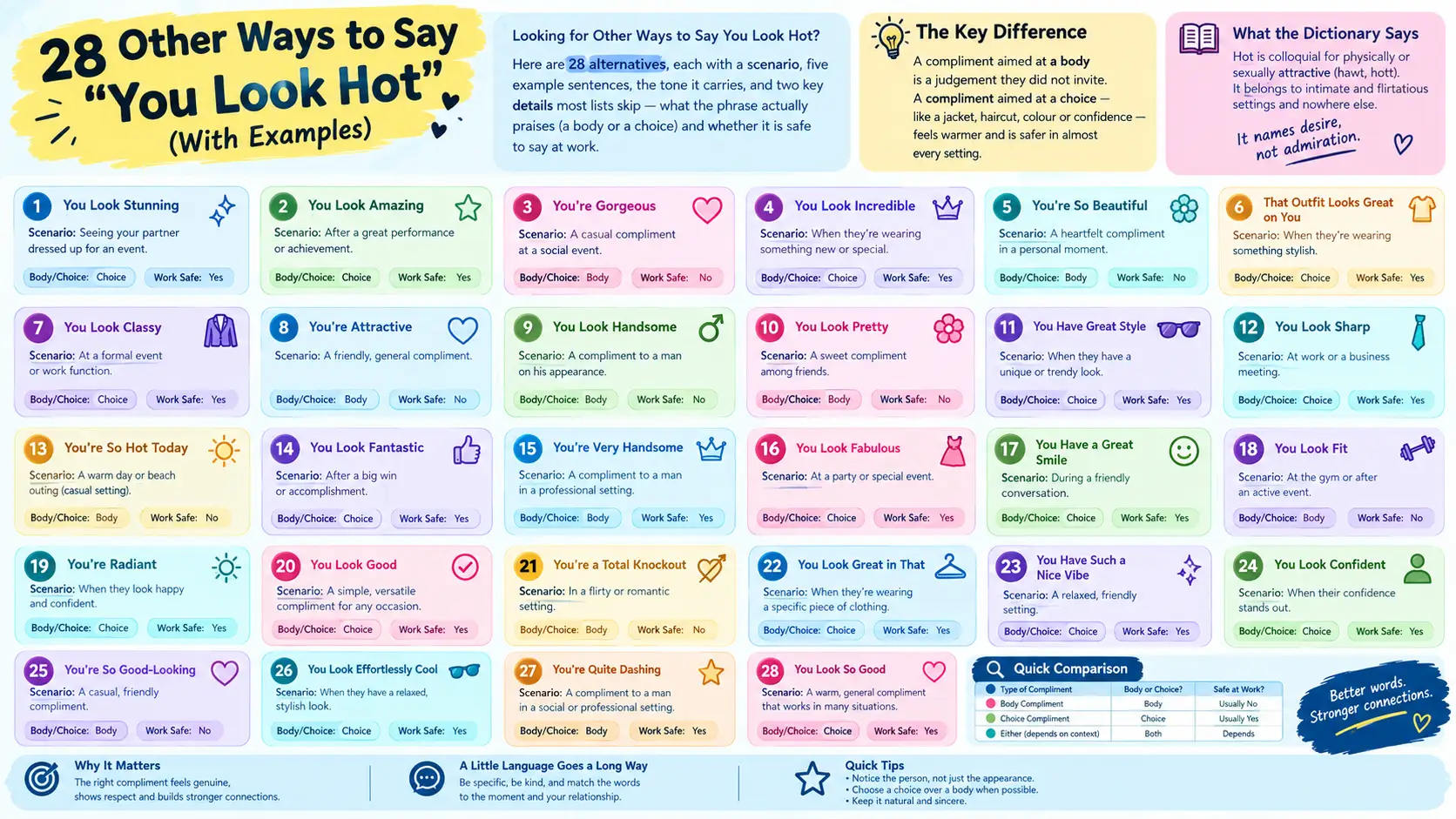
Looking for Other Ways to Say You Look Hot? Here are 28 alternatives, each with a scenario, five example sentences that contain the phrase, the tone it carries, and the two columns no other list on this subject includes — whether the compliment praises a body or a choice, and whether it is safe to say at work.
Those two columns are the whole craft of complimenting appearance. A compliment aimed at somebody’s body is a judgement they did not invite; a compliment aimed at a choice — the jacket, the haircut, the colour, the confidence — praises something they decided, and the second kind is both warmer and safer in almost every setting.
The dictionary is blunt about what the original phrase means. Used of a person, hot is colloquial for physically or sexually attractive, with the alternative spellings hawt and hott — which is why it belongs to intimate and flirtatious settings and nowhere else. That is not a matter of politeness so much as of register: the word names desire rather than admiration, and most of the alternatives below swap one for the other.
Appearance compliments carry more weight than their senders usually intend, and there is a well-studied reason. The physical attractiveness stereotype, commonly called the beautiful-is-good stereotype, is the tendency to assume that physically attractive people also possess other desirable traits, such as intelligence, social competence and morality — an advantage sometimes described as pretty privilege. Physical attractiveness has a measurable effect on how people are judged in employment, friendship, social opportunity and marriage, and the bias has been observed not only in social settings but in workplaces and in the judicial system.
The research behind that has a specific origin. The stereotype was first formally observed in a 1972 study by Karen Dion, Ellen Berscheid and Elaine Walster, in which university students judged photographs of people categorised as attractive, average or unattractive. Attractive individuals were rated as more socially desirable, with better job and marital prospects and better social and professional lives — and the one dimension that did not follow the pattern was parenting, where attractive people were not expected to be better parents. Which is the useful warning for a workplace: a comment on a colleague’s appearance is never only a comment on their appearance.
Two of the words on this page have etymologies that reverse their modern meanings entirely. pretty comes from Middle English prety, from the Old English prættiġ — tricky, crafty, sly, cunning, wily, astute — from Proto-West Germanic *prattug and Proto-Germanic *prattugaz, boastful, sly, slick, deceitful, tricky, cunning. It is literally prat, a trick, plus -y, and the cognates still carry the older sense: Dutch prettig means nice, pleasant, Low German prettig means funny, and Icelandic prettugur still means deceitful, tricky. For the way the meaning drifted, compare canny, clever and cute — all of which started as words about shrewdness.
handsome is even plainer about its origins: it began as a word about convenience. From Middle English handsum, from Old English, from Proto-West Germanic *handusam, handy — literally hand plus -some, and still handy, manageable in Dutch handzaam and West Frisian hânsum. The original sense was easy to handle or use, which gave suitable, then apt, clever in the mid-sixteenth century, and only in the late sixteenth century the appreciative senses we use now. So telling a man he is handsome once meant telling him he was easy to pick up.
Which sets the frame for the twenty-eight alternatives below. The compliments that land are specific, aimed at something chosen, and calibrated to the relationship — and the comparison table marks which ones praise a body, which praise a choice, and which are safe to say to somebody you work with.
28 Other Ways to Say “You Look Hot”
Every entry has a scenario, five example sentences containing the phrase, and an attribute line ending in whether it praises a body or a choice and whether it is safe at work.
This is the list in full, and it also answers other ways to say u look hot, other ways to say you’re hot, other ways to say your hot, other ways to say you are hot, other ways to say you are so hot, other ways to say someone looks hot, another way to say you look hot, another way to say you’re hot, different ways to say you’re hot, ways to say you’re hot, ways to say you’re so hot, what is another way to say you look hot, better way to say you look hot, how to say you look hot, how to say you look so hot, other ways to say hot, other ways to say you’re attractive, other ways to say you look cool, other ways to say you look gorgeous, other ways to say you look handsome, other ways to say you look pretty, other ways to say you look so pretty, other ways to say you’re pretty, other ways to say you’re so pretty, ways to say you look good and how to say you look good in other words — with dedicated sections below for flirty, funny, gendered and workplace wording, replies, and eleven languages.
1. You Look Stunning
The most useful single swap in the list: it is as strong as hot and has no element of appetite in it.
Scenario: Seeing your partner dressed up for an event.
Examples:
- You look stunning — and that colour was absolutely the right call.
- You look stunning tonight. I am going to be no use at all in conversation.
- You look stunning, and you knew it before I said it.
- You look stunning in that dress; it is the best thing you own.
- You look stunning — genuinely, I had to stop on the stairs.
Why it works: Stunning is the present participle of stun, so the sentence reports an effect on the speaker rather than a verdict on the listener — a small grammatical difference that makes it feel generous instead of evaluative. That is the mechanism behind every strong compliment on this page: describe what happened to you, not what is true of them. Examples one and four add the second ingredient, which is a choice: the colour, the dress, the decision. For how to say you’re hot respectfully, this is the answer — same intensity, no implied appraisal.
Tone: elegant, admiring | Formality: neutral | Best for: partners, formal events, special occasions | Avoid in: casual chats, where it is a degree too grand | Praises: the effect on you | Safe at work: no
2. You Look Gorgeous
Warm, romantic and the most-used alternative in British and Irish English.
Scenario: Complimenting someone during a date.
Examples:
- You look gorgeous — I have been looking forward to this all week.
- You look gorgeous, and I am glad we made the effort rather than staying in.
- You look gorgeous in that colour; it does something no other colour does.
- You look gorgeous, and your hair like that is new, isn’t it?
- You look gorgeous. That is the whole message.
Why it works: Gorgeous sits between beautiful, which is sincere, and hot, which is appetitive — which makes it the right register for a date, where both would be slightly wrong. It is also the entry that travels furthest socially: in much of the UK and Ireland it is used between friends and family as well as partners, where in American English it stays closer to romance. Example four is the move worth copying, because noticing something new is proof of attention rather than of taste. The anticipation that precedes an evening out is in Looking forward to seeing you.
Tone: warm, romantic | Formality: informal to neutral | Best for: dates, partners, heartfelt compliments | Avoid in: professional settings | Praises: the person, warmly | Safe at work: no
3. You Look Amazing
The safe everyday default, and the one that works on the widest range of people.
Scenario: Casual compliment to a friend or partner.
Examples:
- You look amazing — whatever you are doing, keep doing it.
- You look amazing today. New jacket?
- You look amazing, and you have been up since five, which makes it worse for the rest of us.
- You look amazing in photographs and somehow better in person.
- You look amazing — and congratulations again on the news.
Why it works: Amazing is enthusiastic without being specific about why, which is exactly what you want when you do not know somebody well enough to comment on anything in particular. It is also the most versatile entry in the standard twenty-five: friends, family, partners, acquaintances and most colleagues can all receive it — though in a workplace it is safest attached to an occasion, as example five does. Add one concrete detail and it stops being generic, which is the point of examples two and three.
Tone: friendly, positive | Formality: neutral | Best for: everyday use, friends, family, occasions | Avoid in: very formal settings | Praises: the overall impression | Safe at work: with an occasion attached
4. You Look Beautiful
The sincere register: it describes rather than reacts, and it carries more weight for exactly that reason.
Scenario: A romantic or sincere moment.
Examples:
- You look beautiful — and you looked beautiful this morning with the hair you are complaining about.
- You look beautiful. I should say it more often than I do.
- You look beautiful, and happy, which is better.
- You look beautiful in that photograph of us from 2019, and you look beautiful now.
- You look beautiful today, and I will tell you again at the reception.
Why it works: Beautiful is the one word in common use that can cover appearance and character at once, which is why it belongs to weddings, anniversaries, hospital rooms and ordinary mornings. It is also the most devalued by repetition: said automatically every day, it stops being heard, which is why examples one and three attach it to something unflattering or something non-physical. Example one is the strongest in this part of the list, because complimenting the version of somebody that they themselves are criticising is the most convincing thing you can do. The occasion register sits in Happy wedding anniversary.
Tone: gentle, sincere | Formality: neutral | Best for: partners, family, weddings, quiet moments | Avoid in: casual jokes, workplace messages | Praises: the person, not the outfit | Safe at work: no
5. You Look So Attractive
The most clinical phrasing in the list, and the register is the problem.
Scenario: Expressing admiration politely.
Examples:
- You look so attractive when you talk about work you actually care about.
- You look so attractive in that jacket — it is doing a great deal.
- You look so attractive, and I am aware that is a slightly formal way to put it.
- You look so attractive today; something has changed and I cannot place it.
- You look so attractive, which you already know, and I am saying it anyway.
Why it works: It is polite, unambiguous and faintly like a written assessment — attractive is the word a form would use. That formality is useful in exactly one situation: when you want to state interest clearly without the heat of hot, which is why it suits a new relationship. For other ways to say you’re attractive, the warmer versions are there is something about you, you are very easy to look at and I find you distracting, all of which say the same thing with less of the clipboard about them. Example one is the best of the five, because attaching attractiveness to animation rather than to features is both specific and flattering.
Tone: polite, appreciative | Formality: neutral to formal | Best for: new relationships, polite settings | Avoid in: deep romantic conversations, where it is too cool | Praises: the person, assessingly | Safe at work: no
6. You Look Incredible
The reaction compliment: it is about surprise, so it needs an occasion to justify it.
Scenario: Reacting to someone’s transformation.
Examples:
- You look incredible — I did not recognise you for a second.
- You look incredible. Six months of training and it shows.
- You look incredible in black tie; it should be compulsory.
- You look incredible, and you have clearly had the haircut you kept threatening.
- You look incredible — and more to the point, you look well.
Why it works: Surprise is a compliment in itself, because it implies a change worth noticing. The risk is the implied comparison: you look incredible after a transformation is heard by some people as a comment on the previous version, which is why example five adds you look well, and why I did not recognise you is safe between friends and unwise with anybody self-conscious. Attach the effort rather than the outcome, as example two does, and the compliment praises a choice instead of a body.
Tone: excited, impressed | Formality: informal to neutral | Best for: transformations, special occasions, big nights out | Avoid in: situations where the comparison would sting | Praises: a change, which is a choice | Safe at work: rarely, and only about an outfit
7. You Look So Stylish
The safest genuine compliment in the whole list, because style is entirely a decision.
Scenario: Complimenting fashion sense.
Examples:
- You look so stylish — where is the coat from?
- You look so stylish, and you are the only person in this office who can wear that colour.
- You look so stylish; you always get the shoes right, which nobody else does.
- You look so stylish, and I am going to copy the whole thing.
- You look so stylish. It is genuinely a skill.
Why it works: Style is chosen, assembled and maintained, so praising it credits judgement rather than genetics — which is why it is the one compliment that works across friendships, workplaces and families without adjustment. Asking where something is from, as example one does, is the highest form of this compliment, because it treats the other person as an authority. For other ways to say you look cool, this is the family: that is a great look, you always dress well, you have very good taste, that works perfectly on you. The workplace praise register sits in Keep up the good work.
Tone: appreciative, trendy | Formality: neutral | Best for: friends, coworkers, anybody you do not want to make uncomfortable | Avoid in: romantic moments, where it is too cool | Praises: a choice, entirely | Safe at work: yes
8. You Look Radiant
It praises a glow rather than a figure, which makes it the gentlest entry here.
Scenario: Someone glowing with happiness.
Examples:
- You look radiant — this job is clearly agreeing with you.
- You look radiant, and I have not seen you this well in a year.
- You look radiant; whatever happened last week, it worked.
- You look radiant today, and the sleep is obviously doing its job.
- You look radiant — happiness is unmistakable on you.
Why it works: Radiant comes from the Latin for to beam or to shine, the same root as radius, so the compliment is about light coming off somebody rather than about their shape. That makes it the right word after good news, recovery, a holiday or a change that has evidently suited them. Two cautions: it is traditionally used of brides and of pregnancy, so it is easily misread as a guess about either, and in a workplace it sits close to the line. Attach the cause, as all five examples do, and the ambiguity disappears.
Tone: soft, glowing | Formality: neutral | Best for: happy occasions, recoveries, weddings | Avoid in: serious settings; and never as a guess about pregnancy | Praises: a state, not a body | Safe at work: borderline
9. You Look Fantastic
Enthusiastic, unfussy and the easiest compliment to say out loud without rehearsing it.
Scenario: Complimenting someone at a casual gathering.
Examples:
- You look fantastic — it has been far too long.
- You look fantastic. Retirement is clearly treating you properly.
- You look fantastic, and the beard is a good decision.
- You look fantastic; I am stealing that shirt at some point.
- You look fantastic — and you are not allowed to tell me it is the lighting.
Why it works: It is warm, unspecific and almost impossible to take badly, which is why it is the standard greeting-compliment at reunions, parties and family gatherings. Its weakness is that it is doing a social job rather than giving information — everybody at the party looks fantastic — so the detail in examples three and four is what makes it land. Example five pre-empts the commonest British response, which is to deflect the compliment rather than accept it.
Tone: positive, upbeat | Formality: informal to neutral | Best for: parties, reunions, family, casual greetings | Avoid in: intimate moments, where it is too breezy | Praises: the overall impression | Safe at work: yes, in passing
10. You Look Elegant
It praises judgement, which is what the word has meant since it was Latin.
Scenario: At a formal event or celebration.
Examples:
- You look elegant — and everybody else has overdone it.
- You look elegant; one good coat beats a whole wardrobe, as you keep proving.
- You look elegant, and you have done it with two colours and no fuss.
- You look elegant tonight, which is precisely the brief for this room.
- You look elegant, and I notice you are the only person who is comfortable.
Why it works: Elegant descends from the Latin eligere, to select — the same root as elect — so the word literally praises good choosing rather than good looks. That etymology is the whole reason it reads as respectful: it credits restraint, judgement and editing, none of which are accidents of appearance. It is the correct compliment at a wedding, a funeral, a formal dinner or a graduation, and it is one of the few that works upward in age and seniority without sounding odd.
Tone: refined, classy | Formality: formal | Best for: formal occasions, older relatives, senior colleagues | Avoid in: casual settings, where it sounds stiff | Praises: judgement and restraint | Safe at work: yes
11. You Look Classy
Entry 10 in informal clothes, and the one word in the pair that reads as a comparison.
Scenario: Complimenting someone’s refined appearance.
Examples:
- You look classy — that suit fits properly, which almost none of them do.
- You look classy, and you have not tried too hard, which is the trick.
- You look classy; the watch finishes the whole thing.
- You look classy, and I say that as somebody wearing fifteen-year-old shoes.
- You look classy tonight, and you always do.
Why it works: Classy is warm, informal and British-inflected, and it praises the same thing as elegant with less ceremony. The caution is built into the word: classy implies a scale with tacky at the other end, so it is heard by some as a comment on other people in the room, or worse, on how somebody usually looks. Examples two and four defuse it — naming the trick, or putting yourself at the bottom of the comparison, keeps the compliment generous.
Tone: respectful, tasteful | Formality: neutral | Best for: friends, colleagues, anybody well turned out | Avoid in: situations where a comparison would be unkind | Praises: taste, which is a choice | Safe at work: yes
12. You Look Charming
It compliments the whole impression, personality included, and the word began as a magic spell.
Scenario: Light and friendly admiration.
Examples:
- You look charming — and you have been charming all evening, which is harder.
- You look charming in that hat, and almost nobody can wear a hat.
- You look charming; the whole table has noticed, not only me.
- You look charming, and the waistcoat is a genuinely brave decision.
- You look charming, which is my way of saying I am enjoying this.
Why it works: Charm comes from the Latin carmen, a song or incantation, so a charming person was originally one who had cast a spell — and the word still carries that sense of an effect rather than a feature. Because it covers manner as well as appearance, it is the gentlest way to compliment somebody you do not know well, and it is one of the few that reads as warm rather than appraising when said to an older person. Example one is the version worth copying, since separating the looking from the behaving makes both compliments land.
Tone: warm, friendly | Formality: neutral | Best for: light romance, new acquaintances, older relatives | Avoid in: intense romantic moments, where it is too mild | Praises: manner and appearance together | Safe at work: borderline — keep it about the outfit
13. You Look Dashing
The standard compliment for a well-dressed man, and the answer to half the searches about men.
Scenario: Complimenting a well-dressed man.
Examples:
- You look dashing — black tie suits you far more than it suits me.
- You look dashing. Your mother is going to take photographs for an hour.
- You look dashing, and the tie is exactly right.
- You look dashing, which I believe is the correct word for a man in a good coat.
- You look dashing — the whole look is very considered.
Why it works: Dashing comes from dash, a word about vigorous movement, so it suggests energy and style together rather than static good looks. It is slightly old-fashioned, and that is the appeal: it lands as a compliment with a smile in it, which is why it works for men who are uncomfortable being complimented at all. For how to say you’re handsome in different ways and other ways to say you look handsome, the usable set is dashing, sharp, smart, distinguished, rugged, you clean up well and that suit was made for you — and the full treatment is in the section on complimenting men below.
Tone: confident, stylish | Formality: neutral to formal | Best for: men in formal wear, weddings, black tie | Avoid in: casual settings, where it is theatrical | Praises: the outfit and the bearing | Safe at work: yes, at an event
14. You Look Fabulous
High energy, slightly theatrical, and the word literally means like a fable.
Scenario: Reacting with excitement.
Examples:
- You look fabulous — turn round, let me see the back of it.
- You look fabulous, and the shoes are an outrage.
- You look fabulous; this is the best thing I have seen all week.
- You look fabulous, and I want the whole story about where you found it.
- You look fabulous — absolutely nobody else could carry that off.
Why it works: Fabulous comes from fable, so the original sense was mythical, scarcely believable — which is why the word is naturally hyperbolic and why it suits a reaction rather than a quiet observation. It is at home in friendship groups, parties and comment sections, and it carries a camp, celebratory warmth that beautiful does not. Example one is the full version, because asking to see more of an outfit is a compliment nobody can doubt.
Tone: excited, expressive | Formality: informal | Best for: friends, parties, celebrations, social posts | Avoid in: formal writing, quiet romantic moments | Praises: the outfit, enthusiastically | Safe at work: yes, in an informal team
15. You Look Alluring
The first openly flirtatious entry, and the lure inside it is doing the work.
Scenario: A romantic or flirty moment.
Examples:
- You look alluring, and you are entirely aware of it.
- You look alluring — this is a deliberate act of sabotage against my concentration.
- You look alluring; I have forgotten what I was going to say.
- You look alluring, and the rest of this evening is going to be difficult.
- You look alluring, which is a very old-fashioned word for a very current problem.
Why it works: Alluring contains lure, so it frames the other person as doing something to you deliberately — which is flattering precisely because it credits them with intent and power. That makes it a flirtation rather than a compliment, and it belongs only where flirtation is already established. Example five is the version that keeps it light, since naming the word as old-fashioned turns a bold line into a shared joke.
Tone: flirty, romantic | Formality: informal | Best for: partners, established flirtation | Avoid in: work, new acquaintances and anybody who has not flirted back | Praises: effect, with intent attributed | Safe at work: no
16. You Look Captivating
It admits to being held, and the root of the word is captive.
Scenario: Deep admiration.
Examples:
- You look captivating — I have been watching you talk for ten minutes.
- You look captivating, and I am not the only person in this room who thinks so.
- You look captivating, and it is not the dress; it is the way you are telling that story.
- You look captivating tonight, and I would like a photograph before we leave.
- You look captivating, which is an inconvenient thing to realise at a work event.
Why it works: Captivating shares its root with captive and capture, so the compliment describes the speaker’s own helplessness — which is the most generous structure a compliment can have. Example three is the strongest sentence in this stretch of the list, because moving the credit from the clothes to the person’s animation is both specific and impossible to receive badly. It is intense, so it needs a real occasion; on an ordinary Tuesday it will be read as a line.
Tone: intense, admiring | Formality: neutral | Best for: romantic admiration, special evenings | Avoid in: casual or professional contexts | Praises: the effect on the speaker | Safe at work: no
17. You Look Mesmerizing
Named after a real person, and the strongest word in the standard list.
Scenario: Being deeply impressed.
Examples:
- You look mesmerizing — I lost the thread of that entire conversation.
- You look mesmerizing, and the candlelight is doing you no favours it needs to.
- You look mesmerizing; I am going to be useless company tonight.
- You look mesmerizing, and you have done it with no visible effort at all.
- You look mesmerizing, which is my excuse for staring.
Why it works: The word comes from Franz Anton Mesmer, the eighteenth-century physician whose theory of animal magnetism gave English mesmerism and then mesmerize — so the literal claim is that you have been hypnotised. That scale is the point and the risk: it is wonderful from a partner and absurd from somebody you met an hour ago. Example five is the one that makes it usable, because turning the compliment into an apology for staring keeps it charming rather than overwhelming.
Tone: deep, emotional | Formality: informal to neutral | Best for: partners, significant evenings | Avoid in: early acquaintance, professional settings | Praises: the effect, at maximum strength | Safe at work: no
18. You Look Divine
Poetic to the point of parody, which is exactly why it survives.
Scenario: Very high praise.
Examples:
- You look divine — and I am saying it in the dramatic voice it deserves.
- You look divine, darling. The whole room is beneath you.
- You look divine; that is the last word I have on the subject.
- You look divine, and you are going to be photographed a great deal tonight.
- You look divine — genuinely, not ironically, for once.
Why it works: Divine is from the Latin divinus, of a god, so the word is hyperbole by construction — and in modern English it is used almost entirely with a knowing theatricality. That makes it a safe way to pay an enormous compliment without the weight of sincerity, which is useful between friends who find earnestness awkward. Example five is the move that lands hardest, since dropping the irony after establishing it makes the compliment unmistakably real.
Tone: highly expressive, poetic | Formality: informal | Best for: friends, theatrical praise, big occasions | Avoid in: sincere quiet moments, where it reads as a joke | Praises: everything, hyperbolically | Safe at work: only as evident humour
19. You Look Like a Star
A comparison rather than a description, which makes it playful rather than appraising.
Scenario: Complimenting someone’s glow.
Examples:
- You look like a star — you are going to be the most photographed person here.
- You look like a star, and the sunglasses indoors were the correct choice after all.
- You look like a star; I am carrying the bags and saying nothing.
- You look like a star today, and the confidence is most of it.
- You look like a star — and the hair, specifically, is doing something cinematic.
Why it works: Comparing somebody to a category rather than rating them personally softens the compliment and makes it shareable in public without embarrassment. It is also a compliment about presence rather than features, which is why it suits an entrance, a stage, a performance or a photograph. Example five shows the repair for all comparison compliments: name the specific thing that triggered it, or the sentence stays decorative.
Tone: admiring, uplifting | Formality: informal | Best for: entrances, performances, photographs, confidence-boosting | Avoid in: formal settings, quiet moments | Praises: presence | Safe at work: yes, at an event
20. You Look So Confident
The one entry in the standard list that compliments a state of mind, and the most under-used of the twenty-five.
Scenario: Highlighting personality.
Examples:
- You look so confident — you walked into that room like you owned the lease.
- You look so confident, and it is new, and it suits you.
- You look so confident; six months ago you would not have taken that meeting.
- You look so confident today, and the posture is doing more than the suit.
- You look so confident, which is the most attractive thing in the room and not a matter of clothes.
Why it works: Confidence is visible, chosen and earned, so complimenting it credits something the person built rather than something they inherited. That makes it the single safest strong compliment available, usable with colleagues, friends, family, students and partners alike. Example three is the version that matters, because naming the change over time turns a compliment into evidence of growth, which almost nobody receives and everybody wants. The appraisal register that pairs with it is in A great asset to the team.
Tone: encouraging, positive | Formality: neutral | Best for: anybody, including colleagues, students and children | Avoid in: flirtation, where it is too earnest | Praises: something earned | Safe at work: yes — the safest in the list
21. You Look Impressive
Formal, slightly distant, and the word is doing assessment rather than admiration.
Scenario: A professional or respectful compliment.
Examples:
- You look impressive — exactly right for a board meeting.
- You look impressive, and the client is going to take you seriously before you speak.
- You look impressive; the whole panel will have noticed the preparation.
- You look impressive today, and you have clearly thought about the room.
- You look impressive, which in this industry is half the argument.
Why it works: It frames appearance as a professional asset rather than a personal quality, which is why it survives in workplaces where the warmer words do not. Its coolness is the feature: impressive is what you say when you want to compliment presentation without any suggestion of attraction. Examples two and five are the useful versions, because tying appearance to how somebody will be received makes the compliment instrumental and therefore comfortable.
Tone: respectful, formal | Formality: formal | Best for: work, interviews, formal environments | Avoid in: romantic settings, where it is chilly | Praises: presentation | Safe at work: yes
22. You Look Polished
It praises preparation, which is the most professional compliment on the page.
Scenario: A neat and refined appearance.
Examples:
- You look polished — and your slides are in the same condition, which is the point.
- You look polished; you always do, and it is noticed more than you think.
- You look polished today, which is more than I managed before eight o’clock.
- You look polished, and for a court appearance that is half the job.
- You look polished, and the detail is in the shoes, as usual.
Why it works: Polished describes the result of effort — literally of work done to a surface — so the compliment is about care rather than about a body. That is exactly why it is safe at work: it reads as a comment on professionalism, which is a legitimate subject between colleagues. Example one is the strongest form, because extending the compliment from appearance to work converts it into a professional observation.
Tone: professional, neat | Formality: formal | Best for: workplaces, interviews, court, client meetings | Avoid in: romantic moments, where it sounds like a review | Praises: effort and care | Safe at work: yes
23. You Look Sharp
Short, confident and the best single compliment for a man in a suit.
Scenario: Smart dressing.
Examples:
- You look sharp — good day for it.
- You look sharp; that jacket fits you properly, which is rarer than it should be.
- You look sharp, and the haircut has landed.
- You look sharp today. Interview?
- You look sharp, and the whole team has noticed, which is why nobody has said anything.
Why it works: Two words, no ceremony, and the metaphor is about precision rather than beauty — which is why men who deflect compliments accept this one. It is the single most usable entry with male colleagues, because it reads as a comment on tailoring rather than on the person. Example four does something worth noting: turning the compliment into a question invites an explanation and makes the exchange a conversation rather than a verdict.
Tone: smart, confident | Formality: neutral | Best for: men, suits, workplaces, formal days | Avoid in: intimate settings, where it is too brisk | Praises: the clothes and the fit | Safe at work: yes
24. You Look Like a Model
The biggest claim in the standard list, and the one most likely to be deflected.
Scenario: Strong admiration.
Examples:
- You look like a model — and I mean the editorial kind, not the catalogue kind.
- You look like a model in that photograph; it should be framed.
- You look like a model, and you are going to tell me it is the angle, and you are wrong.
- You look like a model, and you have been dressing better than everybody here for years.
- You look like a model today. The coat is doing a great deal of work.
Why it works: It is enormous praise, instantly understood, and it is also a comparison to a professional standard — which is why it tends to be laughed off. Specificity rescues it: the editorial distinction in example one, the photograph in example two, the coat in example five. Two cautions: between strangers it reads as a line, and to anybody self-conscious about their body a comparison with models can land badly rather than well. Between friends and partners, said with evidence, it is one of the warmest things on this page.
Tone: highly flattering | Formality: informal | Best for: close friends, partners, photographs | Avoid in: professional settings, first meetings | Praises: appearance, by comparison | Safe at work: no
25. You Look Absolutely Wonderful
The kindest entry, and the one that works across the widest age range.
Scenario: A warm and kind compliment.
Examples:
- You look absolutely wonderful — and it is lovely to see you out and about again.
- You look absolutely wonderful, Gran, and that brooch is the one from the wedding photographs.
- You look absolutely wonderful; the whole family has said so.
- You look absolutely wonderful, and you sound even better, which matters more.
- You look absolutely wonderful today, and I wanted to say it before the room filled up.
Why it works: Wonderful covers appearance, health and spirits at once, which makes it the right word after an illness, in later life, or at any moment where hot and its relatives would be absurd. That breadth is why it is the most useful compliment in a hospital, a care home or a family gathering. Example four is the version that is remembered, because moving from looking to sounding tells somebody you were paying attention to more than their clothes. The homecoming register beside it is in Welcome home.
Tone: warm, sincere | Formality: neutral | Best for: older relatives, recoveries, family occasions, anybody at all | Avoid in: flirtation, where it is affectionate rather than charged | Praises: the whole person | Safe at work: yes
3 More Alternatives You Will Not Find on Other Lists
All twenty-five standard alternatives are adjective swaps: a different word in the same slot, still aimed at the person. Not one names a specific choice, not one uses the room as evidence, and not one tells you what to say when the compliment is aimed at you. These three do.
26. That jacket is a very good decision.
The specific-choice compliment, and the most useful pattern in this entire article.
Scenario: Anybody, anywhere — colleagues, strangers, friends, partners, and especially anybody you do not want to make uncomfortable.
Examples:
- That jacket is a very good decision.
- Those are excellent glasses — they change your whole face, in the right direction.
- Whoever cut your hair knew exactly what they were doing.
- That colour is the right call; most people cannot wear it.
- You put outfits together better than anybody I work with, and I have been meaning to say so.
Why it works: It moves the compliment from the body to the decision, and the decision is the only part the other person is responsible for. That single shift solves almost every problem with appearance compliments at once. It is safe at work, because praising a jacket is a comment on judgement rather than on a person; it is impossible to receive badly, because nobody is self-conscious about having chosen well; and it is more flattering than the adjectives, because it credits taste rather than luck. There is a research reason to prefer it, too: because the beautiful-is-good stereotype means attractiveness is already read as a proxy for competence and character, a compliment that praises a choice sidesteps the whole apparatus and says something the person can actually own. The formula is three parts: name the item, say what it does, and stop. Example three is the strongest variant, since crediting the haircut rather than the head makes the compliment specific, warm and entirely unobjectionable.
Tone: specific, warm, unfussy | Formality: any | Best for: colleagues, strangers, friends, family, partners — everybody | Avoid in: moments that call for romance rather than observation | Praises: a choice, by design | Safe at work: yes — this is the work version
27. You walked in and the room noticed — not just me.
The effect compliment with social proof, which flatters without appraising.
Scenario: Entrances, events, parties, presentations — and any situation where a direct personal compliment would be too much.
Examples:
- You walked in and the room noticed — not just me.
- Three people asked me who you were before I got to the bar.
- The entire table stopped talking when you came over. I thought you should know.
- Whatever you did before you left the house, it worked on everybody, not only on me.
- I watched you hold that room for twenty minutes. Nobody looked at their phone once.
Why it works: A compliment from one person is an opinion; a report of other people’s reactions is evidence. That is why this construction lands harder than any adjective, and why it is believed by people who routinely deflect praise — there is nothing to argue with, because you are describing what happened rather than what you think. It also removes the awkwardness of a personal appraisal, which makes it usable where you look stunning would be too intimate: a work event, a first meeting, a friend’s wedding. Example five extends it past appearance altogether, and it is the version worth keeping for anybody who would rather be admired for what they did than for how they looked. One rule: it has to be true, since an invented room full of admirers is the easiest lie to catch.
Tone: observational, generous | Formality: neutral | Best for: entrances, events, presentations, people who deflect compliments | Avoid in: quiet one-to-one moments, where it is oddly indirect | Praises: an effect, with witnesses | Safe at work: yes
28. Thank you — that is a nice thing to hear.
How to receive one, which is the half of this subject nobody writes about.
Scenario: Somebody has just told you that you look hot, gorgeous, stunning or anything else on this page.
Examples:
- Thank you — that is a nice thing to hear.
- Thank you. I made an effort, so I am glad somebody noticed.
- Thank you — and you are not looking so bad yourself.
- Thank you. I am going to take that at face value instead of arguing with it.
- That is kind, thank you. Though I would rather be told I was right about the figures.
Why it works: For what to reply when someone says you look hot, the honest answer is that almost everybody gets this wrong in the same way: they deflect. Oh, this old thing, it is just the lighting and I look awful, actually all reject a gift that somebody has just handed over, and the person who gave it learns not to bother again. Thank you is the complete answer, and everything after it is optional. The four useful extensions are: accept the effort, as example two does; return it, as example three does; name the deflection and refuse it, as example four does; or redirect to something you would rather be praised for, as example five does. Example five is the one to use at work, since it accepts the compliment politely and moves the conversation back to the thing you want to be known for. And if the compliment was unwelcome, the reply is shorter still: I would rather we kept it to work, said once, plainly, with no softening. The gratitude set in full is in I appreciate you.
Tone: gracious, unbothered | Formality: any | Best for: receiving any compliment at all | Avoid in: nothing — the only wrong answer is a denial | Praises: nothing; it accepts | Safe at work: yes, with example five
Quick Comparison Table
All 28 alternatives, with what each one actually praises and whether it is safe to say at work. Those two columns settle almost every question people have about complimenting appearance.
| Phrase | Tone | Best for | Avoid in | Praises | Safe at work |
|---|---|---|---|---|---|
| 1. You Look Stunning | Elegant | Formal events, partners | Casual chats | The effect on you | No |
| 2. You Look Gorgeous | Romantic | Dates, partners | Professional settings | The person, warmly | No |
| 3. You Look Amazing | Friendly | Everyday use, occasions | Very formal settings | The overall impression | With an occasion |
| 4. You Look Beautiful | Sincere | Emotional moments, family | Casual jokes, work email | The person, not the outfit | No |
| 5. You Look So Attractive | Polite | New relationships | Deep romantic talks | The person, assessingly | No |
| 6. You Look Incredible | Impressed | Transformations, big nights | Where comparison would sting | A change, which is a choice | Rarely |
| 7. You Look So Stylish | Appreciative | Friends, coworkers, anybody | Romantic moments | A choice, entirely | Yes |
| 8. You Look Radiant | Soft | Happy occasions, recoveries | Serious settings; pregnancy guesses | A state, not a body | Borderline |
| 9. You Look Fantastic | Upbeat | Parties, reunions, family | Intimate moments | The overall impression | Yes, in passing |
| 10. You Look Elegant | Refined | Formal occasions, senior people | Casual settings | Judgement and restraint | Yes |
| 11. You Look Classy | Tasteful | Friends, colleagues | Where a comparison would wound | Taste, which is a choice | Yes |
| 12. You Look Charming | Warm | Light romance, older relatives | Intense romantic moments | Manner and appearance | Borderline |
| 13. You Look Dashing | Confident | Men in formal wear | Casual settings | The outfit and the bearing | Yes, at an event |
| 14. You Look Fabulous | Expressive | Friends, parties, social posts | Formal writing | The outfit, enthusiastically | Yes, informal teams |
| 15. You Look Alluring | Flirty | Partners, established flirtation | Work, new acquaintances | Effect, with intent attributed | No |
| 16. You Look Captivating | Intense | Romantic admiration | Casual or professional contexts | The effect on the speaker | No |
| 17. You Look Mesmerizing | Deep | Partners, significant evenings | Early acquaintance | The effect, at maximum | No |
| 18. You Look Divine | Theatrical | Friends, big occasions | Sincere quiet moments | Everything, hyperbolically | Only as humour |
| 19. You Look Like a Star | Uplifting | Entrances, photographs | Formal settings | Presence | Yes, at an event |
| 20. You Look So Confident | Encouraging | Anybody, including colleagues | Flirtation | Something earned | Yes — the safest |
| 21. You Look Impressive | Formal | Work, interviews | Romantic settings | Presentation | Yes |
| 22. You Look Polished | Professional | Workplaces, court, clients | Romantic moments | Effort and care | Yes |
| 23. You Look Sharp | Smart | Men, suits, workplaces | Intimate settings | The clothes and the fit | Yes |
| 24. You Look Like a Model | Flattering | Close friends, partners, photos | Professional settings, strangers | Appearance, by comparison | No |
| 25. You Look Absolutely Wonderful | Sincere | Older relatives, recoveries | Flirtation | The whole person | Yes |
| 26. That jacket is a very good decision. | Specific | Everybody, every setting | Moments calling for romance | A choice, by design | Yes — the work version |
| 27. You walked in and the room noticed. | Observational | Entrances, events, deflectors | Quiet one-to-one moments | An effect, with witnesses | Yes |
| 28. Thank you — that is a nice thing to hear. | Gracious | Receiving any compliment | Nothing | Nothing; it accepts | Yes |
Three patterns come out of the table, and the first is the one that decides whether a compliment is welcome.
First, the compliments that work praise a choice or an effect; the ones that misfire praise a body. Stylish, elegant, classy, polished, sharp, dashing and confident all name something the person decided — the coat, the restraint, the preparation, the posture; hot, attractive and like a model name something they did not. That is why entry 26 is the most useful line on this page: moving the compliment from the person to the jacket makes it specific, flattering and safe in a single move.
Second, exactly eleven of the twenty-eight are safe to say to a colleague, and they share a feature. Entries 7, 10, 11, 13, 20, 21, 22, 23, 25, 26 and 27 all point at clothing, preparation, bearing or the room’s reaction rather than at the person’s attractiveness. Everything in the gorgeous, beautiful, alluring, captivating, mesmerizing group belongs to intimacy, and the research explains why the distinction matters at work: because the beautiful-is-good stereotype already biases judgements about competence, employment and opportunity, a comment on a colleague’s looks is never heard as only a comment on their looks.
Third, the strongest entries describe the speaker rather than the listener. Stunning, captivating, mesmerizing and entry 27 all report an effect — being stopped, held, hypnotised, noticed by a room — which is generous because it makes no claim about the other person at all. Compare the two structures directly: you are beautiful is a verdict, and I had to stop on the stairs is a fact. The second is harder to argue with, which is why it is harder to deflect.
What Does “You Look Hot” Mean?
The phrase you look hot is commonly used to compliment somebody’s physical appearance, especially when they look attractive, confident or stylish. It carries a strong, bold tone, and it can feel intense depending on the situation and the relationship.
The dictionary sense is narrower than most senders assume. Used of a person, hot is colloquial for physically or sexually attractive — so the word names desire rather than admiration, which is the difference between it and every alternative on this page. That is also why the register is so fixed: there is no formal version of hot, only other words.
When to Use “You Look Hot”
You can use you look hot in casual, romantic or flirty situations where both people are comfortable with direct compliments. It works best in close relationships, where tone and intention are clearly understood.
Three conditions have to hold, and if any one of them is missing the phrase misfires. The relationship has to be intimate or openly flirtatious; the setting has to be private or social rather than professional; and the other person has to have given some sign that direct compliments are welcome. Between partners it is affectionate shorthand; from an acquaintance, a colleague or a stranger it is an unasked-for assessment, and the alternatives below exist for exactly those situations.
Pros and Cons of “You Look Hot”
It is a direct and clear compliment, it shows strong attraction, and it works well in romantic settings. Against that, it can feel too intense or objectifying, it is not always suitable for formal or new relationships, and it sounds generic through overuse.
| Pros | Cons | The fix |
|---|---|---|
| Direct and clear compliment | Can feel too intense or objectifying, because it names desire rather than admiration | Entry 1 or 26: same strength, no appraisal |
| Shows strong attraction | Not always suitable for formal or new relationships | Entry 5 for a new relationship; entry 21 for anything formal |
| Works well in romantic settings | May sound generic or overused — it is the default, so it carries no detail | Name the item, the colour or the change |
| Short and unmistakable | It praises a body rather than a choice | Entry 7, 22 or 26, all of which praise decisions |
| Carries real heat between partners | It is unusable at work, and the reason is documented | Entry 20 or 26 for colleagues |
| Easy to say without rehearsing | It is hard to receive, so it often produces a deflection | Entry 28 for the reply |
Every item in that middle column has the same root: the sentence is about a body rather than a decision. Intense, objectifying and generic are three descriptions of one problem, and the repair is not a softer adjective — it is moving the compliment onto something the other person chose.
Why We Need to Use Alternatives
Using different phrases instead of you look hot helps you sound more genuine, respectful and creative. It lets you match your words to the situation, the relationship and the tone, which makes the compliment feel more special and more memorable.
There is a documented reason to take the choice seriously, and it is not only about manners. The beautiful-is-good stereotype means physically attractive people are assumed to possess other desirable traits — intelligence, social competence, morality — and attractiveness measurably affects judgements about employment, friendship and opportunity. So a compliment about appearance arrives attached to all of that, which is why it is welcome from a partner, awkward from a colleague, and worth replacing with a compliment about judgement or effort wherever the relationship is not personal. The non-appearance praise register is in Keep up the good work.
Introduction: Why Finding the Right Words Matters
Because a compliment is one of the few sentences whose effect depends almost entirely on whether it was aimed at something the other person chose.
The Problem With “You Look Hot”
| The problem | Why it happens | The fix |
|---|---|---|
| It names desire, not admiration | The dictionary sense is physically or sexually attractive | Entry 1: stunning is as strong and has no appetite in it |
| It is aimed at a body | So there is nothing in it the person chose | Entry 26: praise the jacket, the colour, the haircut |
| It is the default, so it says nothing | Everybody has heard it; no detail survives | Add one specific: that colour was the right call |
| It is wrong at work | Appearance comments carry documented bias with them | Entries 20, 22 and 26 are the workplace set |
| It assumes a shared register | Fine between partners, intrusive from an acquaintance | Entry 7 or 27, which comment on style or effect |
| It is awkward to answer | Most people deflect rather than accept | Entry 28: thank you, and nothing else is required |
Rows two and six are the two that most people never think about. A compliment aimed at a body gives the recipient nothing to accept except genetics, which is why it so often produces an awkward deflection rather than a thank-you — and a compliment that is hard to receive quietly teaches the giver to stop giving them. Row four is the one that matters professionally: at work the safe set is short, and it is the set that points at clothing, preparation, bearing or results.
How to Use This Guide
| If you want | What it covers | Where to look |
|---|---|---|
| Everyday English alternatives | Casual, sincere and you look good in other words | Entries 1–9, and the synonym tables below |
| Flirty and funny | Playful lines, teasing, and one-liners | The flirty and funny sections, with the read-the-room rules |
| Complimenting a woman | Specificity and respect rather than appraisal | How to say you look hot to a girl, below |
| Complimenting a man | The awkwardness most people feel, and how to get round it | How to say you look hot to a guy, below |
| Everyday wording | Why today changes the whole sentence | How to say you look pretty today, below |
| Work and friendship | Safe, non-flirtatious options | Entries 7, 20, 21, 22, 23 and 26 |
| Eleven languages | Spanish, French, Italian, Portuguese, German, Russian, Chinese, Japanese, Korean, Hindi, Malayalam | With the slang and formality traps marked |
| Sign language and non-verbal | Why a borrowed hot does not work in ASL | The sign language section, below |
| Replies | What to say when it is aimed at you | Entry 28 and the reply section |
One rule carries the whole page: name the thing, then stop. A compliment with a specific object — the coat, the colour, the haircut, the confidence, the way somebody held a room — is warmer, safer and far more memorable than any adjective applied to a person. Everything below is that rule applied to a different relationship, a different setting or a different language.
Better Ways to Say “You Look Hot” in English
The English alternatives divide into three registers: casual, which is safe anywhere; romantic, which reports an effect; and the synonym set, which lets you pick by exact shade of meaning.
Casual and Everyday Alternatives
For ways to say you look good in ordinary conversation, the short versions work better than the grand ones.
| Say | Best for | Why it works |
|---|---|---|
| You look great today | Anybody, any day | Today makes it an observation, not a verdict |
| You’re glowing | Good news, holidays, recoveries | Praises a state rather than a shape |
| That suits you | New clothes, new hair | Three words, and entirely about the choice |
| You look well | Family, older relatives, recoveries | British, warm, and about health as much as looks |
| Something about you today | When you cannot place it | Honest, and invites them to tell you |
| You scrub up well | Friends, affectionately rude | Teasing; strictly for people who joke with you |
| New hair? It works | Any change | Noticing is the compliment |
| You look like you have had eight hours’ sleep | Colleagues, friends | Funny, and oddly the one people believe |
| You look happy, which looks good on you | Anybody | Moves the praise from face to mood |
Row one contains the single most useful word in casual compliments: today. You look great today is an observation about a particular day, where you look great is a judgement about a person — and the first is far easier to accept, because it does not invite the listener to wonder about yesterday. Rows three and seven are the next most useful, since that suits you and new hair? it works are both pure choice-praise. Row one also travels to greetings — the same today trick runs through Happy birthday in advance. Row six needs a warning: you scrub up well is affectionate between friends and mildly insulting from anybody else.
Sincere and Romantic Alternatives
| Say | Best for | Why it works |
|---|---|---|
| You’re stunning | Partners, big occasions | The strongest respectful word available |
| You take my breath away | Weddings, anniversaries, rare moments | Reports an effect, which is unarguable |
| I cannot stop looking at you | Partners | Confession rather than assessment |
| You are the best-looking person in this room, and it is not close | Partners, playful | Comparative, and warm because it is absurd |
| I forget what I was saying when you walk in | Partners | Specific, and about them rather than their clothes |
| You look like the reason I was early | Dates | Flirtation with a compliment inside it |
| Twelve years and you still do this to me | Long relationships | Duration is the compliment |
| You are beautiful, and I do not say it enough | Any time | Admits the gap, which makes it credible |
Every strong romantic compliment in that table has the same shape: it describes what happened to the speaker. You take my breath away, I cannot stop looking at you and I forget what I was saying are all reports rather than ratings, which makes them impossible to argue with and difficult to deflect. Row seven is the one that matters most in a long relationship, because after a decade the compliment that counts is that you are still saying it. The occasion wording is in Happy wedding anniversary, and the deeper statement of feeling in It means a lot to me.
How to Say You Look Good in Other Words
For how to say you look good in other words, twelve words with their exact register, so you can pick by shade rather than by habit.
| Word | Register | Best for |
|---|---|---|
| gorgeous | Warm, romantic, very British | Friends and partners alike in the UK and Ireland |
| stunning | Strong, respectful | The best single swap for hot |
| radiant | Soft, about light | Happy occasions, recoveries |
| striking | Cool, admiring, non-sexual | Safe for colleagues and strangers |
| dashing | Energetic, old-fashioned | Men in formal wear |
| distinguished | Respectful, age-friendly | Older men, senior colleagues |
| immaculate | About precision | Tailoring, grooming, uniforms |
| put together | Casual, approving | Praises assembly, which is a skill |
| a knockout | Informal, hyperbolic | Friends, parties |
| easy on the eye | Understated; British English | Mild, and often used about a third person |
| handsome | Classic, usable for anyone | Note: it began as a word meaning handy |
| lovely | Gentle, broad | Family, neighbours, any age |
Four of these solve specific problems the common words cannot. Striking is admiring without being sexual, which makes it the one strong adjective you can use about a colleague or a stranger; distinguished compliments an older man without implying that youth is the standard; immaculate praises precision, which suits uniforms and tailoring; and put together credits assembly, which is a skill rather than a gift. And handsome carries a small piece of history: it began as a word meaning handy — easy to handle or use — and only acquired its appreciative sense in the late sixteenth century.
The pretty family has its own set, and it is the most searched of all.
| If you searched | Say | Why it works |
|---|---|---|
| other ways to say you look pretty | You look lovely | Softer, and it works at any age |
| other ways to say you look so pretty | You look so pretty, and that colour is why | Keeps the praise and adds the reason |
| other ways to say you’re pretty | You have a really lovely face | Warmer and more specific than the adjective |
| other ways to say you’re so pretty | You are properly beautiful, and you should be told more often | Upgrades and acknowledges the shortage |
| different ways to say you look pretty | That is a very good look on you | Entirely about the choice |
| different ways to say you’re so pretty | I have never once seen you look bad | Comparative over time, which is hard to deflect |
| how to say you look really pretty | You look really pretty — genuinely, not politely | Marks it as sincere |
| how to say you look very pretty | You look very pretty today, and the hair is new, isn’t it? | Observation plus a question |
| another way to say you looked very pretty today | You looked lovely today — I meant to say so at the time | A late compliment reads as considered |
| how to say you’re beautiful in other way | You are the sort of person people look at twice | Indirect, and therefore easy to receive |
| how to say you’re pretty cool, another way to say you’re pretty cool | You are extremely cool, and I say that reluctantly | Praises manner, not appearance |
Row nine is the most under-used compliment in English: the late one. You looked lovely today — I meant to say so at the time arrives hours after the event, which proves it was a thought rather than a reflex, and people remember those far longer than the ones delivered on sight. Row six works the same way through time: I have never once seen you look bad is a claim about years, and years are harder to wave away than an evening. And pretty itself has the strangest history of any word here — from the Old English prættiġ, tricky, crafty, sly, cunning, so the compliment was once an accusation of cleverness, with Icelandic prettugur still meaning deceitful.
Flirty Ways to Say You Look Hot
For flirty ways to say you look hot, the whole technique is to describe your own reaction rather than to assess the other person — and to leave an exit so the line is easy to laugh off.
Playful and Teasing Compliments
| Say | Best for | Why it works |
|---|---|---|
| Are you trying to distract me? Because it is working | Established flirtation | Accuses them playfully, which flatters |
| That is an unfair advantage and you know it | Partners, flirting | Frames the compliment as a complaint |
| I had a whole plan for this evening and you have ruined it | Dates | Theatrical, and warm underneath |
| Who told you you could look like that on a Tuesday? | Partners, playful | Mock outrage; reads as delighted |
| This is a lot to deal with before coffee | Mornings, partners | Funny, affectionate, low pressure |
| Stop it. Carry on. | Flirting | Four words, and it says everything |
| You are showing off now | Friends, flirting | Teasing, and entirely about effort |
| I am going to need a minute | Partners, big occasions | Reports an effect without an adjective |
Every row above is a complaint on the surface and a compliment underneath, which is why teasing works. That is an unfair advantage and who told you you could look like that on a Tuesday? both credit the other person with power, and being credited with power is more flattering than being rated. Two rules keep it comfortable: only tease somebody who teases you back, and keep the deniability — every line here is answerable with a laugh, which means nobody is cornered. Read the room before any of it: flirtation that has not been reciprocated is not flirtation.
Smooth and Confident Lines
| Say | Best for | Why it works |
|---|---|---|
| You look incredible, and I wanted to say it before anybody else did | Dates, events | Confident, and it names the competition |
| I have been looking forward to this all week, and you have just justified it | Dates | Compliment attached to anticipation |
| You look like the best decision I have made this month | Established flirtation | Playful and direct at once |
| I would like it on record that you look extraordinary | Partners, events | Mock-formal, which carries real warmth |
| That colour, that cut, that entrance — all deliberate, I assume | Flirting | Credits the planning |
| You are the reason I am going to be bad company tonight | Partners | Admits the effect, which is the compliment |
| I am not going to pretend I did not notice | Early flirtation | Honest, light, and easy to answer |
Confidence in a compliment comes from specificity, not from volume. That colour, that cut, that entrance — all deliberate, I assume works because it names three decisions and credits the planning behind them, which is both more observant and more flattering than any superlative. Row seven is the one to use early: I am not going to pretend I did not notice is honest, light and easy to answer, which is exactly what an opening line should be.
Funny Ways to Say You Look Hot
For funny ways to say you look hot, the joke has to be aimed at you or at the situation — never at the person you are complimenting.
Self-Deprecating and Goofy Options
| Say | Best for | Why it works |
|---|---|---|
| You look incredible and I look like I was assembled in the dark | Partners, friends | Self-deprecation lowers the stakes |
| One of us made an effort and it was not me | Couples getting ready | Funny, and the compliment is implicit |
| I am going to walk slightly behind you so the contrast is less obvious | Friends, partners | Absurd, and affectionate |
| You look like a magazine cover and I look like the subscription form | Friends | The best structure in the set |
| Standing next to you is a public service I am happy to perform | Partners | Grand, silly, warm |
| I have been upstaged and I am taking it well | Any occasion | Light, and it credits them entirely |
Self-deprecation does something no straight compliment can: it removes the pressure to respond gracefully. Because the joke is at your expense, the other person can laugh instead of having to accept praise — which makes this the easiest register for anybody who finds compliments awkward to give or to receive. Row four is the strongest construction, since a two-part comparison with a punchline delivers the compliment and the joke in one sentence.
Witty One-Liners for Any Occasion
| Say | Best for | Why it works |
|---|---|---|
| Who approved this? I was not consulted | Partners, close friends | Mock bureaucracy; always lands |
| This is illegal in at least three counties | Flirting, friends | Hyperbole as compliment |
| Sorry, I was busy being distracted | Flirting | Admits the effect with a shrug |
| The rest of us are just here for scale | Group photographs | Works as a caption |
| You have no right to look like that in this weather | British friends | Weather plus compliment; unbeatable |
| Absolute scandal. Keep it up. | Friends | Two sentences, no adjectives |
| I hope you are proud of yourself, because I am | Friends, partners | Warm underneath the joke |
| Photograph it, because nobody will believe us | Friends, big nights | Playful, and it asks for evidence |
These are built for texts, captions and comment sections, where brevity is the whole form. Absolute scandal. Keep it up. and the rest of us are just here for scale both work because they imply the compliment instead of stating it, and an implied compliment is harder to deflect than a direct one. Row five is the British specialism: attaching a compliment to a complaint about the weather is the national register, and it is received as warmly as anything on this page. The group-caption equivalents are in Hey everyone.
How to Compliment Specific People and Situations
The recipient decides everything: the same sentence that delights a partner can land as an intrusion from a colleague, and the fix is always to move the compliment onto a choice.
How to Say You Look Hot to a Girl
For how to say you look hot to a girl and other ways to say you’re hot to a girl: be specific, aim at something chosen, and say it once rather than repeatedly.
| Say | Best for | Why it works |
|---|---|---|
| That dress is a very good decision | Any stage | Praises the choice, not the body |
| You look stunning — and you look like you know it, which is better | Partners | Credits confidence as well |
| You have the best taste of anybody I know | Friends, partners | A judgement about judgement |
| You look lovely today | Acquaintances, colleagues at an event | Mild, warm, and safe |
| Your hair like that is extremely good | Any change | Specific; noticing is the compliment |
| I cannot stop looking at you, and it is becoming a problem | Partners | Reports an effect |
| You are far too interesting to be this good-looking as well | Established flirtation | Praises the mind first |
| You look like you are having a good day, and it suits you | Anybody | Mood rather than appearance |
The difference between a compliment and an unwanted assessment is specificity and restraint. A line aimed at a body is an opinion nobody asked for; a line aimed at the dress, the taste, the hair or the confidence credits a decision — which is why rows one, three, five and seven are the ones that are welcomed. Row seven is the strongest in the table, because leading with far too interesting places her mind in front of her appearance and makes the second half land as an afterthought rather than the point. Three practical rules: say it once, do not repeat it in the same conversation; keep it out of a first professional interaction entirely; and if there is no response, let it go — a compliment is a gift, not an opening bid.
How to Say You Look Hot to a Guy
For how to say you look hot to a guy, other ways to say you’re hot to a guy, how to say you’re handsome in different ways and other ways to say you look handsome: most men are complimented on their appearance rarely, which means the compliment lands harder and is deflected faster.
| Say | Best for | Why it works |
|---|---|---|
| You look sharp | Any man, any setting | Two words; the easiest to accept |
| That jacket fits you properly, which is rarer than it should be | Friends, partners, colleagues | Specific and technical |
| You clean up well | Friends, affectionate | Teasing, and men accept teasing more easily |
| You look dashing — black tie suits you | Weddings, formal events | Classic, and slightly playful |
| The beard was the right call | Any change | Credits a decision |
| You look good. I am allowed to say that. | Men who deflect | Pre-empts the deflection |
| You are the best-dressed man here and it is not close | Partners, friends | Comparative, warm, funny |
| Strong look. Very considered. | Informal, modern | Reads as approval rather than appraisal |
Two things are true at once here: men receive far fewer appearance compliments than women, and they are markedly worse at accepting them. That is why the technical compliments work best — a jacket that fits, a beard that was the right call, a strong look — because they are about equipment and decisions rather than about the man. Row six is the direct solution: you look good, I am allowed to say that pre-empts the deflection by naming it. And handsome itself is worth knowing about — it comes from a Proto-West Germanic word meaning handy, and for its first century in English it meant easy to handle, then apt, clever, before it meant good-looking at all.
How to Say You Look Pretty Today
For how to say you look pretty today, the word today is doing almost all the work, and it is worth understanding why.
| Say | Best for | Why it works |
|---|---|---|
| You look pretty today | The plain version | Today makes it an observation |
| You look really pretty today — the colour is doing it | Friends, partners | Adds the reason |
| You look pretty today, and I know you were up at five | Partners, colleagues | Acknowledges the effort behind it |
| Something about today is working | When you cannot place it | Honest and light |
| You look pretty every day, and especially today | Partners | Removes the implied comparison |
| You looked pretty today — I meant to say so earlier | Any | The late compliment, which lands hardest |
| Pretty is underselling it, frankly | Partners, flirting | Upgrades the word itself |
| You look pretty and extremely capable, which is an unfair combination | Colleagues at an event | Pairs looks with competence |
Today turns a verdict into an observation. You look pretty is a statement about a person, and the listener has to decide whether to accept a general claim; you look pretty today is a statement about a particular Tuesday, which is easy to accept and easy to say. It carries one risk, and row five is the cure: today can imply a contrast with other days, so you look pretty every day, and especially today removes it in six extra words. Row six is the version people remember for years — a compliment delivered hours later, with I meant to say so earlier, is evidence of thought rather than reflex.
Workplace and Friendship-Appropriate Alternatives
At work the safe set is short, and every item in it points at clothing, preparation, bearing or results rather than at attractiveness.
| Say | Best for | Why it works |
|---|---|---|
| You look sharp | Colleagues, any gender | Clothing, not the person |
| That is a great jacket | Anybody | Praises the item only |
| You look very polished for the client meeting | Colleagues | Ties appearance to the occasion |
| You look so confident today | Colleagues, reports | Praises bearing, which is earned |
| You always look immaculate — it is noticed | Long-standing colleagues | Professional observation |
| Good suit. Important day? | Colleagues | Compliment plus a question |
| You held that room beautifully | After a presentation | Moves the praise to performance |
| That was a very strong piece of work | Any time | The compliment people actually want |
| Not an appearance comment, just: good to see you on form | Close colleagues | Explicitly steps around it |
The reason for the restriction is documented rather than merely cultural. Because the beautiful-is-good stereotype means attractiveness is already read as a signal of competence and character — with measurable effects on employment and opportunity, observed in workplaces and even in the judicial system — a comment on a colleague’s looks is never received as only a comment on their looks. Rows seven and eight are the ones worth building a habit around: praising how somebody held a room, or the quality of a piece of work, gives them something they can put in an appraisal. Row nine is the explicit option, and in a close team it works: naming that you are deliberately not commenting on appearance is both funny and clear. The professional praise set is in A great asset to the team, and the forward-looking career register in Excited for what’s next professionally.
Two short exchanges show the difference specificity makes.
Theo: You look hot.
Nadia: Ha. Thanks. It is just the dress.
The compliment was aimed at a body, so there was nothing in it to accept except genetics — and the reply does what most people do, which is hand it back.
Theo: That dress is a very good decision — and you walked in and the whole table stopped talking. Not just me.
Nadia: I will take that, thank you. I spent an unreasonable amount of time on it, so I am glad somebody noticed.
Theo: It shows. Also, the shoes are doing a lot of quiet work.
Nadia: They cost more than the dress. Do not tell anybody.
Same admiration, same length, and this time it has become a conversation. The second version praises a decision, reports an effect with witnesses, and names one specific detail — which is the three-part shape behind every compliment on this page that gets accepted instead of deflected.
How to Say You Look Hot in Different Languages
Eleven languages, and one rule holds in nearly all of them: the literal translation of hot is slang or crude, and the natural compliment is some version of you look very good.
Romantic Languages: Spanish, French, Italian, and Portuguese
For how to say you look hot in spanish, how to say you look hot today in spanish, how to say you look very hot in spanish, how to say you’re really hot in spanish, how to say you’re very hot in spanish, ways to say you’re hot in spanish, how to say you look really pretty in spanish, how to say you look very pretty in spanish, how to say you look pretty today in spanish, how to say you look very pretty today in spanish, different ways to say you’re pretty in spanish, how to say you look hot in french, how to say you’re so hot in french, how to say you’re really hot in french, how to say you look very pretty in french, how to say you look hot in italian and how to say you look hot in portuguese.
| Language | Say | Pronunciation | The note |
|---|---|---|---|
| Spanish | estás muy guapa / estás muy guapo | es-TAS mooy GWA-pa / -po | You look very good-looking — the everyday standard |
| Spanish | ¡qué guapa estás! | keh GWA-pa es-TAS | How good you look! — warm and exclamatory |
| Spanish | estás guapísima | gwa-PEE-see-ma | The superlative: you look stunning |
| Spanish | hoy estás muy guapa | oy es-TAS mooy GWA-pa | You look very good today — the today version |
| Spanish | estás radiante | es-TAS ra-dee-AN-teh | You look radiant |
| Spanish | estás buenísima | es-TAS bweh-NEE-see-ma | Crude — closest to hot, and best avoided |
| French | tu es magnifique | tü eh ma-nyee-FEEK | You look magnificent — the safest strong compliment |
| French | tu es canon | tü eh ka-NON | Slang for hot; friends and partners only |
| French | tu es sublime / tu es superbe | sü-BLEEM / sü-PERB | Formal-register praise; usable with vous |
| French | tu es très jolie | trè zho-LEE | You are very pretty |
| Italian | sei bellissima | say bel-LEES-see-ma | You are beautiful, superlative |
| Italian | sei uno schianto | say OO-no SKYAN-to | You are a knockout — literally a crash |
| Italian | sei carina oggi | say ka-REE-na OH-jee | You look lovely today |
| Portuguese | você está linda | vo-SAY esh-TA LEEN-da | You look beautiful |
| Portuguese | você está uma gata | oo-ma GA-ta | Slang, Brazilian, close to hot |
| Portuguese | você está maravilhosa | ma-ra-vee-LYO-za | You look marvellous |
Spanish is the one most people get wrong, and the error is predictable. estás muy guapa is the everyday compliment and the right answer for almost every situation; estás buenísima is the literal equivalent of hot and is crude enough to cause offence outside an intimate relationship. Note the verb as well: Spanish uses estar rather than ser for appearance, so estás muy guapa means you look good on this occasion, while eres guapa claims it permanently. French has the same split: tu es magnifique is safe in any register, and tu es canon is slang reserved for friends and partners. And Italian sei uno schianto is worth learning for its literalness — it means you are a crash.
Germanic and Slavic Languages: German and Russian
For how to say you look hot in german and how to say you look hot in russian: both languages have a direct equivalent, and both reserve it for intimacy.
| Language | Say | Pronunciation | The note |
|---|---|---|---|
| German | du siehst gut aus | doo zeest goot ows | You look good — the everyday form |
| German | du siehst toll aus | doo zeest tol ows | You look great; warm and safe |
| German | du siehst heiß aus | doo zeest hyce ows | The literal you look hot; intimate only |
| German | du siehst scharf aus | doo zeest sharf ows | Sharp — and in this use, hot; informal |
| German | du bist hübsch | doo bist hüpsh | You are pretty |
| German (formal) | Sie sehen gut aus | zee zayn goot ows | The Sie form — and a reminder that this is rarely said at work |
| Russian | ты красивая | ty kra-SEE-va-ya | You are beautiful, to a woman |
| Russian | ты великолепна | ve-lee-ko-LYEP-na | You are magnificent |
| Russian | ты классно выглядишь | KLAS-na vy-GLYA-deesh | You look great; informal |
| Russian | ты выглядишь сексуально | sek-soo-AL-na | The direct equivalent of hot; partners only |
German formality is the thing to get right, and it is not about the adjective. du siehst gut aus uses the informal du; the Sie form, Sie sehen gut aus, is grammatically correct and socially rare, because appearance compliments between colleagues are far less common in German workplaces than in English-speaking ones. du siehst heiß aus is the word-for-word translation and belongs only between partners. Russian marks gender in the adjective, so ты красивая is said to a woman and ты красивый to a man, and ты выглядишь сексуально is as direct as it looks.
Asian Languages: Chinese, Japanese, Korean, and Hindi
For how to say you look hot in chinese, how to say you look pretty today in chinese, how to say you look very pretty in chinese, how to say you look hot in japanese, how to say you look so pretty in japanese, how to say you look pretty today in japanese, how to say you look very pretty in japanese, how to say you look hot in korean, how to say you look pretty today in korean, how to say you look hot in hindi and how to say you’re my hot queen in malayalam.
| Language | Say | Pronunciation | The note |
|---|---|---|---|
| Mandarin | 你好漂亮 | nee how pyao-lyang | You are so pretty — the standard |
| Mandarin | 你今天很漂亮 | nee jin-tyen hen pyao-lyang | You look very pretty today |
| Mandarin | 你今天真好看 | nee jin-tyen jen how-kan | You look really good today; more casual |
| Mandarin | 你好帅 | nee how shwhy | You are so handsome — for men |
| Mandarin | 你真性感 | nee jen shing-gan | Sexy; very direct, partners only |
| Japanese | きれいだね | kee-ray da neh | You look beautiful — the safest |
| Japanese | 今日きれいだね | kyoh kee-ray da neh | You look beautiful today |
| Japanese | かわいいね | ka-wa-EE neh | Cute — extremely common, wide age range |
| Japanese | かっこいいね | kak-ko-EE neh | Cool, good-looking — usually of men |
| Japanese | セクシーだね | SEK-shee da neh | Borrowed sexy; intimate only |
| Korean | 예뻐요 | YEP-peo-yo | You are pretty, polite form |
| Korean | 오늘 예뻐요 | OH-neul YEP-peo-yo | You look pretty today |
| Korean | 잘생겼어요 | jal-saeng-GYEOS-seo-yo | You are handsome |
| Korean | 멋있어요 | MEO-shis-seo-yo | You look cool — style rather than features |
| Hindi | तुम बहुत सुंदर लग रही हो | tum ba-hut SOON-dar lag ra-hee ho | You are looking very beautiful (to a woman) |
| Hindi | आज तुम बहुत सुंदर लग रही हो | aaj tum ba-hut SOON-dar… | You look very beautiful today |
| Hindi | तुम बहुत हैंडसम लग रहे हो | tum ba-hut HAND-some lag ra-hey ho | You are looking very handsome (to a man) |
| Malayalam | നീ ഒരു സുന്ദരിയാണ് | nee o-ru soon-da-ri-YAA-nu | You are beautiful (to a woman) |
| Malayalam | എന്റെ സുന്ദരി റാണി | en-te soon-da-ri RAA-ni | My beautiful queen |
The cultural note matters more here than the vocabulary. In Mandarin, Japanese and Korean, direct compliments about sexual attractiveness — 你真性感, セクシーだね, 섹시해요 — are reserved for intimate relationships and land as startling anywhere else, while the everyday compliments are about being pretty, clean-looking, cool or cute. Japanese かわいいね is the widest-used of all and applies to people, clothes and objects across a very broad age range. Korean marks politeness in the verb ending, so 예뻐요 is the polite form and 예뻐 the casual one, which matters more than the adjective you pick. For Malayalam, എന്റെ സുന്ദരി റാണി is the my beautiful queen phrasing, with നീ ഒരു സുന്ദരിയാണ് as the plain you are beautiful.
Sign Language and Non-Verbal Compliments
For how to say you look hot in sign language: American Sign Language has established signs for BEAUTIFUL, PRETTY, CUTE and HANDSOME — and the sign for HOT in the temperature sense is not used as a compliment about appearance.
Three things are worth knowing before borrowing the phrase. ASL is a full language with its own grammar rather than signed English, so a word-for-word rendering of you look hot does not carry the English slang sense; HOT, signed as a claw hand turned sharply away from the mouth, belongs to temperature and spice; and attractiveness is normally expressed with BEAUTIFUL — an open hand circling the face — or with CUTE or HANDSOME, with facial expression carrying much of the meaning. Facial grammar is not optional in ASL: eyebrows, mouth shape and head movement are part of the sentence, which is why a flat-faced sign reads as a statement and the same sign with raised brows reads as a compliment.
The non-verbal version works in every language, and it is more effective than most sentences. A double-take, a held glance, a slow smile, a hand to the chest, or simply stopping mid-sentence all communicate admiration without a word — and they are the physical equivalent of entry 27, because they report an effect rather than delivering a verdict. One caution that applies universally: sustained staring reads as intrusive rather than admiring, in every culture on this page.
What to Reply When Someone Says You Look Hot
For what to reply when someone says you look hot: thank you is the whole answer, and almost everything people say instead of it is a form of handing the compliment back.
| Reply | Best for | Why it works |
|---|---|---|
| Thank you — that is a nice thing to hear | Anybody | The complete answer; nothing else is needed |
| Thank you. I made an effort, so I am glad it showed | Friends, partners, colleagues | Accepts the effort as well as the compliment |
| Thank you — you are not looking so bad yourself | Flirting, friends | Returns it without deflecting |
| I am going to take that at face value rather than argue | Anybody | Names the deflection and refuses it |
| That is kind. Though I would rather be told I was right about the figures. | Work | Accepts, then redirects to the work |
| Thank you — it is the shoes, and I will accept credit for buying them | Friends | Funny, and still an acceptance |
| I would rather we kept it to work, thanks | Unwelcome, at work | Said once, plainly, with no softening |
| Noted, and not reciprocated — but thank you for the thought | Unwanted flirtation | Clear, and leaves dignity intact |
The commonest reply in English is a denial, and it costs more than people realise. Oh, this old thing, it is just the lighting and I look awful today all reject something that has just been offered, and the person who offered it quietly learns not to bother. Rows two and four are the useful upgrades: accepting the effort gives the compliment somewhere to land, and naming the deflection out loud is oddly disarming. Row five is the one for work, where accepting gracefully and steering back to the task is both polite and clear. And rows seven and eight exist because not every compliment is welcome — a single plain sentence, with no apology attached, is the correct response, and it does not need to be softened to be civil. The gratitude wording in full is in I appreciate you.
Choosing the Right Compliment: A Quick Reference
Three questions settle it: how close are you, is the setting personal or professional, and are you praising something they chose?
Match the Phrase to the Relationship
| Who you are complimenting | What the compliment needs | Example |
|---|---|---|
| A stranger in a shop or a queue | Praise one item, briefly, then leave it | Those are excellent glasses. |
| A new acquaintance | Style rather than looks | You look so stylish — where is the coat from? |
| A friend | Specific, funny, affectionate | Who approved this? I was not consulted. |
| A close friend of long standing | Comparative over time | I have never once seen you look bad. |
| A partner, everyday | One detail, said out loud | That colour was the right call. |
| A partner, a big occasion | Report the effect | I had to stop on the stairs. |
| A date | Confidence plus specificity | You look incredible, and I wanted to say it first. |
| Someone you are flirting with | Leave an exit | Are you trying to distract me? It is working. |
| A colleague | Clothing, preparation or bearing only | You look sharp. Important day? |
| A junior colleague | Work, not appearance | You held that room beautifully. |
| An older relative | Warmth, health and detail | You look absolutely wonderful — and that brooch. |
| A teenager or child | Confidence and choices | That is a very good look, and you chose it yourself. |
| Someone recovering from illness | Well rather than hot | You look well. Genuinely well. |
| A group photograph | Collective and light | The rest of us are just here for scale. |
Read down the table and one rule emerges: the closer the relationship, the closer the compliment is allowed to get to the person; the more professional it is, the more it must be about the choice. Tell a partner they are stunning, a colleague that their jacket is a good decision, and a junior colleague that they held the room. The two rows most people get wrong are the junior colleague and the person recovering from illness — in the first case appearance praise arrives in an unequal relationship, and in the second you look well is worth more than any superlative. The praise-vocabulary question it borders on is discussed in Good girl.
Common Mistakes to Avoid
| The mistake | Why it misfires | Say instead |
|---|---|---|
| You look hot to a colleague | It names desire in a professional relationship | You look sharp, or entry 26 |
| You look great — have you lost weight? | Ties approval to a body changing | You look well, with no theory attached |
| You look so much better than last time | A compliment with an insult inside it | You look great today, full stop |
| You are pretty for a… | A comparison that undoes the compliment | Remove the clause entirely |
| You look tired but still good | The first half cancels the second | Pick one; if it is concern, drop the compliment |
| Repeating it three times in an evening | It stops being a compliment and becomes a theme | Say it once, properly |
| You should wear that more often | Instruction dressed as praise | That works beautifully on you |
| Complimenting a stranger’s body | Unasked-for assessment | Compliment an item, or say nothing |
| Borrowed slang in another language | Canon, buenísima and sexy are intimate registers | Use the you look very good form |
| Insisting after a flat response | Turns a compliment into pressure | One mention, then let it go |
| No homo, but or similar hedges | The hedge insults the compliment | Say it plainly: you look good, mate |
| Arguing with a deflection | No, you really do! forces a debate | I will leave it there — but I meant it |
Rows two, three and five are the backhanded compliments, and they are the most damaging entries on this page. Have you lost weight? ties approval to a body changing; better than last time smuggles an insult into praise; and tired but still good cancels itself in four words. The general rule is that a compliment should contain no comparison the other person did not invite — not with their past self, not with other people, not with a category. Row ten is the one that matters most socially: a compliment is a gift, and a gift repeated after a flat response becomes pressure. And row nine is the cross-cultural trap: the slang words for hot in Spanish, French, Japanese and Korean all sit in intimate registers, so the safe choice abroad is always the you look very good form.
FAQs: Frequently Asked Questions
1. Why should I use other ways to say “You Look Hot”?
Using other ways to say you look hot makes compliments more creative, confident and less generic, and it helps the words feel meaningful rather than automatic. There is a sharper reason too: the phrase names desire rather than admiration, so it fits intimacy and misfires everywhere else. The alternatives let you match the compliment to the relationship — stunning for a partner, sharp for a colleague, that jacket is a very good decision for anybody.
2. Do alternative compliments really make a difference?
Yes — a creative phrase and a thoughtful touch elevate the moment, and they make the person feel appreciated rather than casually noticed. The mechanism is specificity: a compliment aimed at a choice gives somebody something to accept, where a compliment aimed at a body gives them only genetics. That is why that colour was the right call is answered with a thank-you and you look hot is so often answered with a deflection.
3. When should I use these compliments?
In everyday conversation, texting, social media or romantic moments — the key is to match the situation, the person and the relationship. Three conditions decide it: how close you are, whether the setting is personal or professional, and whether the compliment is aimed at something chosen. If any one of those is wrong, the phrase misfires, which is why the comparison table above marks what each entry praises and whether it is safe at work.
4. Can these compliments improve relationships?
Yes — expressing admiration, showing care and adding warmth strengthen relationships by making interactions more genuine and emotionally positive. The versions that do the most work are the ones that report an effect: I forget what I was saying when you walk in, I had to stop on the stairs, twelve years and you still do this to me. Duration and specificity are the two things a compliment cannot fake.
5. Are these alternatives suitable for formal and casual use?
Many are — with the right tone you can use them in casual conversation and in more intentional communication without sounding awkward or repetitive. Eleven of the twenty-eight are safe in a professional setting, and they are the ones that point at clothing, preparation, bearing or results: stylish, elegant, classy, dashing, confident, impressive, polished, sharp, wonderful, plus the specific-choice and room-noticed forms.
6. What’s the best way to say “you look pretty” in Spanish?
¡qué guapa estás! for the exclamation, te ves muy bonita for you look very pretty, and qué linda te ves hoy for how you look today. For different ways to say you’re pretty in spanish, how to say you look really pretty in spanish, how to say you look really pretty today in spanish and how to say you look very pretty today in spanish: estás guapísima, estás realmente guapa, hoy te ves realmente bonita and hoy estás muy guapa. The safest everyday choice is estás muy guapa, and the verb to use is estar rather than ser.
7. What’s another way to say “you look hot”?
For what is another way to say you look hot, another way to say you look hot, another way to say you’re hot, other ways to say you look so hot and better way to say you look hot: you look stunning is the best single swap, because it is just as strong and contains no appraisal. After that: you look incredible, you look gorgeous, that jacket is a very good decision, you walked in and the room noticed. If you want the heat without the word, describe the effect: I had to stop on the stairs.
8. How do you say “you’re hot” respectfully?
For how to say you’re hot respectfully: swap the body for a choice, or the verdict for an effect. You look stunning, that colour is the right call, you look so confident today, I cannot stop looking at you. The first three praise something the person decided, and the fourth describes what happened to you — both structures compliment without assessing, which is what respect means in this context.
9. What are other ways to say “you look pretty”?
For other ways to say you look pretty, other ways to say you look so pretty, other ways to say you’re pretty, other ways to say you’re so pretty, different ways to say you look pretty and different ways to say you’re so pretty: you look lovely, that is a very good look on you, you have a really lovely face, I have never once seen you look bad, or you are properly beautiful, and you should be told more often. The comparative-over-time versions are the hardest to deflect.
10. How do you say “you look good” in other words?
For how to say you look good in other words, ways to say you look good and how to say you’re beautiful in other way: pick by shade. Striking is admiring and non-sexual, so it is safe with colleagues; put together praises assembly; immaculate praises precision; distinguished compliments an older man; radiant describes a state; easy on the eye is British understatement. And lovely works at any age, in any direction.
11. How do you compliment a woman without it sounding like a line?
For how to say you look hot to a girl and other ways to say you’re hot to a girl: be specific, aim at a choice, and say it once. That dress is a very good decision, your hair like that is extremely good, you have the best taste of anybody I know, you are far too interesting to be this good-looking as well. Three rules: no repetition in the same conversation, nothing about a body from somebody you barely know, and if there is no response, let it go.
12. How do you compliment a man on his appearance?
For how to say you look hot to a guy, other ways to say you re hot to a guy, other ways to say you’re hot to a guy, how to say you’re handsome in different ways and other ways to say you look handsome: use the technical compliments, because men deflect the general ones. You look sharp, that jacket fits you properly, you look dashing, the beard was the right call, strong look, very considered, and the direct you look good — I am allowed to say that.
13. How do you say “you look pretty today”?
For how to say you look pretty today and another way to say you looked very pretty today: the word today is what makes the sentence easy to accept, because it turns a verdict into an observation. Add the reason — the colour is doing it — or remove the implied comparison with you look pretty every day, and especially today. And the late version is the most effective of all: you looked lovely today — I meant to say so earlier.
14. What compliments are safe at work?
Only the ones aimed at clothing, preparation, bearing or results. You look sharp, that is a great jacket, you look very polished for the client meeting, you look so confident today, you held that room beautifully, that was a very strong piece of work. The reason is documented rather than merely cultural: because attractiveness already biases judgements about competence and opportunity, a comment on a colleague’s looks is never heard as only that.
15. What do I say when someone says I look hot?
For what to reply when someone says you look hot: thank you, and nothing else is required. The four useful extensions are to accept the effort (I made an effort, so I am glad it showed), return it (you are not looking so bad yourself), refuse your own deflection (I am going to take that at face value), or redirect at work (though I would rather be told I was right about the figures). If it is unwelcome: I would rather we kept it to work, thanks, said once and not softened.
16. What does “hot” actually mean as a compliment?
Used of a person, hot is colloquial for physically or sexually attractive, with the alternative spellings hawt and hott. That is why there is no formal version of it: the word names desire rather than admiration, so changing the register means changing the word entirely — which is what the twenty-eight alternatives above do.
17. Where does the word “pretty” come from?
From a word meaning sly. Pretty comes through Middle English prety from the Old English prættiġ — tricky, crafty, sly, cunning, wily, astute — from Proto-West Germanic *prattug and Proto-Germanic *prattugaz, boastful, sly, slick, deceitful, tricky, literally prat plus -y. The cognates keep the old sense: Dutch prettig is pleasant, Low German prettig is funny, and Icelandic prettugur is still deceitful. Compare canny, clever and cute, which drifted the same way.
18. Where does “handsome” come from?
From a word meaning handy. It came through Middle English handsum from Proto-West Germanic *handusam, literally hand plus -some, and it survives as handy, manageable in Dutch handzaam and West Frisian hânsum. The original sense was easy to handle or use, which gave suitable, then apt, clever in the mid-sixteenth century, and only then the appreciative sense we use now, from the late sixteenth century.
19. Why do people deflect compliments?
Because a compliment aimed at a body offers nothing the person can take credit for, so accepting it feels like agreeing with a claim about themselves. A compliment aimed at a choice removes the problem entirely: nobody is embarrassed to be told they chose a good jacket. The other half is cultural — British and Irish English in particular treats self-deprecation as politeness, which is why it is just the lighting is the standard reply.
20. What is a backhanded compliment, and what are the common ones?
A compliment containing a comparison the other person did not invite. The usual offenders: have you lost weight?, you look so much better than last time, you look tired but still good, you are pretty for a… and you should wear that more often. Each one praises and withdraws in the same sentence. The repair is to remove the comparison: you look well, you look great today, that works beautifully on you.
21. What are flirty ways to say it?
For flirty ways to say you look hot: describe your own reaction and leave an exit. Are you trying to distract me? Because it is working, that is an unfair advantage and you know it, stop it. Carry on., I am going to need a minute, I am not going to pretend I did not notice. Each one is answerable with a laugh, which is what makes flirtation comfortable rather than pressurising — and none of it belongs anywhere flirtation has not been reciprocated.
22. What are funny ways to say it?
For funny ways to say you look hot: aim the joke at yourself or the situation. You look incredible and I look like I was assembled in the dark, who approved this? I was not consulted, the rest of us are just here for scale, you have no right to look like that in this weather, absolute scandal. Keep it up. Self-deprecation is the useful mechanism, because it removes the pressure to respond gracefully.
23. How do you say “you look hot” in Spanish?
estás muy guapa to a woman and estás muy guapo to a man — literally you look very good-looking, and the right answer in almost every situation. For emphasis, estás guapísima; for today, hoy estás muy guapa; for a glow, estás radiante. Avoid estás buenísima outside an intimate relationship, since it is the crude equivalent of hot. Note the verb: Spanish uses estar for appearance, so the compliment is about how somebody looks now.
24. How do you say it in French, Italian or Portuguese?
tu es magnifique in French, sei bellissima in Italian, você está linda in Portuguese — and for how to say you look pretty today in italian, sei carina oggi. The slang equivalents of hot are tu es canon, sei uno schianto — literally you are a crash — and você está uma gata, all of which belong between friends and partners. For formal French use vous: vous êtes magnifique.
25. How do you say it in German or Russian?
du siehst gut aus in German and ты классно выглядишь in Russian for the everyday version. The literal equivalents are du siehst heiß aus and ты выглядишь сексуально, and both are reserved for intimacy. For how to say you look very pretty in german, du siehst sehr hübsch aus. German formality matters: the Sie form, Sie sehen gut aus, is correct but rarely used, because appearance compliments between colleagues are much less common in German workplaces. Russian marks gender, so ты красивая is said to a woman.
26. How do you say it in Chinese, Japanese or Korean?
你好漂亮 in Mandarin, きれいだね in Japanese, 예뻐요 in Korean — all meaning you look beautiful or pretty. For today: 你今天很漂亮, 今日きれいだね, 오늘 예뻐요. The direct words for sexy — 你真性感, セクシーだね, 섹시해요 — are intimate-register only, and the everyday compliments are about looking pretty, clean, cool or cute instead.
27. How do you say it in Hindi or Malayalam?
तुम बहुत सुंदर लग रही हो to a woman and तुम बहुत हैंडसम लग रहे हो to a man in Hindi, with आज तुम बहुत सुंदर लग रही हो for today. In Malayalam, നീ ഒരു സുന്ദരിയാണ് is you are beautiful, and for how to say you’re my hot queen in malayalam the phrasing is എന്റെ സുന്ദരി റാണി, my beautiful queen. Hindi marks gender in the verb, so lag rahi ho is said to a woman and lag rahe ho to a man.
28. How do you say “you look hot” in sign language?
You generally do not — and that is the useful answer. American Sign Language is a full language with its own grammar rather than signed English, so the English slang sense of hot does not carry; the sign for HOT, a claw hand turned sharply away from the mouth, belongs to temperature and spice. Attractiveness is expressed with BEAUTIFUL — an open hand circling the face — or with PRETTY, CUTE or HANDSOME, and facial expression carries much of the meaning, since eyebrows and mouth shape are part of ASL grammar rather than decoration.
29. Is “you look hot” ever the right choice?
Yes — between partners, in private or social settings, where direct compliments are already part of how you speak to each other. In that context it is affectionate shorthand, and replacing it with you look elegant would be oddly formal. Delivery changes everything: said warmly to somebody who welcomes it, it is a compliment; said to a colleague, a stranger or anybody who has not invited that register, it is an assessment nobody asked for. Everywhere in the second category, entry 26 is the better sentence.
Final Thoughts
A compliment about appearance is never only about appearance, and the words that work are the ones aimed at something the other person decided.
Three things are worth carrying away. First, the dictionary sense of hot is physically or sexually attractive, so it names desire rather than admiration — which is why it belongs to intimacy and why stunning is the swap that keeps the strength and drops the appraisal. Second, the compliments that are accepted rather than deflected describe the speaker: I had to stop on the stairs is a fact, where you are beautiful is a verdict. Third, the safest and warmest version of all praises a choice — the jacket, the colour, the haircut, the confidence, the way somebody held a room.
There is a research reason to take the distinction seriously rather than treating it as etiquette. The beautiful-is-good stereotype means physically attractive people are assumed to have other desirable traits, including intelligence, social competence and morality, and attractiveness measurably affects judgements about employment, friendship and opportunity — in social settings, in workplaces and in the judicial system. The stereotype was first formally observed in a 1972 study by Karen Dion, Ellen Berscheid and Elaine Walster, in which attractive people were rated as more socially desirable with better job and marital prospects — and the single dimension that did not follow the pattern was parenting. Which is the practical point: an appearance compliment at work arrives attached to all of that, and a compliment about judgement, effort or results does not.
And the vocabulary has a sense of humour about itself. Pretty comes from the Old English prættiġ, tricky, crafty, sly, cunning, by way of Proto-Germanic *prattugaz — literally prat, a trick, plus -y — and the cognates still show it, with Icelandic prettugur meaning deceitful and Dutch prettig meaning pleasant. Handsome began as Proto-West Germanic *handusam, handy, and meant easy to handle before it meant good-looking; charm was an incantation, fabulous was like a fable, mesmerizing is named after an eighteenth-century physician, and elegant is from the Latin for to select — which is the whole argument of this page hidden in an etymology: elegance is choosing well.
Conclusion: Compliment With Confidence
Use you look stunning when you want the full strength without the appraisal, that jacket is a very good decision with anybody at all including colleagues, you look so confident today when you want to praise something earned, you walked in and the room noticed for somebody who deflects compliments, and thank you — that is a nice thing to hear when one is aimed at you.
The original is short, warm between partners and wrong nearly everywhere else. Name the thing, aim at the choice, describe your own reaction rather than their qualities, say it once, and accept the compliment when it comes back — and in another language, reach for the you look very good form rather than the local slang for hot. Specificity is the whole craft, and it is free.