28 Other Ways to Say “Excited for What’s Next Professionally” (With Examples)
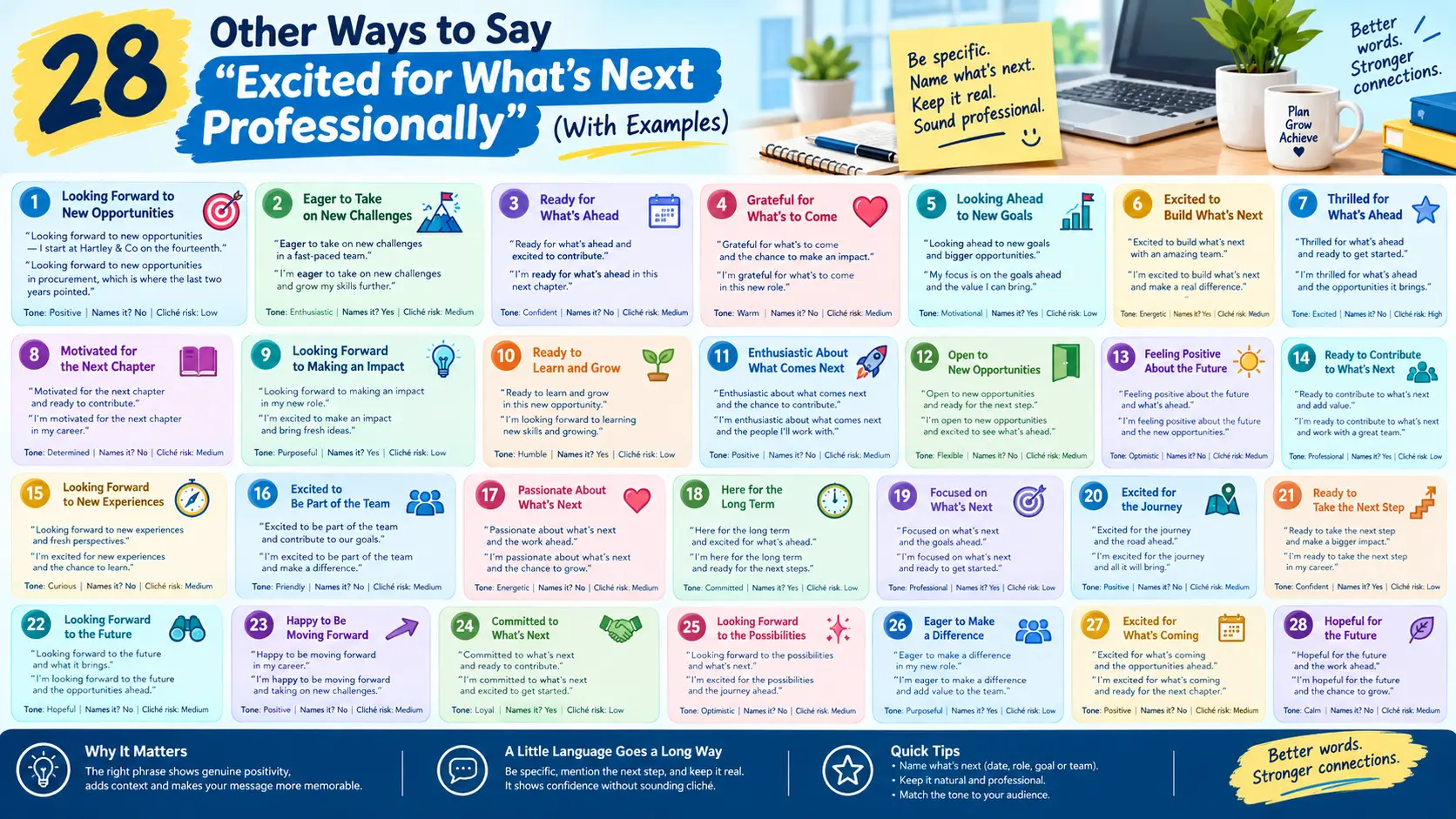
Looking for Other Ways to Say Excited for What’s Next Professionally? Here are 28 alternatives, each with a scenario, five example sentences that contain the phrase, the tone it carries, and the two columns no other list on this subject includes — whether the phrase actually names what is next, and how badly it reads as a platform cliché.
Those two columns exist because this phrase has a specific, well-known failure. It announces a feeling about an unnamed future, so anybody is able to post it about anything — which is exactly why it has become the standard opening of career announcements, and exactly why readers scroll past it.
The vocabulary of excitement is unusually violent once you look at where the words come from. To excite arrived through Middle English exciten and Old French exciter from the Latin excitō, to call out, call forth, arouse, wake up, stimulate — the frequentative of excieō, from ex, out, plus cieō, to call, summon. It is the same root as cite and incite, so the literal sense is closer to summoning something out of somebody than to feeling pleased.
Thrilled is stranger still, and the etymology is a useful corrective to the word’s modern blandness. Thrill comes from the Old English þȳrlian, to pierce, derived from þȳrel, a hole — the word that survives in archaic English as thirl. To be thrilled is, historically, to be pierced, which is a long way from the register of thrilled to announce in a press release.
And eager began as a word about taste. It was inherited from Middle English egre, from Old French aigre, from the Latin ācrus, a variant of ācer, sharp, keen — the same family as acid, acerb and acrid. French vinaigre, and therefore English vinegar, is literally sharp wine built on the same word, which is why eager still carries an edge that excited does not: it suggests appetite rather than pleasure.
The most useful etymology for professional writing, though, is enthusiasm. First attested in 1603, it came from Middle French enthousiasme and Late Latin enthusiasmus, from the Ancient Greek ἐνθουσιασμός, built from ἐν, in, plus θεός, god, plus οὐσία, essence. Enthusiasm originally meant having a god inside you — divine possession — and for much of the seventeenth and eighteenth centuries it was a term of criticism rather than praise, used of religious extremists. The word has only been a workplace virtue for about two centuries, which is worth remembering when a cover letter describes somebody as enthusiastic.
The feeling itself has been studied, and the research names the risk this phrase runs. Anticipation is an emotion involving pleasure or anxiety in considering or awaiting an expected event; anticipatory emotions include fear, anxiety, excitement, hope and trust — and when the anticipated event fails to occur, the result is disappointment for a positive event, or relief for a negative one. One name for pleasurable anticipation, as the literature puts it, is simply excitement.
There is also a reason to treat the feeling as a professional skill rather than a mood. The psychiatrist Robin Skynner considered anticipation one of “the mature ways of dealing with real stress”: “You reduce the stress of some difficult challenge by anticipating what it will be like and preparing for how you are going to deal with it” — and there is evidence that the use of mature defences such as sublimation and anticipation tends to increase with age, while anticipation of negative events tends to decrease. Anticipation is more broadly described as a central motivating force in everyday life, the ordinary process of imagining or speculating about the future.
Which gives the honest frame for the twenty-eight alternatives below. A good forward-looking sentence does what the stock phrase does not: it names the thing, the date or the first task — and anticipation that has been thought through reads as competence, while anticipation that has not reads as noise. The comparison table marks which entries name what is next and which merely announce a feeling about it.
28 Other Ways to Say “Excited for What’s Next Professionally”
Every entry has a scenario, five example sentences containing the phrase, and an attribute line ending in whether it names what is next and how high the cliché risk is.
This is the list in full, and it also answers excited for what’s next synonym, excited for what’s next to come, other ways to say excited for the future, other ways to say excited for the opportunity, other ways to say excited for you, other ways to say excited to be here, other ways to say excited to meet you, other ways to say excited to see you and what other ways to say happy new year — each of which has its own section below.
1. Looking Forward to New Opportunities
The safest professional form, and the one that says least.
Scenario: Job transition announcement.
Examples:
- Looking forward to new opportunities — I start at Hartley & Co on the fourteenth.
- Looking forward to new opportunities in procurement, which is where the last two years pointed.
- Looking forward to new opportunities, and open to conversations about contract work from January.
- Looking forward to new opportunities after six years I would not trade.
- Looking forward to new opportunities — specifically, anything involving supplier audits.
Why it works: It is correct, modest and impossible to object to, which is why it is the default on professional platforms. The weakness is in the noun: opportunities names a category rather than a thing, so anybody is able to post the sentence about anything. Every example above repairs it the same way — a date, a field, a type of work, a stated availability. For anybody actually job-hunting, example three is the version that produces replies, because open to conversations about contract work from January tells a reader what to do.
Tone: positive, professional | Formality: formal to neutral | Best for: career announcements, LinkedIn, email sign-offs | Avoid in: casual conversation, where it is stiff | Names what’s next: no, unless you add it | Cliché risk: high
2. Eager for the Next Chapter
Warm, slightly literary, and the metaphor is doing more work than most senders realise.
Scenario: Beginning a new position.
Examples:
- Eager for the next chapter — first day in the Leeds office on Monday.
- Eager for the next chapter, and grateful for the one that just closed.
- Eager for the next chapter: three years of training, and now a caseload of my own.
- Eager for the next chapter, which starts with a fortnight of shadowing the night shift.
- Eager for the next chapter after a decade in the same building.
Why it works: Chapter frames a career as a book, which makes the change sound planned rather than abrupt — useful when a move was not entirely your choice. Eager is also the sharper word: it comes from the Latin for sharp, keen, the root behind acrid and vinegar, so it suggests appetite where excited suggests pleasure. Example two is the one that reads best in public, because thanking the previous chapter is what stops a career post sounding like an escape.
Tone: warm, hopeful | Formality: neutral | Best for: new jobs, graduations, career changes | Avoid in: formal reports, technical writing | Names what’s next: no, unless you add the detail | Cliché risk: high on social platforms
3. Ready for New Challenges
It offers competence rather than feeling, which is the most useful swap in the standard list.
Scenario: Accepting additional responsibilities.
Examples:
- Ready for new challenges — starting with the regional rollout in March.
- Ready for new challenges, and the team of four that comes with them.
- Ready for new challenges; the migration was the hardest thing I have run, and I would run it again.
- Ready for new challenges, including the parts nobody volunteers for.
- Ready for new challenges, and I have asked for the compliance portfolio specifically.
Why it works: Ready is a claim about capability, and a claim takes evidence in a way a feeling cannot. That makes it the right phrasing for a promotion, an internal application or a performance conversation, where the question being answered is about ability rather than keenness. Examples three and five are the strongest: naming a hard thing you have already done, or a portfolio you have asked for, turns readiness into a track record.
Tone: confident, determined | Formality: formal to neutral | Best for: promotions, internal applications, appraisals | Avoid in: emotional messages, condolences | Names what’s next: yes, with examples one or five | Cliché risk: medium
4. Optimistic About the Future
Calm rather than enthusiastic, which makes it the right register after a difficult period.
Scenario: Career milestone update.
Examples:
- Optimistic about the future — the order book is the fullest it has been for two years.
- Optimistic about the future after a frankly brutal eighteen months.
- Optimistic about the future, and realistic about the next quarter.
- Optimistic about the future; the three of us are staying and the plan is unchanged.
- Optimistic about the future, and the reasons are in the figures rather than in the mood.
Why it works: Optimistic is a stance rather than a state, so it survives being written by somebody who has had a hard year — which excited does not. It is the standard register for company updates, trading statements and team messages after bad news, because it claims confidence without claiming joy. Example five is the version that is believed: optimism attributed to figures rather than to feeling is read as judgement, and judgement is what the audience is assessing.
Tone: positive, reassuring | Formality: formal | Best for: company updates, team messages, after a hard period | Avoid in: technical writing, where it is editorial | Names what’s next: no | Cliché risk: medium
5. Enthusiastic About My Career Journey
Personal-branding English, and the entry with the most dated vocabulary in it.
Scenario: Reflecting on professional growth.
Examples:
- Enthusiastic about my career journey — from the apprenticeship in 2014 to running the depot now.
- Enthusiastic about my career journey, which has been far less linear than the profile suggests.
- Enthusiastic about my career journey, and particularly about the move from delivery to design.
- Enthusiastic about my career journey; three industries, one thread, which is logistics.
- Enthusiastic about my career journey and the people who have carried bits of it with me.
Why it works: It suits a profile summary, a personal statement or an interview answer about trajectory, because journey gives a sequence of jobs a shape. Two cautions, though. Career journey is heavily used in personal branding, so it carries the strongest whiff of the platform of any phrase here; and enthusiastic has an older meaning worth knowing — the word comes from the Greek for having a god inside you, and for two centuries it was an insult aimed at religious extremists. Example four is the one that redeems the phrase, because naming the thread through three industries is the actual content a reader wants.
Tone: personal, inspiring | Formality: neutral | Best for: profile summaries, personal statements, interview answers | Avoid in: formal documentation, technical reports | Names what’s next: no — it looks backwards | Cliché risk: very high
6. Excited About Future Growth
Corporate vocabulary, and the one entry that can mean the company or the person.
Scenario: Sharing long-term career goals.
Examples:
- Excited about future growth — two new sites this year and a third under offer.
- Excited about future growth, and specifically about learning the commercial side properly.
- Excited about future growth; the chartered qualification is the next milestone.
- Excited about future growth, which for me means depth rather than a bigger title.
- Excited about future growth, and the team is growing from nine to fourteen.
Why it works: Growth is the shared vocabulary of business plans and development conversations, which makes the phrase legible in both. The ambiguity is the problem: future growth can mean revenue, headcount or your own development, and a reader cannot tell which. Example four is the most interesting version, because defining growth as depth rather than promotion is both unusual and credible in an appraisal. The ongoing-development register sits in A great asset to the team.
Tone: motivational, positive | Formality: neutral to formal | Best for: professional posts, development plans, appraisals | Avoid in: legal documents, formal notices | Names what’s next: only if you say whose growth | Cliché risk: high
7. Motivated by What Lies Ahead
It reports a drive rather than a mood, which is the sturdier of the two claims.
Scenario: Starting a new project or role.
Examples:
- Motivated by what lies ahead — the first milestone is a working prototype by June.
- Motivated by what lies ahead, and by how badly the current process needs replacing.
- Motivated by what lies ahead; we have eleven weeks and a very clear brief.
- Motivated by what lies ahead, starting with two months of unglamorous data cleaning.
- Motivated by what lies ahead, and the figures from the pilot are the reason.
Why it works: Motivation implies sustained effort, where excitement implies a reaction — so this phrasing survives the second month of a project, when the excitement has worn off. Example four is the one that earns trust: naming the boring part of the work proves you have read the brief rather than the headline. The phrase is slightly formal in speech, so in a meeting I am looking forward to getting into it does the same job.
Tone: determined, inspiring | Formality: formal to neutral | Best for: project starts, new roles, kick-off messages | Avoid in: casual chat, where it sounds rehearsed | Names what’s next: yes, with a milestone | Cliché risk: medium
8. Inspired by New Possibilities
The vaguest entry in the standard list, and the one that needs an object most urgently.
Scenario: Exploring career opportunities.
Examples:
- Inspired by new possibilities — three conversations this week about moving into accessibility work.
- Inspired by new possibilities in the sector, particularly around retrofit.
- Inspired by new possibilities after a course that genuinely changed how I work.
- Inspired by new possibilities, and currently reading everything I can find on procurement reform.
- Inspired by new possibilities, which is a polite way of saying I am looking for the next thing.
Why it works: Possibilities is the right noun when nothing is settled, so it is honest for somebody exploring rather than announcing. Unattached, however, it is pure atmosphere — which is why four of the five examples name a sector, a course, a subject or a number of conversations. Example five is worth noting for its candour: saying plainly that you are looking is more effective than any amount of inspiration, and readers reward it.
Tone: creative, uplifting | Formality: neutral | Best for: exploratory posts, networking, creative fields | Avoid in: formal applications, where it reads as unfocused | Names what’s next: no | Cliché risk: very high
9. Ready to Embrace New Opportunities
Entry 1 with a verb added, and the verb is the part to watch.
Scenario: Announcing a career move.
Examples:
- Ready to embrace new opportunities — available from the first of next month.
- Ready to embrace new opportunities in the charity sector after eleven years in retail.
- Ready to embrace new opportunities, and happy to start with a short contract to prove the fit.
- Ready to embrace new opportunities; my CV is attached and my phone is on.
- Ready to embrace new opportunities, including a relocation if the role is right.
Why it works: Ready to plus a verb signals action, and embrace signals willingness rather than mere availability — which matters in a market where a candidate’s flexibility is part of the offer. Embrace is also the most padded word in this list: ready for new opportunities says the same thing in one word less, and available from the first of next month says something the original cannot. Examples three to five are what a recruiter is reading for: a start date, a willingness to relocate, a way to contact you.
Tone: positive, proactive | Formality: neutral | Best for: job searches, availability posts, recruiter messages | Avoid in: internal announcements, where it implies you are leaving | Names what’s next: yes, with a date | Cliché risk: high
10. Thrilled About Upcoming Ventures
The highest-energy entry in the list, and the one most likely to be read as press-release English.
Scenario: Launching a new initiative.
Examples:
- Thrilled about upcoming ventures — the second site opens in Sheffield in April.
- Thrilled about upcoming ventures, and the first of them has a customer already.
- Thrilled about upcoming ventures; after two years of planning, the lease is signed.
- Thrilled about upcoming ventures, which is a grand way of saying we have finally started.
- Thrilled about upcoming ventures — three of them, and I will say more in June.
Why it works: Thrilled is the strongest positive adjective available in professional writing, which is why it opens so many announcements — and why it has worn thin. The etymology is a reminder of how much stronger the word once was: thrill comes from the Old English þȳrlian, to pierce, from þȳrel, a hole. Reserve it for genuinely large news, and pair it with the concrete fact, as examples one and three do. Example four is the honest version, and self-awareness about the register is usually read as confidence rather than weakness.
Tone: energetic, enthusiastic | Formality: neutral | Best for: launches, openings, genuinely big news | Avoid in: routine updates, legal documents | Names what’s next: yes, with a place or a date | Cliché risk: very high
11. Looking Ahead with Confidence
Leadership register: it claims steadiness rather than enthusiasm, which is what an audience wants from whoever is in charge.
Scenario: Reflecting on future goals.
Examples:
- Looking ahead with confidence — the order book covers the next two quarters.
- Looking ahead with confidence, and with a plan that survives a bad January.
- Looking ahead with confidence; nobody is being made redundant, and that is the headline.
- Looking ahead with confidence after the hardest trading year in a decade.
- Looking ahead with confidence, and the reasons are set out on page four.
Why it works: Confidence is the one thing a team cannot supply for itself, so stating it from a leadership position does real work — and looking ahead keeps the tense forward without promising a specific outcome. The sentence is only believed when it is accompanied by evidence, which is why examples one, three and five all point at something checkable: an order book, a redundancy assurance, a page reference. Example three is the version staff actually read for, because confidence without reassurance about jobs is heard as spin.
Tone: professional, assured | Formality: formal | Best for: leadership updates, annual reports, all-staff messages | Avoid in: informal chats, where it sounds like a statement to the market | Names what’s next: no | Cliché risk: medium
12. Encouraged by Future Prospects
The most restrained entry, and the one that admits things were not always encouraging.
Scenario: Career development discussions.
Examples:
- Encouraged by future prospects — two interviews this week after a very quiet autumn.
- Encouraged by future prospects in the sector, which is finally hiring again.
- Encouraged by future prospects, and by the fact that the retraining was worth it.
- Encouraged by future prospects; the apprenticeship route has opened up locally.
- Encouraged by future prospects, with the caveat that nothing is signed yet.
Why it works: Encouraged implies a previous discouragement, which makes this the honest phrase for somebody in a recovery or a slow patch. That is exactly the register missing from the rest of the list: excited and thrilled both presume good news, while encouraged only presumes movement. Example five is worth copying for anybody mid-process, because naming that nothing is signed prevents the awkward follow-up questions a premature announcement invites.
Tone: hopeful, professional | Formality: formal to neutral | Best for: development conversations, job searches in progress, recovery periods | Avoid in: celebratory announcements, where it undersells | Names what’s next: yes, with the specifics | Cliché risk: low
13. Prepared for the Next Step
It claims readiness and names a direction, which is the two-part structure a promotion message needs.
Scenario: Promotion announcement.
Examples:
- Prepared for the next step — I take over the northern region on the first of April.
- Prepared for the next step, and the handover with Priya is already mapped out.
- Prepared for the next step; four years of deputising have been good practice.
- Prepared for the next step, and the first thing on the list is the supplier review.
- Prepared for the next step, with a team I already know and trust.
Why it works: Prepared is stronger than ready because it implies work already done rather than willingness, which is precisely the claim a newly promoted person needs to make. Example four is the single most effective sentence in a promotion announcement: naming the first task tells colleagues what to expect in week one, and that is what they are actually wondering. The incoming-role version is in I am excited to join the team.
Tone: confident, focused | Formality: formal to neutral | Best for: promotions, internal moves, leadership appointments | Avoid in: speculative posts, where the step does not exist yet | Names what’s next: yes, by design | Cliché risk: low
14. Excited to Continue Growing
Development English, and the only entry that explicitly claims nothing has finished.
Scenario: Discussing personal development.
Examples:
- Excited to continue growing — the diploma starts in September and the firm is funding it.
- Excited to continue growing, and I have asked to spend a day a month in the workshop.
- Excited to continue growing; the feedback about chairing meetings was fair and I am working on it.
- Excited to continue growing, which this year means less breadth and more depth.
- Excited to continue growing, and the mentoring has been the most useful part of it.
Why it works: Continue presupposes that growth has already been happening, which makes the phrase appropriate in an appraisal where the alternative reads like an admission of inexperience. Example three is the one that impresses in a review, because accepting a specific piece of criticism and naming the work being done about it is the clearest evidence of development anybody can offer. In a public post it is unremarkable; in a development conversation it is exactly right.
Tone: positive, ambitious | Formality: neutral | Best for: appraisals, development plans, training applications | Avoid in: announcements of a finished achievement | Names what’s next: yes, with the course or the plan | Cliché risk: medium
15. Energized by Future Possibilities
American-leaning, high-energy, and the spelling is the first thing a British reader notices.
Scenario: Entering a new career phase.
Examples:
- Energised by future possibilities — the pilot in Bristol starts next month.
- Energised by future possibilities, and by a brief that is genuinely open.
- Energised by future possibilities; I have not been this interested in the work for years.
- Energised by future possibilities, and the first proper test is the autumn conference.
- Energised by future possibilities after a long stretch of maintenance work.
Why it works: It suits a phase change — a new product, a new discipline, a return from a career break — and claims personal energy rather than institutional optimism. Two practical notes. In British English the spelling is energised, and in American English energized, so match the audience. And possibilities is the same empty noun as in entry 8, which is why examples one and four attach a city and a date.
Tone: dynamic, optimistic | Formality: neutral | Best for: new phases, returns from a break, creative work | Avoid in: formal documentation, conservative industries | Names what’s next: no, unless you add it | Cliché risk: high
16. Hopeful About What’s Ahead
The gentlest entry, and the right one when the future is genuinely uncertain.
Scenario: Career transition.
Examples:
- Hopeful about what’s ahead — nothing confirmed yet, and that is all right.
- Hopeful about what’s ahead after the restructure took my role with it.
- Hopeful about what’s ahead, and taking a fortnight before I start looking properly.
- Hopeful about what’s ahead; three good conversations in a week is a better sign than it sounds.
- Hopeful about what’s ahead, and grateful for the messages, which have genuinely helped.
Why it works: Hope is an anticipatory emotion that does not claim certainty, which makes it the only honest option after a redundancy, an illness or a failed application. The research puts it plainly: anticipatory emotions include fear, anxiety, excitement, hope and trust — and hope is the one that survives not knowing. Example two is the phrasing that gets support rather than pity, because naming the restructure in a flat sentence invites practical help instead of condolence.
Tone: warm, encouraging | Formality: neutral | Best for: redundancies, uncertain transitions, job searches | Avoid in: confident announcements, where it sounds tentative | Names what’s next: no — and it says so honestly | Cliché risk: low
17. Ready to Take on New Responsibilities
The most precise entry in the standard list, because responsibilities is a countable noun.
Scenario: Promotion or leadership role.
Examples:
- Ready to take on new responsibilities — the safeguarding lead role from January.
- Ready to take on new responsibilities, specifically the budget and the two junior roles.
- Ready to take on new responsibilities; I have been covering most of them informally since March.
- Ready to take on new responsibilities, and clear about which ones I would hand over in exchange.
- Ready to take on new responsibilities, with the training to go with them.
Why it works: You can count responsibilities, name them and negotiate them, which makes this the most useful phrasing of all in an internal conversation about scope. Example four is the sentence that gets promotions: offering to hand something over in exchange shows you understand capacity, and it is the detail most applicants leave out. Example three is the second-best, since informal cover already performed is the strongest possible evidence.
Tone: responsible, confident | Formality: formal | Best for: promotions, leadership applications, scope conversations | Avoid in: social posts, where it reads as angling | Names what’s next: yes — countably | Cliché risk: low
18. Passionate About Future Success
The most overused word in professional English, attached to the vaguest noun in it.
Scenario: Discussing professional ambitions.
Examples:
- Passionate about future success — and by success I mean the retention figures, not the awards.
- Passionate about future success, measured in cases closed rather than hours billed.
- Passionate about future success; the team’s, specifically, since mine follows from it.
- Passionate about future success, and the first target is cutting the backlog by half.
- Passionate about future success in a job I have wanted since I was nineteen.
Why it works: Passionate is strong, memorable and so heavily used in applications that many recruiters treat it as filler. The repair is to define the noun it attaches to, which every example above does: retention figures, cases closed, the team’s success, a halved backlog. Defining what you mean by success is also the most interesting answer available to an interview question about ambition, because it is the one answer that cannot be prepared from a template. Example five is the exception that works without a measure, since a specific biographical fact carries its own evidence.
Tone: ambitious, inspiring | Formality: neutral | Best for: interviews, applications, ambition conversations | Avoid in: formal reports; and never twice in one document | Names what’s next: only once you define success | Cliché risk: very high
19. Open to New Professional Experiences
The recruiter-facing phrase, and the one that functions as a signal rather than a sentiment.
Scenario: Exploring opportunities.
Examples:
- Open to new professional experiences — permanent or contract, and available from March.
- Open to new professional experiences in the North West, or remote with occasional travel.
- Open to new professional experiences, and particularly interested in the public sector.
- Open to new professional experiences; my notice period is a month.
- Open to new professional experiences, and happy to be approached directly rather than through an agency.
Why it works: Open to is functional language: it tells recruiters and contacts that approaches are welcome, which is a piece of information rather than a mood. That makes it the most practically useful entry in the second half of the list, and every example above adds the detail a recruiter needs: contract type, geography, sector, notice period, preferred route. The one risk is internal — posted publicly while you are still employed, this phrase is read by colleagues as notice of your departure.
Tone: flexible, welcoming | Formality: neutral | Best for: job searches, recruiter outreach, profile headlines | Avoid in: internal channels while you are still in post | Names what’s next: yes, with the practical details | Cliché risk: medium
20. Grateful and Excited for the Future
Gratitude first, excitement second, which is the correct order for an announcement about leaving somewhere good.
Scenario: Celebrating achievements.
Examples:
- Grateful and excited for the future — six years at Hartley, and a new role in May.
- Grateful and excited for the future, and specifically grateful to Priya, who hired me when I had nothing to show.
- Grateful and excited for the future; the team taught me most of what I know.
- Grateful and excited for the future, and I am keeping every one of these phone numbers.
- Grateful and excited for the future after the most difficult and most useful year of my career.
Why it works: Putting the thanks before the enthusiasm prevents the commonest misread of a career post, which is that you are glad to be leaving. Example two is the version that is shared and remembered, because naming the person who took a chance on you is the single most generous thing a career announcement can contain. The sentence is otherwise content-free, so pair the gratitude with one specific and the excitement with one date. The full gratitude set is in I appreciate you.
Tone: appreciative, positive | Formality: neutral | Best for: departures, milestone posts, thank-you announcements | Avoid in: technical writing | Names what’s next: no, unless you add the role | Cliché risk: high
21. Eager to Keep Learning and Growing
The phrase that reads as modest from a junior colleague and as odd from a senior one.
Scenario: Professional development discussions.
Examples:
- Eager to keep learning and growing — the next thing is the technical certification in the spring.
- Eager to keep learning and growing, and I have asked to sit in on the commercial negotiations.
- Eager to keep learning and growing; twenty years in and the regulations still change every year.
- Eager to keep learning and growing, mostly from the apprentices, who ask better questions than I do.
- Eager to keep learning and growing, and the shadowing day was worth a term of training.
Why it works: It signals humility, which is valuable at the start of a career and ambiguous later — a director who is eager to keep learning can sound either admirably open or vaguely unqualified. Examples three and four solve that completely: naming what specifically still changes, or naming the junior people you learn from, converts the humility into authority. Without a named activity it is the emptiest kind of development talk, which is why four of the five examples contain one.
Tone: curious, ambitious | Formality: neutral | Best for: appraisals, training applications, early-career posts | Avoid in: senior leadership announcements, unless you name the specifics | Names what’s next: yes, with the course or the activity | Cliché risk: high
22. Excited to Build on Recent Success
The only entry that points backwards and forwards at once, which makes it the strongest for a post-project update.
Scenario: After completing a successful project.
Examples:
- Excited to build on recent success — the pilot cut processing time by a third, so it goes national in June.
- Excited to build on recent success, and the same team is staying together for phase two.
- Excited to build on recent success; the award was nice, the retention figures were better.
- Excited to build on recent success, which means fixing the two things the pilot got wrong.
- Excited to build on recent success after a launch that genuinely worked.
Why it works: Build on presupposes a foundation, so the sentence carries an implicit claim of achievement and a plan in the same breath. That makes it the most credible entry in the list, because the past half is checkable — and example one shows the full version, with a measured result and a named next stage. Example four is the version that earns trust from an experienced audience, since naming what the pilot got wrong signals that the success has been assessed rather than celebrated.
Tone: confident, optimistic | Formality: neutral to formal | Best for: post-project updates, phase-two announcements, results posts | Avoid in: situations with no recent success to point at | Names what’s next: yes, with the next stage | Cliché risk: low
23. Looking Forward to Meaningful Growth
It qualifies the growth, and the qualifier is the only part doing any work.
Scenario: Career advancement planning.
Examples:
- Looking forward to meaningful growth — by which I mean work with patients rather than more management.
- Looking forward to meaningful growth, which for me is depth in one discipline rather than a wider title.
- Looking forward to meaningful growth; the next step is accreditation, not a promotion.
- Looking forward to meaningful growth, and I would rather be excellent at one thing than adequate at four.
- Looking forward to meaningful growth after two years of growth that was mostly headcount.
Why it works: Meaningful is an implicit criticism of growth for its own sake, which makes this phrasing useful in exactly the conversations where somebody is being offered a promotion they do not want. Every example above defines the term, and that definition is the content: patients rather than management, depth rather than title, accreditation rather than promotion. Left undefined, meaningful growth is the single vaguest phrase on this page.
Tone: thoughtful, positive | Formality: neutral | Best for: career planning, appraisals, declining a promotion gracefully | Avoid in: public announcements, where it needs explaining | Names what’s next: only once you define meaningful | Cliché risk: high
24. Inspired to Reach New Heights
The most metaphorical entry, and it belongs to speeches rather than inboxes.
Scenario: Setting ambitious goals.
Examples:
- Inspired to reach new heights — and the target is two hundred placements this year.
- Inspired to reach new heights, starting with the national final in October.
- Inspired to reach new heights; the club has never had a side in the top division before.
- Inspired to reach new heights, which will take a bigger team and a longer run-up.
- Inspired to reach new heights after watching the first cohort graduate.
Why it works: Height metaphors suit genuinely aspirational contexts — sport, fundraising, awards, records — where ambition is the point of the message. In ordinary professional writing it is florid, and in a technical report it would be startling. Attach a number, as examples one and two do, and the grandeur is earned; without one, this is the entry most likely to be read as padding.
Tone: aspirational, motivational | Formality: neutral | Best for: speeches, sport, fundraising, awards, rallying messages | Avoid in: routine email, technical documents | Names what’s next: yes, with a target | Cliché risk: very high
25. Positive About the Road Ahead
Calm, collective and the standard close of a team message after a hard stretch.
Scenario: Looking toward future opportunities.
Examples:
- Positive about the road ahead — the funding is confirmed for three years.
- Positive about the road ahead, and nobody is being asked to work another weekend.
- Positive about the road ahead; we know what went wrong and the fix is already in.
- Positive about the road ahead, with a quieter quarter and a shorter list.
- Positive about the road ahead after a year that asked a great deal of everybody.
Why it works: It is the gentlest of the confident phrasings, which makes it right for a team that has just been through something difficult and would find enthusiasm grating. Examples two and four are the ones that will actually be welcomed, because positivity backed by a removed burden — no weekend work, a shorter list — is believed in a way that positivity alone is not. Avoid it in a document that will be scrutinised, where the road ahead reads as a substitute for a plan.
Tone: encouraging, confident | Formality: neutral to formal | Best for: team updates, messages after a hard period, newsletters | Avoid in: academic papers, scrutinised documents | Names what’s next: no | Cliché risk: medium
3 More Alternatives You Will Not Find on Other Lists
Not one of the twenty-five standard alternatives names what is actually next, asks the reader for anything, or handles the extremely common case where you are not yet allowed to say. These three do.
26. Next: the Leeds role, from 14 April. That’s the whole announcement.
The named next thing, with the feeling removed entirely.
Scenario: Any career announcement where you know the facts — a new job, a promotion, a launch, a move.
Examples:
- Next: the Leeds role, from 14 April. That’s the whole announcement.
- From Monday I am head of compliance at Hartley. Same sector, bigger remit, shorter commute.
- New job, old industry: I start as a technical author on the second of June.
- Three things next: the accreditation in March, the Bristol pilot in May, and a fortnight off in between.
- Leaving on the 30th, starting on the 6th, and taking the week between them off. That is all the news.
Why it works: It inverts the standard structure. Every one of the twenty-five entries above announces a feeling about an unnamed future; this announces the future and leaves the feeling out — and readers find that both more interesting and more credible, because facts are checkable and enthusiasm is not. Three practical advantages follow. It cannot be read as a platform cliché, because there is no adjective in it to recognise; it answers the questions the comment section would otherwise ask — where, when, doing what; and it is shorter, which on a professional feed is itself a form of confidence. If you want the warmth, add one clause of thanks at the end rather than at the beginning, as entry 20 does in reverse. The only time this fails is when the facts are not yours to publish, which is what entry 28 is for.
Tone: plain, confident | Formality: neutral | Best for: job changes, promotions, launches, any post where the detail exists | Avoid in: situations still under wraps, or where warmth is the whole point | Names what’s next: yes — that is the entire entry | Cliché risk: none
27. Here’s what I’m looking for, and here’s how you can help.
The ask, which is the part career posts leave out and then wonder why nothing happens.
Scenario: Job searches, freelance launches, fundraising, anything where you need other people to act.
Examples:
- Here’s what I’m looking for, and here’s how you can help: operations roles in the North West, and an introduction to anybody hiring.
- Looking for contract work from January — if you know a team short of a technical writer, send them my way.
- Two ways to help: a referral, or ten minutes to tell me what the market looks like in your sector.
- If you have ever worked with me, a public comment on this post is worth more than a private message.
- What would help most: three introductions. Names, not advice.
Why it works: Anticipation is not a request, and a reader who feels goodwill but has no instruction does nothing with it. Naming the ask converts sympathy into action, and naming it narrowly converts it into the right action — which is why example five works better than a general appeal: most people respond to three introductions and freeze at any help appreciated. Two rules keep it from reading as entitled. Make the ask small and concrete, since ten minutes or one name is easy to give; and say what you are offering in exchange where you can, even if it is only to do the same for them. Example four is the most under-used tactic in a job search: public endorsements are visible to people who will never read your profile.
Tone: direct, practical | Formality: neutral | Best for: job searches, freelancing, fundraising, launches | Avoid in: internal announcements, celebratory posts with no ask | Names what’s next: yes — and what you need | Cliché risk: none
28. I can’t say much yet — but I’ll post the detail on the 14th.
The holding statement, for the fortnight when something is true and not yet announceable.
Scenario: An offer accepted but not public, a contract agreed but not signed, a restructure under consultation, a product in embargo, or a notice period not yet served.
Examples:
- I can’t say much yet — but I’ll post the detail on the 14th.
- Something is changing and it is good; I am not able to name it until the contracts are signed.
- Under embargo until Thursday. Ask me again on Friday and I will tell you everything.
- In consultation at work, so I am saying nothing publicly until it concludes. Messages welcome, questions difficult.
- Last day here is the 30th. Where I am going next is not mine to announce yet.
Why it works: This is the single most common situation in professional life that no list of phrases covers. You know what is next, you are not allowed to say, and the alternatives are silence — which looks like nothing is happening — or a vague excited for what’s next, which looks like a cliché and invites exactly the questions you cannot answer. The holding statement solves both by naming a date: it signals movement, explains the vagueness, and tells people when to come back. Three details make it work. Say that you cannot rather than implying it, because an unexplained silence is read as bad news; give a date and keep it, since a holding statement with no end becomes a mystery; and pre-empt the awkward question, as example four does, so colleagues know which subjects are available. It is also the honest option in a consultation or redundancy process, where cheerful future-talk would be both premature and unkind to the people still waiting.
Tone: discreet, straightforward | Formality: neutral | Best for: embargoes, unsigned contracts, consultations, notice periods | Avoid in: cases where you are free to speak — use entry 26 instead | Names what’s next: names the date, which is the next best thing | Cliché risk: none
Quick Comparison Table
All 28 alternatives, with whether the phrase names what is actually next and how high the cliché risk is. Those two columns are the reason some career announcements get read and most get scrolled past.
| Phrase | Tone | Best for | Avoid in | Names what’s next | Cliché risk |
|---|---|---|---|---|---|
| 1. Looking Forward to New Opportunities | Professional | Career announcements | Casual conversations | No, unless added | High |
| 2. Eager for the Next Chapter | Hopeful | New jobs, graduations | Formal reports | No, unless added | High |
| 3. Ready for New Challenges | Confident | Promotions, appraisals | Emotional messages | Yes, with the detail | Medium |
| 4. Optimistic About the Future | Positive | Company updates, after hard news | Technical writing | No | Medium |
| 5. Enthusiastic About My Career Journey | Inspirational | Profiles, personal statements | Formal documentation | No — it looks backwards | Very high |
| 6. Excited About Future Growth | Motivational | Professional posts, development plans | Legal documents | Only if you say whose growth | High |
| 7. Motivated by What Lies Ahead | Determined | Project starts, kick-offs | Casual chat | Yes, with a milestone | Medium |
| 8. Inspired by New Possibilities | Creative | Exploratory posts, networking | Formal applications | No | Very high |
| 9. Ready to Embrace New Opportunities | Proactive | Job searches, recruiter messages | Internal announcements | Yes, with a date | High |
| 10. Thrilled About Upcoming Ventures | Energetic | Launches, openings, big news | Routine updates | Yes, with a place or date | Very high |
| 11. Looking Ahead with Confidence | Assured | Leadership updates, reports | Informal chats | No | Medium |
| 12. Encouraged by Future Prospects | Hopeful | Searches in progress, recovery | Celebratory announcements | Yes, with specifics | Low |
| 13. Prepared for the Next Step | Focused | Promotions, internal moves | Speculative posts | Yes, by design | Low |
| 14. Excited to Continue Growing | Ambitious | Appraisals, training applications | Finished-achievement posts | Yes, with the course | Medium |
| 15. Energized by Future Possibilities | Dynamic | New phases, returns from a break | Conservative industries | No, unless added | High |
| 16. Hopeful About What’s Ahead | Warm | Redundancy, uncertainty | Confident announcements | No — and says so honestly | Low |
| 17. Ready to Take on New Responsibilities | Responsible | Promotions, scope conversations | Social posts | Yes — countably | Low |
| 18. Passionate About Future Success | Ambitious | Interviews, applications | Formal reports; twice in one document | Only once you define success | Very high |
| 19. Open to New Professional Experiences | Functional | Recruiter outreach, searches | Internal channels while in post | Yes, with the practicals | Medium |
| 20. Grateful and Excited for the Future | Appreciative | Departures, milestone posts | Technical writing | No, unless you add the role | High |
| 21. Eager to Keep Learning and Growing | Curious | Appraisals, early-career posts | Senior announcements, undetailed | Yes, with the activity | High |
| 22. Excited to Build on Recent Success | Confident | Post-project and phase-two updates | Where there is no success to cite | Yes, with the next stage | Low |
| 23. Looking Forward to Meaningful Growth | Thoughtful | Planning; declining a promotion | Public posts, undefined | Only once you define it | High |
| 24. Inspired to Reach New Heights | Aspirational | Speeches, sport, fundraising | Routine email, technical work | Yes, with a target | Very high |
| 25. Positive About the Road Ahead | Encouraging | Team updates after a hard period | Scrutinised documents | No | Medium |
| 26. Next: the Leeds role, from 14 April. | Plain | Any post where the detail exists | Things still under wraps | Yes — that is the entry | None |
| 27. Here’s what I’m looking for, and how you can help. | Direct | Searches, freelancing, launches | Celebratory posts with no ask | Yes — and the ask | None |
| 28. I can’t say much yet — detail on the 14th. | Discreet | Embargoes, consultations, notice | When you are free to speak | Names the date | None |
Three patterns come out of the table, and the first is the finding that no other list on this phrase reports.
First, not one of the twenty-five standard alternatives names what is next on its own. Every one of them announces a feeling about an unspecified future — opportunities, possibilities, growth, the road ahead, the next chapter — which is precisely why they are interchangeable and precisely why readers skim them. Eleven of them become specific the moment one clause is added: a date, a place, a target, a milestone, a course, a notice period. That clause, not the adjective, is the whole of the craft here, and entries 26 to 28 exist because the gap is otherwise total.
Second, five entries carry a very high cliché risk and four carry almost none. Enthusiastic about my career journey, inspired by new possibilities, thrilled about upcoming ventures, passionate about future success and inspired to reach new heights are the five that read as platform English — not because they are wrong, but because they are the exact wording of thousands of identical posts. The low-risk entries are the ones with a countable noun in them: responsibilities, the next step, recent success, future prospects.
Third, the register splits by what the audience is assessing. A public post is assessed for interest, so facts win; an appraisal is assessed for judgement, so meaningful, continue and prepared win; a team message after bad news is assessed for steadiness, so optimistic and positive about the road ahead win. And one entry stands apart: for a redundancy or an uncertain transition, entry 16 is the only honest option on the list, because hope is the one anticipatory emotion that does not claim to know the outcome.
What Does “Excited for What’s Next Professionally” Mean?
The phrase excited for what’s next professionally expresses a positive outlook toward future career opportunities, growth and achievements. It shows that somebody is optimistic about upcoming challenges, new responsibilities or professional milestones, and people use it in job updates, promotion announcements, networking messages and career-related conversations, where it conveys enthusiasm, confidence and readiness for future success.
Structurally, it is an emotion attached to an unnamed object, and that is the whole of its character. What’s next is a placeholder: it works precisely because it commits to nothing, which is useful when you cannot say more and a liability when you can.
The emotion has a technical name as well. Anticipation is an emotion involving pleasure or anxiety in considering or awaiting an expected event, and the literature notes that one name for pleasurable anticipation is simply excitement — the same family as hope, trust, fear and anxiety. Which is why the phrase is sincere and still lands badly: the reader has no way of telling whether the pleasure is attached to anything real.
When to Use “Excited for What’s Next Professionally”
You can use this phrase when:
- Starting a new job — where entry 26 or 13 names the role and the date.
- Accepting a promotion — where entry 17 names the responsibilities.
- Launching a business — where entry 10 fits, if the news is genuinely large.
- Completing an important project — where entry 22 points backwards and forwards at once.
- Announcing career changes on social media — the setting where the cliché risk is highest.
- Speaking with colleagues or professional contacts — where the spoken short forms work better than the written ones.
- Updating your professional profile — where entry 19 does the functional work.
One timing rule matters more than the wording: do not post it before the facts are settled. An announcement of feeling made a fortnight before the contract is signed invites questions you cannot answer, which is what entry 28 is designed to prevent.
Pros and Cons of “Excited for What’s Next Professionally”
Pros
- Positive and optimistic — and it signals ambition without claiming anything specific.
- Professional and appropriate — usable upward, downward and externally.
- Easy to understand — no reader has ever had to work out what it means.
- Works in many situations — from a promotion to a resignation.
- Encourages supportive responses — it invites congratulation without demanding it.
Cons
- Can sound generic — because the object of the excitement is unnamed.
- Frequently used on professional platforms, to the point of being the house style.
- May lack personal emotion — the adjective does the feeling, so no detail has to.
- Doesn’t specify future goals — the drawback that all three extra entries exist to fix.
- Assumes good news — the con no other list mentions, and the reason entries 12 and 16 are on this page.
Why Do We Need to Use This Phrase?
Using excited for what’s next professionally helps communicate ambition while remaining humble and professional. It signals that you are ready to grow, learn and embrace new opportunities, and it creates a positive impression while showing confidence without appearing arrogant.
There is a less obvious reason as well, and the psychology supports it. Anticipation has been described as one of “the mature ways of dealing with real stress”: you reduce the stress of a difficult challenge by anticipating what it will be like and preparing for how you are going to deal with it. Saying what you are looking forward to is therefore not only a social signal but a form of preparation — which is exactly why the versions that name the first task are the ones that read as competent. The arrival-side phrasing is in I am excited to join the team.
Introduction: Why Finding the Right Words Matters, and Why We Need Fresh Ways to Express Anticipation
Introduction: why we need fresh ways to express anticipation. Because this is the single most repeated sentence on professional networks, and repetition is the one thing that makes a positive message invisible — which is why finding the right words matters more here than in almost any other kind of message.
The Problem With Overused Phrases: Saying “Excited” Every Time
| The problem | Why it happens | The fix |
|---|---|---|
| It names no future | Opportunities and possibilities are categories, not things | Entry 26: name the role, the date, the place |
| Everybody posts it | The wording is identical across thousands of announcements | Remove the adjective entirely and lead with the fact |
| It asks for nothing | Goodwill with no instruction produces no action | Entry 27: name the ask, small and concrete |
| It cannot handle an embargo | So the vague version is used to cover what cannot be said | Entry 28: say you cannot say, and give a date |
| It claims a feeling the reader cannot check | Enthusiasm is unverifiable; a start date is not | Attach one checkable detail |
| It assumes good news | Excited is impossible after a redundancy | Entry 12 or 16, which assume only movement |
| The intensifier does the work | Thrilled, passionate and delighted are discounted on sight | One fact beats three adjectives |
The problem with saying excited every time is visible in the first row and the last. Rows one and seven are the two that matter most. An unnamed future cannot be interesting, and an intensifier cannot make it so — thrilled, delighted and passionate are discounted on sight because every reader has seen them attached to nothing a hundred times. Row six is the one that causes real harm: the whole vocabulary of excitement presumes good news, so somebody announcing a redundancy is left with a set of phrases that do not fit their situation at all.
How to Choose the Right Alternative
| The situation | What the sentence needs | Example |
|---|---|---|
| A public career post | Facts, then one line of warmth | Next: the Leeds role, from 14 April. |
| A job search | The ask, narrowly defined | Looking for operations roles in the North West — introductions welcome. |
| A promotion announcement | Readiness plus the first task | Prepared for the next step — first job is the supplier review. |
| A cover letter | Specific enthusiasm, zero adjectives spare | Eager to contribute to the retrofit programme specifically. |
| An interview answer | Define the word you are using | By success I mean retention figures, not awards. |
| An appraisal | Judgement rather than energy | This year, depth rather than breadth. |
| A team message after bad news | Steadiness plus a removed burden | Positive about the road ahead, and nobody works another weekend. |
| A redundancy or an uncertain patch | Hope, honestly labelled | Hopeful about what’s ahead — nothing confirmed yet, and that is all right. |
| An embargo or notice period | A date rather than a feeling | I can’t say much yet — detail on the 14th. |
| A congratulation to somebody else | Make it about them | Thrilled for you — you have wanted this for three years. |
| A first meeting | Something specific about them | Looking forward to meeting you — I read the Bristol case study. |
| A reunion | Warmth plus a plan | Can’t wait to see you — Thursday, seven o’clock, usual place. |
The framework is three questions: who is reading, what are they assessing, and do you have the facts yet? A public audience assesses interest and rewards facts; an interviewer assesses judgement and rewards definitions; a team assesses steadiness and rewards removed burdens. And if the facts are not yet yours to publish, the correct move is a dated holding statement rather than a vague feeling, because vagueness in place of news is read as either nothing happening or something going wrong.
Excited for What’s Next Synonym: Core Alternatives for General Anticipation
For excited for what’s next synonym, the useful synonyms for excited for what’s next split into single words, which carry register, and phrases, which carry content.
Single-Word Alternatives and Synonyms at a Glance
| Word | Register | The note |
|---|---|---|
| eager | Appetite, with an edge | From the Latin for sharp — the root of acrid |
| keen | British, understated, slightly dry | Safe in every professional register |
| enthusiastic | Formal and a little dated | Originally meant possessed by a god |
| thrilled | Strongest positive adjective in business English | Historically meant pierced |
| delighted | Formal, warm, letter English | The standard choice for announcements |
| pumped | American, informal, high energy | Gym and sport register; never in writing to a client |
| psyched | American, informal | From psych up; dated for some readers |
| stoked | Surfing slang turned general informal | Strong in speech, odd in email |
| buzzing | British informal | Common in the North of England and in sport |
| raring to go | Idiomatic, energetic | Implies readiness as well as appetite |
| champing at the bit | Impatient rather than merely keen | Horse metaphor; chomping is the common variant |
| itching to start | Informal, impatient | Vivid, and slightly too physical for formal writing |
Those are the single-word synonyms at a glance, and four of them are worth choosing deliberately rather than by habit. Keen is the safest professional substitute in British English and sounds measured rather than breathless; delighted is the correct formal choice for an announcement; eager carries appetite, which is why it works in a cover letter; and thrilled should be rationed, because its strength is the only thing it has and overuse spends it. The informal set — pumped, psyched, stoked, buzzing — is regionally and generationally marked, so it works in speech between people who already speak that way and reads as costume in an email. And champing at the bit has a specific meaning worth keeping: it describes impatience at being held back, not simple enthusiasm.
Short Phrase Alternatives for Everyday Conversation
| Say | Register | Why it works |
|---|---|---|
| Can’t wait to see what’s ahead | Spoken, informal | Warm and natural in conversation |
| Looking forward to what comes next | Neutral, written | The plain version of the stock phrase |
| Curious to see where this goes | Measured, honest | Claims interest rather than certainty |
| Keen to get started | Professional, British | Points at the beginning rather than the feeling |
| Ready when it is | Dry, patient | For a start date not yet fixed |
| Counting down to the first day | Warm, concrete | A countdown implies a known date |
| Can’t wait to get my hands on it | Informal, practical | Enthusiasm for the work, not the news |
| Genuinely looking forward to this one | Marks sincerity | Genuinely separates it from the routine version |
| Interested to see how it unfolds | Cool, professional | Suitable where enthusiasm would be premature |
| Already planning the first fortnight | Competent | Preparation read as anticipation |
Those phrase-level alternatives for everyday conversation do something the single words cannot, and rows three, eight and ten do it best. Curious to see where this goes claims interest without claiming confidence, which is the honest position at the start of most things; genuinely looking forward to this one marks the sentence as not routine; and already planning the first fortnight converts a feeling into evidence of preparation. That last move is the most effective move on this page, because a reader who hears that you have started planning believes the enthusiasm automatically. The working-relationship version is in I look forward to working with you.
Other Ways to Say Excited for What’s Next to Come
For excited for what’s next to come, the phrasing shifts from a single event to a sequence — which is the right frame for a programme, a long build or a career rather than a start date.
Formal and Professional Options: Emphasizing the Journey Ahead
| Say | Best for | Why it works |
|---|---|---|
| Eager to see where this leads | Open-ended projects | Interest in the direction, not the destination |
| Anticipating what lies ahead | Formal writing | The literary register of the stock phrase |
| Interested in what the next year brings | Annual reviews, reflective posts | A named time frame |
| Taking it one stage at a time, and looking forward to all of them | Long programmes | Enthusiasm with a realistic shape |
| Looking forward to the whole of it, including the hard parts | New roles | Signals that you have read the brief |
| Glad to be at the start of this rather than the end | Early-stage work | Unusual, and memorable |
| Whatever this becomes, I want to be in the room | Start-ups, new teams | Commitment rather than prediction |
| Three years in and still finding new parts of it | Long service | Anticipation inside an existing job |
Rows four, five and seven are the three that read as adult rather than merely keen. Looking forward to the whole of it, including the hard parts tells a reader that you know what the work contains, which is a far stronger signal than enthusiasm on its own — and in a new role it is the sentence that reassures whoever hired you. Row seven is the one for genuinely uncertain ventures: committing to be in the room regardless of the outcome is a promise you can keep, where predicting success is not. Row eight is worth noting, because anticipation is usually treated as something only new starters feel, and saying it about a job you have held for years is both unusual and persuasive.
Casual and Conversational Options: Short and Punchy Options for Messages and Captions
| Write | Length | Why it works |
|---|---|---|
| Onwards. | One word | Carries momentum and no fuss |
| Here we go. | Three words | Start-line energy |
| Watch this space. | Three words | Implies news is coming, without a date |
| More soon. | Two words | The honest version of watch this space |
| Day one. | Two words | Works as a caption with a photograph |
| Next chapter, same notebook. | Four words | Continuity and change at once |
| Big year ahead. | Three words | Vague, but at least brief |
| New job, old industry. | Four words | Two facts, no adjectives |
| Started today. | Two words | A fact, and the shortest announcement possible |
| Can’t wait. Will explain on Friday. | Six words | Anticipation plus a dated promise |
On a feed or in a caption, brevity is itself a signal of confidence. Started today and new job, old industry are the two strongest items in the table, because each is pure fact and the reader supplies the enthusiasm. Watch this space is the one to avoid unless you mean it, since an undated tease invites questions and then disappoints; more soon, or better, will explain on Friday, keeps the same effect and tells people when to come back. And onwards survives every context on this page, including a redundancy, which is why it has outlasted every fashionable alternative.
Other Ways to Say Excited for the Future
For other ways to say excited for the future, the choice is between two registers that are not interchangeable: hopeful, which claims no outcome, and bold, which claims a plan.
Optimistic and Hopeful Phrasings
| Say | Best for | Why it works |
|---|---|---|
| Hopeful about what’s ahead | Uncertain transitions | Claims no outcome, which is honest |
| Buoyed by the possibilities | Formal, written | Nautical metaphor: lifted rather than driven |
| Quietly optimistic | British understatement | Confidence with the volume turned down |
| Cautiously optimistic | Business updates | Standard register where facts are incomplete |
| Encouraged by the direction | Mid-recovery | Thanks movement rather than arrival |
| Genuinely hopeful, for the first time in a while | After a hard stretch | Honest, and far more affecting |
| Expecting good things, and prepared for the rest | Any | Pairs optimism with realism |
| Trusting the work will show | After effort with no result yet | Patience rather than enthusiasm |
This is the register for anything unsettled, and three rows are worth learning. Cautiously optimistic is the standard business form where the facts are incomplete, and it is believed precisely because it concedes the incompleteness. Quietly optimistic is its British cousin, carrying the same meaning with less process language. And row six is the one that affects readers: genuinely hopeful, for the first time in a while admits a previous difficulty, and an admission makes the optimism credible in a way no adjective does. Hope is also the anticipatory emotion that survives not knowing, which is why it is the right word when the alternative — excitement — would be a claim you cannot support.
Bold and Confident Phrasings
| Say | Best for | Why it works |
|---|---|---|
| Fired up about the future | Informal, spoken | American-leaning; strong in a rallying message |
| Ready to take on what’s next | Professional | Readiness, which is a claim about capability |
| All in on the next twelve months | Teams, start-ups | Commitment with a time frame |
| Out of the blocks on Monday | Informal | Sprint metaphor; implies immediate action |
| No intention of coasting | Appraisals, leadership | Defines itself against the alternative |
| Building, not waiting | Launches, new ventures | Two words, one contrast |
| The best year yet, and I will put numbers on that | Ambitious claims | Promises evidence rather than asserting |
| Hungry for the next one | Sport, sales, competitive fields | Appetite rather than pleasure |
Bold and energetic phrasings need something behind them, or they read as bluster. Rows five, six and seven all supply it in different ways: no intention of coasting defines itself against a real alternative, building, not waiting contrasts two postures in three words, and I will put numbers on that promises the evidence rather than asserting the result. Keep the sport metaphors for audiences that use them — out of the blocks and hungry for the next one are native in sales and sport and faintly comic in a professional services firm. And the bold register is the wrong one entirely after bad news, where the hopeful set above is the only option that will be read as sincere.
Other Ways to Say Excited for the Opportunity
For other ways to say excited for the opportunity, the professional versions replace the feeling with a contribution and name the thing the opportunity actually is.
Formal Alternatives for Cover Letters and Interviews
| Write | Where it goes | Why it works |
|---|---|---|
| Eager to contribute to [the specific thing] | Cover letters | Contribution, not feeling — and it names the thing |
| Enthusiastic about the chance to work on the retrofit programme | Cover letters, applications | The adjective earns its place with an object |
| Grateful for the opportunity, and clear about what I would do with it | Interviews | Gratitude plus a plan |
| I would welcome the chance to take this further | Follow-ups | Active rather than reactive |
| This is the role I would have applied for twice | Interviews | Specific, memorable, and hard to fake |
| Delighted to accept | Offer acceptance | The correct formal register for a yes |
| Pleased to have been considered, whatever the outcome | Applications | Graceful, and keeps the door open |
| Keen to start, and happy to begin with the unglamorous half | Interviews, first days | Signals you have read the job description |
In job interviews and cover letters, row one is the formula that gets read: eager to contribute to plus the specific programme, product or problem. Enthusiasm addressed to a named thing is evidence that you have researched the employer, which is the actual question behind every line of an application. Row five is the strongest interview sentence in the table, because the role I would have applied for twice is a specific claim about fit rather than a general claim about keenness. Row eight is the quiet winner: volunteering for the unglamorous half of the job tells an interviewer you have read beyond the title.
In Professional Emails and Messages: Casual Alternatives for Colleagues and Networking
| Write | Best for | Why it works |
|---|---|---|
| Really glad this came up | Colleagues, networking | Warm and unforced |
| This is exactly the kind of work I wanted | Chat, informal calls | Specific about fit rather than feeling |
| Count me in | Internal projects | Three words; commitment, not enthusiasm |
| Say yes for me — I want the Bristol strand | Teams you know well | Names the part you want |
| Happy to be asked, and I have capacity from March | Freelance, secondments | Interest plus availability |
| Good timing — I have just finished the audit work | Networking, referrals | Explains why you are free |
| I’d take that on tomorrow | Informal, confident | Readiness with no padding |
| Thanks for thinking of me — tell me more | Approaches from recruiters | Opens the conversation without committing |
In internal and informal settings, the useful currency is capacity rather than keenness. Happy to be asked, and I have capacity from March answers the two questions the other person has, and good timing — I have just finished the audit work explains why you can take it on. Row four is the move that gets you the work you want, since naming the strand you are interested in is how allocations are actually decided. And row eight is the correct reply to a recruiter: tell me more costs nothing and commits to nothing. The group-invitation register is in Join us.
Other Ways to Say Excited for You
For other ways to say excited for you, the whole trick is to make the sentence about them: their wait, their deserving, their news.
Celebratory and Supportive Phrases
| Write | Best for | Why it works |
|---|---|---|
| Thrilled for you | Any good news | The standard, and warmer than congratulations |
| So happy this is happening for you | Long-awaited news | Names that it was awaited |
| Nobody deserves this more | Promotions, awards | A judgement, which is the compliment |
| You have wanted this for three years — and now it is yours | Close friends, colleagues | Proof you remembered |
| Delighted for you and the family | Relocations, births, big moves | Includes the household |
| This is the best news I have had all week | Friends | Makes their news yours |
| I am going to be insufferable about telling people | Playful, close relationships | Pride, phrased as a joke |
| Proud of you, and not remotely surprised | Mentees, former colleagues | Confidence as well as congratulation |
Among the celebratory and supportive expressions above, rows three, four and eight are the ones that are remembered. Nobody deserves this more is a judgement rather than a feeling; you have wanted this for three years proves you were paying attention; and proud of you, and not remotely surprised adds a second compliment inside the first. Row seven is worth keeping for close friends, because pride phrased as a joke is often easier to receive than pride stated plainly. The farewell register that often follows is in I wish you the best professionally.
Matching Tone: Formal vs. Friendly, and When to Use Each in Texts and Social Posts
| Who you are writing to | Write | The register |
|---|---|---|
| To a mentor or senior colleague | Delighted to hear of your appointment — thoroughly deserved | Formal, warm, restrained |
| To a peer | Thrilled for you — the Leeds role is a good fit | Warm plus a specific comment |
| To a close friend | I am so pleased for you I could shout | Unrestrained, which is the point |
| To an acquaintance | Congratulations — that is excellent news | Safe, brief, sincere |
| To somebody you manage | Very pleased for you, and the team will say the same | Includes the group |
| To a client or supplier | Congratulations on the appointment; we look forward to working with you in the new role | Formal and forward-looking |
| To somebody whose news is bittersweet | Pleased for you, and we will miss you — both things are true | Honest about the mixture |
| Publicly, on a post | Richly deserved. Congratulations. | Short, and reads as sincere |
One rule covers the table: formality goes up with distance, and specificity goes up with closeness. An acquaintance gets congratulations, that is excellent news; a peer gets a comment about the actual role; a close friend gets something unrestrained. Row seven is the one most people get wrong: when somebody’s good news means losing them, saying both things out loud — pleased and sorry — is received far better than pretending only one is true.
Other Ways to Say Excited to Be Here
For other ways to say excited to be here, arrival language works best when it carries either preparation or an offer of usefulness.
In Meetings and Introductions: Professional Settings and New Roles
| Write | Best for | Why it works |
|---|---|---|
| Glad to be here — and I have read the last three board papers | First meetings | Preparation as a greeting |
| Pleased to be joining at a busy time | First days | Acknowledges the situation |
| Good to be in the room for this one | Significant meetings | Specific to the occasion |
| Thank you for having me | Guest appearances, panels | Courteous and correct |
| Glad to be part of it | Teams, projects | Modest and warm |
| Delighted to be here, and I will mostly listen today | First team meeting | Signals that you will not overclaim |
| Here, and ready to be useful | First days | Offers work rather than feeling |
| It is good to be back | Returns from leave | Short, and all that is needed |
In professional settings — meetings and new roles — row one is the single most effective thing a new arrival can say. Glad to be here — and I have read the last three board papers converts a pleasantry into evidence of preparation, and preparation is what the room is quietly assessing. Row six is its complement: saying you will mostly listen today reassures a team that you are not about to rearrange everything in week one. Row seven is the shortest useful version, because ready to be useful offers work rather than a mood. The joining announcement itself is in I am excited to join the team.
In Events and Gatherings: Social Settings
| Write | Best for | Why it works |
|---|---|---|
| So glad I came | Parties, events | Said during, not after |
| This is exactly where I wanted to be tonight | Warm gatherings | Specific and generous to the host |
| Good to be among people who care about this | Clubs, conferences, communities | Names the shared interest |
| Thanks for having us — the place looks wonderful | Hosted events | Thanks plus a compliment |
| I have been looking forward to this all week | Any invitation | Tells the host their event mattered |
| First time here, and I will be back | New venues, groups | Commits to returning |
| Glad to see so many familiar faces | Reunions, annual events | Inclusive and warm |
| Delighted to be here, and I know almost nobody — introduce me | Networking events | Honest, and it starts conversations |
In social settings — events and gatherings — the useful move is to credit the host or the room rather than describe your own feelings. I have been looking forward to this all week tells a host their event mattered before it happened, which is worth more than any compliment afterwards. Row eight is the most practical line here: admitting you know almost nobody and asking to be introduced is how networking actually works, and it is far more effective than standing near the food. The arrival-home version of the same warmth is in Welcome home.
Other Ways to Say Excited to Meet You
For other ways to say excited to meet you, the strongest versions contain one piece of evidence that you know who the other person is.
Professional Introductions: In-Person and Virtual Alternatives
| Write | Best for | Why it works |
|---|---|---|
| Looking forward to meeting you | Email, before the event | The plain standard; never wrong |
| Looking forward to meeting you — I read the Bristol case study | Preparation, which is the real compliment | |
| Good to meet you at last | First in-person meeting after email | At last acknowledges the wait |
| Pleased to meet you | Formal introductions | Correct, and slightly old-fashioned |
| I have heard a great deal about you — all of it good | Introductions by a mutual contact | Flattering and specific |
| Nice to put a face to the name | Video calls after email | The standard line, and it works |
| Thanks for making the time — I know the diary is full | Meetings with senior people | Acknowledges the cost |
| I am looking forward to this one | Any meeting you actually want | This one marks it as not routine |
Row two is the whole lesson in one line. Looking forward to meeting you — I read the Bristol case study proves you have done ten minutes of preparation, and ten minutes of preparation is more flattering than any adjective. Row seven is the one to use with anybody senior, since acknowledging the cost of their time is both accurate and rare. Row eight is worth keeping as a habit: this one quietly distinguishes a meeting you want from the four others in the same diary.
| The setting | Write | The move |
|---|---|---|
| In an email before meeting | Looking forward to Thursday — I will bring the figures we discussed | Anticipation plus a deliverable |
| On a video call | Good to meet you properly — the email thread did not do it justice | Warm, and slightly funny |
| In person, first handshake | Good to meet you. I have been looking forward to this. | Short and unforced |
| Introduced by a mutual contact | Priya has told me what you did with the Leeds contract | Specific, and credits the introducer |
| A cold approach | We have not met — I am Daniel, and I work on the retrofit side | Names yourself and your relevance |
| A client first meeting | Pleased to meet you, and thank you for the brief, which was unusually clear | Formal plus a genuine compliment |
| A panel or interview | Thank you for seeing me — I have been looking forward to the conversation | Correct for the setting |
| Joining an existing group | I am the new one. Tell me who everybody is. | Disarming, and it starts the conversation |
Those in-person and virtual introduction alternatives have one failure mode and one fix. The failure is describing your own feelings; the fix is naming something about them, the introducer, or what you will bring. Row four is the most generous version, because crediting the mutual contact repays the introduction at the same time. Row eight is the most effective line in the table for joining an established group, since asking to be told who everybody is hands the room a small, easy job and makes you memorable. The self-introduction formulas are in My name is, and the group-greeting versions in Hey everyone.
Friendly and Warm Alternatives vs. Professional Variations
Warm vs. professional variations: the difference between the two registers is one word of restraint. Can’t wait to meet you is warm and reads as effusive from a stranger in a professional context; looking forward to meeting you is the same sentiment with the volume at a professional level. For a first client contact, pleased to meet you and I look forward to meeting you are the two forms that cannot misfire; save can’t wait for people you have already spoken to, and for channels where the rest of the conversation is informal.
Other Ways to Say Excited to See You
For other ways to say excited to see you, the reunion register wants a date and the professional register wants a purpose.
Casual Messages to Friends and Family
| Write | Best for | Why it works |
|---|---|---|
| Can’t wait to see you | Friends, family, partners | The warm standard |
| Counting down to Thursday | Any planned meetup | A countdown implies a known date |
| It has been far too long | Old friends | Names the gap |
| Six sleeps and counting | Children, partners, playful | Affectionate arithmetic |
| Already looking forward to the pub bit | Friends | Specific about the part you want |
| See you Thursday — same place, same time, same arguments | Long friendships | Funny and familiar |
| I will be the one grinning at the arrivals gate | Airports, reunions | Visual, and it sets the scene |
| Good to have you back in the same city | Returns, relocations | Warm without ceremony |
Among the casual alternatives for friends and family above, rows two, four and seven all work by making the anticipation concrete. A countdown, a number of sleeps or an image of you at the arrivals gate all give the other person something to picture, which is why they land better than a general statement of eagerness. Row five is the small move worth copying: naming the specific part you are looking forward to — the pub, the walk, the cooking — reads as genuine in a way that can’t wait to see you no longer does on its own.
Polite and Professional Contexts
| Write | Best for | Why it works |
|---|---|---|
| Looking forward to seeing you on Thursday | Any professional meeting | The plain standard with a date in it |
| I look forward to seeing you at the conference | Formal writing | Correct in letters and formal email |
| Good to see the meeting is going ahead | After rescheduling | Relief, politely stated |
| I will see you there, and I will bring the revised figures | Project meetings | Anticipation plus a commitment |
| It will be good to speak properly rather than by email | Long email threads | Names what the meeting is for |
| Looking forward to catching up in person | Clients you know | Warm, professional, safe |
| See you on site — I will be there from eight | Site visits, shifts | Practical and specific |
| Pleased we are finally getting this in the diary | After several attempts | Acknowledges the difficulty |
For polite alternatives for professional contexts, I look forward to seeing you is the correct form and the safest. Note the grammar: I look forward to takes the gerund, so it is seeing rather than see, and the contracted looking forward to is the everyday version while I look forward to is the formal one. Row four is the strongest entry here, because attaching a commitment — the revised figures — turns a courtesy into a plan. The dedicated set is in Looking forward to seeing you.
Two short exchanges show how much the specifics change the response.
Marta: Big news — new role! Excited for what’s next professionally. Watch this space!
Oliver: Congratulations! What is the new role?
Marta: Will share more soon!
Three messages, no information, and the one person who engaged has been given nothing to do with his goodwill. The post announced a feeling about an unnamed future, so the only possible reply was a question.
Marta: Next: head of compliance at Hartley, from 14 April. Same sector, bigger remit, and the first job is the supplier review I have been complaining about for two years. Two things that would help: an introduction to anybody doing supplier audits at scale, and a recommendation for a good course on procurement law.
Oliver: Perfect fit. I will introduce you to Priya, who audits for three of the big contractors — and the CIPS short course is the one everybody here has done.
Marta: That is exactly what I needed. Thank you — and I will tell you how the first month goes.
Same news, same length, and this time the announcement has produced an introduction and a recommendation. It names the role, the date and the first task, and it ends with two small, concrete asks — which is the four-part shape behind every career post on this page that does anything at all.
What Other Ways to Say Happy New Year: Seasonal Anticipation
For what other ways to say happy new year, the forward-looking register is the same as the rest of this page — and the one improvement that matters is allowing for a year that was not good.
Fresh Takes on a Classic Greeting
| Write | Best for | Why it works |
|---|---|---|
| Happy new year — and a quiet one, if that is what you need | Anybody | Allows for a year that was hard |
| Wishing you a good year, and an easier one | After a difficult twelve months | Honest about the previous year |
| All the best for 2027 — and for January, which is the hard part | Friends, colleagues | Specific and faintly funny |
| Here’s to a year that treats you kindly | Cards, messages | Puts the year in charge, not the reader |
| Happy new year to you and yours | Families, neighbours | Household-wide, and traditional |
| New year, same number, and I am glad of it | Long friendships | Continuity rather than reinvention |
| Wishing you a year with good news in it | Anybody waiting on something | Wishes events rather than feelings |
| Happy new year — no resolutions from me, only a calendar | Playful | Declines the genre, warmly |
Of those fresh takes on classic new year wishes, rows one, two and seven work for everybody. A wish for a quiet or easier year acknowledges that the last one was hard for some readers, which the standard greeting cannot do — and for anybody who has had a bereavement, an illness or a redundancy, that acknowledgement is the difference between a message that lands and one that stings. Row seven is the most useful formula: wishing somebody a year with good news in it wishes for events rather than a mood, which is both kinder and more plausible. The advance-greeting logic is in Happy birthday in advance.
Matching the Message to the Recipient: Work and Social Media
| The setting | Write | Why it works |
|---|---|---|
| Team message | Happy new year, all. One priority each for January, posted below. | Greeting plus scope |
| Client email | Happy new year — I hope the break was a real one. The revised schedule is attached. | Warm, then the substance |
| Social post | Three things I want from 2027: the accreditation, one good hire, and fewer Sunday evenings at the laptop | Specific, and the last one is honest |
| Supplier or partner | Happy new year, and thank you for a year in which nothing went badly wrong | Thanks the absence of trouble |
| Internal, after a hard year | Happy new year. Last year asked a great deal of everybody, and this one asks less. | Acknowledges, then reassures |
| Networking | Happy new year — and if you are hiring in the first quarter, I am listening | Greeting with a quiet ask |
| To somebody job-hunting | Happy new year — and the January listings are better than the December ones, genuinely | Encouragement with a fact |
| Short, public | Onwards into 2027. | Two words, no resolutions |
Forward-looking new year messages for work and social media are read for one thing: what January is going to be like. So the useful version carries scope — one priority each, a revised schedule, a shorter list — rather than resolutions. Row three is the strongest public version, because three specific wants, including an honest one about working weekends, is the opposite of the usual resolution post. Row four is worth sending to suppliers: thanking a partner for a year in which nothing went badly wrong credits work that by definition left no trace.
Quick Reference: Choosing the Right Phrase at a Glance
Quick reference: matching the right phrase to the right situation comes down to eight questions, and the first two decide almost everything.
Phrase Picker by Situation
Sixteen situations, and the phrase to reach for in each.
| The situation | Use | Why |
|---|---|---|
| Work: a public career post | Next: the Leeds role, from 14 April | Facts, no adjective |
| Work: a promotion | Ready to take on new responsibilities — the budget and two junior roles | Countable, and negotiable |
| Work: an appraisal | Excited to continue growing — the diploma starts in September | Judgement plus a funded plan |
| Work: a project kick-off | Motivated by what lies ahead — prototype by June | A milestone, not a mood |
| Work: after a hard year | Positive about the road ahead, and nobody works another weekend | Steadiness plus a removed burden |
| Work: nothing announceable yet | I can’t say much yet — detail on the 14th | A date instead of a feeling |
| Interviews | This is the role I would have applied for twice | A specific claim about fit |
| Cover letters | Eager to contribute to the retrofit programme | Contribution, named |
| Job search posts | Here’s what I’m looking for, and how you can help | The ask, narrowly defined |
| Redundancy or uncertainty | Hopeful about what’s ahead — nothing confirmed yet | Hope claims no outcome |
| Friends: good news of theirs | Nobody deserves this more | A judgement about them |
| Friends: a plan to meet | Counting down to Thursday | Anticipation with a date in it |
| First meetings | Looking forward to meeting you — I read the Bristol case study | Ten minutes of preparation |
| Events and gatherings | I have been looking forward to this all week | Credits the host in advance |
| Greetings: a new year | Wishing you a year with good news in it | Wishes events, not moods |
| Captions and short posts | Onwards. | One word, and it survives every context |
Read down the right-hand column and the pattern is obvious: fourteen of the sixteen contain a fact, a date, a name or a number. Only two are pure register — nobody deserves this more and onwards — and both work because they are about somebody else or because they are two syllables long. If a situation is not on this list, the default still holds: name the next thing, put a date on it, and keep the adjectives to one.
A Simple Selection Checklist
| Ask yourself | Why it matters | What to do |
|---|---|---|
| Who is reading? | Public audiences assess interest; interviewers assess judgement | Facts for a feed, definitions for an interview |
| Do I have the facts? | If yes, lead with them; if no, give a date | Entry 26, or entry 28 |
| Is the news good, or merely movement? | Excited presumes good news | Entry 12 or 16 for an uncertain patch |
| What do I want to happen? | Goodwill with no instruction produces nothing | Entry 27: name the ask |
| Which channel? | Length follows the medium | Caption: two words. Email: two lines. Letter: a sentence. |
| Is the excitement mine or about them? | Congratulations should be about them | Nobody deserves this more |
| How many adjectives have I used? | More than one is padding | Cut to one, and add a fact |
| Could anybody else have posted this? | If yes, it is a cliché | Add the date, the place or the first task |
Question eight is the test that catches every cliché on this page: could anybody else have posted this? If the answer is yes, the sentence contains no information, and the fix is a date, a place, a target or the first task. Question four is the one people skip, and skipping it is why so many well-meant career posts produce nothing but congratulations.
Common Mistakes to Avoid
| The mistake | Why it misfires | Write instead |
|---|---|---|
| Excited for what’s next! with no detail | Anybody could post it about anything | Entry 26: name the thing and the date |
| Thrilled and delighted and passionate in one post | Stacked intensifiers are discounted on sight | One adjective, one fact |
| Posting before the contract is signed | Invites questions you cannot answer | Entry 28: a dated holding statement |
| Excited after a redundancy | The word presumes good news | Entry 16: hope, honestly labelled |
| Humbled and excited | The two words contradict each other | Pick one, and attach a fact to it |
| Watch this space with no date | A tease that disappoints | More on Friday |
| A career post with no ask | Goodwill arrives and dissipates | Entry 27: two small, concrete requests |
| Enthusiasm with no preparation | Readers hear the gap | Already planning the first fortnight |
| Congratulations that are about you | I am so excited for your news centres the sender | You have wanted this for three years |
| Can’t wait to a new client | Too effusive for a first contact | I look forward to meeting you |
| American spellings for a British audience | Energized jars in UK writing | Match the audience: energised |
| The same post every six months | Repetition makes the next one invisible | Save the announcement for actual news |
Row five deserves naming because it has become the house style of professional networks: humbled and excited. Humility is a claim about your own smallness and excitement is a claim about your own feelings, so the pair cancel out and read as a formula rather than a sentiment. Row three is the one that causes real trouble, since announcing a move before the paperwork exists can breach an embargo and will certainly produce questions you are not able to answer. And row four is the most important: the entire vocabulary of excitement presumes good news, which is why entries 12 and 16 exist on this page and on no other list.
Final Thoughts
The phrase announces a feeling about an unnamed future, and almost everything that improves it is a fact rather than a better adjective.
Three things are worth carrying away. First, the vocabulary is far more violent than its office use suggests: to excite is from the Latin excitō, to call out, arouse, stimulate, built on cieō, to call; thrill is from the Old English þȳrlian, to pierce; and eager comes from the Latin for sharp, the root of acrid and vinegar. Second, enthusiasm meant divine possession before it meant keenness, which is a useful thing to remember about a word now used three times in the average cover letter. Third, anticipation is an emotion involving pleasure or anxiety about an expected event, and when the event fails to arrive the result is disappointment — which is the real risk of announcing a future you have not yet secured.
And the most practical finding is the one from the psychology rather than the etymology. Anticipation is described as one of the mature ways of dealing with real stress: you reduce the stress of a difficult challenge by anticipating what it will be like and preparing for how you are going to deal with it. Which means the sentence that reads as most confident is also the one that reflects the most preparation: not excited for what’s next, but next is the supplier review, and I have already read the contracts.
Conclusion: Express Yourself with Precision and Freshness
Use next: the Leeds role, from 14 April for any announcement where the facts exist, ready to take on new responsibilities for a promotion, excited to build on recent success after a project that worked, hopeful about what’s ahead when nothing is settled, and I can’t say much yet — detail on the 14th for the fortnight when something is true and not yet announceable.
The original is a pleasant sentence with no content in it. Name what is next, put a date on it, say what you want from the reader, and keep the adjectives to one — and when the news is not good, swap excitement for hope, which is the one anticipatory emotion that does not claim to know how things turn out. Everything else on this page is register, and register is the easy part.
FAQs: Frequently Asked Questions
1. Why should I use other ways to say “Excited for What’s Next Professionally”?
Using different expressions improves clarity and meaning, and makes your message more professional, authentic and engaging in professional settings. There is a sharper reason as well: the standard phrase names no future, so anybody is able to post it about anything — which is why readers skim it. One clause fixes it: the role, the date, the place or the first task.
2. Where can I use these alternative phrases?
In emails, job applications, interviews, social media and business communication, speaking to a colleague, a client or a friend. The channel sets the length: a caption takes two words, an email takes two lines, a cover letter takes a sentence with an object in it. And a public feed rewards facts, because that is the only part of an announcement a stranger finds interesting.
3. Do these alternatives improve professional communication skills?
Yes — using varied expressions strengthens communication, professional growth and overall confidence. The largest single improvement is structural rather than lexical: attaching a date, a target or a named task to the sentence. Anticipation is also described in the psychological literature as one of the mature ways of dealing with stress, since you reduce the stress of a challenge by anticipating it and preparing — so a specific sentence reflects real preparation.
4. Are these phrases suitable for formal writing?
Many are — the polished alternatives suit professional communication where you want to sound authentic rather than repetitive. The formal set is delighted, pleased, keen, I look forward to, anticipating what lies ahead and eager to contribute to. Keep pumped, psyched, stoked and buzzing out of formal writing entirely, since all four are strongly marked by region and generation.
5. How many alternative phrases should I learn?
Around thirty is the useful number for fluency and vocabulary diversity, which is why this page lists 28 with examples. In practice you need four: one for a public announcement, one for an application, one for an uncertain patch, and one holding statement for the fortnight when you are not yet allowed to say. Those four cover almost every professional situation, and the rest is register.
6. What is a synonym for “excited for what’s next”?
For excited for what’s next synonym: single words first — eager, keen, enthusiastic, thrilled, delighted, raring to go; then phrases — looking forward to what comes next, curious to see where this goes, keen to get started. Keen is the safest professional substitute in British English, and delighted the correct formal one. The strongest option is not a synonym at all: name the next thing and leave the adjective out.
7. What are other ways to say “excited for what’s next to come”?
For excited for what’s next to come: eager to see where this leads, anticipating what lies ahead, interested in what the next year brings, looking forward to the whole of it, including the hard parts, or simply onwards. This family suits a sequence rather than a single event — a programme, a long build, a career — and the version that reads as adult is the one that admits the hard parts exist.
8. What are other ways to say excited for the future?
For other ways to say excited for the future, pick a register. Hopeful: hopeful about what’s ahead, quietly optimistic, cautiously optimistic, buoyed by the possibilities. Bold: ready to take on what’s next, fired up about the future, all in on the next twelve months, building, not waiting. Hopeful claims no outcome and bold claims a plan, so the first fits uncertainty and the second fits a launch.
9. What are other ways to say excited for the opportunity?
For other ways to say excited for the opportunity: eager to contribute to the retrofit programme, enthusiastic about the chance to work on this, I would welcome the chance to take it further, delighted to accept, or keen to start, and happy to begin with the unglamorous half. Name the opportunity, because enthusiasm addressed to a specific programme is evidence that you researched the employer.
10. What are other ways to say excited for you?
For other ways to say excited for you: thrilled for you, so happy this is happening for you, nobody deserves this more, you have wanted this for three years, or proud of you, and not remotely surprised. Make the sentence about them rather than about your own reaction — naming their wait or their deserving is what turns a congratulation into something they keep.
11. What are other ways to say excited to be here?
For other ways to say excited to be here: glad to be here — and I have read the last three board papers, pleased to be joining at a busy time, here, and ready to be useful, delighted to be here, and I will mostly listen today, or socially, I have been looking forward to this all week. Arrival language works best carrying either preparation or an offer of usefulness, since both are checkable and a mood is not.
12. What are other ways to say excited to meet you?
For other ways to say excited to meet you: looking forward to meeting you, good to meet you at last, pleased to meet you, nice to put a face to the name, or best of all, looking forward to meeting you — I read the Bristol case study. Ten minutes of preparation is more flattering than any adjective. Keep can’t wait to meet you for people you have already spoken to, since from a stranger in a professional context it reads as effusive.
13. What are other ways to say excited to see you?
For other ways to say excited to see you: casually, can’t wait to see you, counting down to Thursday, it has been far too long, I will be the one grinning at the arrivals gate; professionally, I look forward to seeing you on Thursday or I will see you there, and I will bring the revised figures. Note the grammar: I look forward to takes the gerund, so it is seeing rather than see.
14. What other ways are there to say happy new year?
For what other ways to say happy new year: happy new year — and a quiet one, if that is what you need, wishing you a good year, and an easier one, here’s to a year that treats you kindly, wishing you a year with good news in it, or simply onwards. The one improvement that matters is allowing for a year that was hard, because for anybody who has had a bereavement or a redundancy the standard greeting can sting.
15. Why does this phrase sound like a cliché on professional networks?
Because the wording is identical across thousands of posts and the object of the excitement is never named. Five phrasings carry the highest risk: enthusiastic about my career journey, inspired by new possibilities, thrilled about upcoming ventures, passionate about future success and inspired to reach new heights. The test is simple: if anybody else could have posted the sentence about anything, it contains no information.
16. What should I post instead of a vague career announcement?
The facts, with the feeling removed: Next: head of compliance at Hartley, from 14 April. Same sector, bigger remit. Facts are checkable and interesting; enthusiasm is neither, which is why the plain version outperforms the warm one on a public feed. Add one line of thanks at the end rather than the beginning, and add two small asks if you want the post to produce anything.
17. How do I announce something I am not allowed to talk about yet?
With a dated holding statement: I can’t say much yet — but I’ll post the detail on the 14th. This is the commonest situation no list of phrases covers — an offer accepted but not public, a contract agreed but unsigned, a restructure in consultation, a product under embargo. Say that you cannot rather than implying it, give a date, and keep it, because unexplained vagueness is read as either nothing happening or something going wrong.
18. What do I say when the news is not good?
Swap excitement for hope. Hopeful about what’s ahead — nothing confirmed yet, and that is all right, or encouraged by future prospects, which implies a previous discouragement and is therefore honest. The entire vocabulary of excitement presumes good news, which is why excited for what’s next after a redundancy reads as performance. Hope is the one anticipatory emotion that does not claim to know the outcome.
19. Why is “humbled and excited” criticised?
Because the two claims work against each other. Humility is a statement about your own smallness and excitement is a statement about your own feelings, so the pair reads as a formula rather than a sentiment — and it has become the house style of professional networks, which is itself the problem. Pick one and attach a fact to it: delighted, and the first job is the supplier review.
20. Where does the word “excite” come from?
From a verb about summoning. Excite came through Middle English exciten and Old French exciter from the Latin excitō, to call out, call forth, arouse, wake up, stimulate — the frequentative of excieō, from ex, out, plus cieō, to call, summon. It is the same root as cite and incite, so the literal sense is closer to calling something out of somebody than to feeling pleased.
21. Where does “thrilled” come from?
From a word meaning to pierce. Thrill comes from the Old English þȳrlian, to pierce, derived from þȳrel, a hole — the word that survives in archaic English as thirl. To be thrilled is historically to be pierced, which is a long way from thrilled to announce in a press release — and a good argument for rationing the word.
22. Where does “eager” come from, and why does it feel sharper?
Because it is literally a word about sharpness. Eager was inherited from Middle English egre, from Old French aigre, from the Latin ācrus, a variant of ācer, sharp, keen — the same family as acid, acerb and acrid. French vinaigre, and so English vinegar, is sharp wine built on the same root, which is why eager suggests appetite where excited suggests pleasure.
23. Did “enthusiasm” always mean something positive?
No — it began as a word about divine possession and was for a long time an insult. First attested in 1603, it came from Middle French enthousiasme and Late Latin enthusiasmus, from the Ancient Greek ἐνθουσιασμός, built from ἐν, in, plus θεός, god, plus οὐσία, essence. Through much of the seventeenth and eighteenth centuries it was a term of criticism aimed at religious extremists, and it has only been a workplace virtue for about two centuries.
24. What is anticipation, and why does it matter here?
Anticipation is an emotion involving pleasure or anxiety in considering or awaiting an expected event; anticipatory emotions include fear, anxiety, excitement, hope and trust. When the anticipated event fails to occur, the result is disappointment for a positive event, or relief for a negative one — which is the real risk of announcing a future you have not secured. One name for pleasurable anticipation is simply excitement.
25. Is being excited about the future actually useful?
Yes, and the psychology is specific about why. The psychiatrist Robin Skynner considered anticipation one of “the mature ways of dealing with real stress”: “You reduce the stress of some difficult challenge by anticipating what it will be like and preparing for how you are going to deal with it”. There is also evidence that the use of mature defences such as sublimation and anticipation tends to increase with age, while anticipation of negative events tends to decrease.
26. How do I word this in a cover letter?
Replace the feeling with a contribution and name the thing. Eager to contribute to the retrofit programme beats excited about this opportunity, because the first proves you read beyond the job title. Use one adjective at most, keep passionate for a sentence where you define what you mean by success, and avoid enthusiastic twice in the same letter.
27. How do I word it in an interview?
Define the words you use. By success I mean the retention figures rather than the awards is the most interesting answer available to a question about ambition, because it cannot be prepared from a template. And this is the role I would have applied for twice is the strongest claim about fit, since it is specific, memorable and difficult to fake.
28. Is it “energised” or “energized”?
Both, depending on the audience: energised in British English and energized in American English. The same split affects recognise, organise and prioritise, and a mismatch is the kind of small signal that tells a reader the text was written for somebody else. Pick one convention and keep it across the whole document, including the profile and the covering email.