FYI Meaning in Text: What It Really Means and How to Use It
FYI Meaning in Text is fixed and old: FYI means “For Your Information.” In a message it says I want you to know this or just so you’re aware. The sender is handing over information without asking for a reply or an action.
Two things make FYI unusual among texting abbreviations. It is decades older than the internet — it started as a wire service abbreviation used by journalists and shows up in a cable from 1948. And it is one of the very few initialisms people actually say out loud, which is why “I’ll send you an FYI” sounds normal while nobody speaks FML or FN aloud.
The same three letters also carry a reputation for sounding sharp, and that reputation is earned for a reason worth understanding. This guide covers the plain uses, the workplace rules, the punctuation, the better alternatives, what to reply, and the exact mechanism that turns a neutral abbreviation into a passive-aggressive one.
Quick Answer: What Does FYI Mean in Text?
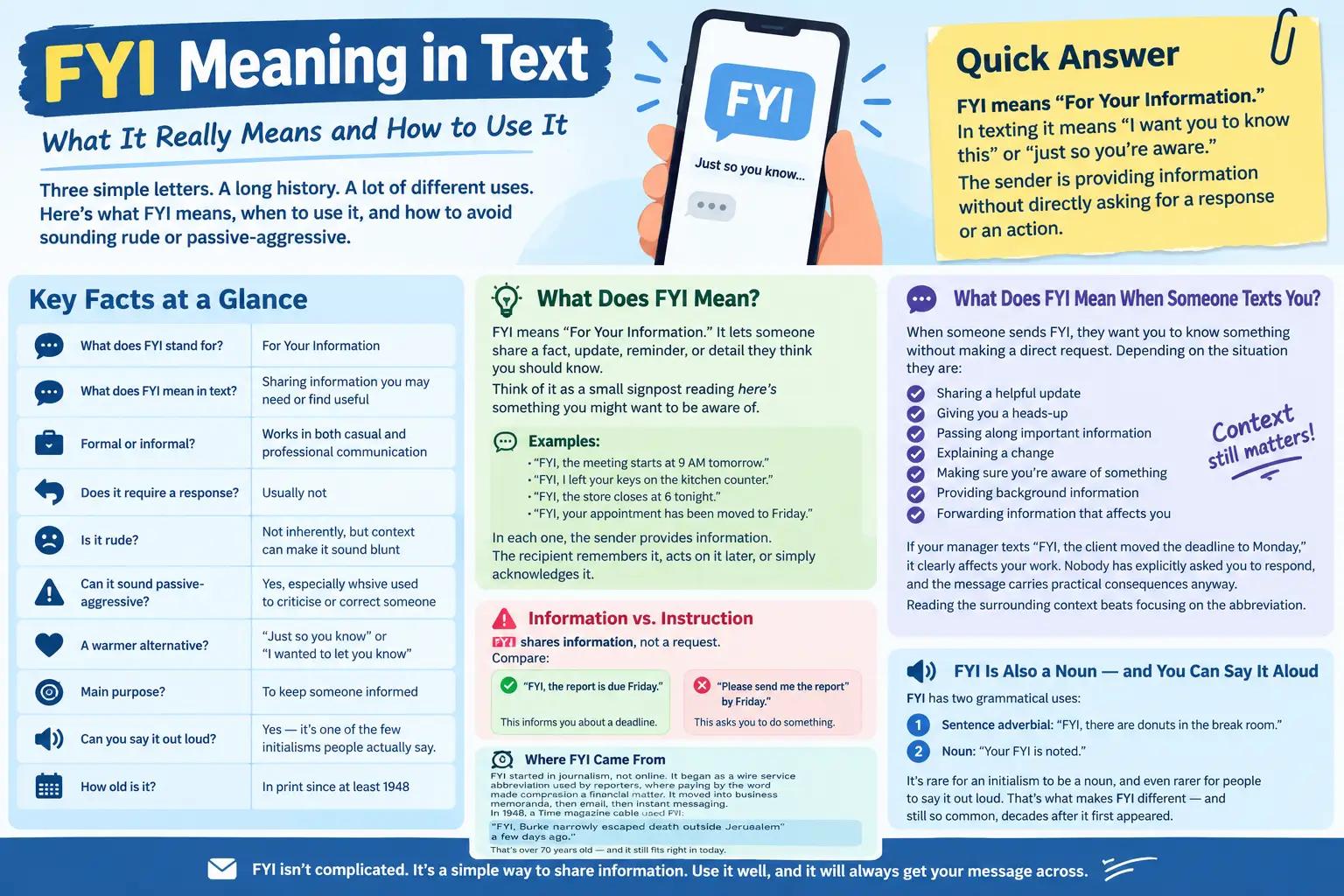
FYI means “For Your Information.” In texting it means “I want you to know this” or “just so you’re aware.” The sender is providing information without directly asking for a response or an action.
| Question | Quick Answer |
|---|---|
| What does FYI stand for? | For Your Information |
| What does FYI mean in text? | The sender is sharing information you may need or find useful |
| Is FYI formal or informal? | It works in both casual and professional communication |
| Does FYI require a response? | Usually not |
| Is FYI rude? | Not inherently, although context can make it sound blunt |
| Can FYI sound passive-aggressive? | Yes, especially when used to criticise or correct someone |
| What’s a warmer alternative? | “Just so you know” or “I wanted to let you know” |
| What’s the main purpose of FYI? | To keep someone informed |
| Can you say FYI out loud? | Yes — unusually for an initialism, people do |
| How old is it? | In print since at least 1948 |
Example:
“FYI, your package arrived this morning.”
That message gives you information. It asks for neither a reply nor an action.
What Does FYI Mean in Text?
The FYI meaning in text is “For Your Information.” It lets somebody share a fact, update, reminder, or detail they believe you should know.
Think of FYI as a small signpost reading here’s something you might want to be aware of.
- “FYI, the meeting starts at 9 AM tomorrow.”
- “FYI, I left your keys on the kitchen counter.”
- “FYI, the store closes at 6 tonight.”
- “FYI, your appointment has been moved to Friday.”
In each one the sender provides information. The recipient remembers it, acts on it later, or simply acknowledges it.
That distinction matters: FYI shares information rather than giving an instruction. Compare:
- “FYI, the report is due Friday.”
- “Please send me the report by Friday.”
The first informs you about a deadline. The second asks you to do something. At work that difference becomes critical, because “FYI, the deadline is Friday” leaves the action unstated while “please submit your report by Friday” does not.
What Does FYI Mean When Someone Texts You?
When somebody sends FYI, they want you to know something without making a direct request. Depending on the situation they are:
- Sharing a helpful update
- Giving you a heads-up
- Passing along important information
- Explaining a change
- Making sure you’re aware of something
- Providing background information
- Forwarding information that affects you
The phrase does not automatically mean you need to do something.
Context still matters. If your manager texts “FYI, the client moved the deadline to Monday,” the information clearly affects your work. Nobody has explicitly asked you to respond, and the message carries practical consequences anyway. Reading the surrounding context beats focusing on the abbreviation.
What Does FYI Stand For?
FYI stands for “For Your Information.”
- F = For
- Y = Your
- I = Information
The full expression has been used in English for decades, particularly in business and written communication, and abbreviations like FYI became even more convenient as digital communication spread.
Instead of writing:
“I am sending you this information so that you are aware of it.”
somebody writes:
“FYI, the schedule has changed.”
Shorter, faster, and immediately recognisable to most English speakers.
Where FYI Came From
FYI began in journalism, not online. It started as a wire service abbreviation used by reporters filing copy, where paying by the word made compression a financial matter rather than a stylistic one. From there it moved into business memoranda, then email, then instant messaging.
Wiktionary records a citation that captures the origin precisely. In Time magazine on 14 June 1948, the Life photographer John Phillips closed a cable about recovering his censor-held photographs of the fighting in the Holy Land with a casual postscript:
“FYI, Burke narrowly escaped death outside Jerusalem a few days ago.”
That sentence is seventy-odd years old and it would pass unremarked in a work chat today. FYI is the oldest abbreviation in most people’s texting vocabulary, which is also why it carries none of the generational marking that FR or DWBI do — your manager and your grandmother both know it.
FYI Is Also a Noun — and You Can Say It Aloud
Two features set FYI apart grammatically.
First, Wiktionary classifies it as a phrase and documents two distinct uses. The familiar one is sentence adverbial: “FYI, there are donuts in the break room.” The second is noun use, where FYI names the message itself:
- “I just wanted to give you an FYI about the donuts in the break room.”
- “He forwards so many FYIs that sometimes it feels a bit like the boy who cried wolf.”
That second example earns its place. FYI pluralises — FYIs — which almost no texting abbreviation does, and the quotation names the exact failure mode covered further down.
Second, FYI is spoken aloud, pronounced eff-why-eye, and Wiktionary even lists eff why eye as an alternative written form. Most texting initialisms are written-only; EVB and FN never leave the screen. FYI crossed back into speech, which is a sign of how thoroughly it settled into the language.
Common Alternatives to FYI
Depending on tone and situation, you could replace FYI with:
- Just so you know
- Just wanted to let you know
- For your awareness
- In case you didn’t know
- I wanted to share an update
- Please note
- Here’s an update
- I thought you should know
These are not exact substitutes. “Please note” sounds more formal, while “just so you know” feels more conversational. The best choice depends on what you are communicating and how you want it to sound.
FYI Meaning in Different Contexts
FYI confuses people because its tone changes with the setting. The same three letters feel helpful in one conversation and slightly sharp in another. The words after FYI matter, and so do punctuation, timing, and the relationship between sender and recipient.
FYI in Text Messages
In casual texting, FYI has a simple job: a heads-up.
- “FYI, Mom said dinner is at 7.”
- “FYI, I’m running about 15 minutes late.”
- “FYI, the tickets are almost sold out.”
These feel natural because the sender is not trying to sound formal. You will also see lowercase fyi in everyday texting, and the meaning is unchanged — though lowercase reads a notch softer, which matters in the awkward cases below.
FYI in WhatsApp and Other Chat Apps
In messaging apps, FYI appears when somebody wants to keep a conversation moving without adding explanation.
- “FYI, I sent the address to the group.”
- “FYI, John won’t be joining us tonight.”
- “FYI, the restaurant changed its closing time.”
In group chats FYI is particularly useful, because it signals that the message is informational and nobody needs to reply. It is a way of posting without starting a thread.
FYI on Social Media
People use FYI on social platforms to correct information, add context, or flag a fact.
“FYI, the event starts at 6 PM, not 7 PM.”
Social media carries a higher risk of misunderstanding, because readers cannot hear your voice or see your face. A message meant helpfully turns condescending fast:
“FYI, that’s not how the product works.”
Even where the information is accurate, the wording feels dismissive. A softer version:
“Just so you know, the product works a little differently.”
The information stays the same. The tone changes, and in public the audience is watching the exchange rather than just reading it.
FYI in Emails
FYI is common in professional email, especially for sharing information without requesting immediate action.
- “FYI, I’ve attached the updated schedule.”
- “FYI, the client approved the revised proposal.”
- “FYI, the meeting room has changed to Conference Room B.”
It also works in subject lines:
FYI: Updated Project Timeline
That tells the recipient the email contains an update rather than a request, which lets them triage it without opening it. In a crowded inbox, FYI in a subject line is a scheduling signal as much as a content one.
FYI at Work
Workplace communication is where FYI earns its keep, because workplaces generate a constant stream of information.
- A manager writes: “FYI, the team meeting has been moved to Thursday.”
- A coworker says: “FYI, I uploaded the latest version to the shared folder.”
- A project lead sends: “FYI, the client requested two changes to the proposal.”
In each case the sender keeps others informed. Workplace communication demands precision, though, and where somebody needs to act, FYI alone is not enough. Instead of:
“FYI, the report is due tomorrow.”
write:
“FYI, the report is due tomorrow. Please send me your section by 3 PM today.”
Now the message does two jobs: it supplies context and states the expected action.
How to Use FYI Correctly in a Text
Make sure the information after FYI is genuinely useful to the recipient. Four habits cover the rest.
Put FYI Before the Information
The standard structure is FYI, + information:
- FYI, the meeting starts at noon.
- FYI, I already sent the invoice.
- FYI, the office will be closed Monday.
A comma usually follows FYI when it introduces the rest of the sentence, which is exactly what a sentence adverbial does — it sits outside the clause and comments on it.
Use FYI When Sharing Information
FYI works best when passing something along.
“FYI, Sarah won’t be at the meeting today.”
That gives the recipient a useful update and asks nothing of them.
Don’t Use FYI When You Really Mean “Do This”
If you need action, say so.
- Less clear: “FYI, the form needs to be completed today.”
- Clearer: “Please complete the form by the end of today.”
The second removes the ambiguity. The first is the single most common misuse, because FYI frames a request as information and leaves the reader to work out that they are the one who has to move.
Use the Right Tone
The words following FYI change everything:
- Helpful: “FYI, the weather forecast changed. You might want to bring an umbrella.”
- Neutral: “FYI, the meeting is now at 4 PM.”
- Potentially sharp: “FYI, I already explained this yesterday.”
That last one reads as a reprimand. If the goal is a reminder:
“Just so you know, I mentioned this yesterday. I can send the details again if helpful.”
A small adjustment, and it prevents unnecessary friction.
FYI Text Examples for Everyday Conversations
Five settings, with the information doing the work in each.
FYI Between Friends
- “FYI, we’re meeting at Mike’s place instead.”
- “FYI, the concert starts at 8.”
- “FYI, I grabbed an extra ticket for you.”
- “FYI, traffic is really bad on the highway.”
Casual and informative. Note that friends rarely need FYI at all — the fact itself would do. It survives here because it marks the message as not requiring a reply, which is a kindness in a busy thread.
FYI in Family Texts
- “FYI, Dad will pick you up at 6.”
- “FYI, dinner is ready.”
- “FYI, Grandma’s appointment is on Tuesday.”
- “FYI, the plumber is coming tomorrow morning.”
Here FYI is a quick heads-up about logistics.
FYI When Making Plans
- “FYI, we’re meeting at the coffee shop instead of the park.”
- “FYI, the movie has been moved to the 9 PM showing.”
- “FYI, I’ll be about 20 minutes late.”
These work because the information is directly relevant to the recipient’s next hour.
FYI When Sharing Important Information
- “FYI, the deadline was extended until Friday.”
- “FYI, the new policy takes effect next month.”
- “FYI, the store is closed for renovations this week.”
Not urgent, still worth knowing. The recipient decides what to do with it, which is precisely the contract FYI offers.
FYI in Group Chats
- “FYI, the venue has changed to Hall B.”
- “FYI, the bus leaves at 7:30, not 8.”
- “FYI, everyone needs to bring their own ID.”
The abbreviation signals a general update for everybody, which stops fifteen people replying “ok”.
Is FYI Rude or Passive-Aggressive?
No, FYI is not inherently rude. Its basic meaning is neutral. How somebody uses it is what makes a message sound cold, dismissive, or passive-aggressive.
Consider:
- “FYI, the meeting starts at 10 AM.”
- “FYI, I already told you the meeting starts at 10 AM.”
The first shares information. The second carries an emotional charge: the sender appears frustrated and implies the recipient was not paying attention. Tone depends heavily on context.
Why Can FYI Sound Passive-Aggressive?
FYI sounds passive-aggressive when somebody uses it to:
- Correct another person
- Point out a mistake
- Express frustration indirectly
- Remind somebody they have already explained something
- Deliver criticism without stating it openly
- Emphasise information the recipient supposedly should already know
“FYI, everyone else submitted their reports on time.”
Technically that is information. In practice it reads as criticism, and there is a precise name for why.
In pragmatics, an implicature is something a speaker suggests or implies with an utterance even though it is not literally expressed. The philosopher H. P. Grice coined the term in 1975, and conversational implicatures arise because listeners expect speakers to follow general rules of conversation — above all, to say things that are relevant.
That expectation is the trap. “Everyone else submitted their reports on time” is a fact about other people, which is irrelevant to you unless it is about you. Since the reader assumes relevance, they reconstruct the missing point: and you did not. The criticism is never written, so the sender can deny it, and it arrives anyway. That is textbook passive-aggressive behaviour — a message driven by a strong negative emotion, expressed in words that do not convey it.
A more direct and professional approach:
“The report deadline was yesterday. Please let me know when you can submit yours.”
Now the sender states the issue and the next step, and nothing is left for the reader to decode. A DPWM-style confrontation is not needed; plain words are.
Does “FYI.” Sound Different?
Yes. A standalone “FYI.” feels abrupt because it provides no information at all. Compare:
- “FYI.”
- “FYI, the schedule changed. The updated version is attached.”
The second gives useful context. The first leaves the reader wondering what they are supposed to know. Don’t make the reader play detective.
The full stop contributes too. Research on text messaging has found that short replies ending in a period are rated less sincere than the identical replies with no punctuation, which is why “FYI.” lands colder than “fyi” even when the sender meant nothing by it.
| Form | How it reads | Why |
|---|---|---|
| “FYI, the room changed to B.” | Neutral and useful | Information follows the signpost |
| “fyi the room changed” | Relaxed | Lowercase and no full stop |
| “FYI.” alone | Abrupt | No information at all |
| “FYI, as I said yesterday…” | Pointed | The reminder is the message |
| “FYI, everyone else is done.” | Critical | Implicature supplies the accusation |
| “FYI: Updated timeline” | Efficient | A subject line doing triage |
When Should You Avoid Using FYI?
FYI is useful and it is not right for every message. Four situations call for something else.
Avoid FYI When You Need Immediate Action
If somebody must do something, make the request clear. Instead of:
“FYI, please send the document today.”
write:
“Please send the document by 5 PM today.”
Notice what the first version does wrong: it staples a request onto an informational frame, so the reader receives two contradictory signals about whether they need to move.
Avoid FYI When Discussing Sensitive Issues
Sensitive conversations benefit from thoughtful, personal language. Telling somebody:
“FYI, your application was rejected.”
sounds unnecessarily cold. A more considerate approach:
“I wanted to let you know that your application wasn’t selected this time.”
The second version acknowledges the human side. FYI treats news as data, and some news is not data to the person receiving it.
Avoid FYI When Correcting Someone
Correcting a person with FYI makes you sound superior. Instead of:
“FYI, that’s not how it works.”
try:
- “Just so you know, it works a little differently.”
- “I think there’s a small detail we should clarify.”
These leave room for a constructive conversation rather than closing it.
Avoid FYI When the Message Is Urgent
FYI implies you are merely sharing information. If something needs immediate attention, use stronger language:
“Urgent: The server is down. Please check it immediately.”
is clearer than:
“FYI, the server is down.”
The wording should match the urgency. An FYI on an emergency actively slows the response, because the frame tells the reader they can deal with it later.
Better Alternatives to FYI
| Alternative | Best Use | Tone |
|---|---|---|
| Just so you know | Casual updates | Friendly |
| Just wanted to let you know | Personal messages | Warm |
| Please note | Important formal information | Professional |
| For your awareness | Workplace communication | Formal |
| In case you didn’t know | Sharing potentially new information | Conversational |
| Here’s an update | Project or status information | Neutral |
| I wanted to share | Personal or professional updates | Warm |
| Please be aware | Important warnings or conditions | Direct |
| Heads-up | Advance notice of something coming | Casual, helpful |
| Urgent: | Anything needing action now | Unambiguous |
Compare:
- “FYI, the event has been cancelled.”
- “Just wanted to let you know that the event has been cancelled.”
The meaning stays similar and the second feels more personal. The extra words are the warmth — brevity and warmth trade off against each other, and FYI sits firmly on the brevity side.
FYI vs. Similar Text Abbreviations
FYI belongs to a family of messaging abbreviations, and the similar-looking ones do different jobs.
| Abbreviation | Full Meaning | Main Purpose |
|---|---|---|
| FYI | For Your Information | Share information |
| BTW | By the Way | Add a side point |
| FWIW | For What It’s Worth | Offer an opinion or perspective |
| ICYMI | In Case You Missed It | Reshare information |
| TMI | Too Much Information | React to excessive personal details |
| PSA | Public Service Announcement | Share information with a wider audience |
| FYA | For Your Awareness | Draw attention to something |
| NFA | No Further Action | State explicitly that nothing is needed |
| FR | For real | Confirm or agree |
FYI vs. BTW
FYI introduces information the sender believes you should know. BTW adds a side comment or extra thought.
- “FYI, the meeting starts at 2 PM.”
- “BTW, did you see John’s new car?”
The first communicates relevant information. The second adds a conversational aside. FYI claims relevance; BTW admits it has none, which is why BTW almost never reads as passive-aggressive.
FYI vs. ICYMI
ICYMI means “In Case You Missed It,” used when resharing something already posted or communicated. It implies the reader overlooked an earlier announcement.
- “FYI, the deadline is Friday.”
- “ICYMI, the deadline was moved to Friday.”
The first simply provides information. The second suggests you missed an earlier announcement — and that built-in suggestion makes ICYMI the sharper of the two when it is aimed at one person rather than a crowd.
FYI vs. FWIW
FWIW means “For What It’s Worth,” used before an opinion, perspective, or personal observation.
- “FYI, the store closes at 8.”
- “FWIW, I think the earlier flight is better.”
These serve different purposes and are not interchangeable. FYI introduces a fact; FWIW introduces a judgement, and FWIW adds a pre-emptive apology for offering it.
FYI vs. “Just So You Know”
They communicate similar ideas with different tone. FYI is shorter and more neutral; “just so you know” feels more conversational.
- “FYI, I’m working from home today.”
- “Just so you know, I’m working from home today.”
Both are perfectly understandable, and the second sounds slightly more personal. In professional writing FYI is efficient:
“FYI, the updated contract is attached.”
In a friendly text you might prefer:
“Just so you know, I left your package by the door.”
Neither is universally better. The right choice follows the relationship and the setting. One rule of thumb: the more the news might land badly, the more words it deserves.
FYI in Professional and Workplace Communication
FYI is useful at work because workplaces generate a constant stream of information. Team members use it to share:
- Project updates
- Schedule changes
- Meeting details
- Client decisions
- Document updates
- Policy announcements
- Changes in deadlines
- Status reports
“FYI, the client approved the revised design.”
A concise way to keep a team informed. Professionals should not use FYI as a substitute for clear communication, though.
FYI for a Simple Update
“FYI, the client meeting is now Thursday at 2 PM.”
FYI With a Required Action
“FYI, the client meeting is now Thursday at 2 PM. Please update your calendar.”
Direct Request Without FYI
“Please update your calendar for the client meeting on Thursday at 2 PM.”
All three work. The best option depends on whether the sender wants to emphasise information, context, or action — and the middle one is the most useful pattern of the three, because it separates the two jobs into two sentences.
A Practical Workplace Rule
Ask one question before sending:
“Does the recipient only need to know this, or do they need to do something?”
- Only need to know → FYI works well.
- Need to act → state the action clearly.
- Need to know and act → combine both.
“FYI, the client moved the deadline to Friday. Please send your final edits by Thursday afternoon.”
Clear, useful, and difficult to misinterpret.
Who Gets the FYI
One workplace habit deserves naming, because it is where FYI acquires most of its bad reputation: the FYI used to create a record. Copying somebody’s manager on an “FYI” turns an informational note into a documented one, and everybody involved knows it. The letters stay neutral while the recipient list does the work.
If the goal is genuinely to inform, inform the person who needs the information. If the goal is to build a paper trail, that is a different message, and the honest version says so.
Common Mistakes People Make When Using FYI
FYI is simple and people still misuse it in six predictable ways.
Using FYI for Every Message
If every email starts with FYI, the abbreviation loses its value. Wiktionary’s own illustration of the noun use names the failure exactly: “he forwards so many FYIs that sometimes it feels a bit like the boy who cried wolf.” Use it when it genuinely signals that you are sharing information.
Using FYI Without Context
“FYI.”
This tells the recipient nothing. Always include the information you are referring to — the signpost is useless with no destination attached.
Using FYI to Hide a Request
“FYI, the presentation needs to be finished today.”
If you expect the recipient to finish it, say so:
“Please finish the presentation by 5 PM today.”
Hiding a request inside an FYI shifts the work of noticing onto the reader, and when they miss it, the sender gets to point at the message.
Using FYI to Criticize Someone
“FYI, everyone else finished this already.”
This reads as a jab rather than helpful information, for the implicature reason set out above.
Using FYI in Sensitive Situations
When emotions are involved, plain language works better. Instead of:
“FYI, you’re being removed from the project.”
a thoughtful message should explain the decision clearly and respectfully. News that changes somebody’s week is not an FYI.
Overusing FYI in Formal Writing
In highly formal documents, precise language such as “please note” works better, or simply state the information directly. FYI is accepted in business email and still reads as shorthand in a contract or a report.
How to Reply When Someone Texts “FYI”
Most FYI messages need no lengthy response. Your reply depends on what the sender communicated.
If No Action Is Needed
- “Thanks for letting me know.”
- “Got it, thanks.”
- “Good to know.”
- “Thanks for the update.”
- “Understood.”
If You Need More Information
Ask a clear follow-up question:
- “Thanks. What time is the new meeting?”
- “Got it. Can you send me the updated address?”
If Action Is Required
Confirm what you will do:
“Thanks for the heads-up. I’ll update the document today.”
Stating the action back is worth the extra line, because it converts an ambiguous FYI into a recorded commitment.
If the Message Sounds Passive-Aggressive
Don’t automatically assume the worst. Text removes many of the cues people use to read tone, and a short message sounds harsher on screen than it would in person.
If clarification helps, respond calmly:
“Thanks. Is there anything you need me to do?”
That question turns an ambiguous exchange into a clear one, and it does something clever: it asks the sender to state the request they left implied. Either they name it, or they confirm there is nothing — and both outcomes end the guessing. A BFFR-style challenge would escalate; this does not.
Reply Matrix
| What arrived | What it wants | Reply |
|---|---|---|
| “FYI, the room changed.” | Nothing | “Got it, thanks.” |
| “FYI, the deadline moved to Friday.” | Possibly action | “Thanks — I’ll adjust my timeline.” |
| “FYI.” with nothing after it | Unknown | “Thanks — what’s this about?” |
| “FYI, I already sent this.” | Acknowledgement | “Apologies, I missed it — found it now.” |
| “FYI, everyone else is finished.” | A deadline, unstated | “Is there anything you need me to do?” |
| “FYI, attached the contract.” | A record that you received it | “Received, thanks.” |
| “FYI, the server is down.” | Probably urgent action | Act first, reply second |
FYI Examples: Good vs. Bad Usage
The difference comes down to clarity, relevance, and tone.
| Example | Assessment | Why |
|---|---|---|
| “FYI, the meeting starts at 10.” | Good | Clear and useful |
| “FYI, I attached the updated report.” | Good | Gives context |
| “FYI, the deadline moved to Friday.” | Good | Shares a relevant update |
| “FYI.” | Poor | Provides no information |
| “FYI, you missed the deadline again.” | Risky | Sounds accusatory |
| “FYI, fix this.” | Poor | An informational phrase on a direct command |
| “FYI, everyone else finished.” | Risky | Reads as passive-aggressive |
| “FYI, please review this by noon.” | Mixed | Clearer rewritten as a direct request |
| “FYI, the fire alarm is active.” | Poor | Urgency framed as information |
The takeaway is simple: FYI works best when the message genuinely exists to inform. Every “poor” and “risky” row above is a message doing something other than informing while wearing an informational label.
A Short Case Study: How One Word Changes the Tone
Imagine a manager notices an employee has not submitted a report. The manager sends:
Imani: “FYI, the report was due yesterday.”
The employee reads it as a reminder, and could equally read it as criticism. Now consider:
Imani: “The report was due yesterday. Can you send me an update on when you’ll have it ready?”
The second is more direct. It identifies the issue and asks for a response. Now imagine the manager simply wants the employee to know a deadline has changed:
Imani: “FYI, the deadline has been moved to Friday.”
Here FYI works perfectly, because the purpose really is to share an update.
The Lesson
The problem is not FYI itself. The real issue is whether the language matches the sender’s purpose.
- Goal is to inform → FYI fits naturally.
- Goal is to request, instruct, correct, or criticise → a more direct sentence works better.
Notice what the first and third messages have in common: identical wording, opposite effect. The only variable is whether the recipient is implicated in the fact. FYI is safe when the news is about the world and risky when the news is about the reader. That single test predicts almost every awkward FYI anybody has ever received, and it is the same context-first logic that governs DTM and DTR.
FYI Meaning in Text: Tone Depends on Context
A useful way to understand FYI is to picture a plain envelope. The envelope does not tell you whether the contents are friendly or serious. The message inside does.
Neutral FYI
“FYI, the office will be closed Monday.”
Friendly FYI
“FYI, I picked up your favourite snacks.”
Helpful FYI
“FYI, traffic is heavy on Route 7 today.”
Potentially Passive-Aggressive FYI
“FYI, I already sent this to you last week.”
Professional FYI
“FYI, the revised contract is attached.”
Urgent Information That Shouldn’t Rely on FYI Alone
“FYI, the building’s fire alarm is active.”
In a genuinely urgent situation the message should state clearly what people need to do. FYI tells a reader they can finish what they are doing first, which is exactly wrong during an evacuation.
| Tone | What makes it that | Safe to send? |
|---|---|---|
| Neutral | A fact about the world | ✅ Yes |
| Friendly | Good news for the reader | ✅ Yes |
| Helpful | Something they can act on if they choose | ✅ Yes |
| Professional | A document or decision, with context | ✅ Yes |
| Passive-aggressive | A fact that implicates the reader | ❌ Rewrite it directly |
| Urgent | Something needing action now | ❌ Say what to do |
| Sensitive | News that affects them personally | ⚠️ Use full sentences |
Does FYI Mean Anything Else?
In messages, no — FYI is one of the most stable abbreviations in English. Unlike FN or EVB, it has no competing slang expansion, which is part of why it survived eighty years.
Outside messaging the letters do label a few specific things:
| Field | FYI stands for | Where you would meet it |
|---|---|---|
| Messaging 💬 | For Your Information | Texts, email, chat, social media — the dominant sense everywhere |
| Television 📺 | FYI, the US cable channel | Lifestyle programming from A+E Global Media, a Hearst unit |
| Internet standards 📝 | FYI, a sub-series of informational documents | Published alongside the RFC series by the IETF |
| Business email 📧 | For Your Awareness, written FYA | A close variant used in some organisations |
| Spoken form | eff-why-eye | Meetings and phone calls, where it is said aloud |
That third row is a nice piece of trivia with a point behind it. The engineers who built the internet adopted FYI as the formal name for documents that inform rather than specify — the same distinction, drawn for the same reason, by people writing technical standards rather than text messages.
FAQs
1. What does FYI mean in text messages?
FYI stands for “For Your Information.” People use it in text messages, emails, and on social media to share useful information without expecting an immediate reply. It is a quick, polite way to keep somebody informed.
2. Is FYI considered rude?
Not usually. The tone depends on context. Used plainly it simply shares information, and used to point out a mistake or criticise somebody it comes across as passive-aggressive — because the reader supplies the criticism the sender left unwritten.
3. Can I use FYI in professional emails?
Yes. FYI is widely accepted in professional email and workplace communication. It signals that information is for reference and requires no action unless stated otherwise. Where action is needed, add a sentence saying so.
4. What are some alternatives to FYI?
“Just so you know,” “for your reference,” “just letting you know,” and “heads-up” all work. The right one depends on whether you’re writing formally or chatting casually, and on how badly the news might land.
5. When should you avoid using FYI?
Avoid it for sensitive topics, critical feedback, and important instructions. In those situations a detailed, personal explanation is clearer and more respectful — and for anything urgent, say what needs doing instead of framing it as information.
6. What does FYI stand for?
For Your Information. Each letter is the first letter of a word, which makes it an initialism, and the expansion has not changed since it entered written English.
7. How old is FYI?
Older than most people assume. It began as a wire service abbreviation used by journalists and appears in a 1948 Time magazine item, where a Life photographer ended a cable from the Holy Land with “FYI, Burke narrowly escaped death outside Jerusalem a few days ago.”
8. Can you say FYI out loud?
Yes, pronounced eff-why-eye, and that is unusual. Most texting initialisms stay on the screen, while FYI crossed into speech — “I’ll send you an FYI” sounds perfectly normal in a meeting.
9. Is FYI a noun?
It functions as one. Wiktionary records noun use alongside the familiar sentence-adverbial use: “give you an FYI about the donuts” and “he forwards so many FYIs.” It even takes a plural, which few abbreviations manage.
10. Why does FYI sound passive-aggressive sometimes?
Because of implicature — what an utterance suggests without stating. Readers assume messages are relevant, so an irrelevant-looking fact gets reinterpreted as being about them. “FYI, everyone else submitted on time” never writes the accusation, and it lands anyway.
11. Does FYI need a reply?
Usually not, which is the whole point of the frame. A short acknowledgement such as “got it, thanks” is courteous, and where the information implies work for you, confirming what you will do is better than a bare thanks.
12. What does a standalone “FYI.” mean?
Very little, and that is the problem. With no information attached it leaves the reader guessing, and the full stop makes it colder — research on texting found short replies ending in a period read as less sincere than the same replies unpunctuated.
13. What is the difference between FYI and BTW?
FYI introduces information the sender thinks you need. BTW adds a side comment. FYI claims relevance, BTW admits it has none, which is why BTW almost never reads as pointed.
14. What is the difference between FYI and ICYMI?
ICYMI means “in case you missed it” and implies you overlooked something already announced. Sent to a crowd it is neutral; sent to one person it can read as a nudge about their attention.
15. Should I use FYI when I need someone to do something?
No. Write the request plainly: “please send the document by 5 PM today.” An FYI frames the message as optional, so a request hidden inside one puts the burden of noticing on the reader.
16. Is lowercase “fyi” different from “FYI”?
The meaning is identical, and lowercase reads a shade softer and more casual. In a tense exchange, fyi is the safer of the two because capitals add emphasis the sentence rarely needs.
17. Does FYI mean anything besides “for your information”?
In messaging, no — it has no competing slang sense, which is unusual. Elsewhere, FYI is a US lifestyle cable channel owned by A+E Global Media, and the IETF publishes an informational FYI document sub-series alongside its RFCs.
18. What’s the quickest test for whether an FYI will sound rude?
Ask whether the fact is about the world or about the reader. “The office is closed Monday” is about the world and lands neutrally. “Everyone else finished” is about the reader, and it will land as criticism however it was meant.
Conclusion
Understanding the FYI meaning in text makes everyday conversations, emails, and messages clearer. FYI stands for For Your Information, and it is a simple abbreviation that saves time while keeping a message polite and easy to follow — whether you’re sending a quick update, sharing something useful, or giving somebody a heads-up.
One test predicts how it will land. Ask whether the fact is about the world or about the reader. “FYI, the office is closed Monday” is about the world, and it reads as neutral and helpful. “FYI, everyone else submitted on time” is about the reader, and it reads as criticism whatever the sender intended — because implicature fills in the accusation that was never written.
The other rule is just as short: FYI informs, so if you need action, say so. Keep it for updates and context, add a sentence naming the task when one exists, and reach for plain words entirely when the subject is sensitive or urgent. An FYI tells the reader they can finish what they are doing first.
It is worth knowing how deep these three letters go. FYI began as a wire service abbreviation among journalists and was already in print by 1948; it works as a noun as well as a sentence adverbial, pluralising into FYIs; and it is one of the rare initialisms people say aloud. Knowing what FYI means, when to use it, and when to avoid it is what keeps a three-letter shortcut from doing damage it was never meant to do.