Copacetic Meaning Explained: Definition, Origin, Pronunciation
Quick Answer: What Does Copacetic Mean?
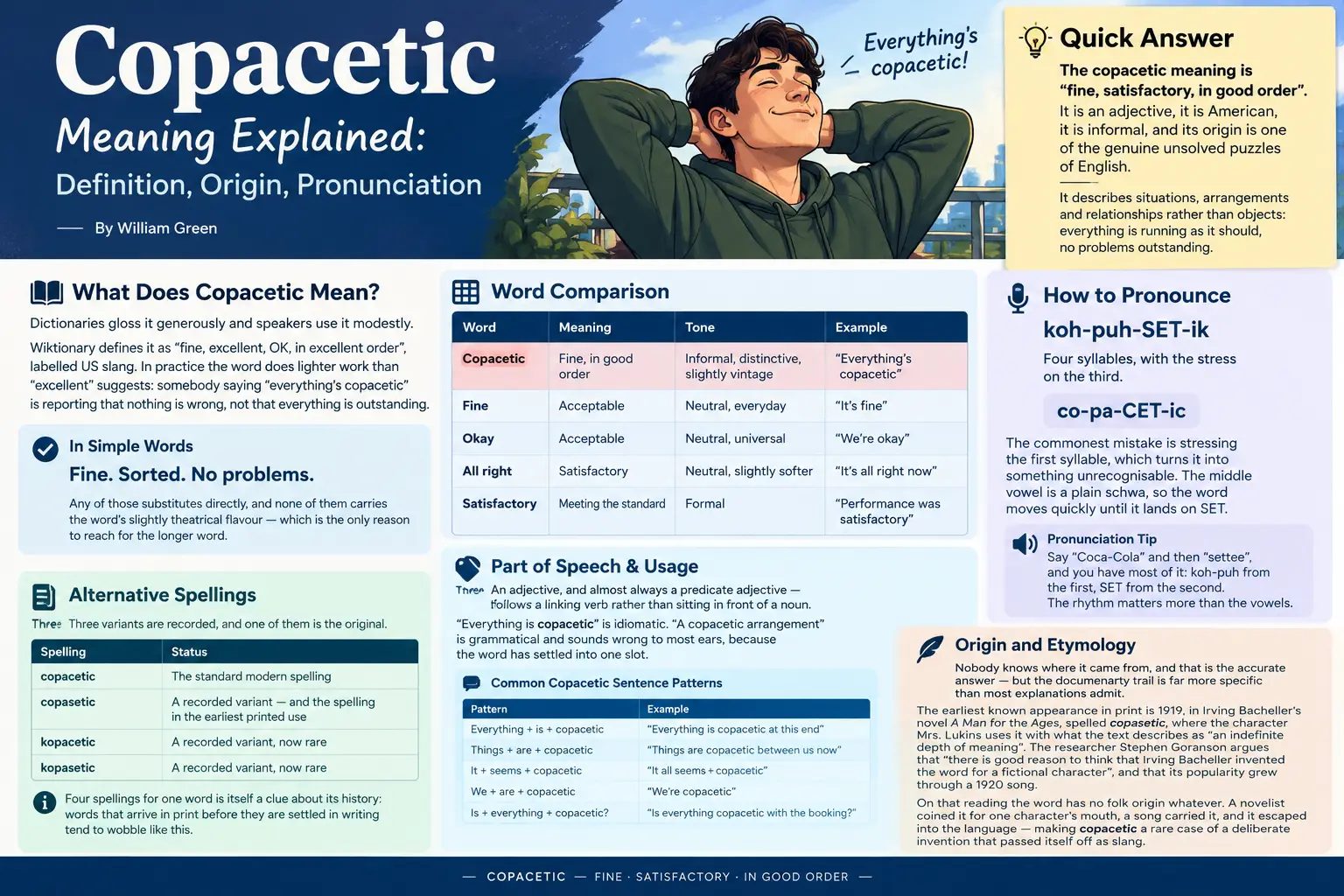
The copacetic meaning is “fine, satisfactory, in good order”. It is an adjective, it is American, it is informal, and its origin is one of the genuine unsolved puzzles of English.
It describes situations, arrangements and relationships rather than objects: everything is running as it should, no problems outstanding.
| Word | Meaning | Tone | Example |
|---|---|---|---|
| Copacetic | Fine, in good order | Informal, distinctive, slightly vintage | “Everything’s copacetic” |
| Fine | Acceptable | Neutral, everyday | “It’s fine” |
| Okay | Acceptable | Neutral, universal | “We’re okay” |
| All right | Satisfactory | Neutral, slightly softer | “It’s all right now” |
| Satisfactory | Meeting the standard | Formal | “Performance was satisfactory” |
Copacetic Definition: What Does Copacetic Really Mean?
Dictionaries gloss it generously and speakers use it modestly.
Wiktionary defines it as “fine, excellent, OK, in excellent order”, labelled US slang. In practice the word does lighter work than “excellent” suggests: somebody saying “everything’s copacetic” is reporting that nothing is wrong, not that everything is outstanding.
Copacetic Meaning in Simple Words
Fine. Sorted. No problems. Any of those substitutes directly, and none of them carries the word’s slightly theatrical flavour — which is the only reason to reach for the longer word.
Alternative Spellings
Three variants are recorded, and one of them is the original.
| Spelling | Status |
|---|---|
| copacetic | The standard modern spelling |
| copasetic | A recorded variant — and the spelling in the earliest printed use |
| kopacetic | A recorded variant, now rare |
| kopasetic | A recorded variant, now rare |
This is the inverse of the usual problem with a short word. An abbreviation like CM has one spelling and fourteen documented meanings; copacetic has one meaning and four spellings, with all the dispute sitting in its history rather than its usage.
Four spellings for one word is itself a clue about its history: words that arrive in print before they are settled in writing tend to wobble like this.
Copacetic Meaning and Part of Speech
An adjective, and almost always a predicate adjective — it follows a linking verb rather than sitting in front of a noun.
“Everything is copacetic” is idiomatic. “A copacetic arrangement” is grammatical and sounds wrong to most ears, because the word has settled into one slot.
Common Copacetic Sentence Patterns
| Pattern | Example |
|---|---|
| Everything + is + copacetic | “Everything is copacetic at this end” |
| Things + are + copacetic | “Things are copacetic between us now” |
| It + seems + copacetic | “It all seems copacetic” |
| We + are + copacetic | “We’re copacetic” |
| Is + everything + copacetic? | “Is everything copacetic with the booking?” |
🔊 How to Pronounce Copacetic
koh-puh-SET-ik — four syllables, with the stress on the third.
co-pa-CET-ic. The commonest mistake is stressing the first syllable, which turns it into something unrecognisable. The middle vowel is a plain schwa, so the word moves quickly until it lands on SET.
Pronunciation Tip
Say “Coca-Cola” and then “settee”, and you have most of it: koh-puh from the first, SET from the second. The rhythm matters more than the vowels.
📚 Copacetic Origin and Etymology
Nobody knows where it came from, and that is the accurate answer — but the documentary trail is far more specific than most explanations admit.
The earliest known appearance in print is 1919, in Irving Bacheller‘s novel A Man for the Ages, spelled copasetic, where the character Mrs. Lukins uses it with what the text describes as “an indefinite depth of meaning”. The researcher Stephen Goranson argues that “there is good reason to think that Irving Bacheller invented the word for a fictional character”, and that its popularity grew through a 1920 song.
Early citations routinely push a word’s history back past its reputation — cap meaning a lie is in print by 1906, decades before anybody called it modern slang. Copacetic runs the other way: the paper trail starts late and points at a single author.
On that reading the word has no folk origin whatever. A novelist coined it for one character’s mouth, a song carried it, and it escaped into the language — making copacetic a rare case of a deliberate invention that passed itself off as ancient slang.
Bill “Bojangles” Robinson and the Peas
The man most associated with the word did not invent it in print, and he did more than anyone to spread it.
Bill “Bojangles” Robinson — born Luther Robinson on 25 May 1878 in Richmond, Virginia, died 25 November 1949 in New York — was “the best known and the most highly paid Black entertainer in the United States during the first half of the 20th century”. He was a tap dancer famous for his stair dance, danced with Shirley Temple in a series of 1930s films as the first Black performer in an interracial dance team in Hollywood, and took his final starring role in Stormy Weather in 1943.
His biography records the origin story he told. Asked how he was doing while shelling peas at a market, “the reply just popped into his head: I’m copasetic”. He then used the word as an opening line in his vaudeville and radio performances, and it reached Webster’s Dictionary in 1934.
Both accounts hold, in different senses. Bacheller has the earliest printed citation; Robinson has the audience of millions. Words usually need both a first appearance and a champion, and this one had them fifteen years apart.
Major Theories About the Origin of Copacetic
| Proposed source | The idea | Standing |
|---|---|---|
| Invented by a novelist | Coined by Irving Bacheller for a character in 1919 | The earliest evidence supports it |
| African-American speech | In use in the late 19th or early 20th century, spread by Bill Robinson | Speculated; no earlier citation found |
| Cajun French | From coup esètique or coupersètique, “capable of being coped with successfully” | No supporting evidence |
| Italian | From copasetti, among Italian speakers in New York | No supporting evidence |
| Chinook Jargon | From copasenee, “everything is satisfactory” | No supporting evidence |
| Hebrew | From hakól b’séder, “everything is in order” | Rejected |
| “Cop on the settee” | A policeman sitting down, therefore nothing wrong | Rejected |
A Note About the Hebrew Theory
It is the most repeated explanation and it is rejected by etymologists.
The story runs that copacetic comes from Hebrew hakól b’séder, “everything is in order”. The appeal is obvious: the meaning matches exactly. The problem is that the sounds do not, and no line of transmission has ever been documented from Hebrew speakers into the American English of 1919.
This is a textbook folk etymology — “a change in a word or phrase resulting from the replacement of an unfamiliar form by a more familiar one through popular usage”. Before comparative linguistics existed, “the derivation of a word was mostly guess-work”, and the guessing has never stopped. These stories survive because they make a strange word comprehensible by attaching it to something recognisable, and once people believe an origin they begin to “pronounce, spell, or otherwise use the word in a manner appropriate to that perceived origin”.
The “cop on the settee” story is the same mechanism in a more obviously invented form. Both are rejected, and both will outlive every correction.
Is Copacetic a Real Word?
Yes. It has been in Webster’s since 1934 and it appears in every major dictionary.
Informal is not the same as incorrect. The word is recorded, dated, spelled several ways and labelled slang — all of which are marks of a documented word rather than a doubtful one.
Is Copacetic Slang?
Yes, and Wiktionary labels it US slang specifically. It belongs to the register of spoken American English rather than to formal prose, which is why it reads as characterful in dialogue and out of place in a report.
How to Use Copacetic in a Sentence
Copacetic for Situations
“The handover went through, everything’s copacetic.” The subject is a state of affairs.
Copacetic for Relationships
“We’re copacetic now” — the argument is over and nothing is outstanding between two people. This is one of its most natural uses.
Copacetic for Plans
“Venue’s booked, caterer’s confirmed, it’s all copacetic.” Arrangements with nothing left to chase.
Copacetic for General Circumstances
“Things have been copacetic since the move.” A stretch of time in which nothing went wrong.
Copacetic in Everyday Sentences
- “Is everything copacetic with the booking?”
- “All copacetic on my end.”
- “It seemed copacetic when I left.”
- “Not entirely copacetic, but close enough.”
Copacetic Examples in Everyday Conversations
Casual Conversation
Noor: did the car pass its MOT
Jonah: all copacetic, one bulb and that was it
After an Argument
Marcus: are we alright after Thursday?
Ada: we’re copacetic. I’d have said if we weren’t.
At Work
“Legal have signed off, so we’re copacetic to launch Monday.” Informal enough for a team channel, wrong for the client email.
Making Arrangements
“Moved it to eight — copacetic?” A one-word request for confirmation.
Checking on a Problem
“Is the server copacetic now or still flaky?” The word carries “genuinely fine” rather than “technically working”.
Copacetic vs. Fine: What’s the Difference?
Meaning almost none. Tone, a great deal.
“Fine” is the most overworked word in English and frequently means the opposite of itself — “I’m fine” said flatly conveys that somebody is not. Copacetic has no such history, so it reads as a genuine report rather than a deflection.
Key Difference
“Fine” works as a brush-off. Copacetic does not. Nobody reaches for a four-syllable vintage adjective in order to shut a conversation down, which is precisely why it sounds sincere.
Copacetic vs. Okay, All Right, and Satisfactory
| Word | Meaning | Tone | Best for |
|---|---|---|---|
| Copacetic | In good order | Informal, characterful | Speech, dialogue, friendly messages |
| Okay | Acceptable | Neutral and universal | Anywhere at all |
| All right | Satisfactory | Neutral, slightly gentler | Reassurance |
| Fine | Acceptable | Neutral, sometimes loaded | Everyday use, with care |
| Satisfactory | Meets the standard | Formal, faintly grudging | Reports and assessments |
| Acceptable | Good enough | Formal, cool | Professional writing |
| In order | Correct and complete | Formal | Documents and procedures |
Copacetic Synonyms and Similar Words
Common Synonyms
Fine, okay, all right, good, acceptable, satisfactory, in order, settled, smooth, going well, under control, sorted, squared away, shipshape.
Context Matters
For a report, use satisfactory. For a friend, use fine or sorted. For dialogue with personality, copacetic is doing something the neutral words cannot.
Copacetic vs. Hunky-Dory
Both mean everything is fine, and they differ in temperature. Hunky-dory is cheerful and faintly comic; copacetic is cooler and more measured. “Everything’s hunky-dory” can sound ironic, and copacetic rarely does.
Is Copacetic Formal or Informal?
Informal, though not incorrect.
Casual Conversation
Its home. Speech, messages, dialogue — anywhere a distinctive word is an asset.
Professional Email
Use satisfactory, acceptable or in order. Copacetic in a client email reads as trying to be charming, which is a risk in writing to somebody you do not know.
Academic Writing
No. Academic prose wants the plainest available word, and the plainest here is satisfactory.
Practical Rule
If you would say it aloud to that person, write it. If not, use “in order”.
Is Copacetic Still Used Today?
Yes, and mostly on purpose.
It survives as a deliberate choice rather than a default, which is an unusual way for informal vocabulary to last. Most of it endures by being needed constantly — an abbreviation for stepping away has outlived every platform it started on because people still need to say it daily. Copacetic endures by being interesting instead.
Writers put it in dialogue to give a character a voice, and speakers use it because it is more interesting than “fine”. That makes it less common than it was in the mid-twentieth century and more noticeable when it appears.
Can You Say “Everything Is Copacetic”?
Yes — it is the most recognisable phrasing the word has.
Variants all work: “things are copacetic”, “everything seems copacetic”, “all copacetic”, and the question form “is everything copacetic?” The word is so strongly associated with everything that the pairing is close to fixed.
Can Copacetic Describe a Person?
Not as a personality. It describes somebody’s circumstances or their relationship with you.
“He’s copacetic now” means his situation has improved or that things between you are settled — not that he is a calm sort of person. Using it as a character trait is the commonest misuse of the word.
Copacetic in American English
It is American, and it stayed American.
Wiktionary’s label is US slang, and the word never crossed into general British usage the way many Americanisms did. A British speaker using it is making a visible choice, and will usually be understood from context rather than from familiarity.
Copacetic in Pop Culture and Media
Its survival is largely down to writers and performers.
Bill Robinson put it in front of vaudeville and radio audiences, and a 1920 song carried it further. Since then it has lived in dialogue — chosen by screenwriters and novelists because it places a character in a register, hints at mid-century America, and avoids the fifth “fine” on a page. That is also why it reads as slightly vintage: most people meet it in fiction before they meet it in conversation.
⚠️ Common Mistakes When Using Copacetic
Assuming It Means “Perfect”
It means nothing is wrong, not that everything is excellent. Dictionaries include “excellent” in the gloss; speakers rarely mean that much by it.
Using It as a Verb
There is no verb. “We copaceticed the deal” is not a sentence.
Treating It as a Personality Trait
It describes situations and relationships, not temperaments.
Assuming Everyone Uses It
Many people have never heard it, and outside the United States that number rises sharply.
Using It in Every Formal Situation
Slang in a formal document reads as a misjudged register, however legitimate the word.
Copacetic vs. Hunky-Dory: What’s the Difference?
| Feature | Copacetic | Hunky-dory |
|---|---|---|
| Core meaning | In good order | In good order |
| Style | Cool, measured | Cheerful, playful |
| Common use | Situations, relationships | General states of affairs |
| Tone | Sincere | Can carry irony |
| Origin | Disputed, first printed 1919 | Disputed, older |
| Example | “We’re copacetic” | “Everything’s hunky-dory” |
A Practical Case Study: Using Copacetic After a Disagreement
Priya: I’ve been worrying all week that I overstepped in that meeting
Tom: honestly, we’re copacetic. I’d have told you.
Priya: you would, wouldn’t you
Tom: every time
“Fine” would not have done the same work here. “We’re fine” after a conflict invites doubt, because it is what people say when they are not. The unusual word signals that Tom chose his answer rather than reaching for the nearest one — which is the whole reason it reassures.
A Practical Case Study: Using Copacetic for Plans
Ife: right — venue confirmed, forty covers, band arriving at six
Dami: and the licence?
Ife: came through this morning. All copacetic.
Here it functions as a status report: every item checked, nothing outstanding. One word replaces “there are no remaining problems”.
Copacetic Meaning: Key Facts to Remember
- ⚡ It means fine, satisfactory, in good order
- ⚡ It is an adjective, almost always after a linking verb
- ⚡ Pronounced koh-puh-SET-ik, stress on the third syllable
- ⚡ Labelled US slang, and still mainly American
- ⚡ First printed in 1919, in Irving Bacheller’s A Man for the Ages
- ⚡ Spelled copasetic in that first appearance
- ⚡ Popularised by Bill “Bojangles” Robinson; in Webster’s by 1934
- ⚡ The Hebrew and “cop on the settee” origins are rejected
- ⚡ It describes situations, not personalities
- ⚡ There is no verb form
Conclusion
Copacetic means everything is in good order, and the interesting part is not the definition — it is that a word this ordinary in meaning has an origin nobody can settle.
What is documented is specific. The earliest known printing is 1919, in Irving Bacheller‘s novel A Man for the Ages, spelled copasetic, in the mouth of a character called Mrs. Lukins, used with “an indefinite depth of meaning”. Stephen Goranson argues from that evidence that Bacheller simply invented it — which would make copacetic a rare successful coinage that passed itself off as old slang. A 1920 song spread it, and then Bill “Bojangles” Robinson, “the best known and the most highly paid Black entertainer in the United States during the first half of the 20th century”, made it his own. His biography tells it plainly: asked how he was while shelling peas at a market, “the reply just popped into his head: I’m copasetic”. He opened vaudeville and radio appearances with it, and by 1934 it was in Webster’s.
Everything else is guesswork, and some of it is discredited guesswork. Cajun French, Italian and Chinook Jargon sources have all been proposed with no supporting evidence. The Hebrew derivation from hakól b’séder and the “cop on the settee” story are both rejected outright, and both are still repeated constantly — because a folk etymology works by “replacement of an unfamiliar form by a more familiar one”, and a strange word attached to a familiar story feels solved even when it is not.
For using it, three things matter. It is an adjective after a linking verb — “everything is copacetic”, not “a copacetic plan”. It describes situations and relationships rather than people’s temperaments, so “he’s copacetic now” means his circumstances have improved. And it is informal: write satisfactory or in order in a report, and save copacetic for speech, dialogue and messages where a distinctive word earns its place.
Its one real advantage over “fine” is trust. “Fine” has been used to end conversations for so long that it now invites suspicion; nobody deploys a four-syllable vintage adjective to fob somebody off. That is why “we’re copacetic” after an argument lands as sincere where “we’re fine” does not.
Frequently Asked Questions
What does copacetic mean?
Fine, satisfactory, in good order. Wiktionary glosses it as “fine, excellent, OK, in excellent order”, labelled US slang. In practice speakers use it to report that nothing is wrong rather than that everything is outstanding.
Is copacetic a real English word?
Yes. It appears in every major dictionary and reached Webster’s by 1934. Being informal is not the same as being incorrect — it is recorded, dated and labelled slang, which are marks of a documented word.
What is the origin of copacetic?
Genuinely unsettled. The earliest printing is 1919, in Irving Bacheller’s novel A Man for the Ages, spelled copasetic and spoken by a character called Mrs. Lukins. Stephen Goranson argues Bacheller invented it; others speculate an earlier African-American origin spread by Bill Robinson.
Is copacetic formal or informal?
Informal. It belongs in speech, dialogue and messages. For professional email use “satisfactory”, “acceptable” or “in order”, and for academic writing use the plainest option available.
Can copacetic describe a person?
Not as a personality trait. It describes somebody’s circumstances or their relationship with you, so “he’s copacetic now” means his situation has improved or that things between you are settled. Using it for a temperament is the commonest misuse.
How do you pronounce copacetic?
koh-puh-SET-ik, four syllables with the stress on the third. The frequent mistake is stressing the first syllable. Saying “Coca-Cola” then “settee” gets you most of the way there.
Who popularised the word copacetic?
Bill “Bojangles” Robinson, the tap dancer and actor who was the highest-paid Black entertainer in America in the first half of the twentieth century. His biography says the word came to him while shelling peas at a market, and he used it to open vaudeville and radio performances.
Did copacetic come from Hebrew?
No. The derivation from hakól b’séder, “everything is in order”, is rejected by etymologists despite matching the meaning almost exactly. No line of transmission into 1919 American English has ever been documented.
Is the “cop on the settee” story true?
No, it is rejected. It is a folk etymology — an invented explanation that makes an unfamiliar word feel solved by attaching it to something familiar. These stories persist because they are satisfying, not because they are supported.
What are the alternative spellings of copacetic?
Copasetic, kopacetic and kopasetic are all recorded. Copasetic is notable because it is the spelling used in the earliest printed appearance in 1919, so the variant predates the standard form.
What is the difference between copacetic and fine?
Almost nothing in meaning and a great deal in tone. “Fine” is so overused as a brush-off that “I’m fine” often signals the opposite. Nobody uses a four-syllable vintage adjective to shut a conversation down, so copacetic reads as sincere.
What is the difference between copacetic and hunky-dory?
Both mean everything is in good order. Hunky-dory is cheerful and playful and can carry irony; copacetic is cooler, more measured and rarely ironic. Both have disputed origins, with hunky-dory the older of the two.
Can you say “everything is copacetic”?
Yes, and it is the word’s most recognisable phrasing. “Things are copacetic”, “all copacetic” and the question “is everything copacetic?” all work too — the pairing with “everything” is close to fixed.
Is copacetic American or British?
American. Wiktionary labels it US slang and it never crossed into general British usage. A British speaker using it is making a visible stylistic choice and will usually be understood from context rather than familiarity.
Is there a verb form of copacetic?
No. It is an adjective only, and almost always a predicate adjective following a linking verb. “Everything is copacetic” is idiomatic; “we copaceticed it” is not a sentence.
Why is copacetic still used?
Because it is chosen rather than defaulted to. Writers use it in dialogue to give a character a voice and to suggest mid-century American speech, and speakers use it because it is more interesting than “fine”. Most people meet it in fiction first, which is why it reads as slightly vintage.